
Search for a folding treadmill for home and you will quickly get pulled into a weird middle aisle: compact walking pads that look easier to live with, cost less upfront, and promise enough movement for a desk-bound day. Some of them are genuinely useful. Some are also being asked to do a job they were not built to do.
Here is the cleanest way to split the decision: if you only need low-speed walking, especially under a desk or in a very tight apartment, a walking pad may be the better fit. If you want to jog, run, use meaningful incline, hold stable handrails, or leave room for your fitness to progress, a folding treadmill is the safer buy.
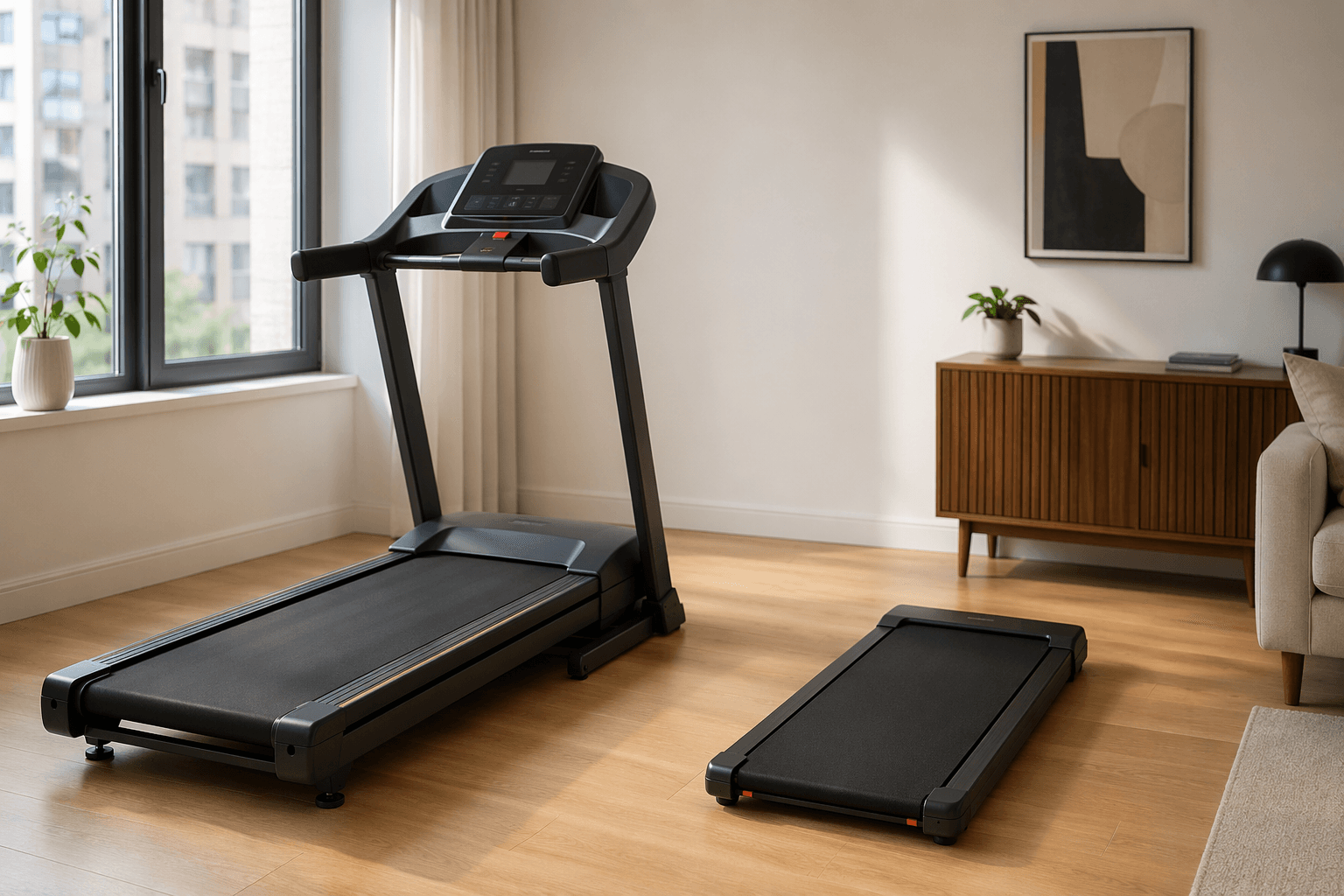
The mistake is treating the two categories as the same machine in different packaging. A shorter deck, lower speed ceiling, and missing handrails do not just make a walking pad smaller. They change how confidently you can move on it, how much stride room you have, and what happens when you get tired or misstep.
The quick decision frame
| Your main use | Better category | Why |
|---|---|---|
| Under-desk walking, light daily steps, very limited storage | Walking pad | The compact deck and low profile are useful when walking is the whole job. |
| Brisk walking with balance support | Folding treadmill | Handrails and a larger frame matter more than a few inches of saved floor space. |
| Jogging or running now | Folding treadmill | Most walking pads do not have the speed, deck length, or stability for running. |
| You are unsure whether you will want to run later | Folding treadmill | It protects your future options better, especially if you plan to keep the machine for years. |
| Apartment use where noise and storage are the main constraints | Depends | Walking pads usually store more easily, but noise, floor vibration, and folded dimensions need model-by-model checking. |
If you already know you will only walk, the more focused comparison in Walking Pad vs. Full Treadmill for Home Walking is a better next stop. This article is for the murkier decision: the buyer who thinks they only need walking today but does not want to buy the wrong machine for the next few years.
Can you run on a walking pad?
Usually, no—not responsibly. Walking pads typically top out around 3–4 mph and use decks in the 40–48-inch range, which makes running unsafe for anyone over 5'6" according to Garage Gym Reviews’ walking pad versus treadmill comparison.[1]
That is not a fussy spec-sheet complaint. Running changes the machine’s job. Your stride lengthens, your foot lands with more force, and your body has less time to correct a drift toward the side or back of the belt. On a short deck, the margin for error shrinks. Without handrails, there is less to catch if your rhythm breaks. A walking pad that feels perfectly sensible for a 2 mph email walk can feel cramped and twitchy once you try to turn that walk into a jog.
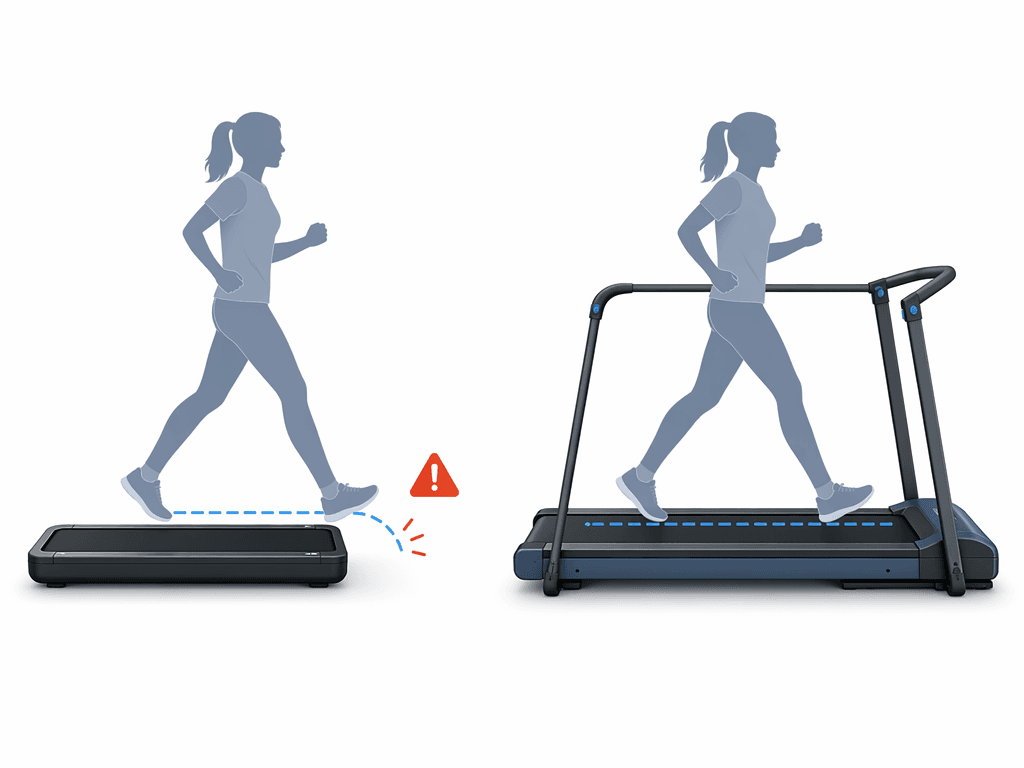
A full folding treadmill is not automatically a great running treadmill, but it usually starts from the right architecture: a longer deck, a sturdier console frame, and handrails that give you somewhere to stabilize during starts, stops, speed changes, and fatigue. Those pieces are especially important for adults over 50 or anyone with balance concerns, because walking pads without handrails carry a higher fall-risk concern in that group.[1]
This is where product labels become annoying. Some newer compact machines are trying to blur the old line. Tech Fitness Lab’s 2026 testing notes hybrid examples including the WalkingPad X25 reaching 10 mph, TOPUTURE models offering 12% manual incline, and Sunny Health options with 4.37% incline.[2] Those are not trivial upgrades. They also do not mean every walking pad is now a treadmill in disguise.
If a compact model claims running capability, check the actual speed ceiling, usable deck length, incline design, and handrail structure before you treat it like a running machine. A 10 mph top speed sounds impressive; it does not, by itself, tell you whether the belt feels roomy, whether the rails are useful at speed, or whether the frame feels steady under repeated running impact.
Stability matters before you think it will
Most buyers notice handrails when they are shopping for someone older, rehabbing, or worried about balance. They should notice them sooner. Handrails are not only for emergencies; they help with mounting the belt, stepping off, changing speed, recovering from a stumble, and dealing with the half-second of awkwardness when the belt starts moving under you.
A walking pad under a desk has a different logic. You are usually moving slowly, looking partly at a screen, and using the desk itself as a psychological boundary. In that setting, the lack of handrails can be part of the appeal: fewer parts, lower profile, easier storage. Move the same pad into open floor space, raise the speed, and ask it to handle brisk intervals or jogging, and the missing structure becomes more important.
There is also a household reality that spec sheets skip: the machine will not be used by the ideal version of you every time. It will be used when you are tired, distracted, rushed, or trying to squeeze in ten minutes before a call. Stability features earn their keep on those ordinary days.
Noise and storage: walking pads have an edge, but not a free pass
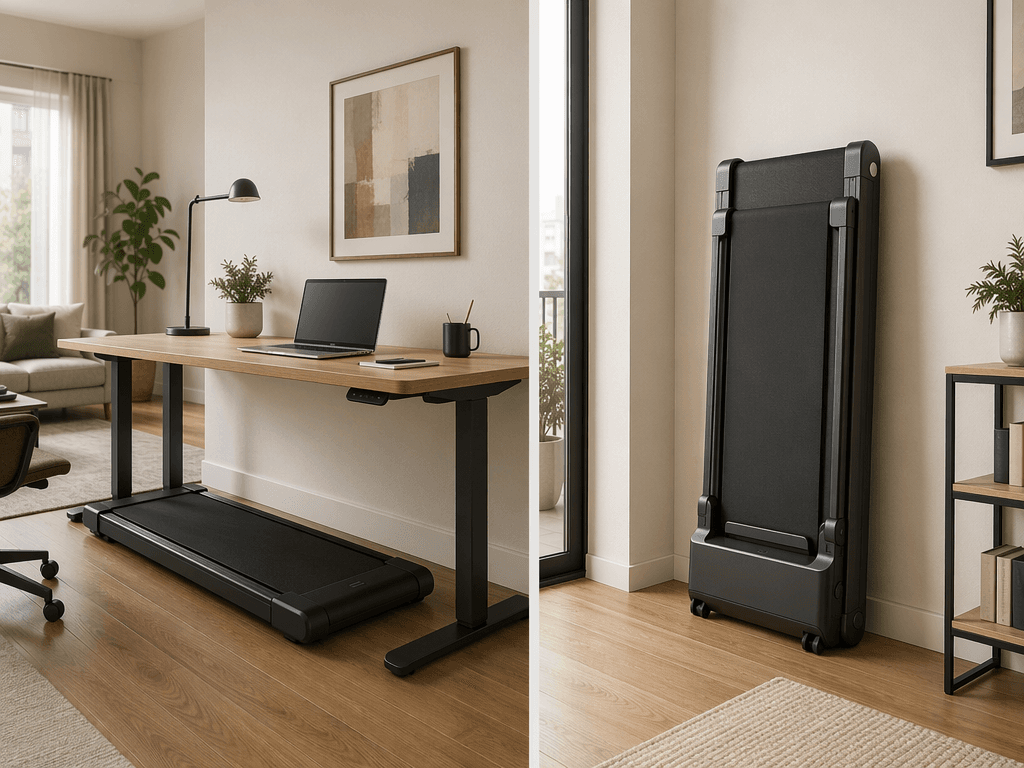
For apartments, the walking pad’s appeal is obvious. It can slide under a desk, lean against a wall, or live in a closet where a folded treadmill simply cannot. If the main problem is where the machine goes between workouts, a walking pad often solves a problem a folding treadmill only reduces.
Noise is more mixed. Tech Fitness Lab reported TOPUTURE at 45–65 dB compared with 50–75 dB for folding treadmills.[2] That range matters if you share walls, live above neighbors, or plan to walk during early calls. Still, a decibel range is not the whole apartment story. Footfall vibration, floor type, user weight, speed, mat quality, and where the machine sits in the room can all change how annoying it feels to everyone else.
Some compact-machine noise claims also come from manufacturers rather than independent testing across every model. WalkingPad’s 45–55 dB apartment-use claim, for example, is manufacturer-reported in the available materials, not independently verified across all models covered here. Folded dimensions can have the same problem: the listed size may be technically correct while still ignoring cord position, wheel clearance, handle angle, or whether you can actually maneuver the unit around furniture.
If fit is the deciding issue, do the boring measurement work before falling in love with either category. Measure the workout footprint, storage footprint, path from delivery door to final room, ceiling clearance if incline is involved, and the space behind the belt. For apartment-specific tradeoffs, use Treadmill for Small Apartments: What Actually Fits or The Small-Space Treadmill Buyer's Guide after you know which category you are leaning toward.
The price question is really a lifespan question
A $300 walking pad is tempting because the purchase hurts less. For a buyer who only wants light walking and may move apartments soon, that can be perfectly rational. The problem starts when that lower price gets compared to a folding treadmill as if both machines are expected to cover the same years and the same workouts.
The long-term gap is large in the available category data: an $800–$1,000 folding treadmill, with examples such as the Horizon 7.0 AT and NordicTrack T Series 6.5s, can offer a 10-plus-year ownership horizon with a lifetime frame warranty, while a $300 walking pad more commonly sits in the 1–3-year range with a 1-year warranty.[1] Prices move often, so those figures should be treated as Q2 2026 pricing context rather than permanent price tags.
That does not make the folding treadmill automatically cheaper in every home. If the walking pad gets used every weekday and a bigger treadmill would become an expensive laundry rack, the cheaper compact machine wins on actual value. But if you already suspect you will want to jog, add incline work, or share the machine with someone who needs more stability, the walking pad’s lower upfront cost can become a delayed replacement cost.
The other trap is assuming that a more expensive treadmill is automatically more durable. Consumer Reports tested 55 treadmills and found that price and screen size had zero correlation with durability; its January 2026 update also noted that the best-rated folding treadmills start around $700.[3] That is useful permission to ignore giant screens, glossy consoles, and app-heavy upsells if your real need is a stable frame, appropriate deck, usable speed range, and warranty coverage.
For buyers who decide the folding category makes more sense but still want to keep the budget disciplined, the next step is not the fanciest connected treadmill. Start with Best Budget Treadmill for Home Use Under $1,000 or the broader Best Home Treadmill for Walkers, Joggers, and Runners decision framework.
Where hybrid machines fit
Hybrid compact treadmills are the reason lazy advice fails. A compact unit with higher speed, some incline, or a foldable rail may be much more useful than an old under-desk-only walking pad. For the right buyer, that middle ground can be appealing: more capability than a basic pad, less visual bulk than a traditional treadmill.
The catch is that the label tells you less than the build. A hybrid that technically reaches running speed but has a short belt and minimal rail support may still be a poor running choice. A compact incline unit may be excellent for walking workouts but not suited to jogging. Newer budget entries, including models such as the DeerRun A1 Pro and TOPUTURE Walking Pad, also have less long-term reliability history in the available materials than more established treadmill brands.
Treat hybrids as machines that need closer inspection, not as proof that walking pads and folding treadmills have merged into one category. If the machine’s most important promise is “small,” judge it as a compact walking solution first. If its most important promise is “running,” judge it against treadmill standards.
A practical way to choose
Start with the fastest workout you honestly want the machine to support over the next few years, not the smallest machine you can imagine tolerating in your room. Then work backward.
- Choose a walking pad if your use case is walking, especially low-speed walking during work, and storage is the constraint that would otherwise stop you from using anything at all.
- Choose a folding treadmill if you want to jog or run, need handrail stability, expect multiple people to use the machine, or want a longer ownership horizon.
- Be cautious with compact hybrids if the advertised speed is high but the deck is short, the rails are minimal, or long-term reliability data is thin.
- Do not pay extra mainly for a bigger screen. Put the money toward deck size, frame stability, warranty, and a speed range that matches your actual training.
If the answer is clearly “folding treadmill,” the remaining question is fit. The Folding Treadmill for Your Home: A 3-Question Diagnostic is the better tool for matching room constraints to treadmill type. If the answer is clearly “walking only,” a walking pad belongs on the shortlist, and a larger treadmill may be more machine than you need.
A walking pad belongs in homes where walking is the whole job. A folding treadmill belongs where running, progression, stability, and longer ownership matter. The expensive mistake is not choosing the smaller machine or the bigger machine; it is pretending they are built for the same future.
References
- Walking Pad vs Treadmill, Garage Gym Reviews, September 2025.
- Best Folding Treadmill, Tech Fitness Lab, 2026.
- Best Treadmills of the Year, Consumer Reports, January 2026.
Comments
Join the discussion with an anonymous comment.