
Jelly Roll's Walk-to-Run Progression You Can Do at Home
Jelly Roll's documented weight-loss arc is built on walking — from short mailbox walks to 5Ks and marathon training — and that progression transfers to a small apartment without a gym membership. Get the stage-by-stage cardio plan plus the noise and floor-protection notes renters need before starting.
- Equipment tier required
- none
- Duration
- 10-30 min
- Difficulty
- beginner
- Target area
- cardio
- Space footprint needed
- small room or hallway
- Noise level
- low
The useful home-workout lesson in Jelly Roll’s weight-loss story is smaller than the headline and more repeatable than the celebrity profile version: he built from walking to longer walks, then to run-walk work, then to public endurance goals. If you arrived searching for “Jelly Roll 300 pound weight loss before and after home workout motivation,” the careful version is this: Men’s Health documented him around 540 pounds in the heaviest period it covered and about 265 pounds by November 2025, or roughly 275 pounds lost; People later described the change as “nearly 300 lbs.” [1][2]
That number is not the part a renter can copy tonight. Neither is the chef, the clinic support, the tour kitchen, or the run coaching. The transferable piece starts much earlier, with the reported mailbox-walk origin and the decision to scale those walks instead of waiting for a perfect training setup. EatingWell described that walking start as incremental, beginning with short trips to the mailbox before distance grew. [3]
An apartment can hold that first rung. It just has different rules: no pounding through a ceiling, no heroic stair sessions on sore knees, no pretending a folding treadmill is quiet because the product page says it is. This version keeps the public milestones intact, then translates them into low-noise, floor-aware cardio you can do with a hallway, a walking pad, a stairwell, or no equipment at all.
The progression worth copying
By April 2024, Jelly Roll was telling Today that he was walking 2 to 3 miles a day, 4 to 6 days a week, after saying he could not walk a mile when he began training in January. His first public race target was the 2 Bears 5K at the Rose Bowl on May 7, 2024. [4]
The race goal was not fast by runner standards, which is exactly why it is useful. People reported that he was aiming for a 15-minute-mile pace for that first 5K. [5] That is brisk walking for some bodies, run-walk territory for others, and a very honest middle step for someone who had recently been working toward simply covering a mile.
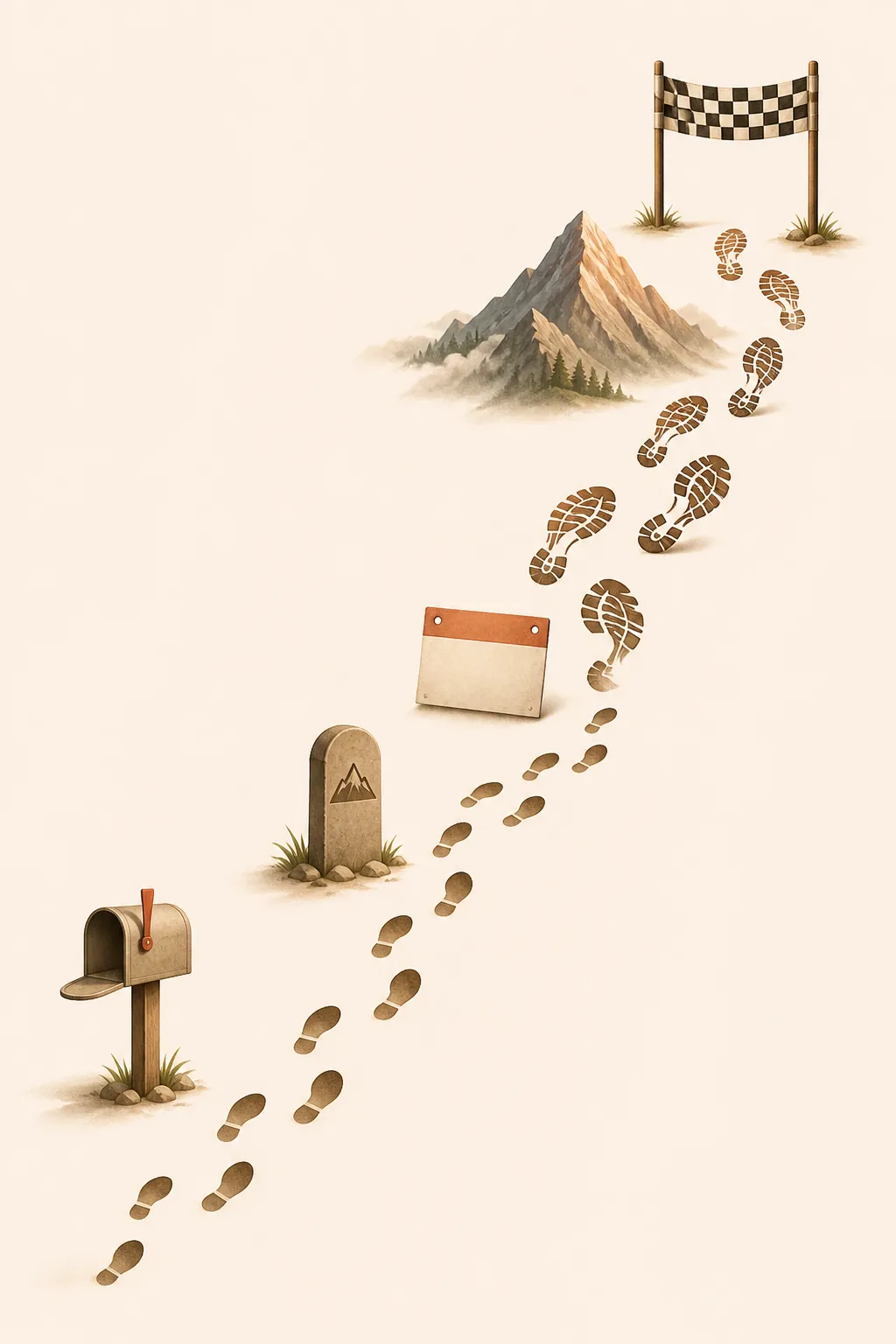
The next milestones kept the same shape: more distance, then harder terrain, then structured running. Men’s Health later reported an interval pattern in late 2025 that included running about 1.5 miles, walking about 0.5 miles, then alternating 0.2-mile run and walk segments. The same profile documented his improvement from being unable to complete a mile in 30 minutes to finishing a mile loop in 12:25. [1]
That is the arc: not “wake up transformed,” but “make the next rung slightly less absurd than the last one.” Mailbox walks become regular mileage. Regular mileage becomes a 5K goal. A 5K goal becomes run-walk intervals. Outdoor efforts and longer race ambitions follow only after that base exists.
There was also a setback. Fox News reported that a collarbone break before Christmas halted his running and walking for weeks, that he regained 12 pounds, and that he was 276 pounds in early 2026 while talking about training for the New York City Marathon. [6] That matters because even walking-based progress is still training. It needs rest, repair, and a restart plan.
Apartment translation: the same ladder, quieter
A small-space plan does not need to imitate the scenery. It needs to imitate the progression. The public version had roads, races, mountains, and coaches. The apartment version can use room loops, hallway laps, low-speed incline walking, carefully chosen treadmill work, and run-walk intervals only when the floor and neighbors can handle them.
| Public milestone | Apartment version | Progress cue |
|---|---|---|
| Short mailbox walks | 5 to 10 minutes of room or hallway walking | You can repeat it most days without joint flare-ups or neighbor noise |
| 2 to 3 miles a day, several days a week | Two or three short walking blocks across the day | Weekly walking time rises before speed does |
| First 5K goal | A home 5K made from accumulated distance or time | You can finish the session without needing a recovery day after every attempt |
| Run-walk intervals | Short, quiet jog intervals on forgiving flooring or brisk incline walks instead | Impact stays controlled; breathing gets challenged |
| Hikes, half-marathon direction, marathon training | Longer low-impact walks plus occasional outdoor sessions when available | Volume increases only when recovery is keeping up |
Start with indoor walks short enough to repeat
The first apartment stage is almost boring on purpose. Pick a route that does not require motivation: bed to door, kitchen to window, hallway end to hallway end, or a walking pad at the lowest comfortable speed. Do it for a duration that feels too easy to brag about. The win is not exhaustion; it is proving the session can exist again tomorrow.
For many beginners, the failure point is the jump from “I walked today” to “I have a walking practice.” That transition is less about intensity than friction. Shoes live where the walk starts. The phone timer is already set. The walking route avoids the squeaky floorboard. The session ends before your knees, calves, or lower back start negotiating with you.
- No equipment: walk room loops or hallway laps for a short timed block.
- Some equipment: use a walking pad at an easy pace while watching a show, taking a call, or listening to one album side.
- Stairwell available: use it sparingly at first, and skip it if descending bothers your knees or echoes through the building.
- Outdoor access limited: save outdoor walks for weekends or errands, but keep the weekday habit indoors.
If you already know you need equipment, compare the practical tradeoffs before buying. FitAtHome’s walking pad vs. full treadmill guide is the better decision point than a dramatic transformation article because it starts with the constraints that actually decide whether you will use the thing: storage, belt size, speed ceiling, stability, and noise.
Then build daily mileage without making one session huge
The move from short walks to 2 or 3 miles a day is where a lot of home plans get silly. You do not need one grand cardio block. You need enough total walking to become normal. In an apartment, that may mean 10 minutes before work, 10 minutes after lunch, and 10 minutes at night. It may mean walking during two phone calls. It may mean a quiet block on the walking pad while dinner is in the oven.
The cleanest rule is to increase the number of repeatable walking blocks before you chase pace. If your current walk leaves you sore or irritable, adding speed is not discipline; it is just a louder way to quit. Add another easy block first. When the easy blocks stop feeling like an event, lengthen one of them.
FitAtHome’s testing lens treats apartment cardio as a noise-and-vibration problem, not just a calorie problem. Walking pads and treadmills make two kinds of sound: motor and belt noise, which you hear in the room, and impact vibration, which your downstairs neighbor may hear more clearly than you do. A thick treadmill mat helps, but it does not turn a hard stride into silence. Shoes matter. Belt feel matters. So does the time of day.
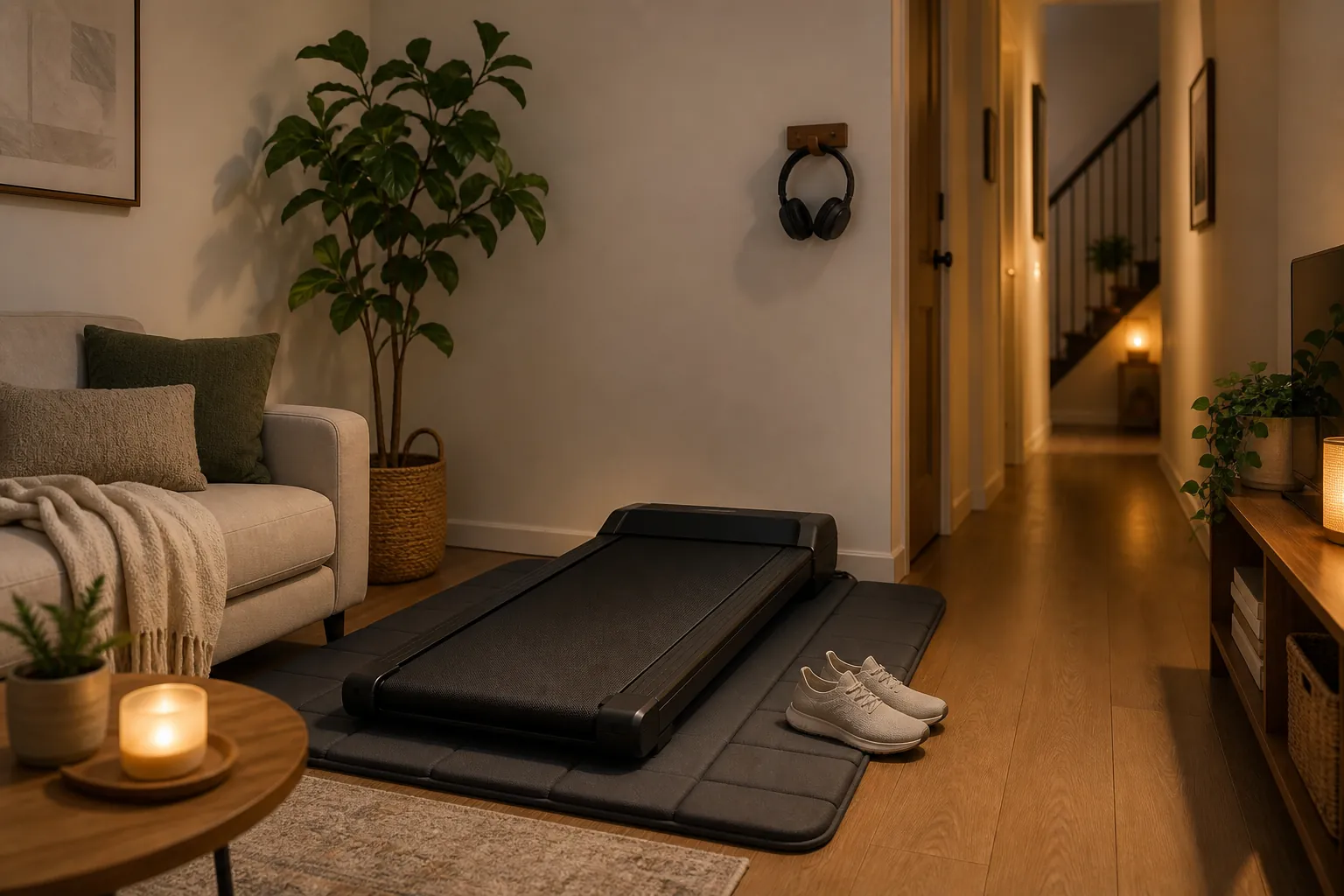
Before you buy a full treadmill for an upstairs unit, use a constraint-based checklist. FitAtHome’s Best Home Treadmill for Walking 2026 and treadmill decision framework are built around the boring questions that prevent expensive regret: where it goes, how often it folds, whether the belt is comfortable for your stride, whether the deck feels stable at your walking speed, and whether the sound is acceptable in your building.
Use a home 5K before you use running
A 5K does not have to start as a race. At home, it can be a distance target if your treadmill or walking pad tracks distance, or a time target if it does not. The point is to give walking a finish line without turning it into a punishment.
If a continuous 5K is too much, split it. Morning and evening halves still teach the body that more total walking is possible. If distance tracking is unreliable, use a consistent timed session and slowly extend it. A beginner does not need a perfect GPS trace around the coffee table.
| If this is true | Do this next |
|---|---|
| You can walk 10 minutes comfortably | Repeat it most days before adding time |
| You can walk 20 to 30 minutes comfortably | Add a second short walk on some days |
| You can accumulate roughly a 5K effort by time or distance | Practice finishing calmly, not faster |
| You finish and recover well the next day | Begin small speed changes or gentle incline work |
This is also where a walking pad can be enough. A full treadmill becomes more relevant if you need incline, a larger deck, handrails, or higher speeds. For many apartment walkers, the better machine is not the most powerful one; it is the one quiet and convenient enough to use on ordinary days.
Treat run-walk intervals as an upgrade, not a moral test
The late-2025 run-walk pattern Men’s Health described is a real training upgrade, not a beginner requirement. [1] In an apartment, it is also the point where noise can jump fast. Running changes impact. Impact changes neighbor tolerance. Neighbor tolerance changes whether your plan survives February.
If you are on a slab floor, in a ground-floor unit, or on equipment that stays stable at jogging speed, run-walk intervals can be simple: walk to warm up, jog briefly, return to walking before your form gets sloppy, and stop while you still feel in control. If you are above someone else, brisk walking, incline walking, or outdoor run-walk sessions may be the better choice.
For a small apartment, the quiet version of the transition looks like this:
- First, make brisk walking repeatable for several weeks.
- Next, add short incline walking blocks if your equipment supports incline.
- Then, test very short jog intervals only during reasonable hours and only on a protected floor.
- If the sound or vibration is obvious, move the jogging outdoors and keep indoor days as walking days.
A renter-safe plan is allowed to stay at walking. That is not a downgrade. If walking volume is increasing, recovery is intact, and the habit fits your home, the plan is doing the job it is supposed to do.
What the celebrity setup changes — and what it does not
The support system around Jelly Roll’s transformation matters because it keeps the story honest. Men’s Health described a wide structure around him, including chef Ian Larios, nutrition coaching, physical therapy support, wellness-clinic context involving metformin and testosterone replacement therapy, run coaching, and a mobile tour-kitchen setup. The same piece also carried an editor’s note that he had a brief early GLP-1 trial for about two weeks and then stopped. [1]
That does not erase the walking progression. It does erase the tidy “just willpower” version. Food access, medical care, schedule control, coaching, and recovery support can all change what a body can tolerate and how quickly a plan can move. A person in a studio apartment with a job, neighbors, and no private chef should not measure the success of a walking plan against a celebrity transformation timeline.
The copyable piece is narrower and still valuable: start below your pride, walk often enough to become consistent, build toward a 5K-style effort, and use running only when your joints, floor, and recovery are ready.
The restart rule after setbacks
The collarbone-break interruption is a better training lesson than another before-and-after photo. A layoff does not mean the previous work was fake. It means the next block has to re-enter lower than where the last block ended.
For apartment cardio, a practical restart has three checks. First, can you walk easily for a short block without protecting the injured area or changing your gait? Second, can you repeat that block the next day without a pain spike? Third, can you add time before you add speed, incline, or jogging?
A restart week should look almost embarrassingly gentle: flat walking, no stair heroics, no sprint intervals, no testing the new version of yourself at 10 p.m. over someone’s bedroom. The purpose is to reconnect the habit, not to repay the missed weeks.
A renter’s decision point
If you have no equipment, start with the lowest-noise walking stage: short room loops, hallway laps, or outdoor errand walks stitched into the day. If you have space for one compact tool, consider whether a walking pad gives you enough speed and convenience before assuming you need a full treadmill. If you want a broader small-space setup, FitAtHome’s guide to compact, quiet, stowable exercise equipment is a better next stop than buying the biggest machine that fits through the door.
If you like celebrity-to-home translations, the same small-space filter applies to other routines, including the Asplund weight-loss home plan and the Amal Clooney home workout routine. The useful question is always the same: which part survives contact with your floor, your schedule, and your recovery?
The motivating part of Jelly Roll’s arc is not that a regular person can reproduce a celebrity transformation package. It is that the first transferable rung is ordinary walking. An apartment can hold that rung if the progression stays gradual, the noise stays tolerable, the floor is protected, and recovery gets treated as part of the plan.
References
- Jelly Roll’s Transformation: Weight Loss and a Healthier Life — Men’s Health, Jan/Feb 2026
- Jelly Roll Shows Off 300-Lb. Weight Loss as Wife Bunnie Xo Jokes She Used Lube to Get Into Latex Dress — People, Feb. 2026
- Jelly Roll Says Walking Helped Him Lose Weight—Here’s How to Try It — EatingWell
- Jelly Roll weight loss — TODAY
- Jelly Roll Lost ‘70-Something Pounds’ While Training for His First 5K — People
- Jelly Roll says he ‘lost his way’ after shedding over 200 pounds, reveals how much weight he gained back — Fox News
What a small equipment investment adds
We don't have a build tagged to this exact tier yet. Browse all builds.
How often should you repeat this?
See our recovery and rest reference for citation-anchored rest-interval guidance.
Spot something off?
Tell us if a movement, tier assumption, or duration didn't match your experience.