
Can You Still Build Muscle on a Low-Protein Diet at Home?
Wondering whether a low-protein diet rules out muscle building at home? This evidence-first article shows why structured training — not extra protein — is the main lever when intake is capped, and pairs the research with a bands-and-bodyweight home routine built for that constraint.
- Equipment tier required
- $0-100
- Duration
- 30 min
- Difficulty
- beginner
- Target area
- full body
- Space footprint needed
- mat-sized
- Noise level
- low
If your protein is capped at 0.6–0.8 g/kg/day, the question is not whether protein matters. It does. The better question is what lever you still control tonight, in your living room, without breaking the diet order your clinician gave you.
The strongest answer we have is not from a supplement label. It is from a small randomized trial in adults over 50 with moderate renal insufficiency who were eating about 0.64 g/kg/day of protein. Over 12 weeks, the group that added resistance training increased total muscle fiber cross-sectional area by about 23% and strength by about 32%. The non-exercising group lost about 13% strength and about 7.7 lb of body weight during the same period.[1][2]
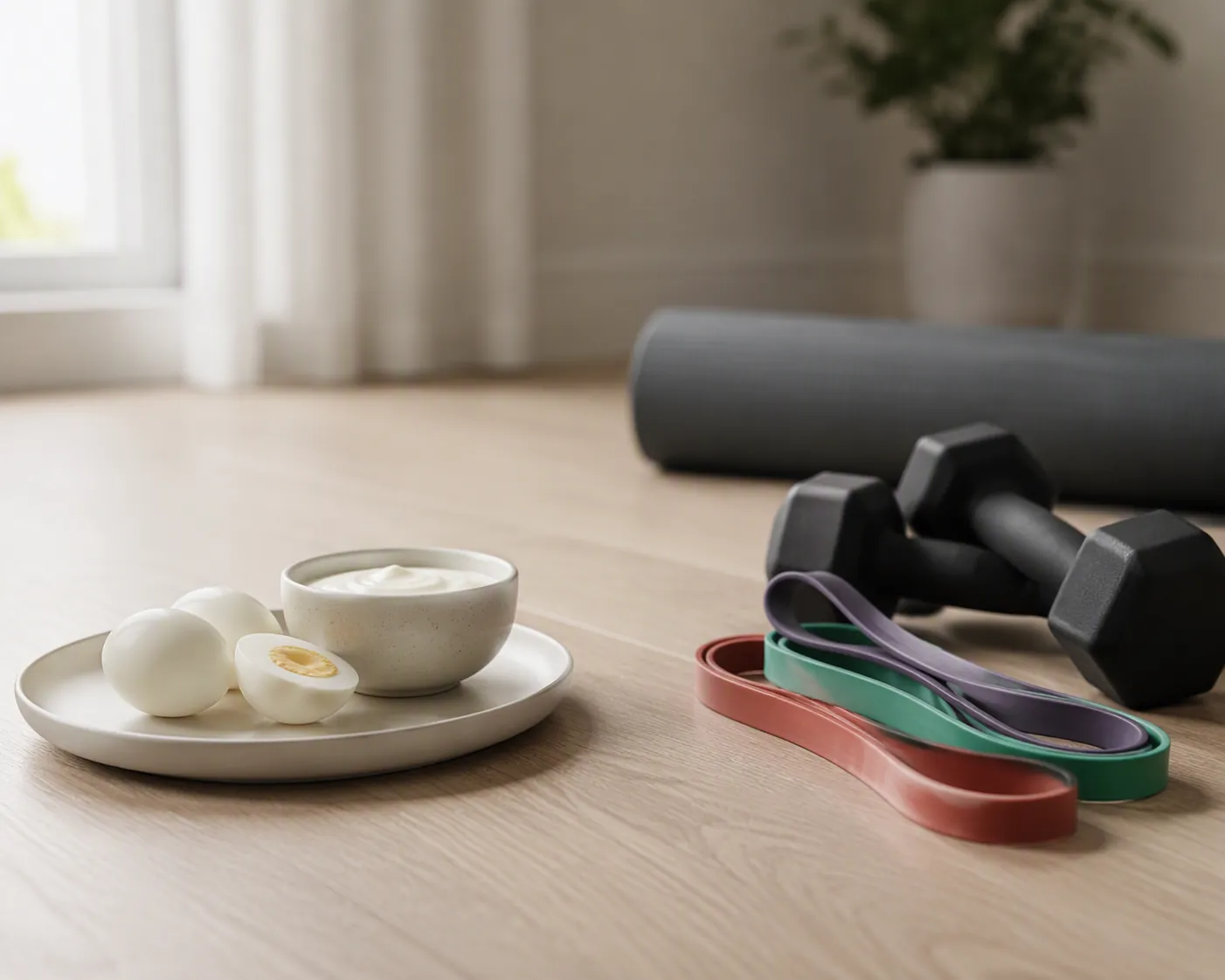
That does not mean everyone on a low-protein diet can maximize hypertrophy. It means something narrower and more useful: in at least one medically constrained, older population, low protein did not make resistance training pointless. The training signal still mattered.
What “low protein” means here
A low-protein diet can mean very different things. For some people, it is a doctor-prescribed cap for chronic kidney disease, PKU, or another medical condition. For others, it is a practical reality: appetite is low, food budget is tight, or meals are mostly built around lower-protein foods.
Those are not the same situation. If your protein target was set by a nephrologist, metabolic specialist, physician, or registered dietitian, do not raise it because a workout article told you muscle needs more. This article is about training under a cap, not replacing medical nutrition care.
For the routine below, assume the protein number is fixed unless your clinician changes it. The work is to make the resistance training organized enough that your body has a reason to keep or build contractile tissue.
The trial that matters most for this question
The Tufts/Castaneda trial is easy to overstate, so keep the frame tight: 26 adults, age 50 and older, moderate renal insufficiency, low-protein diet at about 0.64 g/kg/day, 12 weeks, published in 2001.[1] It was not a study of young bodybuilders, severe frailty, dialysis patients, or people casually skipping protein.
Inside that narrow frame, the result is still hard to ignore. The resistance-training group did not merely slow loss. They increased muscle fiber size: total cross-sectional area rose about 23%, with type I fibers up about 24% and type II fibers up about 22%. Strength rose about 32%.[1][2]
The comparison group is what makes the result practical. People who stayed on the low-protein diet without exercise lost strength and body weight. The USDA summary reported about a 13% strength loss and about 7.7 lb of body-weight loss in the non-exercising group.[2]
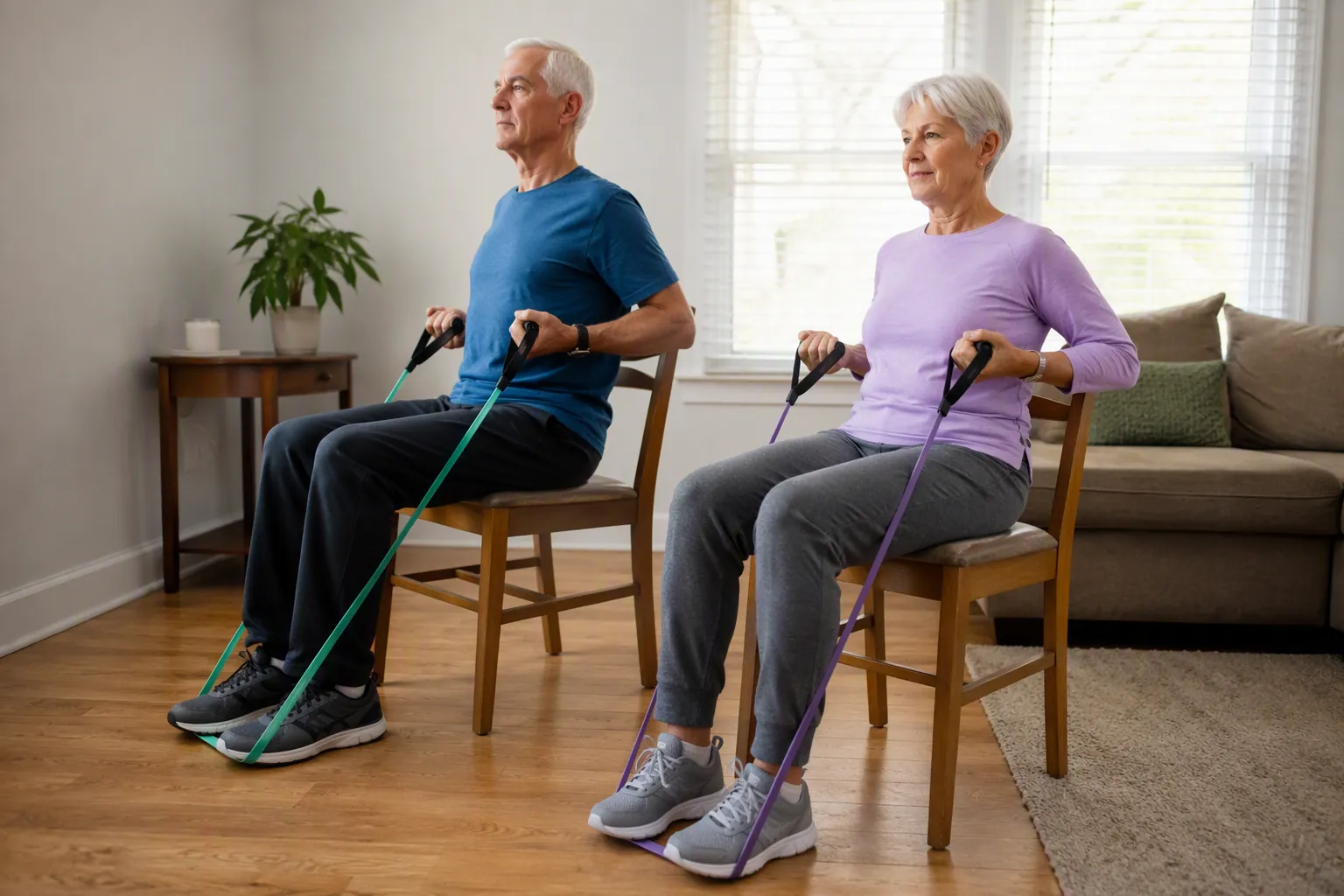
That is the difference between worrying about protein and giving muscle a job. If intake cannot move upward, the home program has to supply progressive tension, enough weekly practice, and a safe route toward harder work.
More protein is not an unlimited muscle switch
Protein still supports muscle repair and remodeling. The mistake is turning that true statement into “training is useless unless you hit bodybuilding numbers.” The evidence does not support that panic.
A 2022 systematic review and meta-analysis of 74 randomized controlled trials found that adding protein to resistance exercise produced only small additional lean-body-mass gains: standardized mean difference 0.22, roughly 0.5–0.7 kg versus control. The effect was significant only at 1.2–1.59 g/kg/day in adults 65 and older and at 1.6 g/kg/day or more in younger adults. Importantly, 80% of included studies already had baseline protein intakes of at least 1.2 g/kg/day.[3]
So the review is not proof that low protein is ideal. It is a calibration tool. Once people are already eating moderate to high protein, adding more tends to buy a small margin, not a completely different body.
A Harvard Health summary of a JAMA Internal Medicine trial points in the same direction for older men. In that trial, 92 men with an average age of 73 were assigned to 0.8 or 1.3 g/kg/day for 6 months, and the higher-protein group did not show significant advantages in lean body mass, muscle performance, or physical function.[4]
The fair conclusion is modest: extra protein can help in some settings, especially when intake is inadequate, but it is not a magic override. If your prescribed ceiling is lower than the usual gym recommendation, the main controllable variable becomes the quality and progression of your training.
Can bands and bodyweight create enough stimulus?
Yes, if you use them like resistance tools rather than warm-up toys. A 2019 comparison of elastic resistance and conventional resistance found similar strength gains, which is enough to justify bands as a serious home-loading option when a gym or heavy equipment is not available.[5]
Bands are especially useful under a low-protein constraint because they let you adjust effort without big jumps. You can shorten the band, step farther away from the anchor, slow the lowering phase, pause at the hardest position, or choose a harder bodyweight variation before adding more total work.
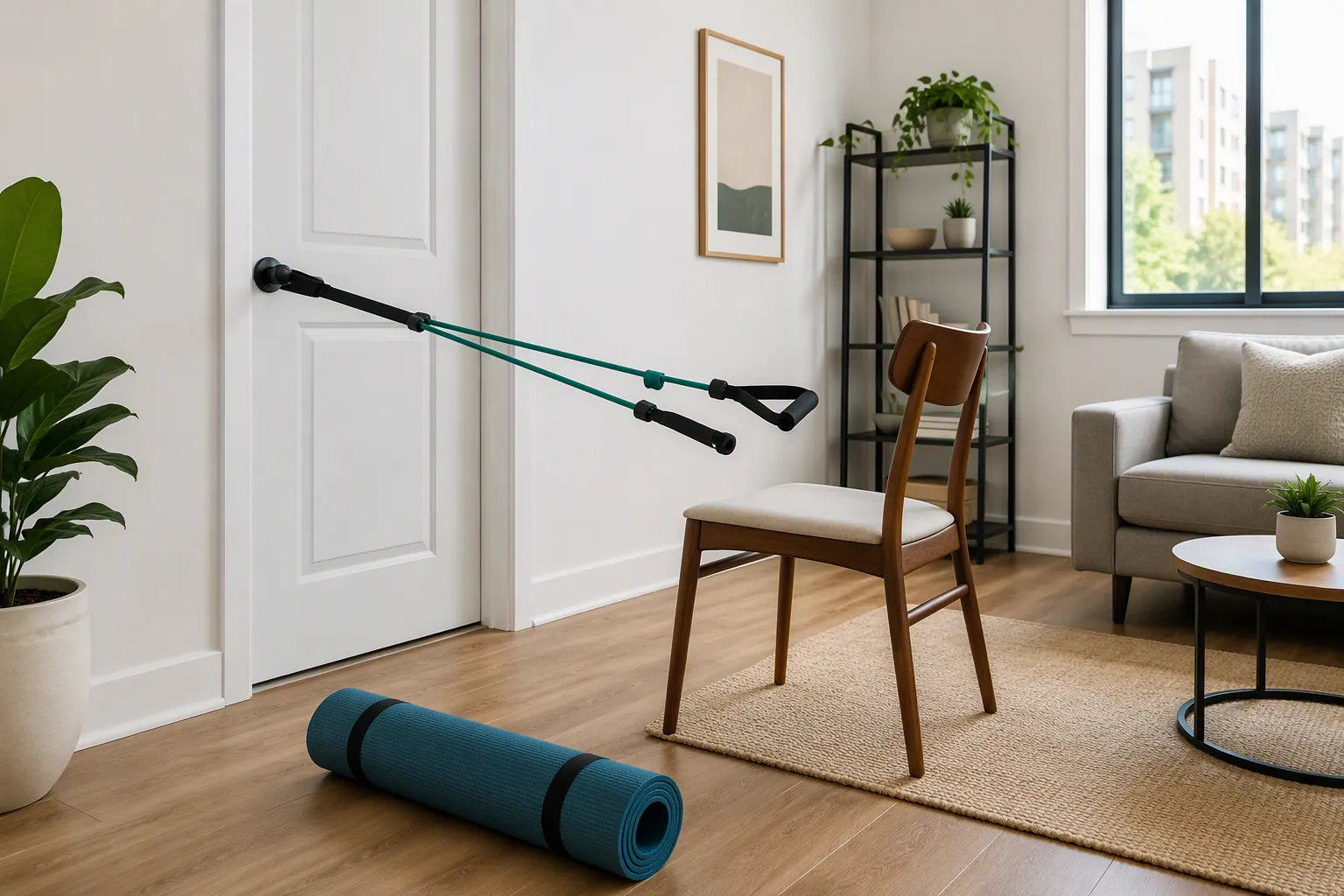
For equipment context, use FitAtHome’s Builds material for tiered band and bodyweight setups, especially if you need no-drill mounting options. The routine below assumes a basic apartment tier: loop or tube bands, a safe door anchor or stable low anchor, a sturdy chair, and floor space about the size of an exercise mat.
The low-protein home workout: 3 days per week
Run this on nonconsecutive days, such as Monday, Wednesday, and Friday. Keep the first week conservative. If you are older, medically complex, detrained, or returning after illness, start with the lower end of the set range and stop each set with more reps in reserve.
| Exercise | Sets | Reps | Effort target | Home setup |
|---|---|---|---|---|
| Chair squat or sit-to-stand | 2–3 | 6–12 | Stop 2–4 reps before failure | Sturdy chair; use hands lightly if needed |
| Band row | 2–3 | 8–15 | Stop 1–3 reps before failure | Door anchor at chest height or seated foot anchor |
| Incline push-up or band chest press | 2–3 | 6–12 | Stop 2–4 reps before failure | Hands on counter, wall, or band behind upper back |
| Supported split squat or step-back lunge | 1–3 | 6–10 per side | Smooth reps; no joint pain | Chair, wall, or countertop for balance |
| Band Romanian deadlift or hip hinge | 2–3 | 8–15 | Hamstrings and glutes working; back neutral | Stand on band and hold handles or loop |
| Band overhead press or lateral raise | 1–2 | 8–12 | Controlled, no shoulder pinch | Light band under feet or hands |
| Dead bug, side plank, or suitcase hold | 1–3 | 20–40 seconds or 6–10 slow reps | Stable breathing | Mat space; optional band or light weight |
Rest 60–120 seconds between harder sets. If your clinician has given blood-pressure, dizziness, surgical, kidney-related, or balance precautions, those override the table.
How the session should feel
The working sets should feel purposeful, not frantic. On most exercises, finish with 1–4 good reps still possible. That keeps the signal strong enough to matter while leaving room to recover on a protein-limited diet.
A good set looks boring from the outside: steady lowering, no breath-holding contest, no twisting to finish the last rep, and no sudden collapse into the chair. If the last two reps are slower but still clean, you are probably in the right zone.
The first four weeks
| Week | Main job | Progression rule |
|---|---|---|
| Week 1 | Learn the movements and find safe band tension | Use the low end of the set range; stop well before form breaks |
| Week 2 | Repeat the same exercises with cleaner reps | Add 1–2 reps per set where last week felt easy |
| Week 3 | Make the main lifts slightly harder | Add band tension, slow the lowering phase, or add one set to one or two exercises |
| Week 4 | Hold the structure and compare performance | Try to beat Week 2 by a small amount without grinding |
Do not add everything at once. A low-protein diet gives you less margin for sloppy volume chasing. Pick one progression at a time: more controlled reps, a harder variation, slightly more band tension, or one additional set on a priority exercise.
Exercise notes that matter
- Chair squat: Start from a seat height that lets you stand without knee pain or momentum. Progress by using less hand assistance, slowing the descent, lowering the seat if safe, or holding a band for light resistance.
- Band row: Pull elbows back toward your ribs and pause briefly when the shoulder blades move together. Progress by stepping farther from the anchor or using a thicker band.
- Incline push-up: Choose a height that lets you keep a straight body line. A wall is easiest, then a counter, then a sturdy table or bench. If wrists or shoulders object, use a band chest press instead.
- Supported split squat: Balance support is not cheating. It lets the legs do the work instead of turning the set into a wobbling drill.
- Band hip hinge: Think hips back, ribs down, spine quiet. You should feel hamstrings and glutes, not low-back strain.
- Core work: Use the version that lets you breathe. Bracing should not become a long breath hold, especially if you have blood-pressure precautions.
Progress without adding protein
When food cannot be pushed higher, progression has to be measured. Track the exercises, band used, reps, sets, and how many reps you think you had left. You are looking for small evidence that the same body can do slightly more work with the same or better control.
| If this happens | Change this |
|---|---|
| You finish every set easily | Add 1–2 reps next time or increase band tension slightly |
| You hit the top of the rep range on all sets | Move to a harder variation or thicker band |
| Your form breaks early | Reduce tension, shorten the set, or use a more supported variation |
| You are sore for several days after every session | Hold the same workload for another week or remove one set from lower-body work |
| Strength drops for two workouts in a row | Check sleep, total calories, illness, medication changes, and recovery before adding work |
The log matters more than the mirror in the first month. If your chair squat goes from 2 sets of 6 controlled reps to 3 sets of 10, or your row uses a stronger band with the same clean posture, that is useful adaptation even before body composition is obvious.
For broader rest and frequency context, use FitAtHome’s Recovery & Rest reference layer. Under a medical diet constraint, recovery is not decorative; it is part of the training dose.
Use your allowed protein more intelligently, if permitted
This is not a hidden recommendation to exceed your cap. If your clinician or dietitian gives you a daily protein target, stay inside it. The practical question is whether the allowed amount is being spent in a way that supports training.
Schoenfeld and Aragon’s review of nutrient timing notes that acute muscle protein synthesis appears to be maximized at roughly 20–25 g of high-quality protein per meal, and they discuss a practical pattern of about 0.4 g/kg/meal spread across the day.[6] For someone with a medical cap, that may need to be scaled down or modified by a dietitian.
The narrow takeaway: avoid accidentally putting nearly all of your allowed protein into one meal if your dietitian says spreading it is appropriate. A capped intake usually needs planning, not random grazing and a late-night scramble.
Where caution belongs
Age and frailty change the risk calculation. The Newcastle 85+ finding is a useful warning here: in the very old, physical activity may not protect function in the same way when protein is inadequate, with intake below 1 g/kg/day described as insufficient in that context. That should not scare an older reader away from training; it should keep the plan medically supervised and appropriately conservative.
Stop treating soreness, dizziness, unusual fatigue, swelling, chest symptoms, or sharp joint pain as proof of commitment. Those are reasons to pause and check the plan. The goal is repeatable training, not one impressive session that costs you the next two weeks.
A low-protein diet makes muscle building less forgiving, especially for older or medically complex readers. It does not make home resistance training pointless. Confirm the protein cap, ask whether protein spacing matters for your case, then run the plan consistently and track whether your strength is moving.
References
- Resistance training to counteract the catabolism of a low-protein diet in patients with chronic renal insufficiency. A randomized, controlled trial. PubMed.
- Exercise Prevents Muscle Loss From Low-Protein Diets. USDA Agricultural Research Service. 2002.
- Systematic review and meta-analysis of protein intake to support muscle mass and function in healthy adults. PMC. 2022.
- Extra protein does not build more muscle. Harvard Health.
- Effects of training with elastic resistance versus conventional resistance on muscular strength: A systematic review and meta-analysis. PMC. 2019.
- How much protein can the body use in a single meal for muscle-building? Implications for daily protein distribution. PMC. 2018.
What a small equipment investment adds
Can insect protein build muscle at home?
Insect protein from crickets and mealworms produces a muscle protein synthesis response comparable to milk protein in acute trials, but the only training study in young men found no extra strength or size gain. This verdict sorts out what the human research actually supports so home lifters can decide if insect protein is worth buying.
Swimming Pool Under $5? The Real Price Ladder
No swimming pool under $5 can support home exercise — that budget buys a resistance band or one community-pool day pass. The verified price ladder runs from $125 inflatables to $25,999+ swim spas, with a depth rule that separates pool toys from real training.
Tour a Small Apartment Home Gym at $100, $300, and $800
Three real apartment gym setups at $100, $300, and $800 with itemized costs, measured decibel ratings, floor-protection methods, and honest notes on what each tier can and cannot do — so you can choose the right entry point without risking your deposit or your neighbor's patience.
How often should you repeat this?
See our recovery and rest reference for citation-anchored rest-interval guidance.
Spot something off?
Tell us if a movement, tier assumption, or duration didn't match your experience.