
The Apartment-Friendly Mamma Mia Dance Workout at Home
Doing the viral Mamma Mia dance workout in a small apartment doesn't have to mean jumping, thumping, or a damaged security deposit. Here's a $0-equipment, 25–30 minute version with no-jump swaps, segment-by-segment noise notes, and honest calorie expectations.
- Equipment tier required
- none
- Duration
- 30 min
- Difficulty
- beginner
- Target area
- full body
- Space footprint needed
- small clear strip of floor
- Noise level
- low
Yes: you can do a Mamma Mia dance workout at home tonight in an upstairs apartment without buying equipment, jumping through the floor, or pretending a yoga mat is soundproofing. Keep it to about 25–30 minutes, clear a strip of floor between the couch and coffee table, use a mat if you have one, and swap every jump for a step, squat, heel curl, or knee lift.
The free YouTube template most people are looking for is the big, cheerful Mamma Mia HIIT format: emkfit’s roughly 25–26 minute dance-party workout built around a warm-up and ABBA-style HIIT blocks has been widely covered as a viral at-home option.[1][2] Kyra Pro’s Mamma Mia dance workout gives the other useful template: more choreographed dance-strength work, with moves like jumping jacks, squats, butt kicks, and a cool-down to “The Winner Takes It All.”[3][4] The apartment version below keeps the spirit and timing, but edits the floor impact.
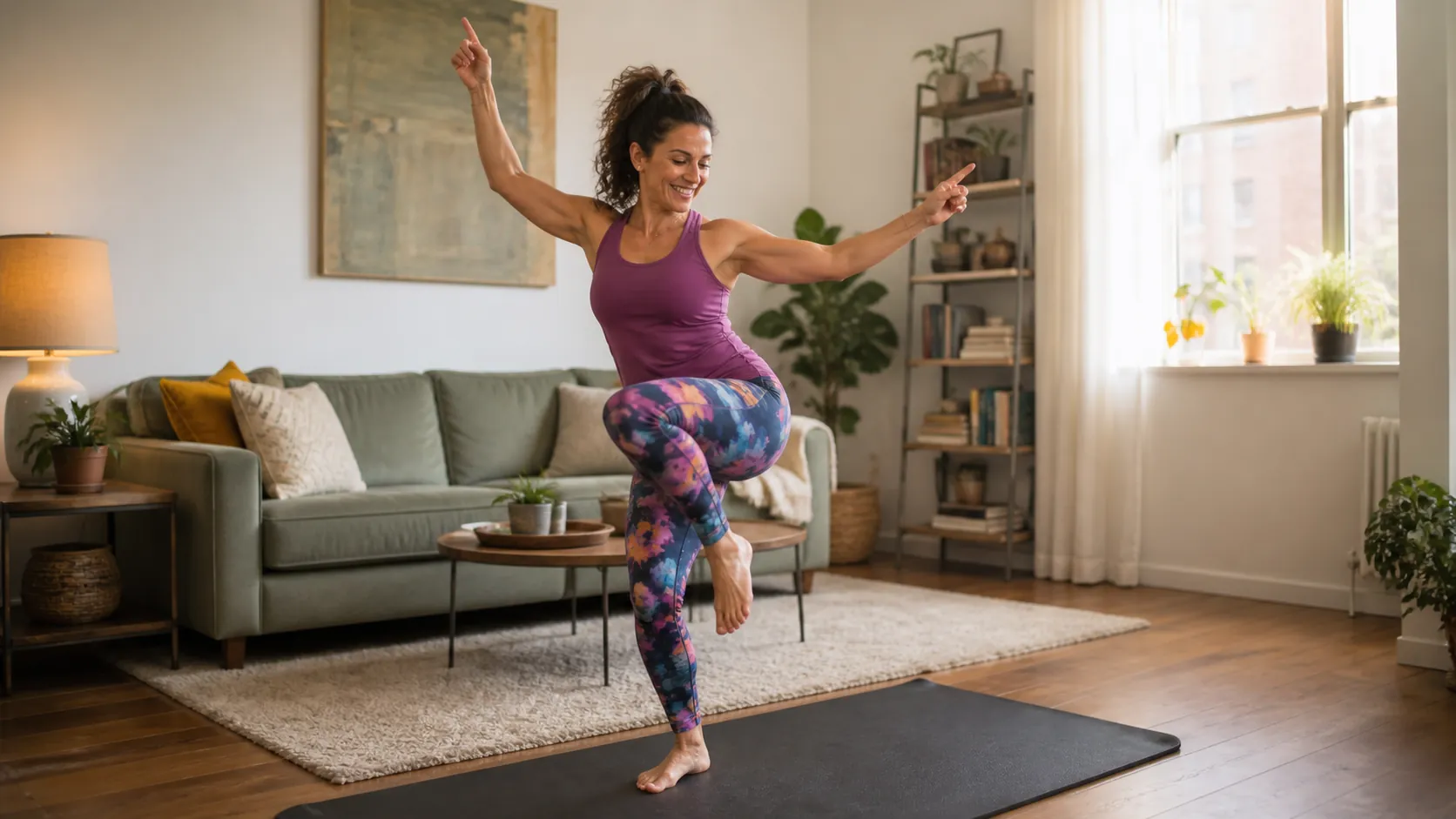
The 25–30 minute apartment version
You need open floor space, shoes or bare feet that do not slide, water nearby, and maybe a mat. The mat is there to reduce scuffs, improve traction, and soften some footfall. It is not there to make airborne landings disappear into the building.
| Time | Segment | Apartment rule |
|---|---|---|
| 0:00–4:00 | Warm-up: step-touch, shoulder rolls, hip circles, easy grapevines | Keep both feet close to the floor; no bouncing yet |
| 4:00–9:00 | Dance cardio block: disco arms, side steps, knee lifts, low turns | Make the arms big and the feet quiet |
| 9:00–14:00 | HIIT-style chorus block: jack swaps, squat pulses, reach-and-pull combos | Replace every jump with a wide step-out |
| 14:00–19:00 | Dance-strength block: squats, standing core, heel curls, low kicks | Use muscle tension instead of impact |
| 19:00–24:00 | Final party block: faster steps, traveling in place, optional low-impact intervals | Intensity rises through tempo, not thudding |
| 24:00–30:00 | Cool-down: step-touch, slow reaches, hamstring and calf stretches | Bring breathing down; no floorwork required |
If you are following emkfit or Kyra Pro directly on another screen, use this as your translation layer. When the instructor jumps, you step. When the instructor hops backward, you march backward softly. When the instructor does butt kicks, you turn them into hamstring curls. You are not doing a lesser workout; you are changing the part of the movement your downstairs neighbor can hear.
0:00–4:00 — Warm up without waking the floor
Start with a step-touch: right foot out, left foot in, then switch. Add easy shoulder rolls, then big overhead reaches. Keep the knees soft and let the hips move, but do not bounce on the beat yet. If you want the musical-theater feeling immediately, use your arms: disco points, curtain-opening reaches, “gimme gimme” pulls, whatever makes you grin without adding vertical lift.
The warm-up is the safest place to keep things almost embarrassingly quiet. If your floor creaks during simple step-touches, shorten your stance and move closer to the center of the room instead of near a wall, radiator, or hollow-sounding floorboard.
4:00–9:00 — Big dance energy, small foot travel
Now bring the effort up. Alternate 30–45 seconds of each move:
- Step-touch with high disco arms
- Grapevine right and left, shortened if your room is narrow
- Alternating knee lifts with opposite-arm pulls
- Low hamstring curls instead of butt kicks
- March-in-place turns, pivoting slowly instead of spinning or hopping
The temptation here is to chase the video’s bounce. Don’t. Chase the breathing. You should feel your heart rate rise because the arms are large, the transitions are quick, and the knees keep lifting. If your feet start slapping, reduce the step size and exaggerate the upper body again.
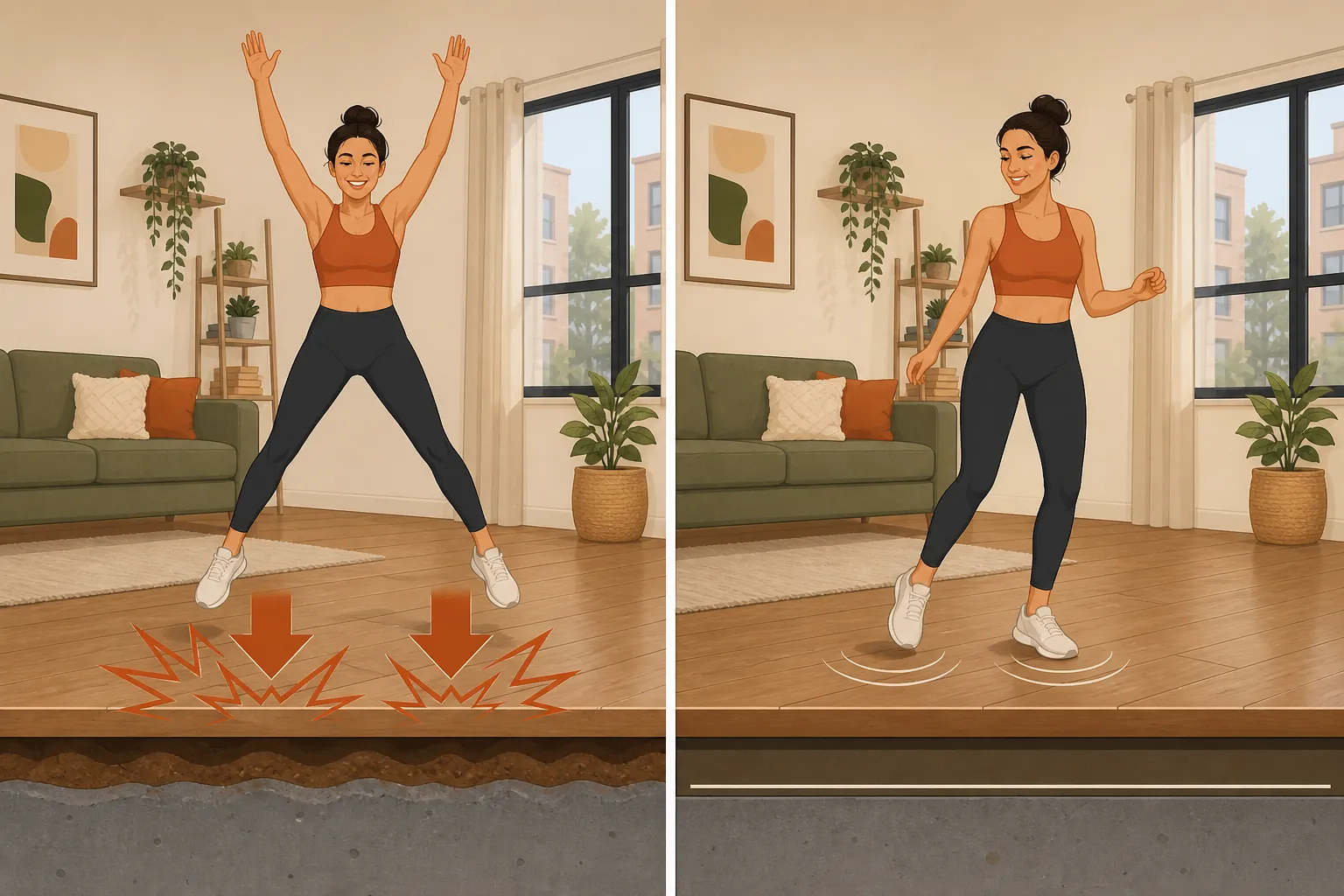
9:00–14:00 — The noisy HIIT block, translated
This is the section that decides whether the workout is apartment-friendly. Viral dance HIIT often uses jumping jacks, squat jumps, skaters, hops, and butt kicks because they are easy to follow and they spike effort fast. They also send force straight into the floor.
| If the video does this | Do this upstairs instead | How to keep it hard |
|---|---|---|
| Jumping jacks | Step-out jacks: right foot out, center, left foot out, center | Bend the knees and make the arms fast |
| Squat jumps | Squat to calf raise | Pause low for one beat before standing |
| Butt kicks | Standing hamstring curls | Pull elbows back hard with each curl |
| High knees | Low marching knee lifts | Drive the opposite arm down as the knee rises |
| Skater hops | Side lunge taps | Reach across the body and sit into the hip |
| Burpees or plank jumps | Squat, step back one foot at a time, stand | Move continuously but quietly |
A useful rule: if both feet leave the floor at the same time, swap it. If one foot lands loudly, slow it down. If you cannot control the landing, remove the landing. For more swap ideas, use FitAtHome’s no-jump apartment workout substitution table as a companion while you learn the pattern.
14:00–19:00 — Dance-strength without floor punishment
This is where Kyra Pro’s dance-strength feeling is especially useful: squats, jacks, butt kicks, and choreographed reaches can become a strength-cardio block without needing any equipment.[3][4] Try four rounds of this sequence:
- Eight slow squats with arms reaching forward.
- Eight step-out jacks, right and left alternating.
- Eight hamstring curls with strong backward elbow pulls.
- Eight standing cross-body knee lifts.
- Hold a low squat pulse for four counts, then stand tall and breathe.
The quiet intensity trick is time under tension. A squat that lowers slowly, pauses, and rises under control can make your legs work harder than a sloppy jump that lands like a dropped suitcase. Keep your weight through the midfoot and heel, and let the arms make the movement feel like choreography instead of penance.
19:00–24:00 — Final party block
For the last working section, rotate between a faster step-touch, knee-lift pulls, grapevines, and low skater taps. If you want intervals, use 40 seconds of faster dancing and 20 seconds of easier marching. The fast portion should feel breathy, but your feet should still sound boring.
This is also the moment to be honest about fatigue. Tired feet get loud. If the floor starts reporting every beat, take the arms higher and the steps smaller. If your calves are taking over, return to marching and knee lifts for one round.
24:00–30:00 — Cool down like you still have neighbors
End with two minutes of step-touch, slower knee lifts, and easy side reaches. Then stretch calves, hamstrings, quads, and hips while standing or holding the back of a couch for balance. A Kyra-style cool-down to “The Winner Takes It All” fits the mood nicely; just keep the dramatic arm sweeps and skip any floorwork if your mat is small or your floor is dusty.[3]
What the mat can and cannot fix
Impact noise is not imaginary. Fitness Blender has written about apartment-friendly workouts from the lived problem of upstairs exercise drawing landlord and neighbor complaints, including dancing that carried through the building.[5] That does not mean you can never do cardio upstairs. It means the workout has to be designed around the floor, not merely placed on top of it.
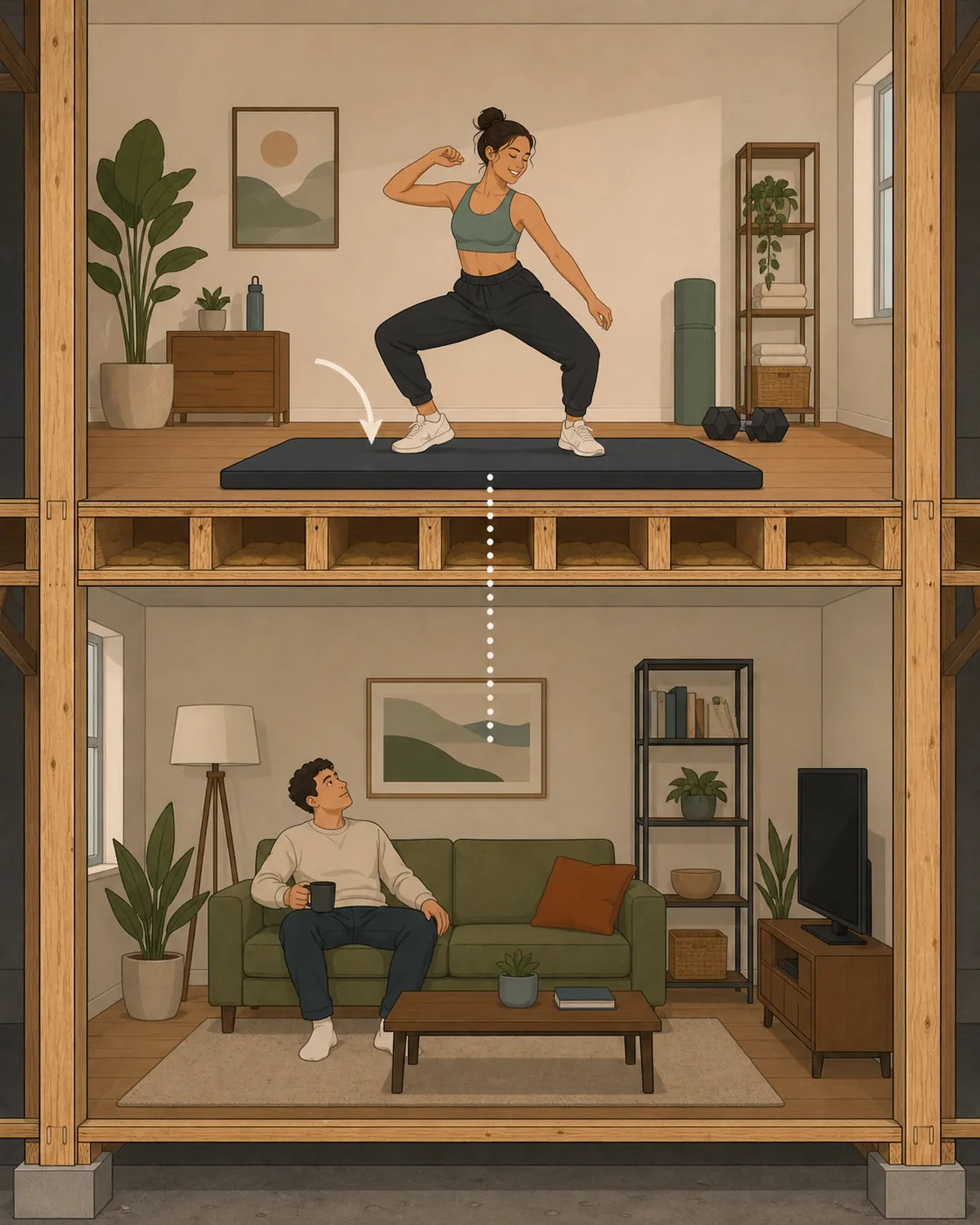
A mat helps most with grip, sweat, scuff prevention, and a little damping under your feet. It does less for heavy impacts traveling through joists. In one apartment-focused forum discussion, renters treated even a 1-inch foam mat as something that could dampen dancing or jumping noise, not eliminate it.[6] That distinction matters. A thick mat under jump squats is still a jump-squat problem.
If you already own a yoga mat, use it. If it slides, put it aside rather than fighting it. If you are choosing a mat for repeated living-room workouts, FitAtHome’s small-home-gym workout mat guide goes deeper on floor protection, thickness, traction, and storage. For a reality check on what small-space testing can look like, the FitAtHome apartment workout protocol is also useful because it treats noise and scuffs as part of the workout result, not an afterthought.
Does a no-jump Mamma Mia workout still count?
For most people, yes. The calorie expectation should sit in the dance-cardio range, not in fantasy HIIT-ad language. Harvard Health’s 30-minute calorie chart estimates disco, ballroom, or square dancing at about 165 calories for a 125-pound person, 198 calories for a 155-pound person, and 231 calories for a 185-pound person. Faster dancing such as fast ballet or the twist is listed at about 180, 216, and 252 calories for those same body weights.[7]
That makes a realistic 30-minute apartment Mamma Mia dance workout roughly a 165–252 calorie session, depending on body weight, pace, arm effort, and how many higher-intensity intervals you keep. A jumpier version may move closer to high-impact aerobics, which Harvard lists higher, but that is also the version more likely to bother the floor and the person below it.[7] If you want to see how those weight-based estimates compare with other home-workout calorie math, FitAtHome’s DQ Blizzard calories home workout uses the same kind of practical framing.
The weekly-cardio math is encouraging without needing to oversell it. U.S. public-health guidance for adults uses 150 minutes of moderate-intensity aerobic activity per week, or 75 minutes of vigorous activity, as the main benchmark.[8] Five 30-minute Mamma Mia sessions can contribute meaningfully to that target if they are done at a steady moderate effort; harder intervals may push parts of the workout toward vigorous effort.
What the dance research supports — and what it does not
Dance cardio is not just a novelty because it is fun. A 2024 systematic review and meta-analysis in PLoS ONE looked at 10 randomized controlled trials with 646 participants and found that dance interventions, compared with normal lifestyle, were associated with reductions in body mass, BMI, waist circumference, body fat percentage, and fat mass.[9]
The same finding needs its guardrails. The authors rated the certainty of evidence as low, the dance forms were not all the same, and the samples were predominantly female.[9] The study supports dance as a legitimate exercise modality over time; it does not prove that one Mamma Mia workout melts fat, or that choreography overrides nutrition, sleep, consistency, and total weekly activity.
Where dance has a genuine advantage is repeatability. A workout you look forward to has a better chance of becoming Tuesday and Thursday and Sunday, not just one heroic living-room event. That is not a cute bonus. For home fitness, especially in a small apartment, adherence is often the whole game.
Quick apartment test before you press play
- Do 20 seconds of step-touch. If it sounds slappy, reduce the step width.
- Do 10 quiet squats. If the floor creaks loudly at the bottom, move to another spot.
- Try one step-out jack. If the mat shifts, remove the mat or switch shoes.
- Keep water within reach so you are not jogging to the kitchen between songs.
- Decide your nonnegotiable swaps before the chorus hits: no jumping jacks, no squat jumps, no hop turns.
If you only want a shorter no-jump day, FitAtHome’s 15-minute living-room workout is a lighter companion. But for the full Mamma Mia dance workout at home, the practical verdict is simple: keep the music, keep the drama, keep the arms, and manage the impact. It still counts as cardio because effort, duration, and consistency matter more than preserving every viral jump.
References
- This Mamma Mia HIIT Dance Workout Feels Like a Full-On Dance Party — POPSUGAR, Aug. 2020
- This ‘Mamma Mia!’ HIIT workout feels like a dance party — KGUN9/Simplemost
- This Mamma Mia workout is the most fun you'll have exercising — Women’s Health UK
- This Mamma Mia! Here We Go Again Dance Workout Is So Fun, It Won't Even Feel Like Exercise — POPSUGAR, Apr. 2021
- Apartment-Friendly Workouts That Pack a Punch — Fitness Blender
- Will a 1” foam mat dampen dancing/jumping exercise? — Reddit r/AskNYC
- Calories burned in 30 minutes for people of three different weights — Harvard Health Publishing, March 2021
- Adult Activity: An Overview — Centers for Disease Control and Prevention
- Is dancing an effective intervention for fat loss? A systematic review and meta-analysis — PLoS ONE, Jan. 17, 2024
What a small equipment investment adds
We don't have a build tagged to this exact tier yet. Browse all builds.
How often should you repeat this?
See our recovery and rest reference for citation-anchored rest-interval guidance.
Spot something off?
Tell us if a movement, tier assumption, or duration didn't match your experience.