
Nikki Hiltz's Home Strength Workout for Runners
Learn how professional miler Nikki Hiltz incorporates strength and mobility work into her training, and how to adapt their equipment-free exercises for your own small-space home gym.
- Equipment tier required
- $0-100
- Duration
- 20 min
- Difficulty
- intermediate
- Target area
- full body
- Space footprint needed
- yoga mat size
- Noise level
- low
Nikki Hiltz’s 2026 Prefontaine Classic win over Faith Kipyegon is the shiny reason to pay attention right now. The more useful reason, especially for runners who already know what an angry calf or tendon can do to a month of training, is quieter: Hiltz treats strength work like a health rule, not a bonus workout.
The line that matters most is not about pace. In Outside, Hiltz said they are “married to” strength work and added, “Every time I accidentally skip a weight session, some little niggle pops up the next week.”[1] That sounds less like a pro-athlete sound bite than the private bargain most experienced runners eventually make with their own body: skip the boring layer often enough, and something small starts negotiating on your behalf.
For the runner holding 20 to 40 miles a week and wondering whether the next mileage bump is going to be the one that bites back, that is the useful version of Nikki Hiltz fitness inspiration for runners. Not copying championship paces. Not pretending a recreational week and a pro week are the same animal. The transferable part is the structure around the running: two deliberate strength sessions, a small pre-run mobility routine, and a real recovery boundary.

The strength work is placed, not squeezed in
COROS’ June 2026 training profile shows Hiltz’s weekly structure with lifting fixed on Wednesday and Saturday, sitting beside demanding running sessions such as double-threshold Tuesday, specific track work on Friday, and complete rest on Sunday.[2] That placement is the point. Strength is not floating around the week waiting for a convenient mood. It has a job and a slot.
There is also a home-training detail worth taking seriously. Vogue reported that Hiltz and Emma Gee “set up a home gym in our garage over the past year.”[3] Vogue does not give a full equipment inventory, so it would be a mistake to turn that garage into a fantasy shopping list. But it does collapse the distance between elite training and small-space training. At least some of this durability work already lives in a home setup.
If you want the larger running architecture around those sessions, the broader week belongs in a different article: How Nikki Hiltz Built Her 1500m Training Routine. Here, the more practical question is what a runner can actually do before work, in an apartment corner, or in a garage without turning strength training into another recovery debt.
| Piece of the system | What Hiltz material supports | Home version for recreational runners |
|---|---|---|
| Pre-run mobility | Six-exercise Runner’s World routine demonstrated by Hiltz | Yoga-mat footprint, no equipment, quiet enough for an apartment |
| Strength twice per week | Wednesday and Saturday lifting shown in COROS weekly structure | Two fixed sessions placed around your harder running days, not added randomly |
| Seasonal emphasis | Outside describes heavier base lifting shifting toward plyometrics in race season | Build basic strength first, then add small controlled power work only if you tolerate it |
| Recovery boundary | COROS shows Sunday as complete rest | One non-negotiable full rest day each week, even if it is not Sunday |
The six-move warmup that actually fits in a small room
Runner’s World published a six-exercise mobility sequence Hiltz demonstrated with Recover Athletics: cat camel, cobra dog, inverted bicycle, tick tock, donkey kick, and donkey whip.[4] This is the rare runner warmup that does not require a mini-track, a turf strip, a box, or downstairs neighbors with saintly patience.
It also aims at the areas that tend to complain before a runner’s aerobic system does: spine, hips, glutes, and the chain that eventually reports trouble through calves, feet, or low back. None of the moves is magic by itself. The value is that the routine touches several common stiffness points before the run starts, instead of waiting for mile three to discover what is not moving well.
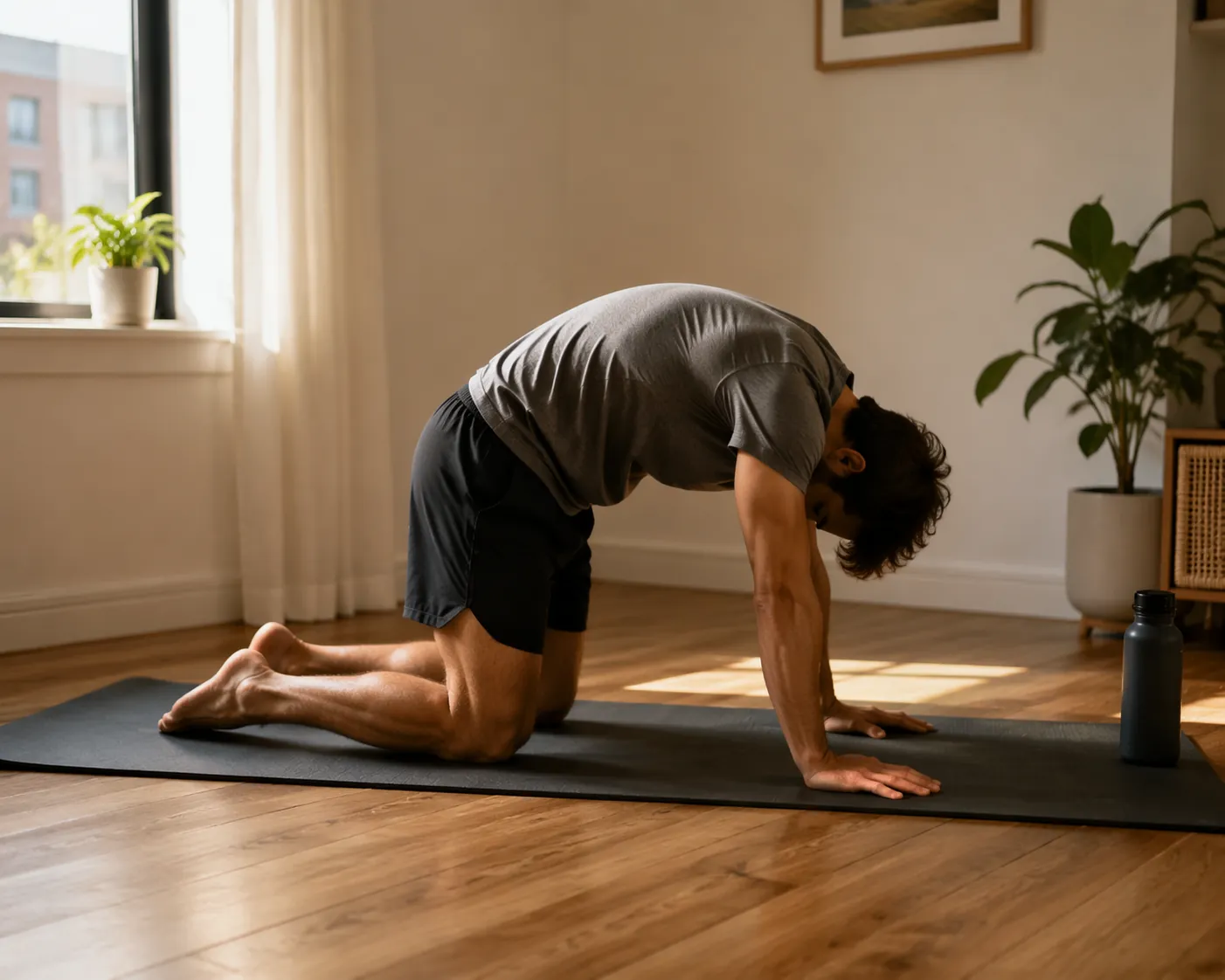
Cat camel
Start on hands and knees and move the spine through controlled flexion and extension. For a runner who sits most of the day and then asks the body to become springy on command, this is a low-drama way to check in with the back before loading it with impact. Keep it smooth rather than forcing range.
Cobra dog
This move takes the body from a cobra-like extension into a downward-dog pattern. The useful part for runners is the transition: hips, trunk, shoulders, and calves all have to cooperate. If the calves feel like cables or the low back wants to do all the work, slow the movement down and shorten the range.
Inverted bicycle
Lying on your back, the inverted bicycle brings hip motion into the warmup without impact. It is especially useful because it asks each leg to move through a running-adjacent pattern while the floor keeps the spine honest. This is not a core contest; if the pelvis rocks all over the place, make the circles smaller.
Tick tock
Tick tock brings rotation into the sequence. That matters because running can make athletes think only in straight lines, while the body still has to manage small rotational forces with every stride. Use this as a controlled hip-and-trunk movement, not as a stretch you drop into aggressively.
Donkey kick
The donkey kick brings the glutes into the conversation before the run. That does not mean you need to chase a burn. The better goal is clean hip extension without arching the low back to fake it. If the movement shows up mostly in your lumbar spine, reduce the range and make it tidier.
Donkey whip
The donkey whip adds a more dynamic hip path after the simpler donkey kick. This is where runners can get sloppy because the move feels easy until it is not controlled. Keep the motion deliberate. The point is to prepare the hip, not to fling the leg around and call it mobility.
As a home routine, this sequence is almost suspiciously convenient: one mat, no jumping, no weights, no app required. It can sit before an easy run, before a workout warmup, or before a short treadmill session. The best version is the one you can repeat when motivation is average and the room is still half dark.
What twice-weekly strength is doing in the week
Hiltz’s Wednesday and Saturday lifts matter because they make strength predictable. A recreational runner does not need the same running load around them, but the pattern is useful: pair strength with the week intentionally, then protect the days that need to stay easy.
Outside describes Hiltz shifting from heavier lifts in the base phase to more plyometric work during race season.[1] That distinction is easy to flatten, and it should not be. Heavy base lifting is about building capacity when the racing demand is lower. Plyometrics are about expressing stiffness, power, and coordination when the body is already closer to race-specific work. For most home runners, the order matters more than the label.
A sensible home version starts with strength you can control: squat patterns, hinge patterns, split-stance work, calf raises, trunk stability, and band-resisted hip work. Published sources do not give Hiltz’s exact garage inventory, so dumbbells, resistance bands, medicine-ball-style options, and bodyweight substitutions should be treated as scaled-down equivalents, not as a claim about what is in Hiltz’s space.
- Base-phase home emphasis: goblet squats, Romanian deadlifts with dumbbells, split squats, calf raises, side planks, and band walks.
- In-season home emphasis: lower volume, cleaner movement, small hops if tolerated, medicine-ball-style throws only where space and noise allow, and fewer exercises that leave the legs heavy.
- Apartment-safe substitution: step-ups become split squats, jumps become fast calf raises or low pogo holds, medicine-ball throws become band presses or controlled push-up variations.
- Durability rule: stop the session with the feeling that you could run tomorrow, because you probably need to.
This is where generic runner-strength lists often go wrong. They name good exercises but ignore the recovery cost. A lift that wrecks your long run is not automatically a better lift because it was harder. The home-gym version has to earn its place by making the running more repeatable, not by proving you can suffer indoors too.
How to place it without copying a pro week
Hiltz’s full training includes elite running demands that should not be translated into recreational targets. Women’s Running, for example, describes Hiltz’s “Essential Workout” with kilometer repeats at paces that belong to a professional miler, not to a runner trying to survive a local 10K build.[5] The useful takeaway is not the pace. It is that strength supports fast running; it does not replace the need to recover from it.
Coach Saltmarsh’s July 2026 championship-miler training table gives a representative shape of the week and explicitly frames it as the general architecture, not Hiltz’s literal logbook.[6] That is the right way to use it. The table helps show why the lifts are not randomly scattered: they live among hard running, easier aerobic volume, and rest.
For a runner at 20 to 40 miles per week, the home adaptation can be simpler. Put one strength session after or later on the same day as a quality run, so the hard stress is consolidated. Put the second session far enough from the long run that it does not turn the weekend into a negotiation with sore glutes. If Saturday lifting compromises Sunday’s only realistic long-run window, move the lift. The principle is fixed strength, not fixed weekdays.
| If your week looks like this | Place strength like this | Keep the mobility here |
|---|---|---|
| Tuesday workout, Saturday long run | Tuesday after the workout or later that day; Thursday or Sunday only if recovery allows | Before most runs, especially workouts and the first run after rest |
| Wednesday workout, Sunday long run | Wednesday after quality; Friday as a lighter strength day | Before Wednesday and Sunday at minimum |
| No formal workouts, mostly easy mileage | Two nonconsecutive days, leaving one day after the harder lift before your longest run | Before runs that follow long sitting, travel, or a rest day |
The rest day belongs to the same system
COROS shows Sunday as complete rest in Hiltz’s weekly structure.[2] For Hiltz, that day is part of a high-performance rhythm. For everyone else, the useful translation is not necessarily Sunday. It is one full rest day that does not become a secret cross-training day, a heavy yard-work day, or a “just a short shakeout” day because the watch looked bored.
Strength training makes more sense when it has recovery to land on. Without that boundary, the runner often adds lifting on top of already stretched mileage, then blames the exercises when the real problem was that nothing in the week ever got easier.
A small-space version you can actually repeat
A runner’s home gym does not need to imitate a performance center. A mat gives you the six-move warmup. A pair of dumbbells covers squats, hinges, split squats, carries, and calf work. A resistance band gives you hip and trunk options. If you have a medicine ball and a garage wall or safe outdoor space, you can add power work; if you live above someone, you probably should not.
- Before runs: cat camel, cobra dog, inverted bicycle, tick tock, donkey kick, donkey whip.
- Twice per week: one lower-body strength session and one lighter strength or power-focused session, adjusted around your hardest runs.
- During base building: emphasize controlled resistance and simple progressive loading.
- During race season: reduce lifting volume and use only plyometric work your calves, Achilles, knees, and hips already tolerate.
- Every week: keep one full rest day protected enough that the next week starts cleaner.
For another example of adapting a pro athlete’s training into a home format, see Ben Simmons’ Comeback Workout for Home Training.
That is the part of Hiltz’s system most runners can borrow without pretending to be Hiltz: not the altitude, not the mile pace, not the exact pro week, but the durable layer that makes more running possible. Two planned strength sessions, a quiet six-move mobility warmup, and a recovery boundary are not glamorous. That is precisely why they have a chance of surviving real life.
References
- The Secret to Nikki Hiltz’s Big Breakthrough, Outside Online, 2025
- Nikki Hiltz Training, COROS, June 2026
- Nikki Hiltz, Vogue, 2026
- Mobility Exercises Nikki Hiltz, Runner’s World, 2022
- Nikki Hiltz Essential Workout, Women’s Running
- Nikki Hiltz Training, Coach Saltmarsh, July 2026
What a small equipment investment adds
Cable Machine Alternatives That Save Space and Money
Compare the best cable machine alternatives for home gyms – from resistance bands and pulley systems to suspension trainers and compact digital units – and find the right option for your space and budget.
Small Treadmill Buying Guide: 7 Critical Specs to Check Before You Buy
A cross-category spec primer for apartment and small-space dwellers comparing walking pads, ultra-compact folding treadmills, and full-size folding treadmills. Learn the concrete thresholds for motor HP, deck length, noise, warranty, and subscription lock-in so you can compare apples to apples.
How to Practice Basketball at Home Without Noise Complaints
Learn how to run a full basketball workout in a small apartment without noise complaints. This guide covers no-dribble handling drills, wall form shooting, and silent ball options that let you train without disturbing neighbors.
How often should you repeat this?
See our recovery and rest reference for citation-anchored rest-interval guidance.
Spot something off?
Tell us if a movement, tier assumption, or duration didn't match your experience.