
Run a Sports Day Workout at Home With No Equipment
Transform classic sports day events into a station-based home workout you can run in your living room or hallway. This routine shows how to map five events to no-equipment bodyweight challenges scored with timed formats that count toward your weekly activity goals.
- Equipment tier required
- none
- Duration
- 5 min
- Difficulty
- beginner
- Target area
- full body
- Space footprint needed
- small room and hallway
- Noise level
- low with modifications
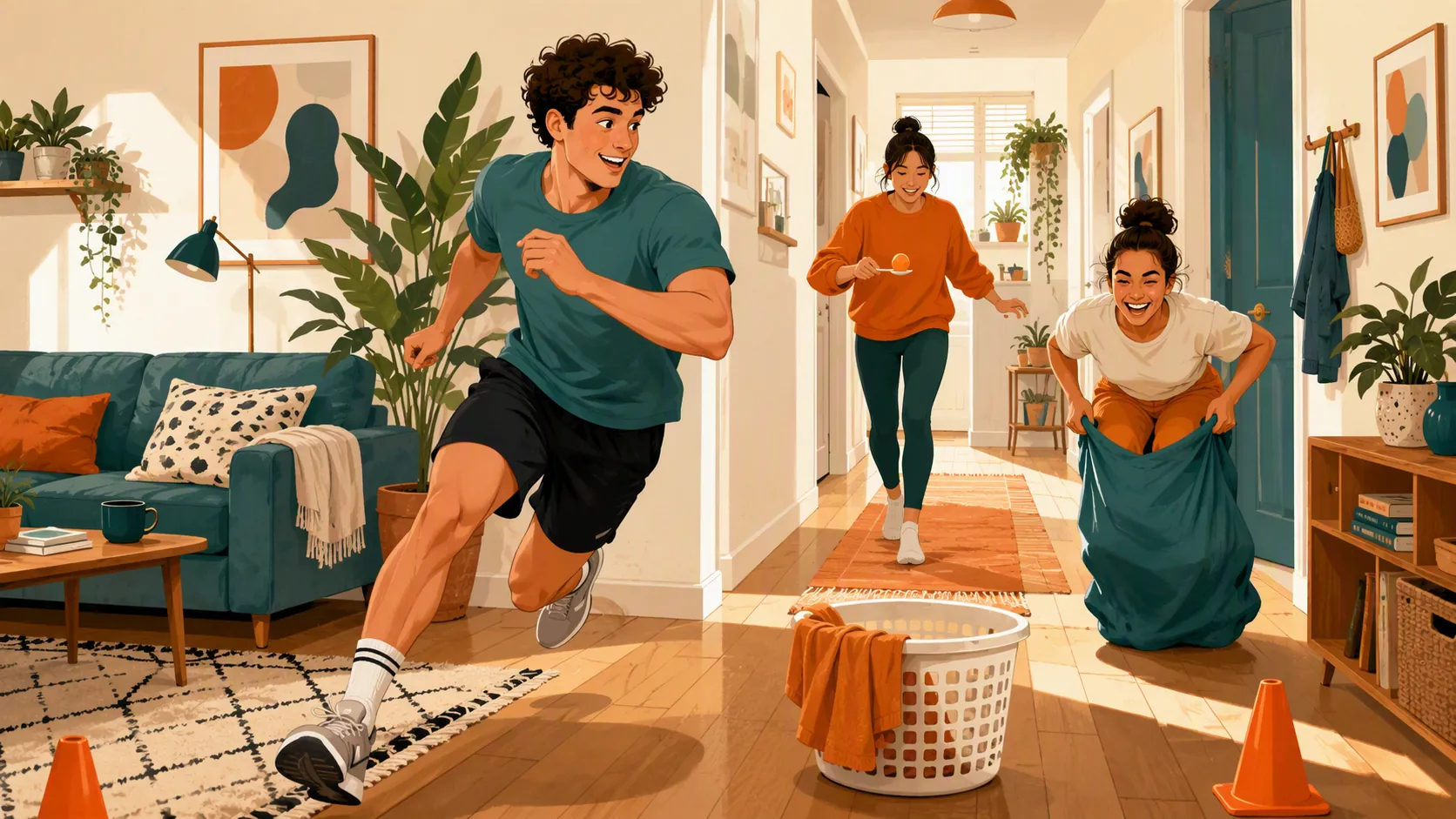
An apartment can pull off a believable field day if you shrink the events instead of the idea. The hallway becomes the relay lane, the egg-and-spoon race turns into a spoon-and-ball walk, squat hops stand in for the sack race, and a hard isometric hold takes the place of tug-of-war. That is the practical shape of sports day fitness event activities at home [1].
The version below uses fixed-time challenges, simple scorekeeping, and a small-circle layout that works solo or with a few people. That matches the competition logic behind 60-second challenges and fun group workout formats without turning the whole thing into a max-effort circuit [2][3].
| Classic event | Home-workout station | Time format | Score method | Quiet or beginner modification |
|---|---|---|---|---|
| Relay race | Hallway shuttle touch-and-return between two markers | 60 seconds | Count clean round trips | Fast march instead of a sprint |
| Tug-of-war | Partner hand-clasp hold or solo wall press | 60 seconds | Count clean 5-second holds | Stay planted and keep the tension isometric |
| Egg-and-spoon | Slow carry with a spoon and a small household item | 60 seconds | Count clean lengths or no-drop returns | Use a shorter lane and a slower walk |
| Sack race | Squat hops or tiny bunny hops in place | 60 seconds | Count clean hops | Swap to squat pulses or heel raises |
| Obstacle course | Household-item agility line with step-overs and sidesteps | 60 seconds | Count full loops | March the route and keep the feet low |
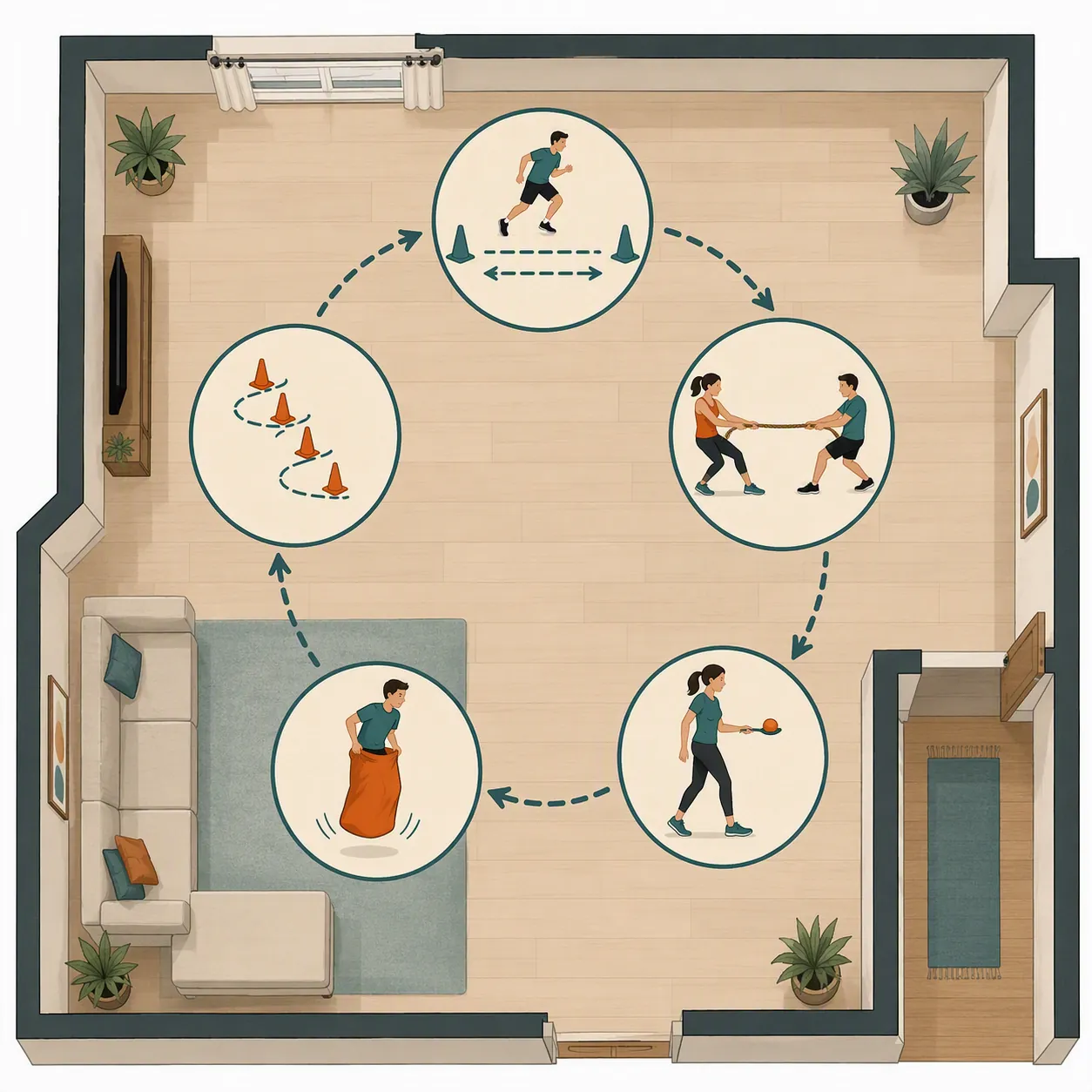
Five Stations, One Loop
Set the stations in a loop around the room so you can move forward without backtracking. A rug edge, doorway, sofa corner, or laundry basket can stand in for a lane marker as long as the route stays obvious.
Relay Race
Mark two points about a hallway apart. Start at one end, touch the far marker, and come back for one score each time you complete the round trip. Solo, keep the turn controlled and stay light on the feet; with 2-8 people, run one shared lane and let each person take a turn for 60 seconds. If neighbors matter more than speed, turn the sprint into a fast march and keep the touch-and-return pattern.
Tug-of-War
Face a partner and lock hands or forearms, then lean back until the line of tension feels honest and hold for five seconds at a time. Score the number of clean holds. Solo, stand side-on to a wall and press or pull into it as hard as you can without moving; the score is still the count of controlled holds. Keep the feet planted if the goal is quiet resistance instead of a wrestling match.
Egg-and-Spoon
Carry a spoon with a small household item balanced on it, then walk the lane without rushing the turn. Score clean lengths or one point per no-drop return. Solo, this is a good place to slow the whole circuit down; in a group, stagger starts so nobody crowds the hallway. If you want less wobble and less noise, use a slower heel-to-toe walk and shorten the lane.
Sack Race
Stand with feet together and use squat hops or tiny bunny hops instead of a full jump circuit. Score the number of clean hops, not the number of frantic contacts with the floor. Solo, stay inside one rug square; with a group, race the timer rather than each other so nobody launches across the room. For a low-impact version, swap to squat pulses or quick heel raises.
Obstacle Course
Build a short agility line with books, shoes, or a sofa edge as the course markers. Move through it with step-overs, sidesteps, a duck-under, or a simple weave around the room, then score each complete loop. Solo, the goal is smooth travel, not a stunt course; with a group, start one person every few seconds so the lane stays clear. If you need to stay quieter, march the route and keep the feet low.
How To Score It
Use one scorecard and one timer. The simplest version is one 60-second round per station, with the number of clean shuttles, holds, lengths, hops, or loops written down next to each event. If you like competition, set bronze, silver, and gold targets before you start so the workout has a finish line that is not just survive it [2][3].
That same format works for a solo run or a group of 1-8. Solo, you are trying to beat your last round. In a small group, everyone can work at once and compare totals, or you can turn it into a relay where the lane resets after each person finishes. If the vibe should stay family-friendly, borrow the lighter household-item feel of silly sports-day ideas and mini-at-home sports days, then keep the scoring obvious and the movement easy to see [7][8].
If you want to make the circuit stricter without adding equipment, pair it with a compact no-equipment conditioning session or a small-space fighter-style workout. If your main problem is noise, a quiet low-jump circuit fits the same renter-first logic, while a bad-weather indoor workout or a BPM-based music playlist keeps the timing and pacing simple.
How It Fits Into a Week
Keep the effort moderate enough that you can repeat it, not just survive it. Adult field-day planning guides use moderate work around 4-5 on a 10-point scale and treat a two-hour event as a normal planning window, which is a reminder that this format should feel playful, sweaty, and still controlled [5][6]. The CDC says adults should aim for at least 150 minutes of moderate-intensity aerobic activity each week, with muscle-strengthening work on 2 days a week, so a sports-day circuit can count as one part of the week rather than the whole program [4].
References
- Bootcamp Ideas - Childhood Throwback: Field Day Workout!
- Gopher Sport - How to Add Fun Competition Workouts to Groups
- Youth Sport Trust - 60 Second Physical Activity Challenges
- CDC - What You Can Do to Meet Physical Activity Recommendations
- Throwback Fitness - Throwback's Playbook for Field Day Games and Activities
- Paperless Post - 10 Tips for Hosting an Adult Summer Field Day
- Scouts UK - Have a silly sports day
- Here Come The Girls - How to Host a Mini Sports Day at Home
What a small equipment investment adds
We don't have a build tagged to this exact tier yet. Browse all builds.
How often should you repeat this?
See our recovery and rest reference for citation-anchored rest-interval guidance.
Spot something off?
Tell us if a movement, tier assumption, or duration didn't match your experience.