
Oba Femi's No-Equipment Workout for Weight Loss
This article adapts WWE star Oba Femi's training philosophy—cutting rest periods and prioritizing high-volume compound movements—into a 25–30 minute bodyweight circuit that fits any small apartment. Follow the four-week progressive structure to support weight loss and body recomposition without a gym or noisy jumping.
- Equipment tier required
- none
- Duration
- 25-30 min
- Difficulty
- beginner
- Target area
- full body
- Space footprint needed
- yoga mat space
- Noise level
- quiet
The useful part of Oba Femi’s training story is not that a WWE powerhouse trained hard. That much was already priced in. The part worth stealing for an apartment workout is more specific: in 2026 coverage of his Celtic Warrior Workouts appearance, Femi described moving away from a pure strength-max approach and toward higher-volume work with limited rest, calling rest reduction “the biggest factor” in his change.[1]
That matters because rest periods are one of the few variables a home trainee can control without a rack, treadmill, sled, assault bike, or downstairs-neighbor apology note. You can make a squat-to-push-up-to-lunge circuit harder by moving cleaner, resting less, and accumulating more quality work in the same 25–30 minutes.
This is not Femi’s exact WWE program, and it is not pretending a civilian can copy a 300-pound elite performer’s training week from a living room. It is an Oba Femi-inspired home workout for weight loss: no equipment, no jumping, no heavy landings, and no claim that the workout replaces the nutrition side of fat loss.

What Actually Transfers From Femi’s Training
Femi’s wrestling context gives the idea credibility, but it also sets the boundary. He is a former shot-put athlete who became a major NXT name before moving into WWE’s larger spotlight, with a résumé that includes the NXT North American Championship and NXT Championship.[2] That background explains why “train like Oba Femi” cannot mean matching his loads, joint stress, or recovery demand.
The transferable pieces are smaller and more useful: compound movements, limited rest, enough volume to challenge conditioning, and shoulder balance work. Femi also emphasized rear-deltoid training after front-dominant work contributed to imbalance and rotator cuff problems, which is exactly the kind of warning a push-up-heavy home routine needs.[1]
The weight-change expectations should stay sober. Yahoo Sports coverage noted fan attention around Femi’s reported move from roughly 310 pounds to about 302 lean pounds over roughly three months ahead of SummerSlam 2026.[3] For a performer already carrying large amounts of muscle, that reads less like a crash transformation and more like recomposition: slightly lighter, sharper, and better conditioned.
The Apartment Version: 25–30 Minutes, No Equipment
The circuit below uses Femi’s short-rest principle without borrowing the parts that do not belong in a small room. No jumps. No burpees with loud landings. No sprinting in place like the floor owes you money. The goal is repeatable pressure: big bodyweight patterns, controlled tempo, and rests short enough that your heart rate stays involved.
| Segment | Time | What You Do |
|---|---|---|
| Warm-up | 4–5 minutes | Joint circles, marching, hip hinges, slow squats, scapular push-ups |
| Main circuit | 18–21 minutes | 6 movements, 3 rounds, controlled work intervals |
| Rear-delt and posture finisher | 3–4 minutes | Prone Y-T-W raises and wall slides |
| Cool-down | 2–3 minutes | Breathing, chest opener, hip flexor stretch |
Warm-Up: Make the First Round Better
Set a timer for 4–5 minutes and move continuously, but not frantically. Do 30–40 seconds each of marching in place, arm circles, hip hinges, slow bodyweight squats, alternating reverse lunges, scapular push-ups from the knees or toes, and bear-plank shoulder taps. The warm-up is not there to burn you out. It is there so the first working round does not feel like a negotiation with your ankles and shoulders.
Main Circuit
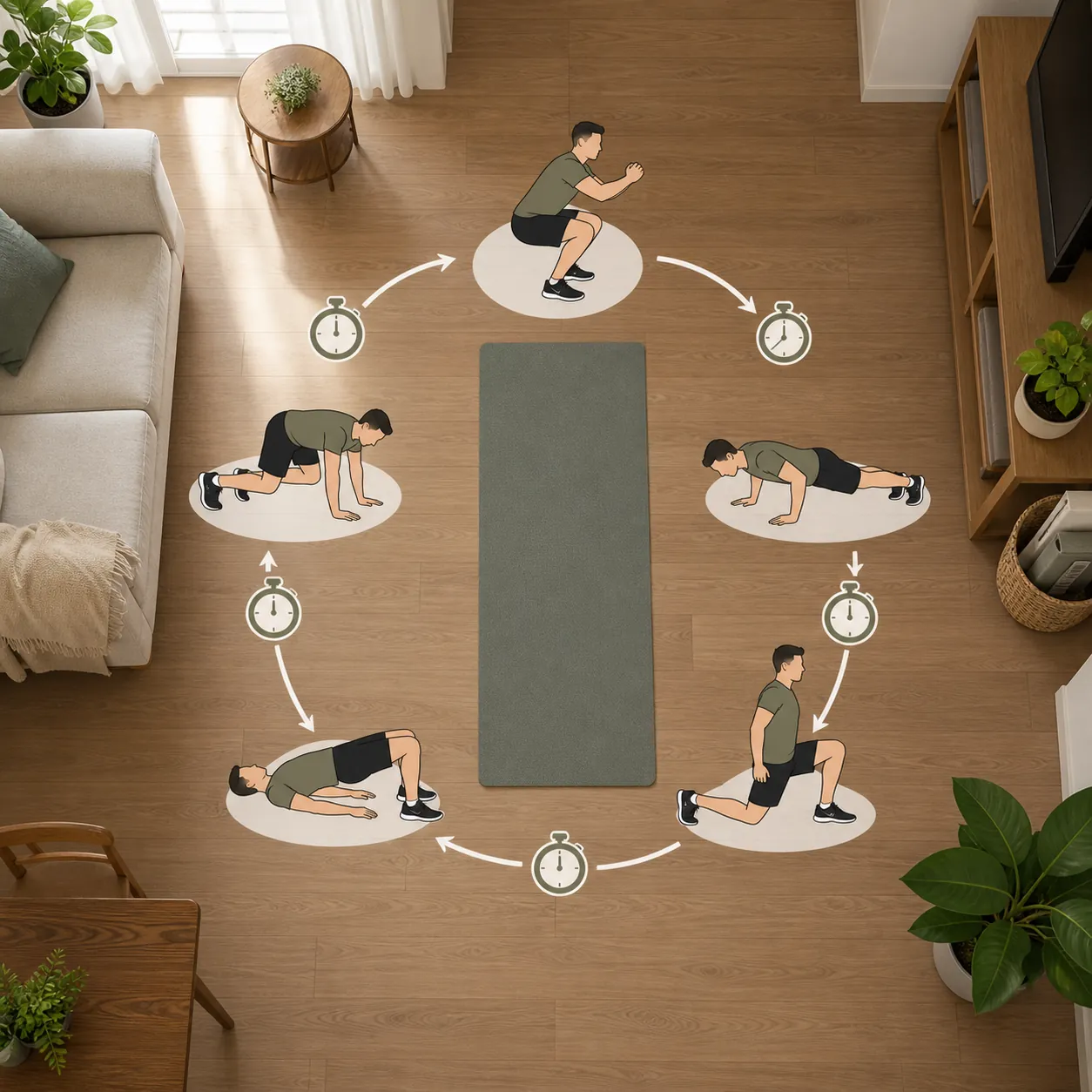
Do 3 rounds. In Week 1, work for 35 seconds and rest for 25 seconds between movements. Rest 60 seconds between rounds. Keep every rep quiet enough that someone in the next room could mistake the session for normal furniture movement.
| Order | Exercise | How to Do It Quietly | Why It Is Here |
|---|---|---|---|
| 1 | Tempo squat | Lower for 3 seconds, stand without bouncing | Leg volume without impact |
| 2 | Push-up | Use hands on a couch or knees if needed | Upper-body push and trunk tension |
| 3 | Reverse lunge | Step back softly, alternate sides | Single-leg work without forward knee crashing |
| 4 | Glute bridge march | Keep ribs down and feet planted | Posterior-chain work with no floor impact |
| 5 | Bear plank shoulder tap | Widen feet, tap slowly, avoid rocking | Core, shoulders, and anti-rotation |
| 6 | Prone swimmer or floor W raise | Lift arms lightly, keep neck long | Rear-deltoid and upper-back balance |
The order matters. Legs come first, then pushing, then single-leg work, then the posterior chain, then trunk control, then rear-shoulder work. That sequence lets the circuit stay demanding without turning into 18 minutes of push-ups and shoulder irritation.
If push-ups are too easy, slow the lowering phase and pause one count at the bottom. If they are too hard, elevate your hands on a sturdy couch, counter, or table edge. The circuit is not graded by whether you choose the hardest-looking version. It is graded by whether you can keep moving with clean reps and repeat the workout later in the week.
Rear-Delt Finisher
After the third round, spend 3–4 minutes on the part most home workouts skip. Do 2 slow rounds of 8–12 prone Y raises, 8–12 prone T raises, 8–12 prone W raises, and 6–10 wall slides. Use a small range of motion if needed. The point is not to fake a cable machine with your imagination; it is to give the rear shoulders and upper back a little direct work so the push-up volume does not own the whole program.
Why Short Rest Helps Weight Loss
Rest-period reduction works because it changes the density of the session. If two workouts use the same movements, the one with shorter rests usually asks you to complete more work per minute. That does not make it magic, and it does not erase the need for food intake to line up with the goal. It does make a no-equipment circuit more useful when the only available load is your own body.
For weight management, the CDC recommends at least 150 minutes of moderate-intensity aerobic activity each week.[4] A 30-minute circuit done five times weekly can meet that benchmark if the pace is honest enough to raise breathing but controlled enough to maintain form. Health.com’s bodyweight-exercise guidance also frames weight loss around a net energy deficit while recognizing bodyweight movements as a way to burn calories and support the process.[5]
That is the honest mechanism: the workout raises weekly activity, preserves a strength-training signal through squats, lunges, push-ups, bridges, and planks, and becomes more demanding as rest drops. The scale moves when that training is paired with an overall calorie deficit. Without that deficit, the circuit can still improve conditioning, work capacity, and movement quality, but weight loss is less predictable.
Four-Week Progression
Do not add chaos before you add consistency. The progression below keeps the same six movements so your body has time to get better at them. The overload comes from less rest, slightly longer work intervals, and cleaner rep density, not from throwing in random exercises every session.
| Week | Work / Rest | Rounds | Between-Round Rest | Progress Target |
|---|---|---|---|---|
| 1 | 35 sec work / 25 sec rest | 3 | 60 sec | Learn the movements and finish without rushing reps |
| 2 | 40 sec work / 20 sec rest | 3 | 60 sec | Add reps only if form stays quiet and controlled |
| 3 | 45 sec work / 15 sec rest | 3 | 45–60 sec | Keep breathing under control while reducing dead time |
| 4 | 45 sec work / 15 sec rest | 4 if recovery is good | 45 sec | Add a fourth round only if joints feel good and reps stay crisp |
You are advancing if you complete more clean reps in the same interval, need fewer form breaks, recover faster between rounds, or finish the same session at a lower perceived effort. Weight can be one measure, but it is not the only useful one. Waist measurement, resting energy, push-up quality, and how your lungs feel on the third round often show the change before the mirror makes up its mind.
If Week 3 feels sloppy, repeat Week 2. If Week 4 makes the shoulders cranky, keep 3 rounds and improve the finisher instead of forcing the fourth round. The program is built to be repeated, not survived once.
How Often to Do It
For a weight-loss-focused week, use the circuit 4–5 times. Five 30-minute sessions line up neatly with the CDC’s 150-minute weekly activity benchmark.[4] Four sessions can still work if nutrition is aligned and daily walking or other movement fills some of the gap.
| Day | Plan |
|---|---|
| Monday | Circuit |
| Tuesday | Circuit or brisk walk |
| Wednesday | Circuit |
| Thursday | Mobility, walking, or rest |
| Friday | Circuit |
| Saturday | Circuit if recovered; walk if not |
| Sunday | Rest |
If you are already active, start with 3 sessions and add from there. If you are new to training, 5 days per week may be too much at first. The best schedule is the one that lets your knees, wrists, and shoulders feel ready to train again.
Quiet Substitutions for Small Rooms
Apartment-friendly workout guidance often removes jumping, encourages controlled tempo, and uses small-space circuits rather than loud impact moves.[6][7][8] That is the right trade here. A quiet reverse lunge you can repeat for four weeks beats a jump lunge you abandon after one complaint from downstairs.
| If the Exercise Is a Problem | Use This Instead | Keep This Standard |
|---|---|---|
| Squats bother your knees | Sit-to-stand from a chair | Stand tall without bouncing off the seat |
| Push-ups bother your wrists | Incline push-ups on fists or handles if available | Keep elbows controlled and ribs down |
| Reverse lunges feel unstable | Split squat with fingertips on a wall | Move slowly and keep the front foot planted |
| Bear plank taps bother shoulders | Forearm plank or dead bug | Brace without holding your breath |
| Prone raises feel pinchy | Wall slides only | Use pain-free range |
For tighter spaces, remove travel from every movement. Reverse lunges become stationary split squats. Bear crawls become bear holds. Marching replaces high knees. If you can fit a yoga mat, you can run the session.
Beginner and Harder Versions
Use the beginner version if you cannot keep nasal or controlled mouth breathing during Week 1, or if your form changes dramatically after the first round.
- Beginner: 30 seconds work, 30 seconds rest, 2–3 rounds, incline push-ups, chair sit-to-stands, split squats with wall support.
- Standard: 35–45 seconds work, 15–25 seconds rest, 3 rounds, regular push-ups or incline push-ups as needed.
- Harder: 45 seconds work, 15 seconds rest, 4 rounds, slower eccentrics, pauses, and stricter plank positions.
Do not make the harder version louder. Add difficulty through tempo, range of motion, pauses, and shorter rest. If you eventually want more resistance, bands or adjustable dumbbells can extend the same framework, but the first four weeks do not require them. For another no-equipment conditioning option, see this NFL training camp home workout; for a similar athlete-to-home adaptation, try the Travis Kelce training camp home workout.
What to Track for Weight Loss
Track three things for four weeks: body weight trend, waist measurement, and circuit performance. Weighing daily is optional, but if you do it, look at the weekly average rather than one noisy morning. Measure your waist once per week under the same conditions. For performance, write down whether you completed all rounds, which push-up version you used, and whether the rest periods stayed honest.
A realistic win after four weeks is not a superstar cut. It is a clearer pattern: more total work in 30 minutes, better control in the third round, a waist measurement moving the right direction, and body weight trending down if food intake supports it. Readers whose primary goal is fat loss may also want a broader weight-loss home workout routine that pairs training consistency with recovery considerations.
The Bottom Line
The best Oba Femi home workout for weight loss is not a fantasy version of his WWE training. It is a scaled version of the principle he highlighted: reduce rest, raise useful volume, and keep the shoulders balanced enough to come back tomorrow. Done 4–5 times per week, paired with a calorie deficit, and progressed over four weeks, this no-equipment circuit can support measurable fat loss and recomposition precisely because it fits the room most people actually train in.
References
- Oba Femi's Workout Secrets: How He Overpowered Brock Lesnar on WWE Raw, AOL / Men's Journal, March 2026.
- Oba Femi, Wikipedia.
- WWE fans think Oba Femi underwent massive weight loss before Brock Lesnar SummerSlam match, Yahoo Sports.
- Physical Activity and Your Weight and Health, Centers for Disease Control and Prevention.
- 15 Bodyweight Exercises That Help Burn Calories and Support Weight Loss, Health.com, February 2026.
- At-Home Circuit Workout — No Equipment Needed, Anytime Fitness.
- Quiet Apartment Workout No Jumping, Ogamic.
- Apartment-Friendly Workouts That Pack a Punch, Fitness Blender.
What a small equipment investment adds
We don't have a build tagged to this exact tier yet. Browse all builds.
How often should you repeat this?
See our recovery and rest reference for citation-anchored rest-interval guidance.
Spot something off?
Tell us if a movement, tier assumption, or duration didn't match your experience.