
If you hike Spy Rock via Cash Hollow, the useful fitness question is not whether it “counts” because the view is pretty. The question is what kind of session you just put into your week. For anyone evaluating Spy Rock trail fitness, the current answer starts with the route itself: the commonly used Cash Hollow approach is about 5.8 miles out and back, with roughly 1,270 feet of elevation gain and a typical time window of 3 to 4 hours.[1]
That route note matters. Older descriptions may refer to the shorter fish hatchery approach, but that access changed after the fish hatchery lot closure in December 2020, so the workout most hikers are evaluating now is longer than the old version.[1] If you are trying to place Spy Rock beside a treadmill incline day, stair climber block, or leg workout, use the Cash Hollow numbers rather than treating every Spy Rock mention as the same physical demand.
On paper, the hike looks like a long lower-body cardio session. In the legs, it is more specific than that: sustained climbing, controlled descending, repeated balance corrections on uneven ground, and a final scramble that asks for coordination after fatigue has already accumulated. That combination is why Spy Rock is closer to a long stair-climber-plus-stability workout than a casual walk.
The Current Cash Hollow Route Is the Workout Being Measured
The Cash Hollow route earns its training value through duration and grade. A 5.8- to 5.9-mile out-and-back does not sound extreme if you only look at distance, but the elevation profile changes the load. The route gains about 1,270 feet, and the climb includes sustained sections that sit in a grade range home-fitness readers would recognize immediately on a treadmill or stair machine.[1][2]
| Workout Variable | Spy Rock via Cash Hollow | Home-Fitness Translation |
|---|---|---|
| Distance | About 5.8–5.9 miles out and back | Longer than a short cardio add-on |
| Elevation gain | About 1,270 feet | Comparable to a sustained incline session rather than flat walking |
| Typical duration | About 3–4 hours | Much longer than a common 45–60 minute cardio workout |
| Terrain | Dirt, roots, rocks, uneven trail, and summit scramble | Adds balance and stabilizer work machines usually remove |
The practical classification is simple: Spy Rock can replace a substantial cardio session and can also interfere with leg recovery. It is not a neat substitute for barbell squats or a structured hypertrophy plan, but it is absolutely enough load to count in the weekly ledger.
The Cardio Demand Comes From Grade Plus Time
The steep parts are where the stair-climber comparison becomes useful. General hiking calorie estimates based on body weight and grade put a 150- to 180-pound person roughly in the 400–656 calories-per-hour range, depending on incline and body size.[3] Applied to Spy Rock’s sustained climbing, that makes the harder uphill stretches more than a scenic warm-up.
For example, Healthline’s hiking estimates, citing the 2024 Compendium of Physical Activities, place a 180-pound person at about 656 calories per hour on steep uphill hiking and about 435 calories per hour on more moderate-grade hiking.[3] Those numbers are not Spy Rock lab measurements. They are general hiking estimates applied to a route with sustained climbing, so they should be read as a plausible range, not a receipt.
That caveat is not a technicality. Pace, pack weight, heat, footing, stops, conditioning, and trail conditions can all move the actual number. A fitter hiker may cover the same section with a lower relative effort. A newer hiker may spend more time near the top of their comfortable heart-rate range. Two people can finish together and still have very different training stress.
The bigger point is duration. A 45-minute stair-climber session can be intense, but Spy Rock commonly asks for 3 to 4 hours of movement.[1] Even if the per-minute burn is not always higher than a gym machine, the total session cost can become large because the work keeps going. For a home-fitness week, that means it should not be logged mentally as “just a walk” on top of normal training.
This is also where a basic aerobic base helps. If a steady hike keeps pushing you above a sustainable effort, the route turns into a grind instead of a controlled endurance session. A beginner who is building toward Spy Rock would be better served by consistent home cardio first: incline walking, step-ups, low-impact zone 2 work, or treadmill rucking before treating a half-day climb as a casual weekend extra.
Uneven Ground Changes the Energy Cost
A treadmill incline can imitate part of Spy Rock, but it smooths away one of the main reasons the trail feels different: uneven ground. The Washington Trails Association cites University of Florida research finding that walking on uneven terrain can require about 28% more energy than walking on flat ground.[4] That mechanism matters because Spy Rock is not only uphill walking; it is uphill walking while your feet keep negotiating roots, rocks, dirt, and changing surfaces.
Machines remove a lot of those decisions. A treadmill belt comes back at the same angle. A stair climber gives you repeated steps at predictable heights. On trail, each foot placement is slightly less guaranteed. The ankle stiffens, the hip adjusts, the trunk resists rotation, and the knee tracks over surfaces that do not care about symmetry.
That does not make the trail magically superior to indoor training. It makes it different. If your home routine already has controlled strength work, Spy Rock adds a messy stability dose. If your home routine is mostly machines, the trail exposes the balance and lateral-control gap that machines often hide.
What Your Legs Are Actually Doing

The climb is the obvious part. Uphill hiking asks the glutes to drive hip extension, while the hamstrings and calves help with propulsion. Harvard Health points to stair climbing, lunges, and squats as practical ways to prepare hiking muscles, which tells you something about the movement pattern: this is repeated lower-body work, not merely transportation.[5]
The descent is quieter but often more memorable the next day. Coming down taxes the quadriceps eccentrically, meaning the muscles work while lengthening to control the body rather than simply pushing it upward. Home workouts can train this with slow lowering phases in split squats, step-downs, and lunges, but a long rocky descent adds repetition and attention. You are braking over and over.
The stabilizers are the part many gym comparisons miss. Outdoor hiking recruits the muscles around the hips, knees, and ankles to manage uneven surfaces, and National Geographic’s expert discussion of hiking emphasizes balance and coordination demands that are not captured by simple step counts.[6] That is the gap between “my legs moved for three hours” and “my legs had to solve small terrain problems for three hours.”
- Glutes: drive the uphill push, especially on steeper sections.
- Quadriceps: control the descent and absorb repeated braking force.
- Hamstrings and calves: assist propulsion and ankle control.
- Core and hip stabilizers: keep the pelvis and trunk organized on uneven footing.
- Ankles and feet: make constant small corrections that indoor machines reduce.
The summit scramble adds a final coordination layer. It is not a rock-climbing workout in the formal sense, but after sustained climbing it asks for hands, feet, balance, and judgment at the same time. That is a different stress than extending a treadmill session by another ten minutes.
Where It Fits in a Home-Fitness Week
Count Spy Rock as a full session. More precisely, count it as a long cardio day with meaningful lower-body load. If your week already includes hard leg training, hill intervals, or heavy step-up work, placing Spy Rock right beside that session may turn normal fatigue into poor recovery.
| If Your Week Includes | How to Treat Spy Rock |
|---|---|
| Heavy leg day | Avoid placing the hike immediately before or after if you care about performance. |
| Easy zone 2 cardio | Spy Rock can replace one longer endurance session, though the terrain adds more leg stress. |
| Treadmill incline or stair climber | Use the hike as an outdoor substitute, not as an extra stacked on top. |
| Beginner cardio base building | Prepare first with shorter incline walks, step-ups, and steady low-impact sessions. |
| Calorie-focused training | Use the calorie range cautiously and track effort, duration, and recovery instead of chasing a single number. |
A reasonable home-based preparation block would not need to be complicated. Build a steady cardio floor with low-impact sessions, then add incline walking or stair work, then make the legs more trail-ready with squats, lunges, step-ups, calf raises, and slow lowerings. If you already use a treadmill ruck, that can approximate the loaded uphill demand, but it still will not reproduce the uneven surface or scramble.
Recovery should be planned the same way you would plan it after a long gym session. Watch the quads after the descent, the calves after sustained climbing, and the hips or ankles if you are not used to trail footing. If the hike leaves your legs heavy, it has already answered the classification question.
What Spy Rock Does Not Replace
Spy Rock is not a precise strength program. It will not progressively load the glutes the way a structured squat or hip-hinge plan can. It will not give you the clean dosage of a treadmill workout where pace, incline, and time are tightly controlled.
That limitation does not weaken the programming judgment. It clarifies it. Spy Rock is best treated as cross-training: a long aerobic session with enough climbing, eccentric descending, and stabilizer work to affect the rest of the week.
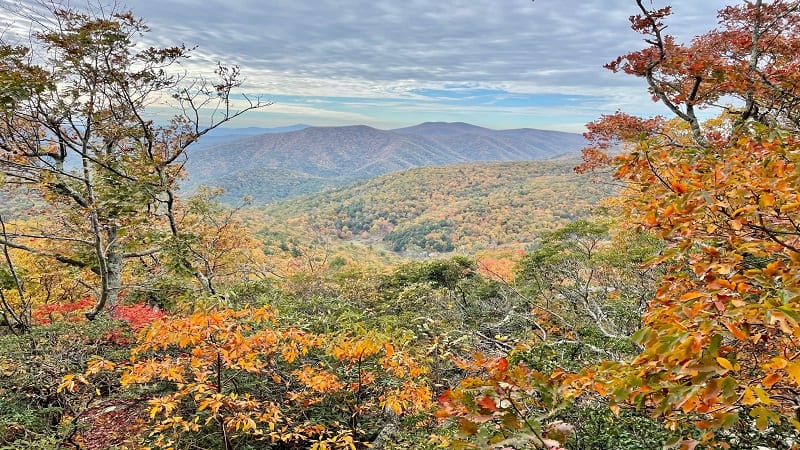
The view from the top is a bonus, and it is a good one. But the training value is already earned before the view arrives: in the grade, the time under effort, the repeated foot placements, and the descent your quads have to control on the way back.
The Programming Judgment
Spy Rock via Cash Hollow can count as a legitimate cardio-and-leg session. For most home-fitness readers, it sits closer to a long stair-climber workout with added balance, eccentric quad work, and trail-stability demands than to a casual walk. Schedule it with recovery in mind, check current access and trail conditions before going, and do not stack it on top of normal leg training as if the body will file it under scenery.
References
- Spy Rock: Hike the AT to 360-Degree Views — Go Hike Virginia
- Spy Rock Trail via Cash Hollow — Komoot
- Hiking: Calories Burned, Weight Loss, and More — Healthline
- Mind & Body: What Hiking Does — Washington Trails Association
- Get your hiking muscles in shape — Harvard Health
- Why hiking is uniquely beneficial — National Geographic

Comments
Join the discussion with an anonymous comment.