
Which NYC Summer Streets Running Workout Fits Your Level?
Summer Streets turns a flat stretch of Manhattan into a car-free running corridor in August 2026. Pick the session for your level — beginner run/walk, intermediate tempo, or advanced long run — with start times, turnaround points, and hydration stops mapped to the real route.
- Equipment tier required
- none
- Duration
- 30–120 min
- Difficulty
- Beginner, intermediate, advanced
- Target area
- Cardiovascular endurance
If you want to use Summer Streets as a real run, pick the workout before you pick the mile. The 2026 Manhattan dates are Aug. 1, Aug. 8, and Aug. 15, with the corridor open 7am–3pm, rain or shine, from the Brooklyn Bridge up Lafayette Street and Park Avenue to East 110th Street, then along Broadway to Dyckman Street.[1][2] That gives runners a rare flat, car-free north-south surface through Manhattan. It does not give you a closed racecourse.
The practical version: start at 7am if you care about rhythm, choose a defined turnaround, and expect interruptions from people, bikes, programming zones, and live cross-street signals. NYC DOT reported more than 500,000 participants across Summer Streets in 2025, which is great for the event and a good reason not to begin your tempo run at late brunch hour.[1]
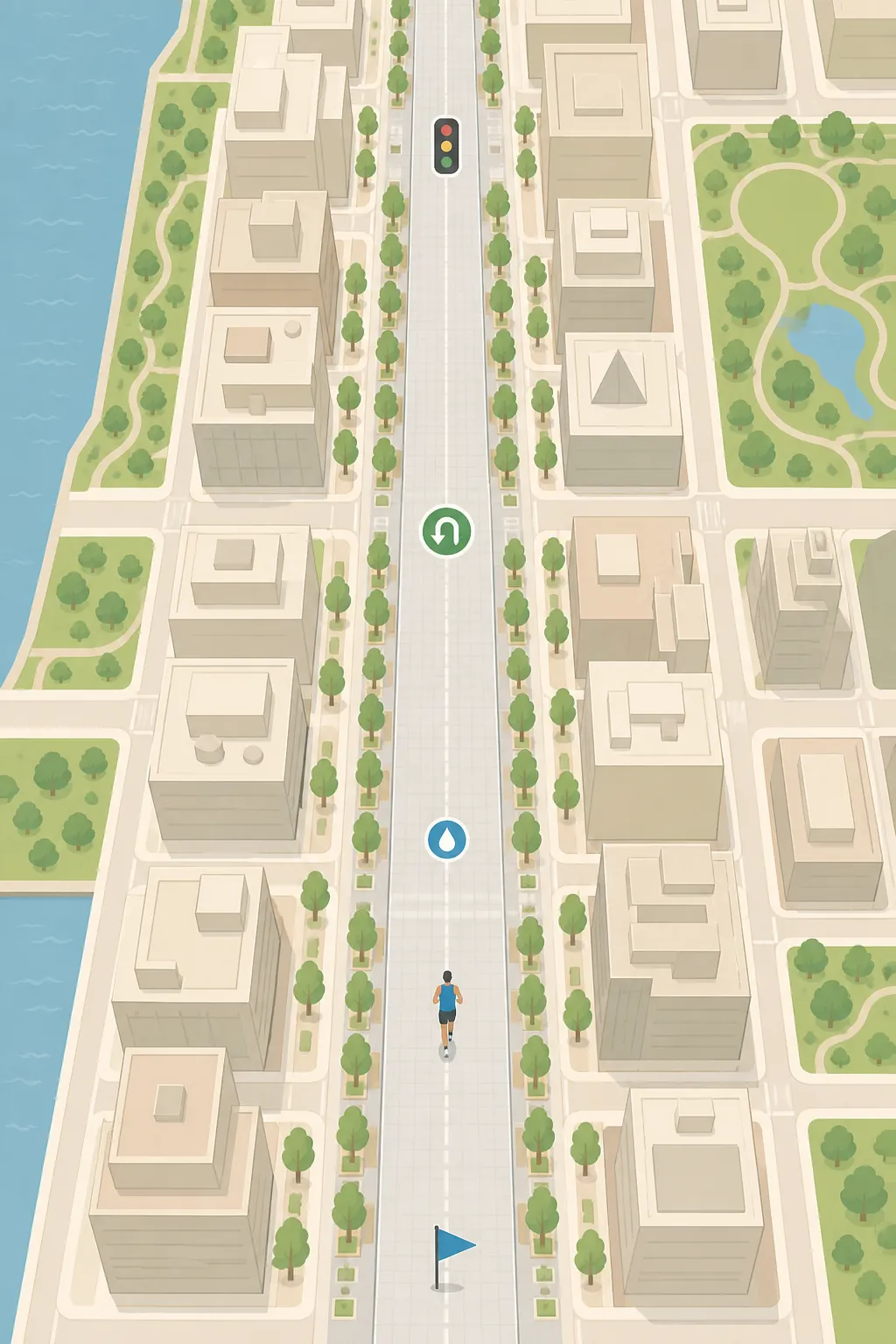
Route distance also needs a little humility. DOT identifies the official corridor endpoints, but does not publish a single mileage figure for the 2026 Manhattan route. West Side Spirit describes the route as “more than 10 miles,” and community-reported route estimates have put the full one-way trip around 14 miles. For training, treat the Manhattan Summer Streets running route as a roughly 10-to-14-mile planning range, not a certified distance.[3]
| Runner level | Best Summer Streets session | Where the route helps | Main constraint |
|---|---|---|---|
| Beginner | Run/walk 5K or timed 5K | Flat surface, clear out-and-back option on Park Avenue | Crowds and confidence at the turnaround |
| Intermediate | Tempo by effort, not exact pace | Long straight sections for sustained running | Live signals and density break perfect splits |
| Advanced | Long run or controlled out-and-back | Enough corridor for marathon-build volume | Hydration, heat, and uncertain full-route mileage |
First, choose the session that fits the day
Summer Streets is tempting because the avenue looks simple: point north, run, turn around when satisfied. That works for an easy jog. It is a worse plan for a workout, especially in August, because the thing that ruins the session is usually not the total distance. It is the first long stop at a signal, the water you assumed would appear, or the crowd you did not want to weave through.
A beginner should use the cleanest controlled version available: the NYRR Start Line Series Manhattan 5K on Aug. 1, or a self-managed run/walk 5K that copies its out-and-back logic without pretending to be part of the race. An intermediate runner should use the corridor for effort-based tempo work, where a stopped light changes the watch split but not the training effect. An advanced runner can use the full corridor idea for a long run, but only with water carried from the start and a turnaround chosen before pride starts negotiating.
Beginner: make the 5K controlled, not crowded
For a first Summer Streets running workout, the best verified anchor is the NYRR Start Line Series Manhattan 5K on Saturday, Aug. 1. It is free, timed, starts at 7:30am, and uses a Park Avenue out-and-back: start at Park Avenue and East 80th Street, run north past East 100th Street, and finish back at East 80th Street. Bib pickup runs 6:00–7:30am, and the listed fluid station is on Park Avenue between East 109th and East 108th Streets.[4]
That setup matters because it removes three beginner problems at once: you do not have to invent the distance, you do not have to decide whether you have gone far enough, and you get a marked out-and-back on the part of the corridor where runners are already expected. The listed fluid station is useful, but notice where it sits. If you are running a conservative 5K from East 80th, you should not treat it as permission to arrive underhydrated in August.
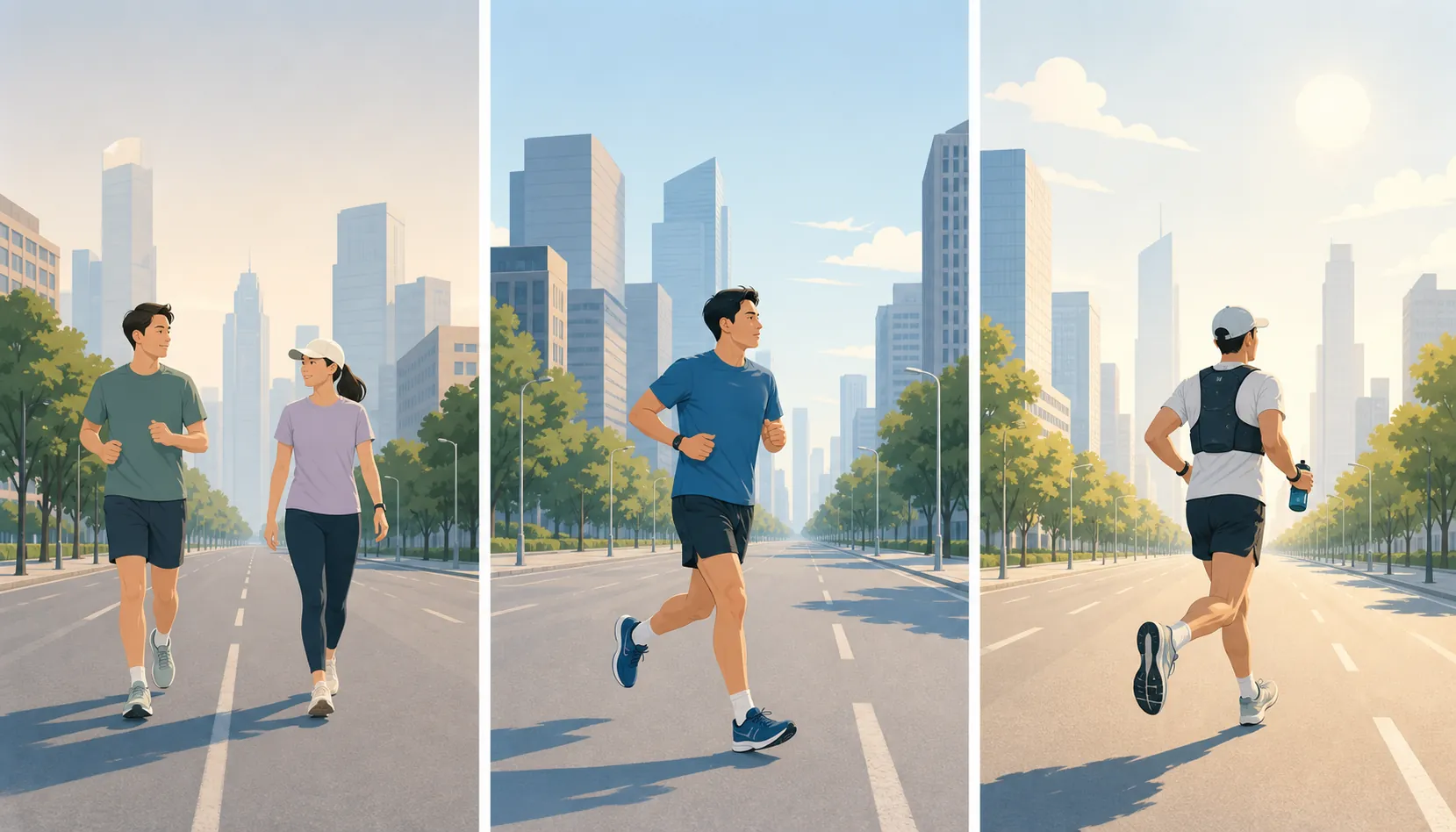
If you are not entering the NYRR 5K, use the same north-south discipline rather than wandering the whole event. Start early, choose a flat stretch where you are comfortable returning to the same point, and keep the workout short enough that you finish before the corridor fills.
- Warm up with 10–15 minutes of easy walking or relaxed jogging.
- Repeat 1 minute running and 1 minute brisk walking 6–10 times.
- Cool down with 10–15 minutes easy.
- Turn around before the run intervals start feeling like a test you need to pass.
That 1:1 run/walk structure comes from coach-authored interval guidance, not from Summer Streets itself, and it is a good fit here because it gives a new runner frequent chances to reset posture, breathing, and lane awareness.[5] On this corridor, a walk break is also traffic management. It lets faster runners and cyclists clear out before you start the next minute.
Keep the beginner route boring on purpose. Park Avenue in the upper 70s through low 100s is more useful than trying to sample the whole event. If you want a simple non-race version, start near East 80th after checking the day’s DOT flyer, head north at an easy effort, and use a timed turnaround rather than chasing an exact map distance. Fifteen to twenty minutes out, then back, is a cleaner first session than getting pulled farther north because the street still looks open.
Intermediate: run tempo by effort, because the signals will not care about your split
The intermediate runner gets the most out of Summer Streets by separating effort from pace. Nike’s tempo-run guidance describes tempo intensity around RPE 7 out of 10, or roughly 75–85% of maximum heart rate, with options such as 10–20 minute tempo blocks or a 4-by-1-mile progression with 2-minute recoveries.[6] That is the right kind of workout for this corridor because you can preserve the effort even when the street forces a pause.
Use the first 10–15 minutes as a real warm-up, not as the first part of the tempo. You need time to see how crowded the lane is, where bikes are moving, and whether the intersections are breaking your rhythm. A community account from an earlier Summer Streets noted that cross-street traffic lights still operated along the route; because that is not the same as a current DOT operational promise, check the 2026 community flyers before you go and assume major cross streets may still interrupt you.[8][2]
| Tempo option | How to run it on Summer Streets | Best for |
|---|---|---|
| 2 x 10 minutes at RPE 7 | Run north for the first block, jog or walk 3 minutes, then return south for the second block. | A first tempo day on the corridor |
| 1 x 20 minutes at RPE 7 | Use only if the lane is open enough that you are not surging around people. | Steady runners comfortable with effort control |
| 4 x 1 mile progression | Run each rep by feel, use 2-minute easy recoveries, and let signals pause the rep rather than forcing a sprint afterward. | Runners building toward continuous tempo |
The mistake is trying to “make up” time after a red light or a dense block. That turns tempo into repeated accelerations, which is a different workout and a worse one in a mixed-use public corridor. If you use heart rate, remember that heat and cardiac drift can push numbers up even when pace stays modest; if you use RPE, keep the effort at controlled-hard, not race-day annoyed. For runners calibrating effort indoors and outdoors, heart-rate tracker basics pair well with this kind of session.
Advanced: long-run the corridor, but do not outsource planning to the open street
The advanced version is the most attractive and the easiest to misread. Brooklyn Bridge to Dyckman sounds like a clean Manhattan long run, and the corridor is long enough to support serious volume. But because the official materials give endpoints rather than a certified mileage number, the smart plan is not “run the whole thing.” It is “choose the long run duration, choose the northern turnaround, and carry enough fluid that the route’s sparse public water does not become your limiting factor.”[1][2][3]
Start at 7am if this is a workout, not a sightseeing run. A northbound start from the Brooklyn Bridge area gives you the psychological benefit of moving with the corridor before it fills, but it also commits you to a long return if you keep extending. A start farther uptown can be more rational if your target is 12–16 miles rather than the full one-way experiment. There is no prize for proving that an estimated route is longer than your bottle.
- For 8–10 miles: choose a mid-corridor out-and-back and finish before the event reaches full density.
- For 12–16 miles: start at 7am, carry fluid, and set a time-based turnaround before the run begins.
- For 18-plus miles: treat Summer Streets as only part of the long run unless you have confirmed water, shade, and exit options.
- For marathon-pace segments: run them early, keep them short, and abandon pace targets if signals or crowding force surges.
The NYRR 5K’s listed fluid station between East 109th and East 108th is useful information even if you are not racing, because it shows how specific and limited verified water details can be.[4] Summer Streets has rest stops and programming zones, but unless you have checked the current DOT map for that Saturday, do not build a long run around assumed water every few miles. Carry a handheld, belt, or vest, and know where you can leave the corridor if the day stops being productive.
Heat is the other limiter. Princeton Sports & Family Medicine describes heat acclimation as a gradual process that generally takes about 10–14 days, with attention to hydration and stopping when heat-stress symptoms appear.[7] A 7am start lowers the risk; it does not erase August. If the hourly forecast is ugly, use a shorter route, move the quality work indoors, or skip the hard layer entirely. The same decision logic behind hourly weather run planning applies here, even though the road is closed to cars.
A clean advanced Summer Streets run might look like this: 15 minutes easy, 70–100 minutes steady aerobic running, optional short marathon-effort blocks only while the lane is open, then an easy finish back toward your exit point. If you are deep in a marathon build, the corridor can replace part of a long-run route, not the recovery habits around it. Cross-training and at-home strength work from an apartment-friendly marathon plan may matter more the next day than squeezing one more northbound mile out of Broadway.
The conditions that override the workout
The corridor is free and rain or shine, but a workout still has go/no-go rules.[1][2] Crowd density changes the run first. If you cannot hold a line without weaving, downgrade speed work to easy running. If you are running with a beginner, move to run/walk earlier rather than asking them to thread through traffic. If you are carrying pace expectations from a normal road workout, leave them at home.
Heat changes the day second. If you have not had gradual hot-weather exposure, do not use Summer Streets as your acclimation experiment and your long run at the same time. Symptoms that point toward heat stress are not training data to push through. For a more conservative framework, the indoor heat rules in heat-wave workout safety are useful because they force the same choice this route does: train, modify, or stop.
Signals change execution third. Treat a red light or managed crossing as a forced recovery, not as an insult to the workout. For tempo, pause the rep mentally and resume the same effort. For a long run, let the stop happen and keep the overall intensity easy. For a beginner 5K, use the stop to check breathing and form.
The best Summer Streets NYC running route is not the longest version you can draw on a map. It is the version that lets the planned session survive contact with August: early start, known turnaround, carried fluid when needed, and enough flexibility to let the open street be useful without pretending it is a racecourse.
References
- NYC DOT Announces Summer Streets Will Return to All Five Boroughs, NYC Department of Transportation, July 10, 2026
- Summer Streets, NYC Department of Transportation
- Summer Streets Will Stretch from Brooklyn Br. to W. 200th St., West Side Spirit
- NYRR Start Line Series Manhattan, New York Road Runners
- Interval Running: Guide, Benefits, and Helpful Apps, Gymshark
- What Is Tempo Running — and How Can It Make You Faster?, Nike
- Heat Acclimation and Running: Unlocking Your Summer Training Potential, Princeton Sports & Family Medicine
- NYC Summer Streets, Samway Explores
What a small equipment investment adds
We don't have a build tagged to this exact tier yet. Browse all builds.
How often should you repeat this?
See our recovery and rest reference for citation-anchored rest-interval guidance.
Spot something off?
Tell us if a movement, tier assumption, or duration didn't match your experience.