
How to Work Out Safely at Home in a Heat Wave Without AC
Working out in a small, un-air-conditioned room during a heat wave carries real heat-stress risk, even indoors. You can train safely by cooling the room ahead of time, adjusting the session to the heat, and using clear stop signals to decide when to skip.
- Citation source
- CDC, National Weather Service, American Red Cross, Mayo Clinic
- Evidence level
- general guideline
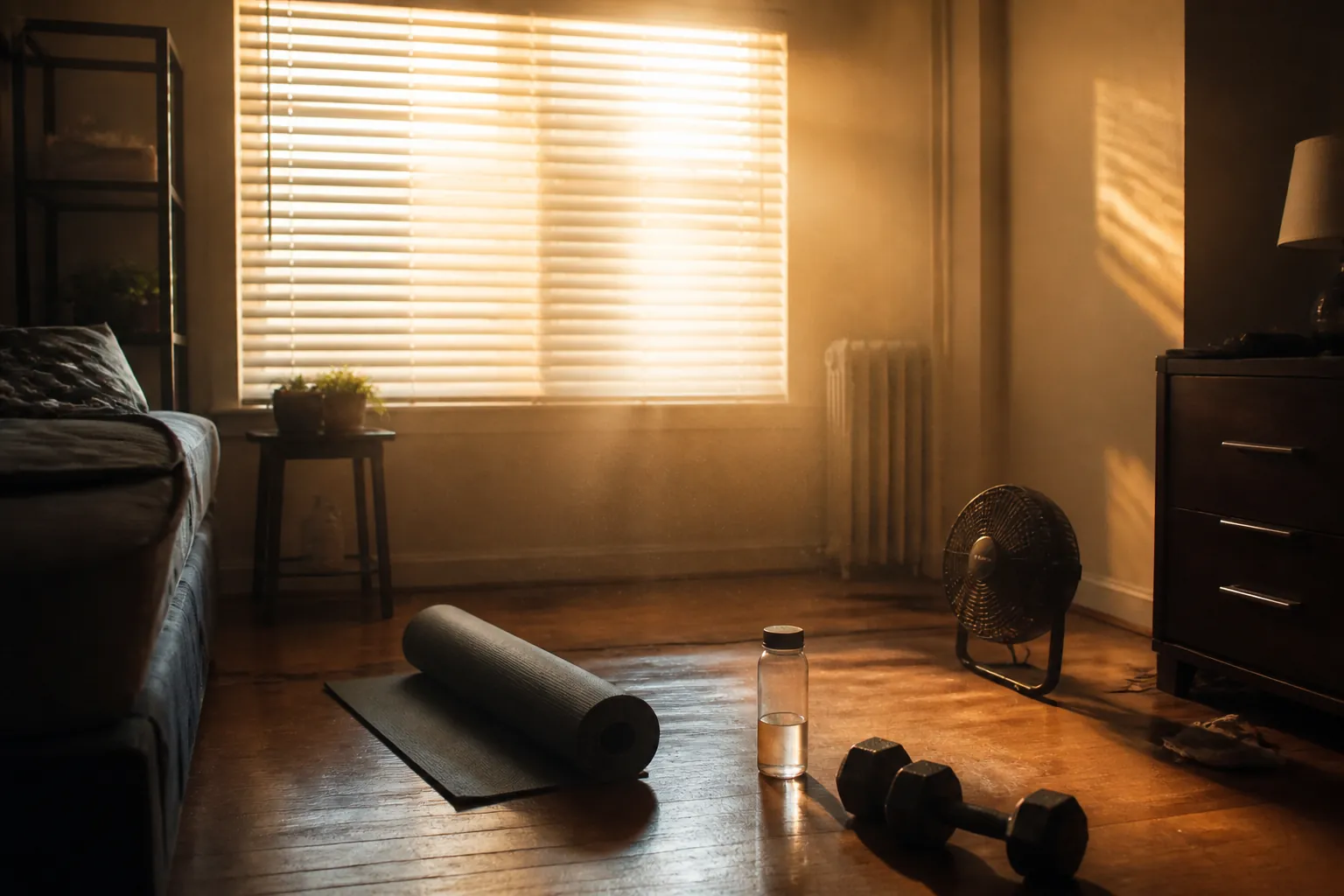
The awkward part of a heat-wave home workout is that the problem is already in the room before you start. The blinds have been glowing all afternoon, the mat is on a warm floor, the fan is mostly pushing the same air around, and “indoors” does not necessarily mean protected. BBC Future, citing University of Sydney heat researcher Ollie Jay, has reported that enclosed, low-airflow spaces can raise heat-stress risk during exercise, which is exactly the condition many small apartments create during a heat wave. [1]
So the safest answer is not “never train” and it is not “just hydrate and listen to your body.” Use a go/no-go system: check the heat index and timing, cool the room before you put on workout clothes, cut the session down, drink deliberately, understand what a fan can and cannot do, and stop early at specific warning signs.
Start with the decision, not the workout plan
Before choosing sets, reps, or intervals, look at the heat risk you are bringing into the session. Weather.com emphasizes heat index rather than air temperature because humidity changes how hard it is for the body to cool itself; it also flags about 90°F and above as an “extreme caution” range where moving exercise indoors or choosing lower-impact alternatives is advised, with roughly noon to 3 p.m. called out as the highest-risk peak-heat window. [2]
That does not automatically make a 6 p.m. bedroom workout safe. A small room can keep the day’s heat after the outdoor peak has passed. If the room still feels heavy, your skin is already hot before warm-up, or the fan is blowing warm air across you, treat the session as a heat-stress decision rather than a normal training day.
| Check | Train only if... |
|---|---|
| Timing | You are outside the worst heat window, or the room has genuinely cooled since then. |
| Room | Blinds were closed during the day, heat sources are off, and you have created some airflow or cooling before exercise. |
| Fan | You are not relying on a fan alone when official heat guidance says that may be unsafe. |
| Workout | The session is shorter, slower, and lower intensity than your usual plan. |
| Body signals | You are prepared to stop at faintness, weakness, confusion, or other heat-illness signs. |
Cool the room before you cool yourself
The best home-workout safety move may happen hours before the workout. In a no-AC apartment, room prep is not cosmetic; it changes the starting conditions. BU Today’s no-AC heat guidance includes keeping blinds or curtains closed during the day, ventilating at night when outside air is cooler, placing a bowl of ice in front of a fan, using a damp T-shirt or misted fabric, taking a cool shower, and unplugging electronics that add heat to the room. [3]
For renters, that list matters because it does not require drilling, rewiring, a portable AC exhaust panel, or a basement you may not have. The practical sequence is simple: block solar heat early, dump heat when the outside air is cooler, remove unnecessary heat sources, and then use water and air movement close to your body during the session.
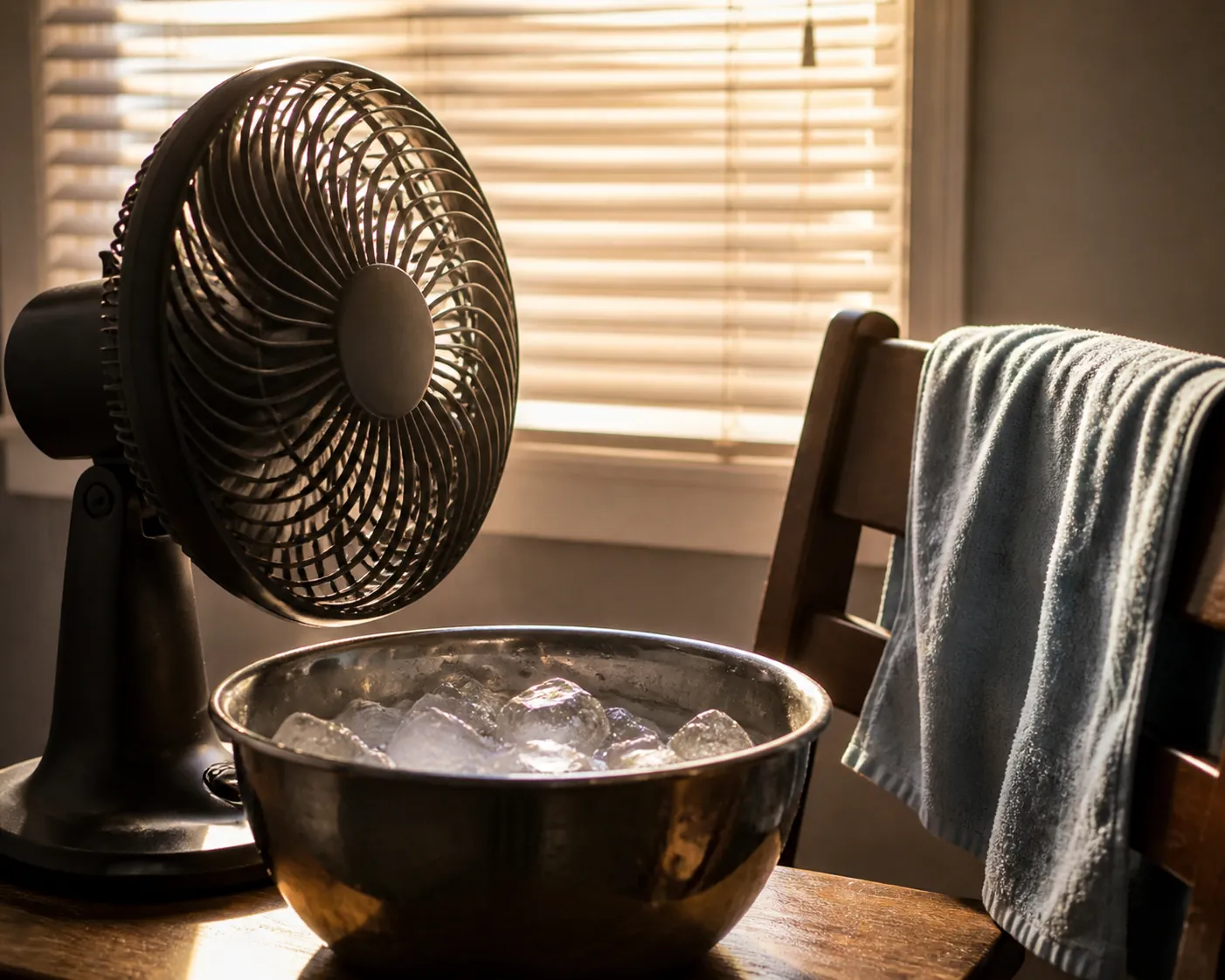
A useful no-AC setup before a short workout looks like this:
- Close blinds or curtains before the sun hits the workout room, not after the room is already hot.
- Open windows at night or early morning only if the outside air is cooler and safe to bring in.
- Turn off or unplug heat-generating electronics you do not need for the session.
- Take a cool shower before training if you are already overheated.
- Wear a damp shirt or keep a damp towel nearby for breaks.
- Place the fan where it moves air across you, not just around the far side of the room.
- Use an ice bowl in front of the fan as a short-term cooling aid, while recognizing that it does not turn the room into air conditioning.
The fan is a tool, not a safety guarantee
Fan guidance is often flattened into a single rule. The official sources do not state it the same way, and that difference is worth preserving. The NHS says electric fans can help when temperatures are below 35°C, about 95°F. [4] The National Weather Service warns that when the heat index is above the high 90s, a fan can make a person hotter instead of cooler. [5] The American Red Cross says not to rely only on fans in the high 90s. [6]
For a home workout, the conservative reading is this: a fan may help sweat evaporate when conditions are moderate enough, especially with damp cloths or misting, but it cannot be the only control in a very hot room. If the fan is blowing hot air and the heat index is in the range where weather and emergency agencies warn against relying on fans, the workout should shrink drastically or be skipped.
Hydrate on purpose, but do not make water the whole plan
Hydration helps, but it does not make a sealed hot room safe. Use the source-reported numbers as planning ranges, not as a personal guarantee. Bastyr Clinics recommends drinking 16–20 ounces, or 500–600 mL, two to three hours before exercising in hot weather. [7] NPR, citing Columbia’s Carol Ewing Garber, reports a during-exercise range of about 0.5–1 liter per hour in hot-weather exercise, with a sports drink suggested when exercise lasts longer than one hour. [8]
For a short home session, that usually means drinking before you start, keeping water within reach, and taking planned breaks rather than waiting until thirst turns urgent. NPR and the Red Cross also support using urine color as a practical hydration gauge: pale yellow is generally a better sign than dark urine. [8][6]
Avoid the bargain where you keep the original workout and try to compensate with more water. If the room is hot enough to strain cooling, the workout itself has to change.
Cut the workout before it cuts you off
During a heat wave without AC, the modified version is the real workout. The CDC’s heat guidance for athletes supports slowing pace, reducing intensity, taking breaks, and watching for heat-illness signs; weather.com and NPR also point toward lower-impact or adjusted exercise in heat. [9][2][8]
Make the edit before the first set. A reasonable heat-wave version might mean twenty minutes instead of forty, steady strength work instead of high-intensity intervals, longer rests between sets, fewer rounds, and no finishers. If you usually train to breathlessness, do not use that as the target in a hot room.
- Swap jump squats, burpees, and fast circuits for slower squats, hinges, wall push-ups, floor presses, carries, or mobility work.
- Use an interval timer for breaks, not just work periods.
- Keep the workout near the fan or airflow source instead of moving through the hottest part of the apartment.
- Stop chasing personal records, density blocks, or “one more round” goals during the heat wave.
- If you are an older adult, beginner, or training alone, make the session easier than you think you need.
If your original plan was intense, use a heat-friendlier routine instead of trying to rescue it. An older adult trying to maintain strength can use a gentler muscle-maintenance routine after 50. Someone who wants movement without equipment can choose a lower-intensity version of a living-room no-equipment workout by removing jumps, extending rests, and ending early.
Use breaks as cooling periods, not scrolling periods
In a hot room, a break should actively reduce heat strain. Sit or stand near airflow, sip water, wipe sweat with a damp towel, and let your breathing come down before starting again. BBC Future discusses practical cooling approaches such as rotating cold wet towels, hand or forearm immersion, misting, and ice slurry pre-cooling; NPR also discusses ice slurry as a hot-weather exercise cooling strategy. [1][8]
The American Heart Association recommends cold cloths to areas such as the neck, groin, and armpits as part of staying active in warm weather. [10] For home training, that can be as simple as keeping two damp towels in the refrigerator before the session and rotating them during rest breaks.
A break that does not cool you is just a pause in heat exposure. If each set feels harder even though the exercises are getting easier, or you need longer and longer to feel normal, that is not a mental toughness test.
Stop rules for a hot-room workout
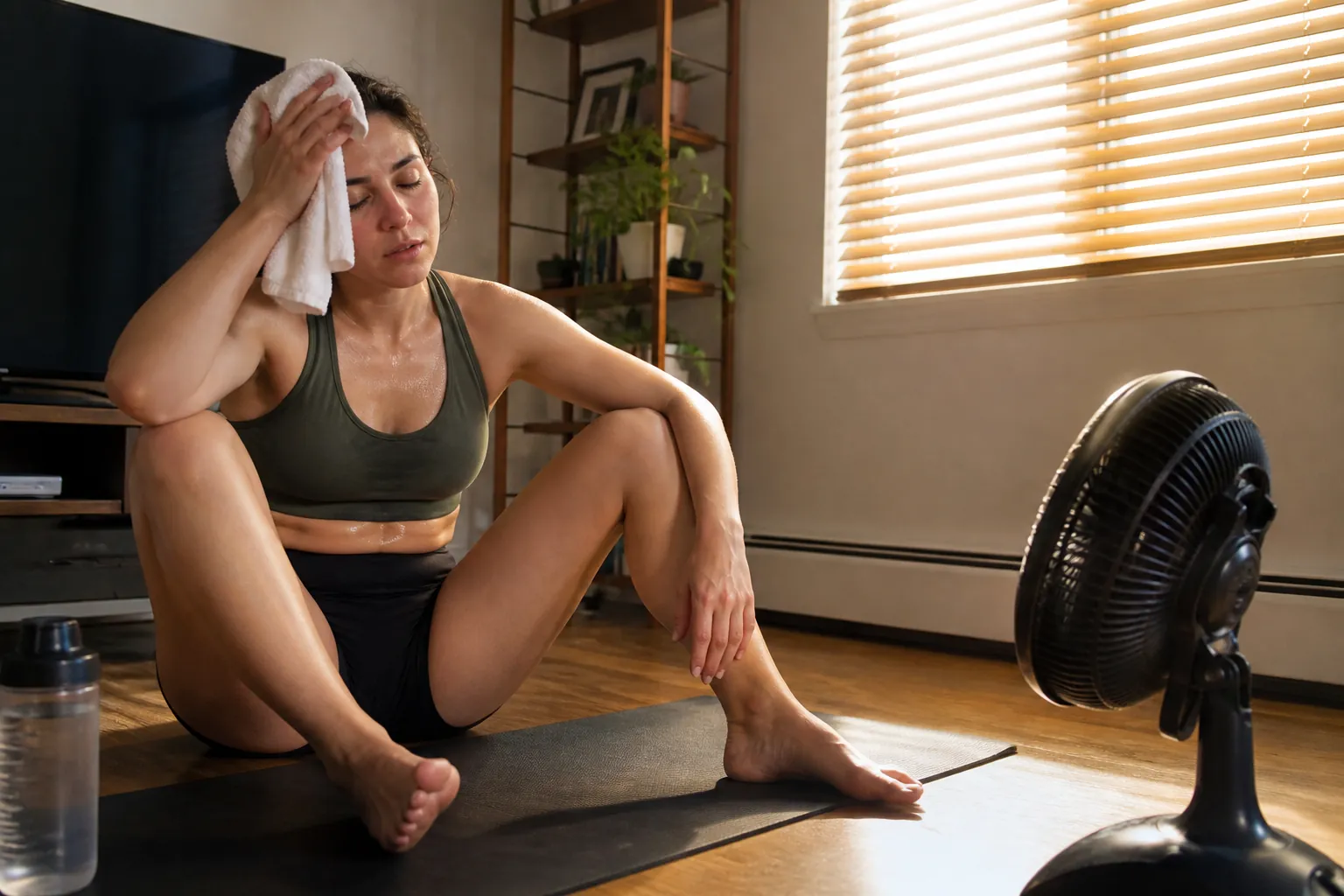
The CDC’s athlete heat guidance is blunt on one important point: faintness or weakness means stop and cool down. [9] At home, especially if you are alone, do not downgrade that into “take thirty seconds and see.” Stop the workout, sit or lie down somewhere cooler if possible, and start active cooling.
| Signal | What to do |
|---|---|
| Feeling faint, weak, unusually dizzy, or unable to continue normally | Stop the workout and cool down. Do not resume the session. |
| Heavy sweating with weakness, cool or moist skin, nausea, headache, dizziness, or muscle cramps | Treat as possible heat exhaustion: move to a cooler place, loosen clothing, sip fluids if able, and cool with water and airflow. |
| Confusion, seizure, loss of consciousness, or heat-stroke-level emergency signs | Call 911. Do not give fluids. |
Mayo Clinic’s first-aid guidance for heat exhaustion includes moving the person to a cooler place, loosening clothing, having them sip cool water or sports drink if they can, and cooling them with water, wet towels, or a fan; the National Weather Service gives similar heat-illness first-aid steps. [11][5]
Heat stroke is different. Mayo Clinic describes heat stroke as a medical emergency associated with a core body temperature around 104°F or higher, and Red Cross and National Weather Service guidance includes emergency signs such as confusion, seizure, or loss of consciousness; the response is to call 911 and not give fluids. [11][6][5]
This is where the workout ends. There is no safe home version of “finish the circuit and then deal with it.”
When skipping is the correct training decision
Skip the workout if the room has not cooled, the heat index is already in the range where official sources warn about fan limits, you have no way to create meaningful cooling breaks, or you are starting the session already lightheaded, weak, nauseated, or unusually fatigued. Skip sooner if you are older, new to exercise, training alone, or taking a medication or managing a health condition that affects heat tolerance.
Acclimatization is not an instant permission slip. Bastyr describes heat acclimatization as taking about 7–14 days, and the American Heart Association gives a range of 4–14 days for becoming more acclimated to hot-weather activity. [7][10] A sudden heat wave in an apartment that has been baking all day is not the moment to test the upper end of your capacity.
If you skip, keep the routine alive with something that does not add heat stress: gentle mobility, stretching, breathing work, or a short walk only if conditions are cooler and safe. Food, sleep, and recovery still count toward training continuity; for a broader recovery anchor, see nutrition and memory for home workouts.
A practical no-AC workout flow
If the checks point toward training, make the session deliberately small:
- Several hours before: close blinds, reduce heat sources, and plan a shorter session.
- Two to three hours before: drink ahead of time using a source-reported preload range as a guide, unless a clinician has told you to restrict fluids.
- Right before: check the heat index, room feel, airflow, water access, and your starting symptoms.
- During: move slowly, extend rests, cool actively, and keep water within reach.
- At the first stop signal: end the session rather than modifying it again.
- After: continue cooling, rehydrate, and avoid adding another heat exposure immediately afterward.
Training at home without AC during a heat wave can be possible, but only when the room is cooled first, the workout is shorter and easier than usual, fan limits are respected, and stop rules are treated as final. When those conditions are not there, skipping is not a failed workout; it is the safety system doing its job.
References
- How to keep exercising when it's really hot, BBC Future, June 2026
- Too Hot To Exercise? Here's How To Beat The Heat, weather.com, June 28, 2026
- How to Stay Cool With No AC, BU Today, July 2024
- Heatwave: how to cope in hot weather, NHS
- Heat Illness, National Weather Service
- Extreme Heat Safety, American Red Cross
- Beat the Heat: How to Exercise Safely and Stay Hydrated in Hot Weather, Bastyr Clinics, July 2025
- How to heat-proof your summer workout, NPR
- Heat and Athletes, Centers for Disease Control and Prevention
- How to Stay Active in Warm Weather, American Heart Association
- First aid: Heat exhaustion, Mayo Clinic
This is general fitness education, not medical advice. For diagnosis or treatment of pain or injury, consult a qualified clinician.
Pick your next session
Replicate Adrien Broner's 45-Day Transformation at Home
Adrien Broner's Locked-In-A-Thon shows that a boxing-style regimen with 2-3 daily sessions can produce visible results in 7 days. This article breaks down his actual routine and shows how to replicate it at home in a small space with minimal or no equipment.
5 Strength Exercises Noah Lyles and Sha'Carri Richardson Both Use
Discover the five strength movements that elite sprinters Noah Lyles and Sha'Carri Richardson both rely on, and get practical substitutions to perform them in a small home gym with basic equipment.
Your Weekly Home Workout Plan Inspired by 2026 USATF Results
Turn the energy of the 2026 USATF Outdoor Championships into a structured weekly home workout plan. This 6-day rotation, inspired by actual athletes and their performances, requires only bodyweight or minimal gear and fits in a small apartment.
Spot something off?
This content sits adjacent to health guidance — tell us if a citation or figure needs a correction.