
When should you do your indoor workout?
There's no universal best time for an indoor workout — the right slot depends on your goal, sleep habits, meal timing, and apartment noise limits. Here's the evidence on morning vs. evening training, plus a two-week test for finding a schedule you'll actually stick with.
- Equipment tier required
- none
- Duration
- 30 min
- Difficulty
- beginner
- Target area
- full body
The best answer to “when should you do your indoor workout?” is not a universal hour on the clock. It is the most repeatable window that still serves your goal, protects your sleep, fits your meals, and does not make your apartment situation worse.
If you need the short version: morning is often the cleanest habit slot because fewer things have had time to interfere; afternoon gives a modest edge for strength and power; evening can work well, especially for aerobic training, as long as it does not crowd bedtime; early and late indoor workouts should usually be quiet workouts.
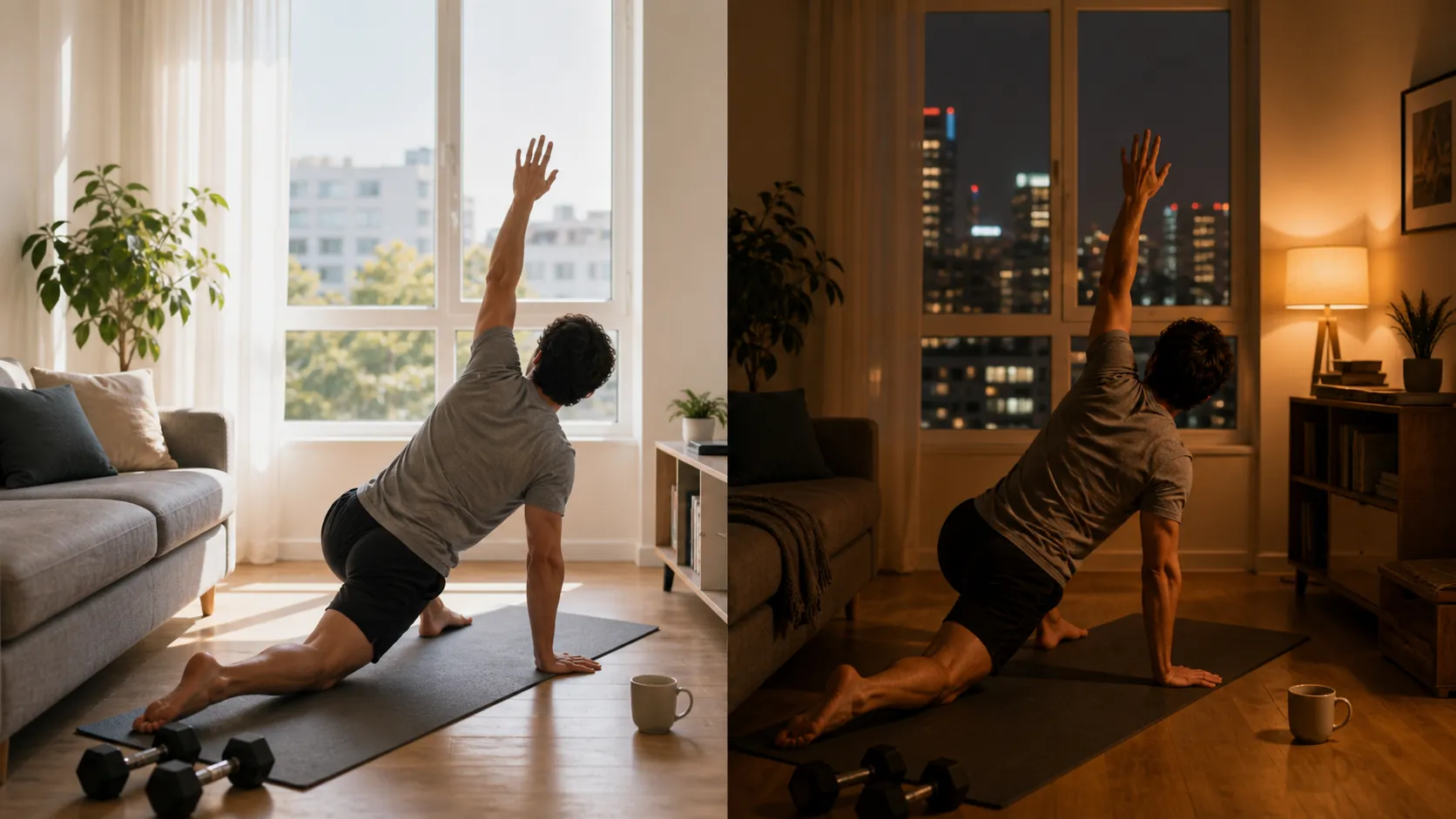
That answer may sound less satisfying than “train at 6 a.m.” or “lift at 5 p.m.,” but it is the one that survives contact with real homes: shared walls, dinner, kids, roommates, a downstairs neighbor, a hot apartment, and the fact that a workout you skip because the timing is perfect only on paper is not a useful workout.
Start with the slot you can repeat
Before chasing the best physiological time, decide when you can train on purpose instead of by accident. In a study of inactive adults with obesity, people assigned to fixed morning or evening exercise windows accumulated roughly three to four times more bouted moderate-to-vigorous physical activity than people allowed to choose freely when to exercise.[1] That does not prove that everyone needs a prescribed slot. It does make one point very hard to ignore: an actual window beats a vague intention.
For indoor training, the “best time” should pass four tests:
- Goal: does this time suit the kind of work you care about most — strength, cardio, mobility, weight management, or habit-building?
- Sleep: can you finish with enough runway before bed, especially if the session is vigorous?
- Meals: are you far enough from a large meal to avoid sluggishness, but not so underfed that the session feels flat?
- Apartment limits: can you do the planned movements without turning your workout into someone else’s ceiling noise?
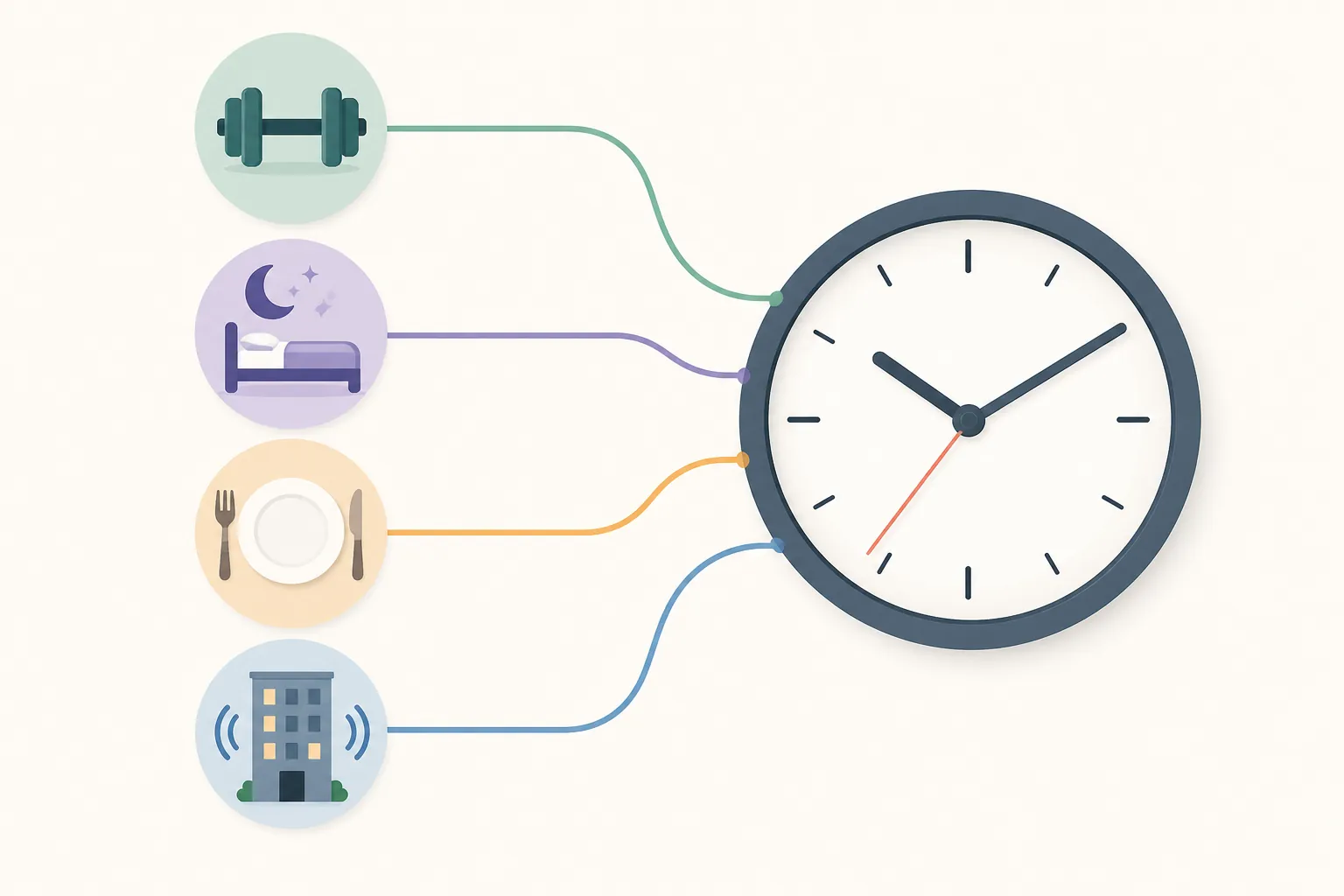
If one of those tests fails, the “ideal” time gets demoted. A 5:30 p.m. strength session may look great on paper, but if it regularly collides with dinner and household traffic, it is not your best slot. A 6 a.m. routine may be excellent for consistency, but not if it requires jumping over a neighbor’s bedroom.
Match the time to the job
Use your training goal as the first filter, then let sleep, meals, and noise narrow the choice.
| If your main goal is... | Start by looking at... | Why it may fit |
|---|---|---|
| Building the habit | Morning or another fixed low-conflict window | A protected slot reduces the odds that work, errands, or fatigue erase the workout. |
| Strength or power | Afternoon to early evening | Strength and power often run higher later in the day, but the edge is modest and not worth losing consistency over. |
| Aerobic fitness | Morning, afternoon, or early evening | Cardio is flexible; evening may be useful for some blood-pressure goals, but bedtime still matters. |
| Mobility, easy recovery, or quiet movement | Early morning or later evening | Low-impact work fits apartments better when other people are sleeping. |
| Fat loss or weight management | The window you can repeat most reliably | Consistency and total activity matter more than turning the clock into a personality test. |
Morning: best for getting it done
Morning works because it protects the workout from the rest of the day. If meetings, commute changes, caregiving, late meals, or simple decision fatigue keep knocking sessions off the calendar, a morning slot may be the most realistic answer.
The tradeoff is that early indoor workouts have two obvious constraints. First, they can be stiff and low-energy at the start, so a longer warm-up is not optional if you are lifting or doing intervals. Second, they are often the least forgiving for noise. A quiet strength circuit, mobility session, bike ride, or mat-based routine fits better than broad jumps, dropped dumbbells, or fast burpees before the building is awake. For a moderate morning template, the beat-the-Monday-blues home workout is closer to the right idea than a heroic dawn boot camp.
One indoor-specific caveat: a morning living-room workout does not give you the same circadian light signal as walking or training outdoors in daylight. If you are using morning movement partly to anchor your sleep-wake rhythm, open the blinds, get outside briefly when possible, or treat the indoor session as the exercise piece rather than the whole light-exposure solution.
Afternoon: the modest performance edge
If your indoor workout is built around strength, power, or hard intervals, afternoon has a real case. A literature summary from Science for Sport notes that morning-to-evening variation in strength and power commonly averages about 3% to 15%, with later-day performance often benefiting as core body temperature rises into the afternoon and early evening.[2]
That range is worth respecting, not worshiping. A person who can lift at 4:30 p.m. with a clear floor, some food in their system, and no neighbor issue may reasonably make that their main strength slot. A person who misses half those sessions because the day keeps overflowing should not keep sacrificing completed workouts for a possible performance bump.
Afternoon is also the most neighbor-friendly time for louder training in many shared buildings. If your program includes jump rope, step-ups, kettlebell cleans, racking plates, or anything that can thud through the floor, mid-day or early evening is usually easier to defend than dawn or late night.
Evening: useful, but bedtime has veto power
Evening training is not automatically a sleep disaster. For many people, it is the only calm window in the day. It can also be relevant for blood pressure, although the evidence needs careful handling. In a 10-week randomized trial discussed in a Chronobiology of Exercise review, evening aerobic exercise in middle-aged hypertensive men was associated with a larger post-exercise blood-pressure reduction than morning exercise — roughly 8 mmHg versus 4 mmHg.[3]
That is clinically interesting in that specific context. It is not a license to tell every healthy renter to do hard cardio at 9:45 p.m. The participants, health status, training mode, and study size matter. If blood pressure is one of your reasons for exercising, use this as a conversation starter with a clinician, not as a blanket rule that evening is superior.
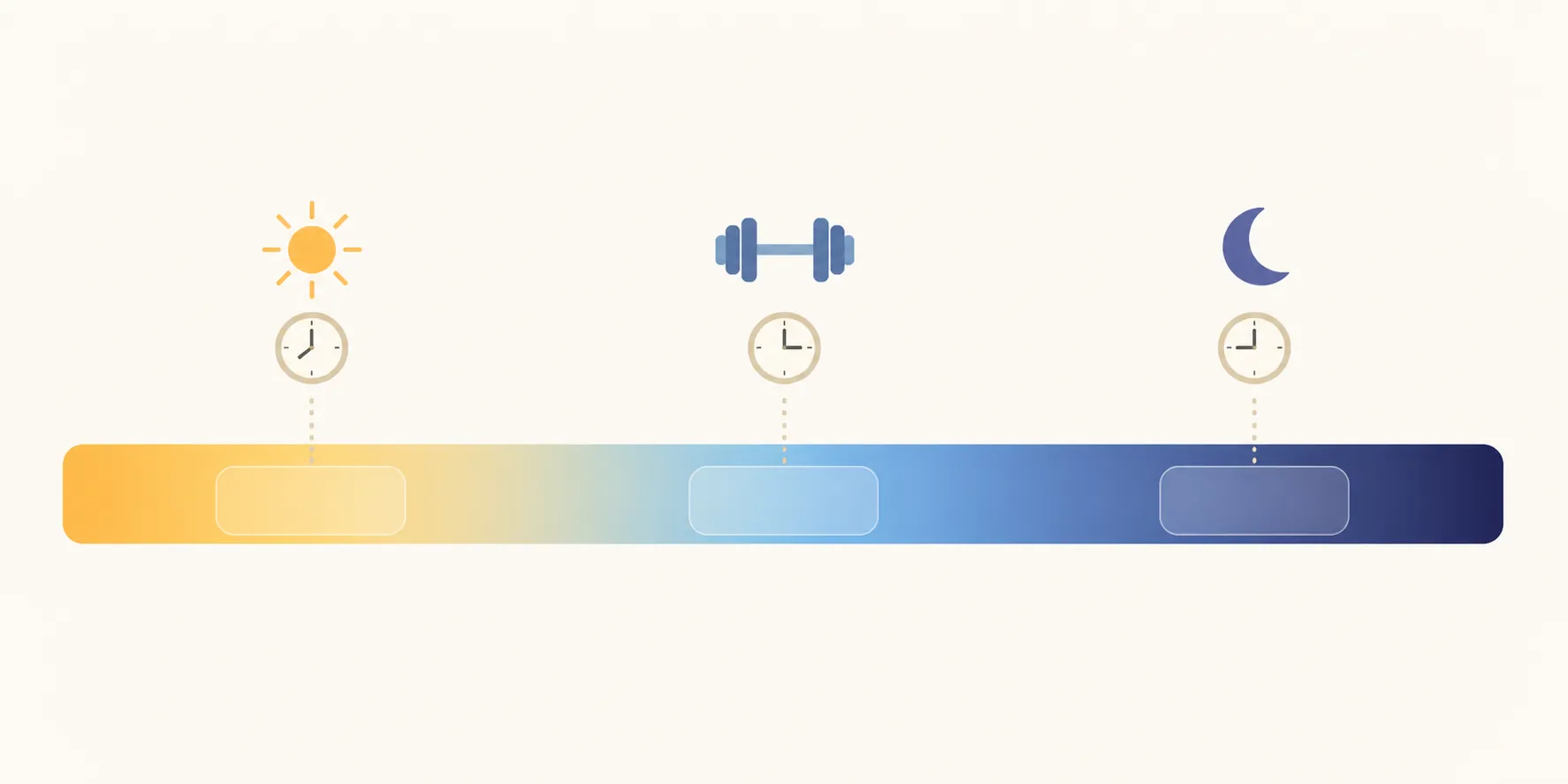
For ordinary scheduling, the practical evening rule is simpler: the later the session, the quieter and less stimulating it should become. Early evening can handle moderate cardio, strength, and intervals for many people. Late evening is better suited to walking pads, easy cycling, mobility, Pilates-style mat work, breathing-focused cooldowns, or quiet strength accessories.
Protect sleep before you optimize performance
Sleep is the filter that can overrule every other timing argument. A large 2025 Nature Communications analysis of about 4 million person-nights of WHOOP data found a dose-dependent relationship between later, higher-strain exercise and delayed sleep. In one comparison, maximal versus light strain ending 2 hours before bed was associated with sleep onset about 36 minutes later.[4]
That dataset is impressive because of its size and its concrete sleep-delay signal, but it is observational, not a controlled trial. The paper also includes WHOOP-affiliated co-authors, which is worth noting because the data come from the platform’s users. The useful takeaway is not “never exercise at night.” It is that hard, late workouts deserve suspicion if your sleep timing starts sliding.
Guidance varies because intensity, fitness level, and individual sleep sensitivity vary. Cleveland Clinic advises avoiding exercise too close to bedtime and gives roughly an hour as a minimum buffer for many people.[5] Northwestern Medicine suggests finishing exercise 2 to 3 hours before bed when sleep is the concern.[6] Sleep Foundation’s synthesis says moderate exercise ending at least about 90 minutes before bedtime is generally less likely to interfere with sleep, while also noting that vigorous late exercise can be more disruptive; Sleep Foundation is affiliate-funded, so it is best treated as a practical synthesis rather than a neutral guideline authority.[7]
For a home schedule, use this working cutoff:
- Hard intervals, heavy lifting, or high-strain circuits: aim to finish about 2 to 4 hours before your usual bedtime.
- Moderate steady cardio or moderate strength: try to finish at least about 90 minutes before bed, then watch your own sleep.
- Mobility, easy walking, light cycling, or gentle core work: late evening may be fine if it helps you unwind and does not become a second wind.
The sign that your slot is too late is not moral failure; it is data. If you lie awake longer, push bedtime later, wake more often, or need more caffeine the next day, move the workout earlier or lower the intensity.
Fit the workout between meals, not on top of them
Meal timing does not need to become a spreadsheet. It just needs to prevent two familiar indoor-workout problems: training so soon after dinner that every plank feels like a mistake, or training so underfed that the warm-up feels like the workout.
Mayo Clinic’s practical timing is a good starting point: eat large meals at least 3 to 4 hours before exercise, small meals or snacks 1 to 3 hours before exercise, and a meal with carbohydrate and protein within about 2 hours after training when possible.[8]
| Your likely workout time | Meal adjustment that usually works |
|---|---|
| Early morning | If you feel fine fasted, keep it light to moderate or short. If you feel weak or dizzy, try a small snack before training. |
| Lunch hour | Avoid a large meal immediately before. Use a snack beforehand, then eat lunch after. |
| Late afternoon | A small snack 1 to 3 hours before can help strength or interval sessions feel less flat. |
| After dinner | Leave enough time after a large meal, or make the workout quieter and easier if dinner ran late. |
If you train late and still need food afterward, keep the recovery meal simple enough that it does not turn into a second dinner that delays sleep. The healthy recovery meals under $5 guide has examples that are more useful here than another lecture about protein timing.
Let the apartment decide what kind of workout belongs in the slot
Indoor timing is not just about your body clock. It is also about the building. Renter and apartment-fitness advice commonly treats early morning before about 9 a.m. and late evening after about 10 p.m. as times to avoid noisy exercise, though these are practical heuristics rather than legal standards; actual quiet hours depend on the lease, building rules, local ordinances, and neighbor tolerance.[9][10]
That distinction matters. The goal is not to invent universal apartment law. It is to avoid choosing a time that makes the workout socially expensive. Once a downstairs neighbor is waiting for the next thud, your routine has a new problem.
| Time window | Better indoor choices | Usually worth avoiding |
|---|---|---|
| Early morning | Mobility, quiet strength, resistance bands, controlled dumbbell work, low-impact cardio | Jump rope, burpees, broad jumps, dropped weights |
| Mid-day or early afternoon | Heavier equipment, impact work, intervals, step-ups, louder transitions | Anything that conflicts with your own work calls or household schedule |
| Early evening | Strength, cardio, circuits, skill practice, moderate impact if the building allows it | Workouts that run so late they squeeze dinner or bedtime |
| Late evening | Walking, easy cycling, stretching, Pilates-style mat work, quiet accessories | High-impact cardio, clanging weights, intense finishers |
If your only available slot is early or late, change the movements instead of abandoning the session. Swap jumps for step-backs, running-in-place for marching intervals, burpees for incline walkouts, and fast transitions for controlled tempo work. The indoor practice drills and no-jump apartment workouts pieces are useful movement libraries for those substitutions.
For shared homes, the best workout time may require an actual conversation before it requires a better program. If equipment lives in a living room or hallway, use the same household-negotiation approach from the weight-loss home routine discussion guide: agree on what space is blocked, when noise is acceptable, and what happens if the plan starts irritating everyone else.
Use weather and room temperature as boundary conditions
Indoor workouts dodge rain, smoke, and icy sidewalks, but the room still matters. In an uncooled apartment during summer, the afternoon strength edge may be irrelevant if the space is hot and stagnant. Morning can become the better hard-cardio window simply because the room is cooler.
This does not need to turn into a separate heat-safety plan every time you schedule squats. Just treat temperature the same way you treat noise: a filter that can override the default. For weather-based timing decisions, the site’s NYC weekend running decision guide is the same kind of thinking applied outdoors.
Run a two-week timing test
Once you have a likely window, test it instead of debating it indefinitely. Two weeks is long enough to expose the obvious problems: the dinner collision, the bedtime creep, the neighbor issue, the 3 p.m. energy dip, or the morning slot that actually feels easier after day four.
Pick one slot and hold it within about 30 minutes for the test. If you choose 7:00 a.m., your workout starts between 6:30 and 7:30. If you choose 5:30 p.m., keep it between 5:00 and 6:00. The point is not to become rigid down to the minute; it is to stop letting every day renegotiate the workout.
There is a physiology reason to give consistency some room. Researchers interviewed by NPR described work from the Esser lab showing that same-time training can shift muscle clocks in mice; after 3 to 6 weeks, training shifted mouse muscle clocks about 4 hours earlier and erased a morning performance gap. That work was discussed as preprint-stage research, and it is mouse data, so it should not be inflated into a human scheduling command. The practical hint is gentler: your body may adapt to a regular training window, and clock alignment does not appear to require hitting the exact same minute every day.[11]
What to log
Keep the log boring. Boring logs get completed.
| Metric | How to record it |
|---|---|
| Workout start time | Write the actual start time, not the planned time. |
| Completion | Done, shortened, moved, or skipped. |
| Energy before training | Use a simple 1–5 score. |
| Session quality | Use a 1–5 score, or record one anchor number such as reps, load, distance, or pace. |
| Sleep that night | Note bedtime, how long it seemed to take to fall asleep, and whether sleep felt worse, normal, or better. |
| Meal fit | Note whether you felt hungry, heavy, nauseated, or fine. |
| Apartment friction | Note noise concerns, interruptions, equipment conflicts, or complaints. |
Use one anchor performance number only if it matches your goal. For strength, that might be the top set or total reps at a familiar load. For cardio, it might be time, pace, heart-rate response, or perceived effort. For mobility, it may simply be whether you completed the session without rushing. Do not build a laboratory around a living-room workout.
How to judge the result
At the end of two weeks, keep the slot if most of these are true:
- You completed most planned sessions without major rescheduling.
- Your sleep did not get later, shorter, or noticeably worse.
- Meal timing felt manageable without nausea, heaviness, or repeated low-energy sessions.
- The workout did not create recurring noise or space problems.
- Performance or session quality was stable enough for your current goal.
Adjust the slot if one filter keeps failing. Move it earlier if sleep is slipping. Move it later if morning stiffness or rushed starts keep shrinking the workout. Change the workout type, not necessarily the time, if the problem is noise. Add or move a snack if the issue is energy or digestion.
Only change one thing for the next test. If you move the session, change the workout, add caffeine, change dinner, and buy new equipment in the same week, you will not know what solved the problem.
A few defensible schedules
These are not rules. They are examples of how the filters work together.
| Situation | Likely best starting slot | Workout style |
|---|---|---|
| You keep missing workouts after work | Morning | Quiet strength, mobility, easy cardio, or a short repeatable circuit |
| You are prioritizing strength and have flexible afternoons | Afternoon | Heavier lifting, power work, or hard intervals |
| You can only train after work but sleep easily | Early evening | Strength or aerobic work with a clear cooldown and bedtime buffer |
| You can only train late at night | Late evening | Low-impact cardio, mobility, quiet accessories, or gentle core work |
| You live above someone and own heavier equipment | Mid-day or early evening when allowed | Heavier work during tolerant hours; quiet substitutions outside them |
| Your apartment overheats in summer | Morning or the coolest available indoor window | Hard cardio earlier; lighter work later if the room stays hot |
The cleanest answer is the one your log can defend: a repeatable indoor workout window, held within about half an hour, that does not steal from sleep, digestion, or neighbor tolerance.
References
- Timing of Exercise in Adults With Obesity Influences Bouted Moderate-to-Vigorous Physical Activity in a Randomized Trial — Translational Journal of the American College of Sports Medicine, 2023
- Exercise Timing: Does it Matter if you Workout in the Morning or Night? — Science for Sport
- Chronobiology of Exercise: Mechanisms and Adaptations — Comprehensive Physiology, 2022
- Effects of exercise timing, dose, and intensity on sleep in a large, global cohort — Nature Communications, 2025
- Is It Bad to Work Out Before Bed? — Cleveland Clinic
- The Right Time for Results — Northwestern Medicine
- Exercise and Sleep — Sleep Foundation
- Eating and exercise: 5 tips to maximize your workouts — Mayo Clinic
- Quiet please! How to exercise in an upstairs flat without annoying your neighbours — The Guardian, November 17, 2020
- Is It OK to Work Out in an Apartment Without Getting Evicted? — Bells of Steel
- How timing your exercise can help you sleep, lower your blood pressure and more — NPR, March 29, 2024
What a small equipment investment adds
We don't have a build tagged to this exact tier yet. Browse all builds.
How often should you repeat this?
See our recovery and rest reference for citation-anchored rest-interval guidance.
Spot something off?
Tell us if a movement, tier assumption, or duration didn't match your experience.