
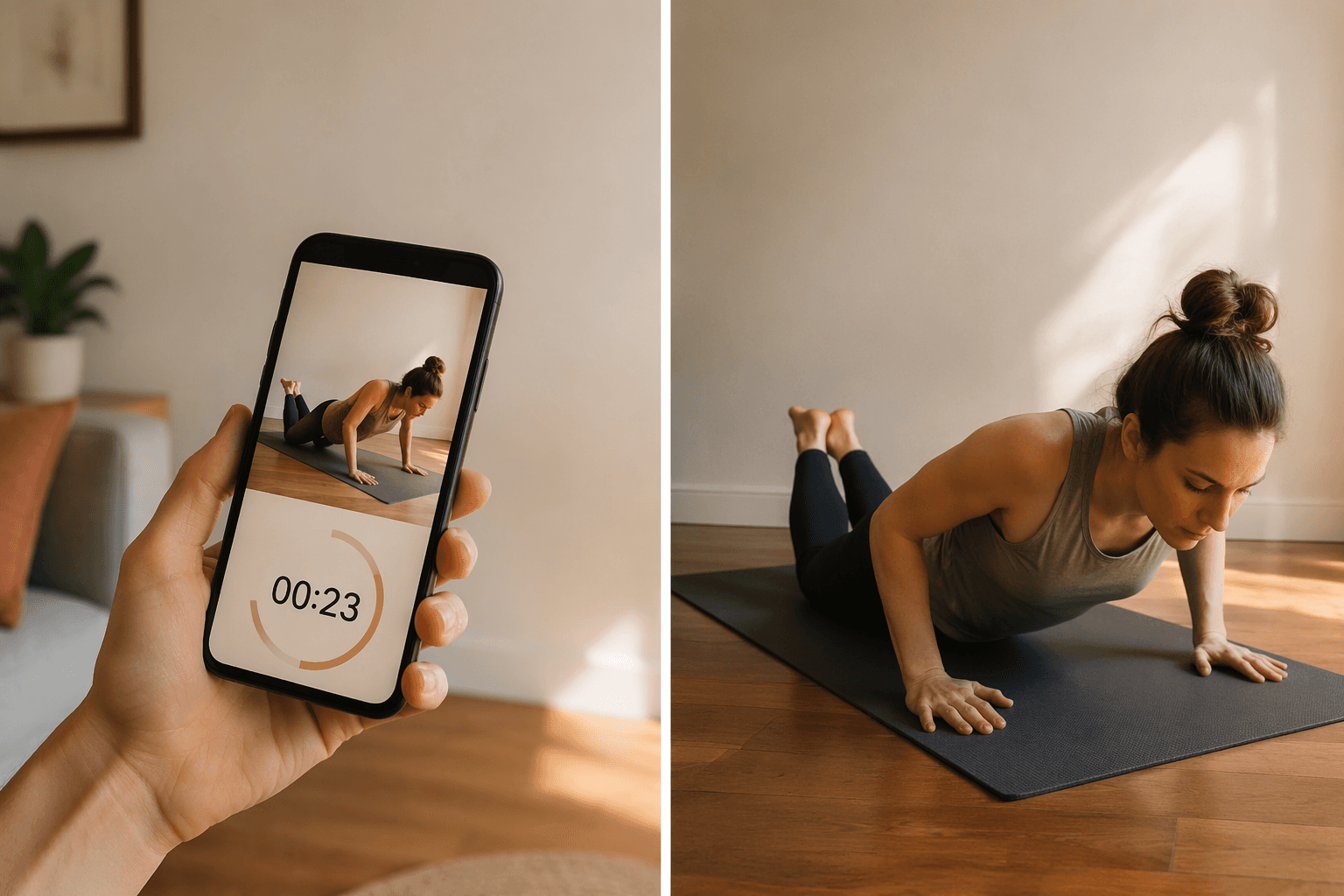
You search the App Store for "free workout app." You download one that looks good—good ratings, thousands of reviews. You open it, select a beginner program, and the screen reads: "Start your 7-day free trial." After a week, it’s $12.99 a month. The app was free to download, but not free to use.
I have downloaded dozens of these apps myself. I am tired of vague promises. So I went through the top workout apps that call themselves free and mapped out exactly what each free tier actually delivers—and where the paywalls sit. This is a transparency audit, not a ranked list. I name names and I give the prices.
A 2024 IHRSA survey found that 72% of pandemic-era fitness app users continued long-term, but only 34% felt they were getting good value from their subscription. Most people keep paying, but most are not happy about it. Reddit threads fill with the same complaint: apps that claim "free" but force upgrades for basic features like custom routines or video instruction. The gap between the label and reality is wide, and beginners get burned hardest.
Three Apps That Actually Mean Free
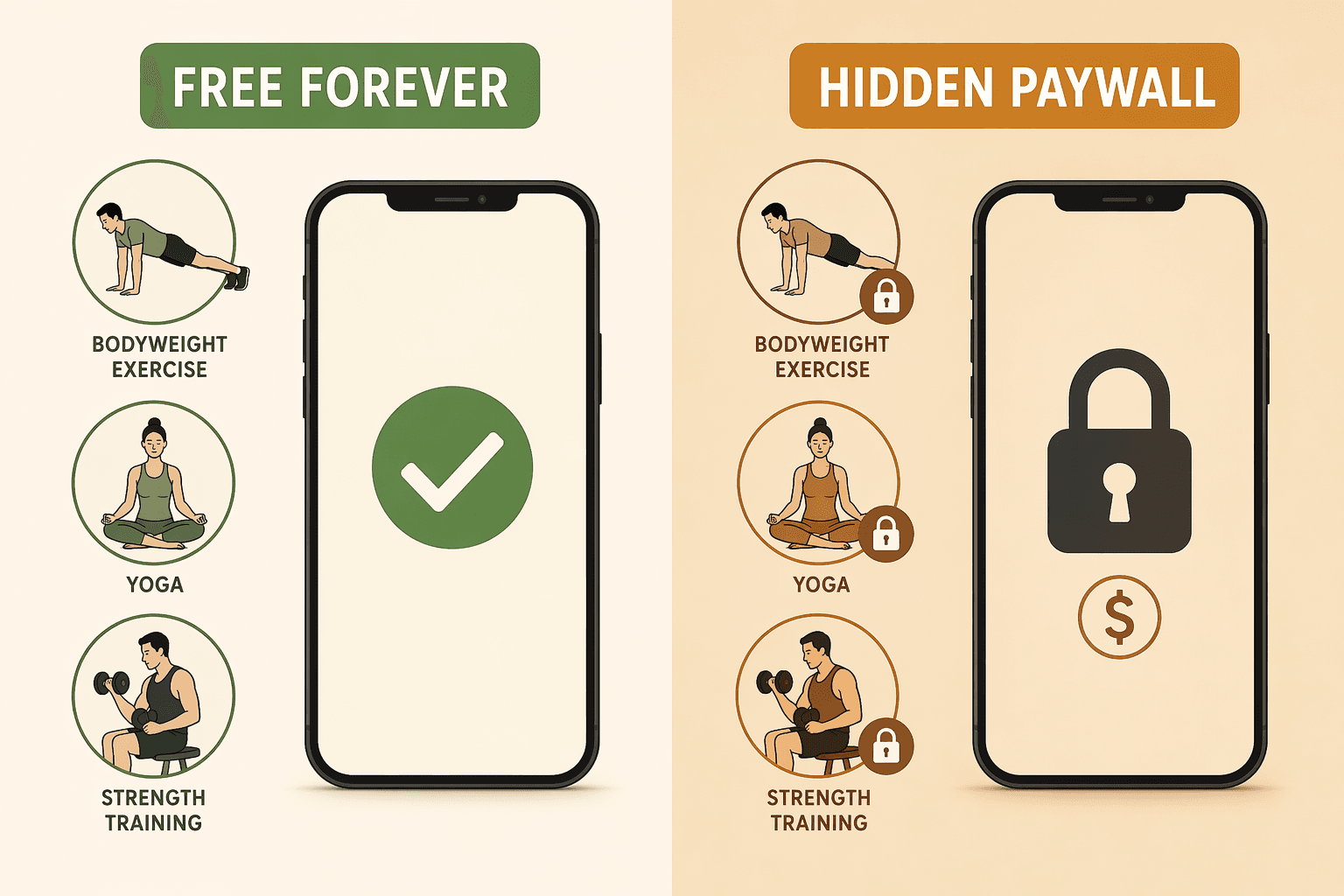
Not all "free" is the same. A handful of apps are genuinely free forever—no premium tier, no subscription required. The rest are free to download but gate their core features behind a paywall or a trial. Below are the two groups. Only three apps have no paid upgrade path.
| Truly Free (No Premium Tier) | Free-to-Download (Paywall or Trial) |
|---|---|
| Nike Training Club — 300+ workouts, all access | Caliber — free exercise library, $200/mo coaching |
| Gymshark Training — guided tutorials, custom plans | FitOn — free workouts, Pro $30/yr for offline & meals |
| Alo Wellness Club — 3,000+ yoga/Pilates/barre classes (free since Dec 2025) | Boostcamp — 1,000+ free strength plans, Pro $14.99/mo |
| Jefit — 1,400+ exercises with ads, Elite $12.99/mo | |
| Strava — free GPS, Premium $11.99/mo | |
| Hevy — free logging, Pro $2.99/mo | |
| Strong — limited to 3 custom routines, premium $4.99/mo | |
| Freeletics — 20 bodyweight workouts free, $124.99/yr |
If you want a workout app that will never ask for a credit card, stick with the first column. The rest are usable without paying, but you will hit limitations. For a feature-by-feature breakdown of the truly free options, see our comparison of best free workout apps in 2026.
Paywall Audit: What Each App’s Free Tier Actually Delivers
Here is the core of this investigation: exactly what you get for free from each app and exactly where the paywall appears. Prices were current at the time of writing, but check the App Store for the latest. I also note any pricing discrepancies between sources.
Truly Free Apps
Nike Training Club — confirmed completely free across all sources. Over 300 workouts including strength, HIIT, yoga, and mobility. No premium tier exists. Garage Gym Reviews called it the only truly free app in their test of 12. PCMag named it the best overall workout app.
Gymshark Training — completely free with no hidden fees, according to Forbes Health. Offers guided exercise tutorials and custom workout plans.
Alo Wellness Club — became completely free in December 2025 (previously $20/month). CNET and Good Housekeeping both confirmed the change. Over 3,000 classes in yoga, Pilates, barre, and strength. No premium tier.
Free-to-Download Apps with Paywalled Features
Caliber — free version has 500+ exercises with no ads and personalized plans (Garage Gym Reviews; Men's Journal says 600+). Premium coaching costs $200/month. Fortune lists a Plus tier at $72/year for nutrition tracking and coaching. So coaching ranges from $6/month to $200/month depending on package. The free tier is genuinely useful, but coaching is expensive.
FitOn — free version gives access to all workouts. Pro unlocks offline downloads, personalized meal plans, and exclusive content. Here is where the pricing gets confusing: Garage Gym Reviews reports Pro at $30/year, CNET says $25 for six months or $30 for a year, but Forbes Health lists $199.99 annually or $79.99 for six months. That is a huge discrepancy—$30 vs $200 for the same tier. I suspect Forbes is quoting a now-defunct or region-specific price, but I cannot verify. Check the current price in the app before buying.
Boostcamp — 1,000+ free strength training plans. Pro ($14.99/month or $79.99/year) adds advanced analytics like volume tracking and progression graphs. The free tier is strong for following programs. Paywalled: analysis and custom plan building.
Jefit — free version has a database of 1,400+ exercises and a training log but shows substantial ads. Video demonstrations are locked behind Elite ($12.99/month or $69.99/year). Garage Gym Reviews and Forbes Health agree on the free features. The paywall is one of the most aggressive: without paying, you are stuck with ad-heavy basic logging.
Strava — free version tracks basic running and cycling with GPS. Premium ($11.99/month or $79.99/year, per Garage Gym Reviews; CNET says $12/month or $80/year) adds advanced analysis, route building, and segment leaderboards. The free tier is usable for casual runners but lacks the social and analytical depth that makes Strava popular. Paywalled: training logs, fitness/sleep insights, and weekly reports.
Hevy — free version includes workout logging, progress charts, and a community feed. Pro ($2.99/month, $23.99/year, or $74.99 lifetime from Garage Gym Reviews) unlocks unlimited custom routines, advanced graphs, and data export. The free tier is generous; the Pro price is low enough that many users might not mind paying.
Strong — free version limits you to saving three custom routines. Premium ($4.99/month or $29.99/year from Forbes Health) removes the limit and adds advanced tracking features. If you want more than three routines—which most people do—you have to pay.
Freeletics — free version offers 20 HIIT bodyweight workouts, 25 exercises, and 20 audio sessions. Premium ($124.99/year from Forbes Health) unlocks the full program library and personalized coaching. The free tier is very limited; after 20 workouts you are done unless you upgrade.
Subscription Costs at a Glance
When 72% of users keep paying but only 34% feel they get good value, the subscription market is clearly broken. The table below shows what each app charges for its premium tier, so you can decide whether the upgrade is justified.
| App | Premium Monthly | Premium Yearly | Lifetime |
|---|---|---|---|
| Caliber (Coaching) | $200 | $72 (Plus) | N/A |
| FitOn Pro | N/A | $30–$199.99 (discrepancy) | N/A |
| Boostcamp Pro | $14.99 | $79.99 | N/A |
| Jefit Elite | $12.99 | $69.99 | N/A |
| Strava Premium | $11.99 | $79.99 | N/A |
| Hevy Pro | $2.99 | $23.99 | $74.99 |
| Strong Premium | $4.99 | $29.99 | N/A |
| Freeletics Premium | N/A | $124.99 | N/A |
Hevy’s $2.99/month or $74.99 lifetime is a no-brainer if you use the app regularly. Jefit’s $12.99/month is hard to defend when Nike Training Club offers video-guided workouts for free. And FitOn’s muddled pricing should make you cautious—I would not trust any stated price until you confirm it inside the app. For a deeper look at whether any premium tier is worth your money, see our free vs paid workout apps comparison.
I am not the only one who finds this pattern infuriating. A Setgraph analysis of Reddit discussions found that the most common complaint across beginner fitness subreddits is apps that claim to be free but force paid upgrades for basic functionality. "I downloaded a 'free' app and I can't even build a custom workout without subscribing," is a recurring theme. Meanwhile, expert testers—Garage Gym Reviews, CNET, and Good Housekeeping—arrive at the same conclusion. Of the twelve apps Garage Gym Reviews tested, only one (Nike Training Club) was completely free. The rest all had a paid upgrade path. The frustration is not anecdotal; it is structural.
Before You Download: A Quick Filter
You do not need to waste time downloading and testing. Use this checklist before you hit install, and you can filter out the deceptive apps in seconds.
- Check the "In-App Purchases" section in the App Store. If you see subscription prices listed, the app is not fully free.
- Look for phrases like "7-day free trial" or "limited free tier." These are trials, not free apps.
- Search the app name plus "free tier review" on YouTube or Reddit. Real users will say how much is actually free.
- Check whether basic features like custom routines, video instruction, or ad-free experience require payment. If core features are locked, it is not free.
- Watch for auto-renewal. I could not find reliable information on cancellation policies for most of these apps. Treat that as a red flag—verify before you enter payment details.
For a deeper dive into the warning signs, read our guide: What 'Free' Workout Apps Don't Tell You — 5 Red Flags to Check Before Downloading.
My bottom line: start with Nike Training Club, Gymshark Training, or Alo Wellness Club. They are the only apps that actually deliver what the label promises. If you need a tracker, Hevy’s free tier is generous and its Pro price is fair. Otherwise, assume every “free” app will try to charge you—and verify before you trust.
Comments
Join the discussion with an anonymous comment.