
Free vs Paid Exercise Tracker Apps: What You Actually Get at Each Price Tier and When It's Worth Upgrading
Free exercise tracker apps meet 70–80% of users' needs, but many apps deliberately limit free tiers to push subscriptions. This guide exposes the artificial limitation trap and provides a structured decision framework to help budget-conscious fitness enthusiasts decide when paying actually solves a real problem.
The Subscription Economy in Fitness Apps: Why Every App Wants You to Pay Monthly
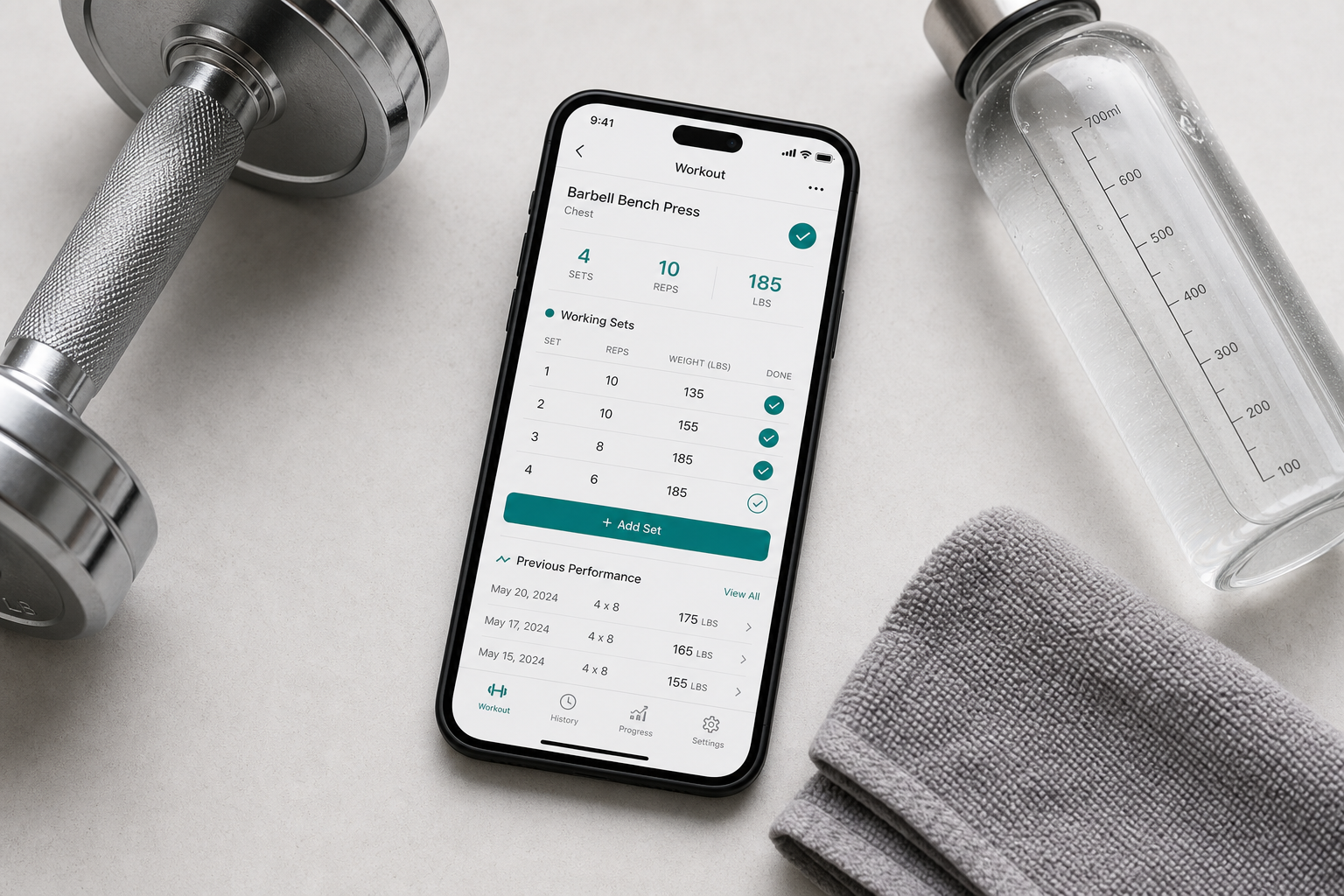
The fitness app market has undergone a quiet but profound shift. A decade ago, most workout trackers were one-time purchases or entirely free, supported by ads. Today, the dominant business model is the recurring subscription. Open the App Store or Google Play and you will find dozens of polished workout trackers, nearly all of them offering a free tier that feels just generous enough to get you started — and just restrictive enough to make you wonder if paying would be better.
This is not an accident. The subscription model is now the standard because it provides predictable revenue for developers and, in theory, ongoing value for users. But the reality is more complicated. Many apps deliberately design their free tiers to create artificial pain points — not because the features are expensive to provide, but because a slightly frustrating experience is the most effective way to convert a free user into a paying subscriber.
This article is not another feature-grid comparison. Our sister guide, Best Free Workout Apps 2026: What the Free Tiers Actually Include, already provides a detailed feature-by-feature audit of what each app offers at $0. Here, we focus on the decision psychology and economics: when does paying for a premium subscription actually solve a real problem, and when is it just responding to marketing pressure and manufactured scarcity?
What Free Apps Actually Give You: The Benchmarks That Set the Standard
Before we talk about what you might be missing by not paying, it is worth establishing just how much you get for free. The landscape has improved dramatically. Several apps now offer genuinely useful, full-featured free tiers that can support a consistent training practice indefinitely.
Hevy: The Gold Standard for Free Workout Tracking
Hevy has become the benchmark for what a free workout tracker should be. Multiple sources, including LoadMuscle and JEFIT's own comparison guide, describe Hevy's free tier as the most generous on the market. At $0, you get core workout tracking (sets, reps, weight, rest timers), progress graphs, social features for sharing workouts, and the ability to create and save routines. The free tier is not a demo — it is a fully functional logging tool that a consistent lifter could use indefinitely without ever feeling the need to upgrade.
Setgraph: Unlimited Free Logging with Advanced Tools
Setgraph takes a different approach. Rather than limiting features, it offers unlimited free logging with a complete per-exercise history and a built-in plate calculator — a genuinely useful tool for lifters who train with barbells. According to Setgraph's own guide, the app provides unlimited free logging with complete exercise history. The trade-off is that Setgraph is a newer, smaller app, so its community features and third-party integrations are less developed than Hevy's.
Nike Training Club: Entirely Free, No Premium Tier
Nike Training Club (NTC) occupies a unique position. Prior to 2020, it had both free and premium versions. Since the pandemic, Nike has made the entire workout library free to use. PCMag named NTC 'Best Overall' in its 2026 roundup, noting it is 'completely free.' Garage Gym Reviews similarly named it the 'Best Free Workout App' as of June 2026. NTC is not a logging tool — it is a guided workout library with certified trainers — but for users who want structured video workouts without paying, it is the clear winner.
FitNotes: Completely Free, But Android Only
FitNotes is the quiet workhorse of free workout tracking. It is completely free with no ads and no premium tier. The catch is significant: it is Android-only. Setgraph's guide confirms this limitation, noting that iOS users have no option to use it. For Android users who want a simple, ad-free logging experience with no subscription pressure, FitNotes is hard to beat.
| App | Free Tier Quality | Key Free Features | Platform Limitation |
|---|---|---|---|
| Hevy | Generous — best in class | Core tracking, progress graphs, social features, unlimited routines | None |
| Setgraph | Generous — unlimited logging | Complete exercise history, plate calculator, unlimited logging | Newer app, smaller community |
| Nike Training Club | Full — entire library free | Certified trainer video workouts, structured programs | Not a logging tool |
| FitNotes | Full — no premium tier | Ad-free logging, no subscription pressure | Android only |
The Artificial Limitation Trap: How Apps Cripple Free Tiers to Push Subscriptions
Not all free tiers are created equal. Some apps offer genuinely useful free experiences. Others deliberately design their free tiers to create friction — not because the restricted features are expensive to provide, but because a slightly frustrating experience is the most reliable conversion mechanism.
This is the artificial limitation trap. The app works well enough to get you invested, then introduces a hard constraint that has nothing to do with the cost of delivering the feature. The constraint exists solely to create a pain point that the premium subscription can relieve.
Strong: The 3-Workout Limit
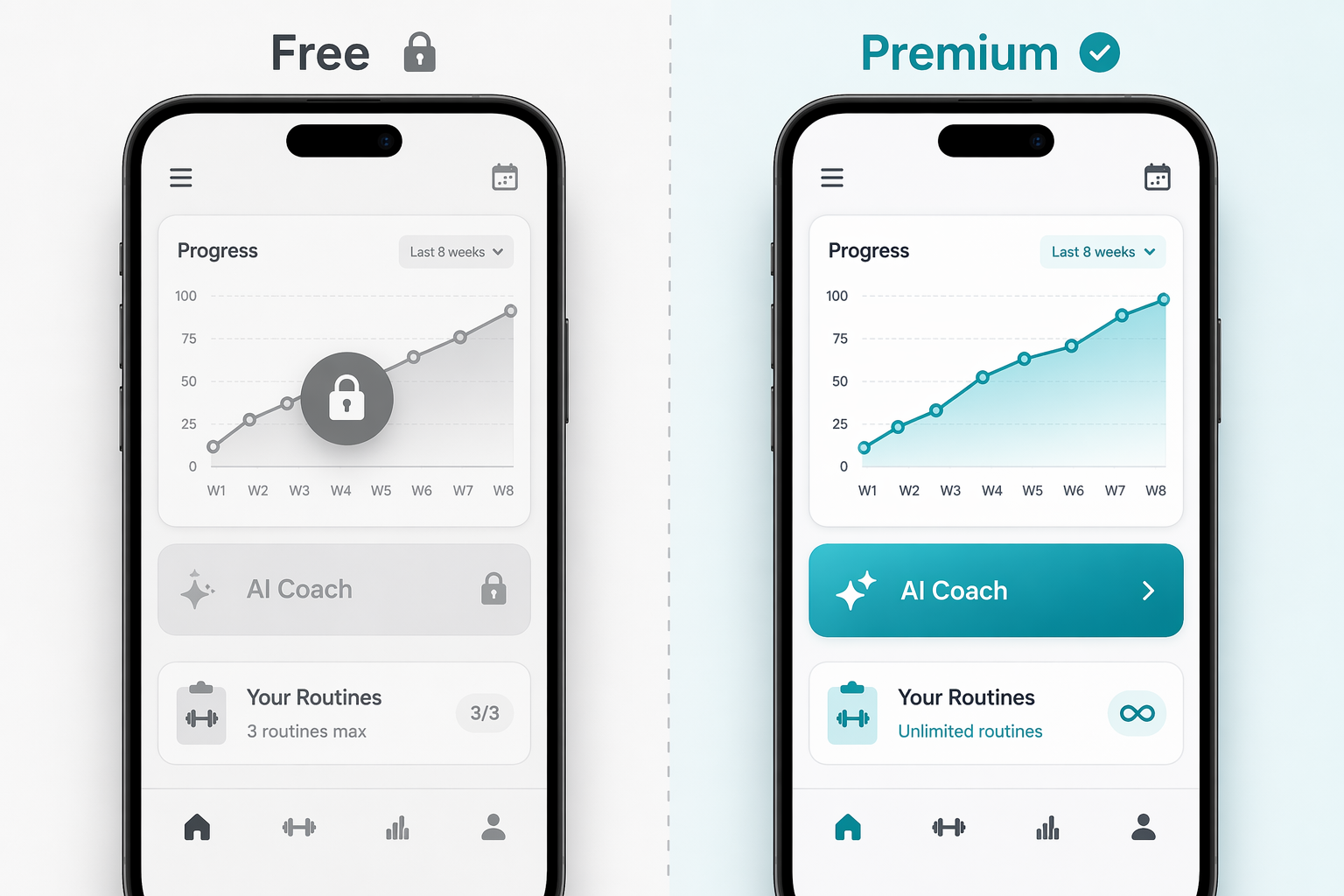
Strong is the most frequently cited example of the artificial limitation trap. Its free tier is limited to three saved routines. Setgraph's guide describes this as 'limited to 3 workouts.' JEFIT's comparison notes that the free tier is 'limited to 3 routines — quickly outgrown.' For a lifter who runs a simple push-pull-legs split, three routines might just barely work. For anyone who wants to vary their training, periodize their program, or save different phases of a plan, three routines is a hard ceiling that has nothing to do with the cost of storing a few extra text entries in a database.
JEFIT: Ad-Supported Free Tier
JEFIT takes a different approach. Its free tier includes full access to the 1,400+ exercise library, unlimited workout logging, and community routines. The limitation is not in functionality but in experience: the free tier is ad-supported. JEFIT's own guide confirms that the free tier includes full access to the exercise library and unlimited logging. For some users, ads are a minor annoyance. For others, they are a dealbreaker that makes the premium tier at $12.99/month feel like a necessary upgrade.
- Strong: Limits free users to 3 saved routines — an artificial constraint designed to push the $4.99/month subscription.
- JEFIT: Offers full functionality but shows ads in the free tier — the limitation is experiential, not functional.
- Hevy and Setgraph: Do not use artificial limitations — their free tiers are genuinely functional, and premium is positioned as an enhancement rather than a necessity.
What Premium Actually Adds: AI Planning, Advanced Analytics, and Data Export
Once you strip away the artificial limitations, what does premium actually buy you? Across the major apps, the premium tier typically unlocks a consistent set of features. Some of these are genuinely valuable for specific user profiles. Others are nice-to-haves that most users will never miss.
| Feature Category | What Premium Unlocks | Who Benefits |
|---|---|---|
| AI-powered programming | Auto-generated workouts based on your goals, history, and available equipment | Users who struggle to design their own programs or want variety without planning |
| Advanced analytics | Trend graphs, volume tracking, strength standards comparisons, periodization charts | Data-driven athletes who want to analyze long-term progress and identify plateaus |
| Data export | CSV or JSON export of all workout history | Users who want data portability or to analyze their training in external tools |
| Ad-free experience | Removal of banner and interstitial ads | Users who find ads disruptive to their workout flow |
| Unlimited routines/exercises | No cap on saved routines, custom exercises, or workout templates | Users who run multiple programs, periodize their training, or coach others |
| Coaching features | Form checks, personalized feedback, or access to certified trainers | Users who want guidance beyond what a logging tool provides |
Pricing varies significantly. Hevy Premium costs $2.99/month, making it one of the most affordable premium tiers. Strong Premium is $4.99/month. JEFIT Premium is $12.99/month. PCMag's buying guide advises that '$25 per month is too high' and that 'a good rate is between $10 and $15 per month' for a workout app. By that standard, Hevy Premium at $2.99/month is an exceptional value — but only if you actually need the features it unlocks.
When Free Is Enough: The 70–80% Rule
The most important question you can ask yourself is not 'What does premium offer?' but 'Do I actually need what premium offers?' For the majority of users, the answer is no.
The 70–80% estimate is not a precise scientific figure, but it reflects a pattern that emerges from the data. FitCraft's analysis cites a statistic from Business of Apps (2026) that 73% of fitness app users abandon free apps within 30 days. This is not a failure of the free tier — it is a reflection of the real challenge in fitness: consistency. Most people do not stop using an app because it lacks AI programming. They stop because they stop working out.
For users who have already built a consistent training habit and know their program, a free app like Hevy or Setgraph provides everything needed: a place to log sets, reps, and weights, a way to track progress over time, and the ability to save and reuse routines. Premium features like AI programming and advanced analytics are solutions to problems these users do not have.
When Premium Is Worth It: Solving Real Problems, Not Marketing Pressure
Premium subscriptions are not inherently bad. For certain user profiles, the features they unlock solve genuine problems that a free tier cannot address. The key is distinguishing between a real need and a manufactured one.
- You struggle with workout consistency and need AI programming to remove the friction of planning. If you find yourself skipping workouts because you do not know what to do, an app that generates workouts based on your goals and history can be a genuine consistency tool.
- You are a data-driven athlete who needs advanced analytics. If you periodize your training, track volume loads, and analyze trend data to identify plateaus, premium analytics features can provide insights that basic logging cannot.
- You run multiple programs or coach others. If you need unlimited routines, custom exercises, and the ability to switch between programs frequently, the artificial limitations of free tiers become a genuine constraint.
- You want data portability. If you plan to switch apps in the future or want to analyze your training data in external tools, premium data export features prevent vendor lock-in.
When evaluating premium, it helps to put the cost in context. FitCraft's cost comparison notes that a personal trainer costs $60–150 per session, a gym membership costs $40–60 per month, and a premium fitness app costs $5–30 per month. At $2.99–12.99 per month, a premium app subscription is a fraction of the cost of a single personal training session. If premium features genuinely improve your consistency or training quality, the investment is trivial compared to the alternatives.
Cost Comparison: What 8 Major Apps Charge and What You Get at Each Tier
The following table provides a structured comparison of eight major workout tracker apps, their free tier limitations, premium pricing, and key premium features. The 'Artificial Limitation' column flags apps that use deliberate feature restrictions to push subscriptions.
| App | Free Tier | Premium Price | Key Premium Features | Artificial Limitation? |
|---|---|---|---|---|
| Hevy | Generous — core tracking, progress graphs, social features | $2.99/month | AI workout generation, advanced analytics, data export | No |
| Strong | Limited — 3 saved routines | $4.99/month | Unlimited routines, advanced analytics, data export | Yes — 3-routine limit |
| Setgraph | Generous — unlimited logging, plate calculator | Not specified | AI features, advanced analytics | No |
| JEFIT | Full — 1,400+ exercise library, unlimited logging | $12.99/month | Ad-free, AI coaching, advanced analytics, data export | Yes — ad-supported free tier |
| FitNotes | Full — completely free, no ads | N/A | N/A | No — no premium tier exists |
| Nike Training Club | Full — entire library free | N/A | N/A | No — no premium tier exists |
| Strava | Generous — activity tracking, segments, social feed | $11.99/month or $79.99/year | Route planning, advanced analytics, training logs, beacon safety feature | Partial — some features locked |
| Apple Fitness+ | Not available — subscription only | $9.99/month or $79.99/year | Guided workouts, trainer-led sessions, Apple Watch integration | N/A — no free tier |
Hidden Costs: Wearable Requirements, Data Lock-In, and Platform Limitations
The price tag on a premium subscription is not the only cost to consider. Several hidden costs can affect your total cost of ownership and your long-term satisfaction with an app.
Wearable Hardware Requirements
Some apps require wearable hardware for full functionality. Apple Fitness+ is the most prominent example — it requires an Apple Watch to access certain features like real-time heart rate zones and burn bar metrics. If you do not already own the required wearable, the total cost of using the app includes the hardware purchase. This category of app is better evaluated within our Fitness Trackers content, where device-specific comparisons and subscription costs are covered in detail.
Data Lock-In: The Strong Problem
Data portability is an underappreciated cost. Setgraph's guide notes that Strong's 'data export requires premium subscription, which feels like holding your data hostage.' If you have months or years of workout history in an app and want to switch to a competitor, the inability to export your data without paying creates a switching cost that keeps you locked in. Before committing to any app, check whether data export is available on the free tier.
Platform Exclusivity
Platform limitations are another hidden cost. FitNotes is completely free and ad-free, but it is Android-only. If you are an iOS user, FitNotes is not an option regardless of how good its free tier is. Similarly, Apple Fitness+ is deeply integrated with the Apple ecosystem and offers limited functionality on other platforms. Always verify that an app supports your platform before investing time in it.
Decision Framework: Which App Tier Fits Your Profile?
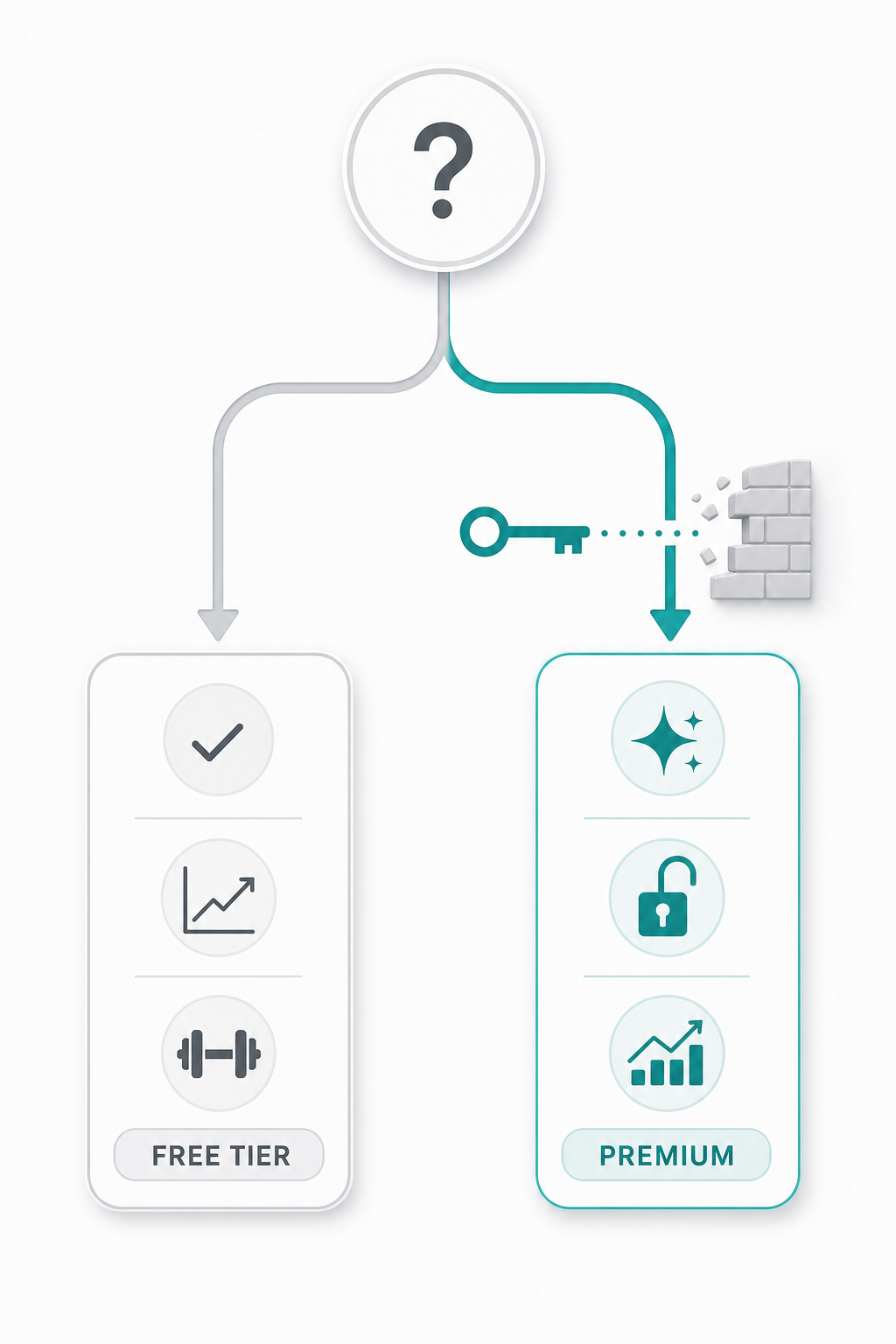
Rather than presenting a one-size-fits-all recommendation, the following decision framework routes you to the right app and tier based on your answers to three questions.
Question 1: Do You Know Your Program or Do You Need AI to Build It?
If you already have a program — whether from a coach, a book, or your own experience — you do not need AI programming. A free tier from Hevy, Setgraph, or FitNotes will serve you well. If you do not know what to do each workout and find yourself skipping sessions because of the planning burden, an app with AI programming (Hevy Premium, JEFIT Premium) may be worth the investment.
Question 2: Do You Need Advanced Analytics or Just Basic Logging?
Basic logging — recording sets, reps, and weights, and seeing progress over time — is available on every free tier. If you need trend graphs, volume tracking, strength standards comparisons, or periodization charts, you likely need a premium tier. Hevy Premium at $2.99/month is the most affordable option for advanced analytics.
Question 3: Are You on iOS, Android, or Both?
Platform compatibility is a hard constraint. FitNotes is Android-only. Apple Fitness+ is iOS-only and requires an Apple Watch for full functionality. Hevy, Strong, Setgraph, JEFIT, and Strava are available on both platforms. If you switch between devices or want the flexibility to use any device, choose a cross-platform app.
| Your Profile | Recommended App | Recommended Tier | Why |
|---|---|---|---|
| Consistent lifter with a known program | Hevy | Free | Core tracking and progress graphs are all you need |
| Beginner exploring different workout styles | Nike Training Club | Free | Entire video library is free; no logging needed |
| Data-driven athlete who analyzes trends | Hevy | Premium ($2.99/mo) | Advanced analytics at the lowest premium price |
| Android user who wants simple, ad-free logging | FitNotes | Free | Completely free, no ads, no premium tier |
| iOS user who wants AI coaching and programming | Hevy Premium or JEFIT Premium | Premium | AI features require premium; Hevy is cheaper at $2.99/mo |
| Multi-platform user who wants data portability | Hevy | Premium ($2.99/mo) | Data export available; affordable premium tier |
| User who runs multiple programs or coaches others | Hevy or Strong | Premium | Unlimited routines require premium on both apps |
Bottom-Line Recommendations per User Profile
The decision to pay for a workout tracker app should be driven by your specific needs, not by marketing pressure or artificial limitations. Here are the bottom-line recommendations for the most common user profiles:
- The consistent lifter who knows their program: Hevy free tier. Core tracking, progress graphs, and social features are all included. No need to pay.
- The beginner exploring different workout styles: Nike Training Club free. The entire video library is free, with certified trainers guiding every session.
- The data-driven athlete who wants trend analysis: Hevy Premium at $2.99/month. The most affordable premium tier with genuine analytics value.
- The Android user who wants simple, ad-free logging: FitNotes free. Completely free, no ads, no subscription pressure. The only catch is platform exclusivity.
- The iOS user who wants AI coaching and unlimited routines: Hevy Premium at $2.99/month or JEFIT Premium at $12.99/month. Hevy is the better value for most users.
- The user who values data portability and wants to avoid lock-in: Hevy Premium at $2.99/month. Data export is available, and the affordable premium tier means you are not trapped by sunk cost.
The bottom line is straightforward: pay only when premium solves a real problem you have identified. If an app's free tier feels artificially cramped, the solution is not necessarily to upgrade — it may be to switch to an app with a more generous free tier. The best workout tracker is the one you actually use consistently, and for the majority of users, that app costs nothing.
This result comes from one real apartment under the stated conditions — it is a strong signal, not a guarantee your space will measure identically.
Builds this evidence supports
No build currently links to this specific test. Browse all builds with a matching tag.
Spot something off?
If this result didn't match your own space, let us know — floor-damage and noise claims carry real deposit-risk consequences if we get them wrong.