
Home Gym Equipment for Beginners: What to Buy First (And What to Skip)
A constraint-based decision guide that helps absolute beginners choose the right home gym equipment based on their space, budget, fitness goal, and living situation — so you avoid wasting money on gear you don't need.
Every beginner home gym guide I read starts with a list of products. Best treadmills under $1,000. Best adjustable dumbbells. Best power racks. Those lists assume you already know what kind of training you want to do. If you are standing in an empty room wondering whether you need a squat rack or a rowing machine, a product list just makes the noise louder.
The real question: What is the best home gym equipment for my specific space, budget, goal, and living situation? Without answering that first, you are shopping blind. And shopping blind is how people end up with a $400 treadmill that collects dust in the corner and a set of dumbbells gathering cobwebs because they bought the wrong kind.
I am going to show you a different approach. Instead of a shopping list, we will walk through a decision tree. You answer four questions about your constraints, and the tree routes you to one of three starter blueprints. No guesswork, no overbuying, no regrets.
Four numbers you need before you open your wallet
Forget brands and model numbers. Start with four numbers that define what will work for you:
- Available floor space. A functional single-machine setup fits in as little as 80 square feet — about 8x10 ft. A more complete arrangement with a cardio machine and strength system works well in 120 to 150 square feet. Measure your room, not your imagination.
- Total budget. A budget gym setup costs between $300 and $1,000. That buys dumbbells, kettlebells, and budget cardio. A full home gym averages $1,500 to $2,500. The average gym membership runs about $65 a month ($780 a year). You have to decide what fits your wallet.
- Primary fitness goal. Are you after strength, general fitness, or cardio? Each goal favors different equipment. Adjustable dumbbells are the most versatile first purchase for strength and general training — they support presses, rows, squats, hinges, carries, and accessory lifts with very little floor demand.
- Living situation. Apartment, garage, shared walls, ceiling height. This is the constraint most beginners overlook. Ceiling height — not floor space — is the number that kills whole categories. Seven to eight feet is the minimum for most equipment; Smith machines and cable towers over 80 inches are non-starters in basements and many apartments. If you have downstairs neighbors, heavy deadlifts on concrete are out.
Once you have these four numbers, you can place yourself in one of three starter scenarios. If you have less than 100 square feet, budget under $600, strength as your primary goal, and live in an apartment — you are Blueprint A. Garage with 120+ square feet, budget $800–$1,500, general fitness, no ceiling issue — Blueprint C. Everything in between goes to Blueprint B.
Three starter blueprints (choose yours)
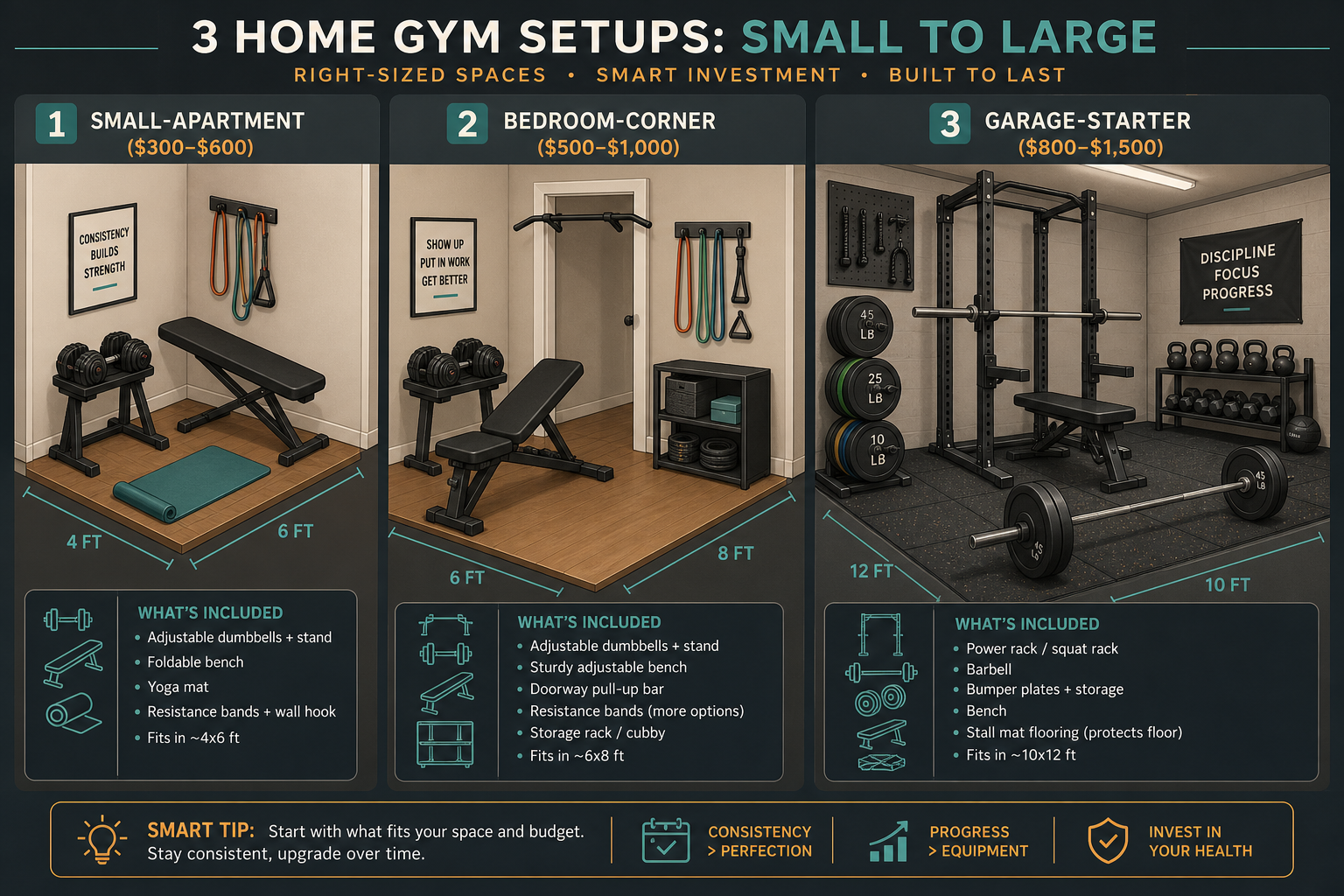
| Blueprint | Cost Range | Key Equipment | Footprint |
|---|---|---|---|
| A: Small-Apartment | $300–$600 | Adjustable dumbbells + bench + resistance bands + mat | ~4x6 ft corner |
| B: Bedroom-Corner | $500–$1,000 | Adjustable dumbbells + sturdier bench + doorframe pull-up bar + storage rack | ~6x8 ft |
| C: Garage-Starter | $800–$1,500 | Power rack + barbell + weight plates + bench + rubber flooring | ~10x12 ft |
Blueprint A: Small-apartment ($300–$600). This is the most common beginner scenario. Your best first purchase is a pair of adjustable dumbbells. The REP Fitness QuickDraw Adjustable Dumbbells start at $335.99 for a 30-lb pair and replace up to 12 traditional dumbbell pairs. Add a folding weight bench (~$100), a set of resistance bands (~$30), and a rubber mat (~$50 for a 4x6 ft stall mat from Tractor Supply). Total: about $515–$600. The entire setup fits in a 4x6 ft corner. Adjustable dumbbells alone support presses, rows, squats, hinges, and carries — most of what you need for strength and general fitness.
Blueprint B: Bedroom-corner ($500–$1,000). You have a spare corner in a bedroom or den, a bit more budget, and maybe a higher ceiling. Start with the same adjustable dumbbells and a sturdier bench (one that can handle decline and upright rows). Add a doorframe pull-up bar ($30–$50). Get a small storage rack for plates if you upgrade later. This setup gives you a full upper/lower split. The pull-up bar unlocks lat work and pull-ups, which dumbbells alone cannot cover well.
Blueprint C: Garage-starter ($800–$1,500). You have a garage or dedicated space, at least 120 square feet, and a budget that allows a real power rack. The REP PR-1100 Power Rack costs $380 and holds 700 lbs. Add a barbell ($150–$250), a set of bumper plates ($200–$400), a bench ($150), and rubber flooring (stall mats at $50 per sheet). Total around $1,200–$1,500. This setup covers squats, bench press, deadlifts, overhead press, rows — the entire strength foundation. If you have a single-car garage, our dedicated garage build guide walks through a complete setup.
A note on the numbers: the combination of adjustable dumbbells, bench, bands, and mat lands around $590–$740 when you avoid top-tier brands. That is less than a year of gym membership for many people, and you keep the equipment.
What to skip — and why each skip comes from your constraints
Most “mistakes” articles tell you not to buy a cheap barbell or an ab machine. The reason is usually vague: “quality issues.” I want to tie each skip directly to your constraints so you see why it matters for your specific situation.
- Budget treadmills under $500. Fitness Outlet says they are “almost universally built to standards not designed for consistent daily use — they wear out quickly.” But the real problem for beginners is that a treadmill under $500 eats floor space you could use for strength equipment. If your primary goal is strength or general fitness, skip the cheap treadmill entirely. If cardio is your goal, save for a used high-quality unit instead.
- Single-use ab gadgets. Ab wheels, sit-up benches, twist machines — they take up space and target one muscle group. Adjustable dumbbells can do ab work through carries, woodchoppers, and weighted crunches. In a small space, nothing single-use belongs.
- Cheap barbells under $100. A $80 barbell will bend, rust, or lose knurling inside six months. If you are building for strength, a barbell is a long-term investment. Skip the cheap one and either start with dumbbells or save for a decent bar ($150+).
- Oversized machines (Smith machines, cable towers over 80 inches) in small rooms. Ceiling height kills these before you even measure. If your room is under 8 ft, a cable tower is out. Even at 8 ft, you lose space for other gear. Stick to free weights.
- Resistance-band-only systems for strength goals. Yes, resistance bands can provide similar strength gains to weights — Cleveland Clinic confirms it. But for progressive overload (the foundation of strength training), bands plateau early. You need to add more bands, not just heavier ones, and the logistics get messy. If your primary goal is strength, buy adjustable dumbbells first, not a band set.
Two upgrades everyone should make (flooring and measuring your ceiling)
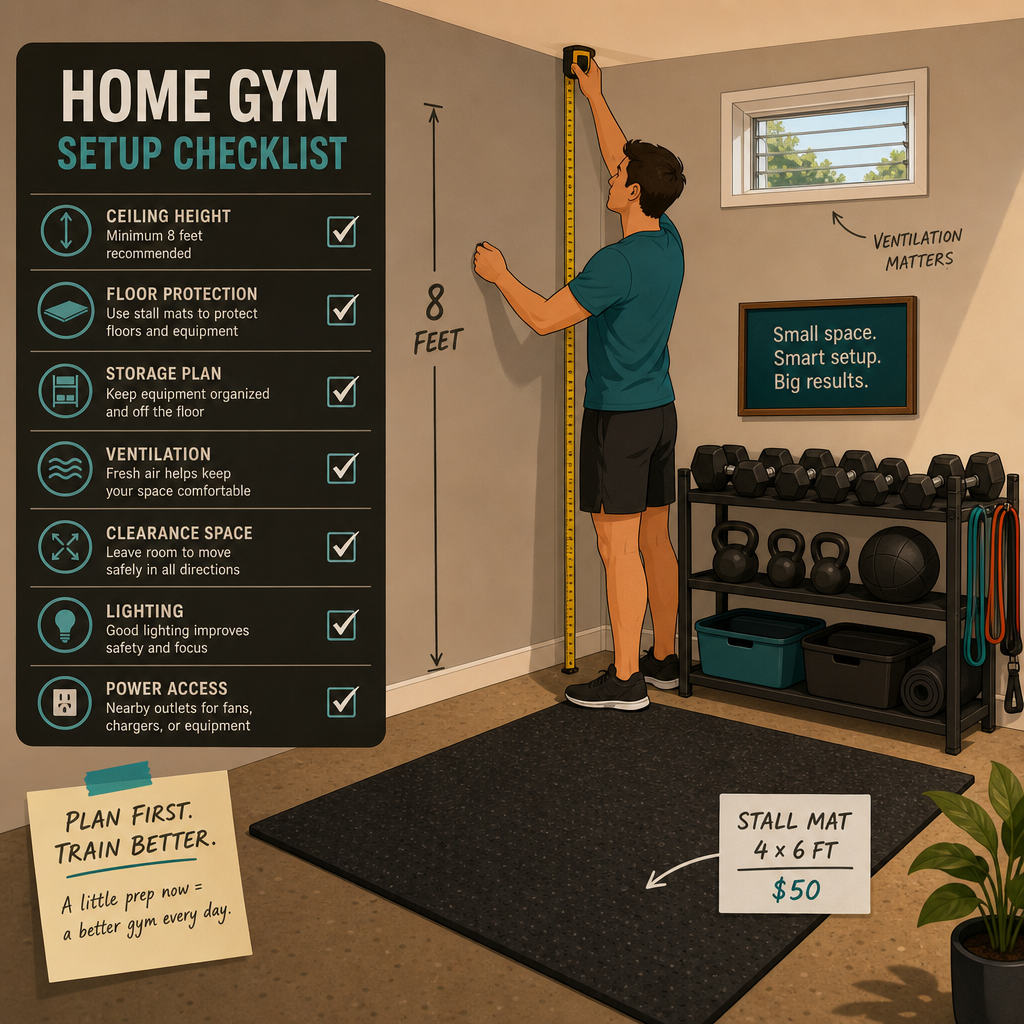
Before you assemble any gear, do two things that cost almost nothing but protect your investment and your living situation.
- Install rubber flooring. Stall mats from Tractor Supply cost about $50 for a 4x6-foot sheet. They protect the subfloor, reduce noise, and improve traction. RitFit calls rubber flooring “one of the smartest early upgrades.” For apartment dwellers, this is non-negotiable — it muffles dropped weights and keeps neighbors from complaining.
- Measure your ceiling height. I keep repeating this because it is the most overlooked dimension. Seven to eight feet is the minimum for most equipment. If you are in a basement or older apartment, measure before you buy anything that stands upright. A Smith machine that fits a standard room may be 82 inches and leave no clearance for your head during shoulder presses.
That is it. Two checks. Under $100 combined. They save you from the most common regret: gear that does not fit or damages the room.
What next? Phase-2 upgrades on a realistic timeline
Your starter blueprint is not your forever setup. It is the minimum viable gym that lets you start training today. Over the next few months, you can add pieces as your budget and space allow. Here is what to plan for, per blueprint:
- Blueprint A (apartment): Add a doorframe pull-up bar ($30). Then consider a folding weight bench that can sit against the wall when not in use. After that, a set of heavier adjustable dumbbells or a kettlebell.
- Blueprint B (bedroom-corner): Upgrade to a better barbell or add a folding power rack if your space allows. A lat pulldown attachment for the rack adds versatility. New plates as you progress.
- Blueprint C (garage): Add a lat pulldown and low row attachment for the power rack. A second set of plates for supersets. A landmine attachment. A heavy bag if you want cardio variety.
For a detailed phased expansion strategy after you have chosen your starter blueprint, see our Phased Buying Guide. It lays out step-by-step what to buy in year one, year two, and beyond. But remember: the blueprints above are starting points, not destinations. Build slowly, measure twice, and buy only what matches your real constraints.
This is general fitness education, not medical advice. For diagnosis or treatment of pain or injury, consult a qualified clinician.
Pick your next session
Browse all routines to find an appropriately-spaced next session.
Spot something off?
This content sits adjacent to health guidance — tell us if a citation or figure needs a correction.