
Matrix fitness equipment is worth the premium only when the treadmill will be used hard enough, long enough, or by enough people to make commercial-grade hardware matter. For a household with three regular users, a runner logging 20-plus miles a week, or an owner trying to keep the same treadmill for 10 years or more, Matrix has a real argument. For one casual walker who wants a nice machine for a few sessions a week, the same money is usually better spent elsewhere.
That is the uncomfortable part of the Matrix decision: the brand is genuinely premium, but premium is not the same as automatically rational. The useful question is not whether Matrix feels better than a mid-range treadmill. It usually does. The question is whether your household will use enough of that extra durability, warranty depth, serviceability, and subscription freedom to justify paying roughly two to three times what a capable NordicTrack or Sole might cost.
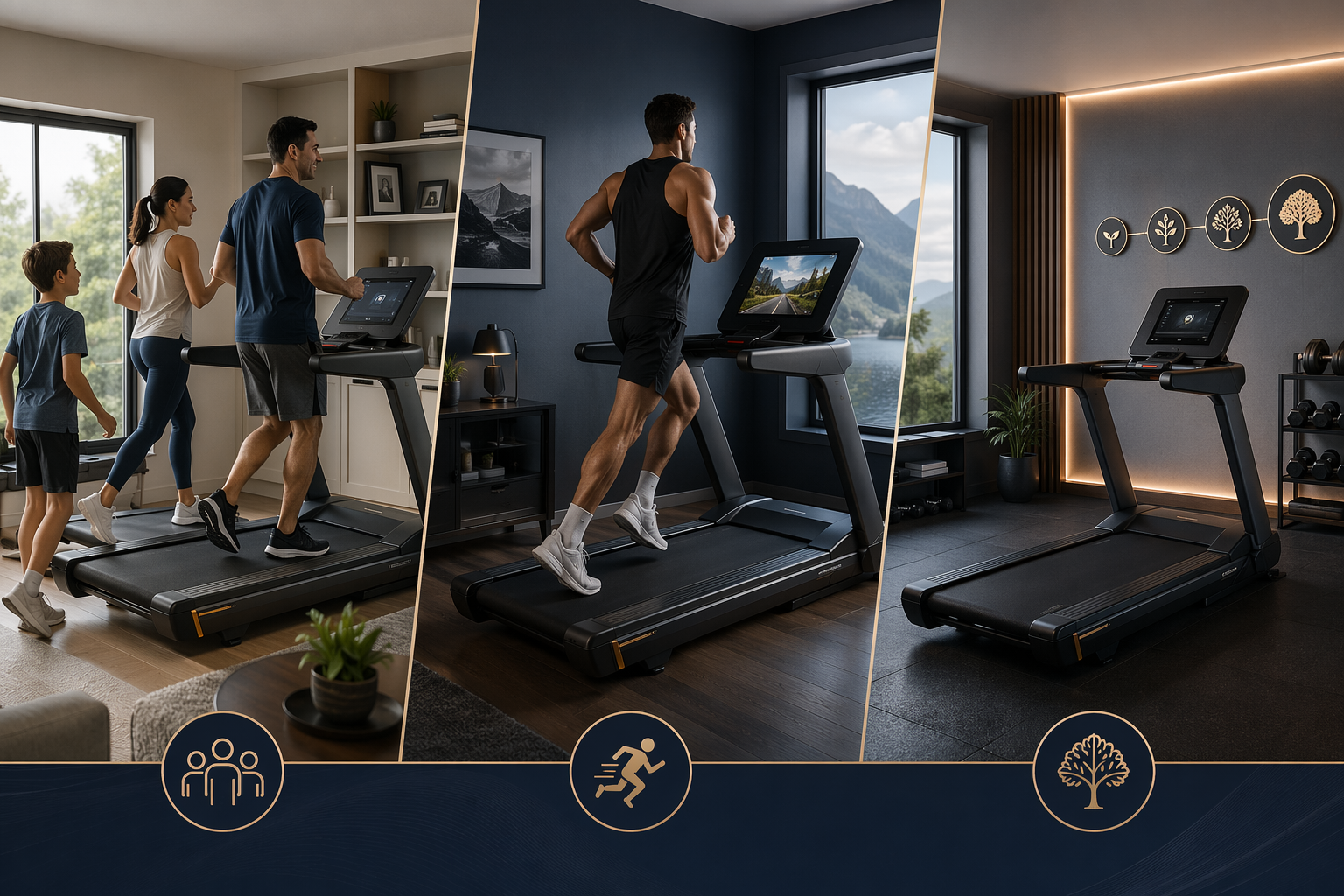
The price jump is the first spec
Before getting pulled into motor labels and touchscreen sizes, put the price bands on the table. Early-to-mid 2026 U.S. MSRP data places Matrix residential treadmills from about $3,299 at the low end to about $7,400 at the top, depending on model and console choice [1]. Promotions can move the actual checkout price, but the decision still lives in premium territory.
| Model | Early-to-mid 2026 U.S. MSRP | Motor | Deck | Foldable? | What the price is really buying |
|---|---|---|---|---|---|
| T30 | $3,299–$4,699 | 3.25 HP DC | 20 in. x 55 in. | No | Entry point into Matrix build and warranty, with the shortest running surface |
| TF30 | $3,499–$4,899 | 3.25 HP DC | 20 in. x 60 in. | Yes | Folding convenience with a full-length deck |
| T50 | $4,499–$6,499 | 3.25 HP DC | 20 in. x 60 in. | No | Heavier non-folding platform without the T75's AC motor |
| TF50 | $4,699–$6,699 | 3.25 HP DC | 20 in. x 60 in. | Yes | Higher-end folding option with Easy Fold hydraulic assist |
| T75 | $5,400–$7,400 | 3.0 HP AC induction | 22 in. x 60 in. | No | The clearest commercial-grade case: AC motor, wider deck, heavy frame, highest price |
Those numbers explain why a Matrix purchase should be judged like a long-term appliance decision, not a feature splurge. At this price, a treadmill has to earn its keep through fewer compromises over time: less strain under repeated use, fewer subscription obligations, better warranty protection, and a frame-deck-motor package that does not feel disposable after the first few years.
Where Matrix changes the ownership math
The strongest Matrix argument is mechanical, not cosmetic. All residential models carry lifetime frame, motor, and cushioning warranties, plus seven years of parts coverage and two years of labor coverage [1]. The labor term matters because it protects the period when a home buyer is most likely to discover whether the treadmill was a good fit for the room, the users, and the weekly workload. It is also longer than the one-year labor coverage cited for NordicTrack or Sole in this comparison context [1].
The deck is another quiet ownership cost. Matrix’s Ultimate Deck System is described as maintenance-free for 25,000-plus miles, eliminating belt lubrication as a recurring task on the covered models [2]. That does not make the treadmill maintenance-proof; belts, electronics, rollers, and consoles are still real components in a real machine. It does mean one common home-treadmill chore is removed from the owner’s calendar, which matters more in a busy household than in a showroom comparison.
The T75 is the model that makes the commercial-grade claim easiest to see. It uses a 3.0 HP AC induction motor, while the other Matrix residential treadmills use 3.25 HP DC motors [1][2]. The practical distinction is not the printed horsepower number. AC induction motors do not use brushes, are described as running cooler, and are reported to last two to three times longer than DC treadmill motors [2]. For a serious runner or a shared household, that is more meaningful than another inch of screen.
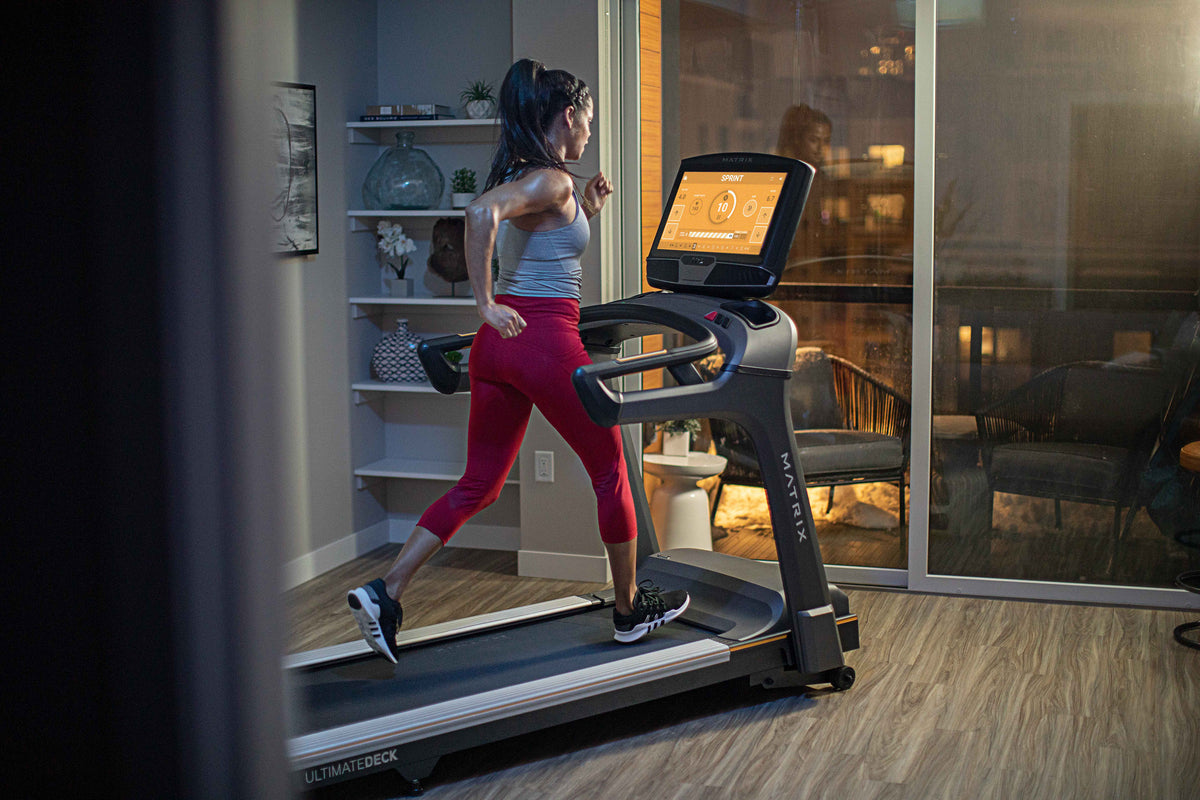
Weight and frame construction also belong in the value discussion because they affect stability and service life. The T75 weighs 375 pounds and uses a heavy-gauge welded steel frame [2]. That much mass is inconvenient on delivery day, but it is part of why the machine feels less like a folding consumer treadmill and more like equipment built to absorb repeated impact.
Serviceability is less glamorous but more useful than a badge on the console. TreadmillReviews.net notes tool-free access panels on Matrix models, and GXMMat’s comparison argues that Matrix is easier to service than Life Fitness in this respect [1][3]. That second point should be treated as a third-party opinion from a gym mat retailer, not as an independent lab result. Still, easy access is exactly the kind of design choice that helps a premium treadmill remain a repairable object instead of becoming an expensive problem.
The subscription issue is not small
Matrix also avoids a trap that has made connected treadmills harder to evaluate: the forced subscription. Its console ecosystem includes options such as HDMI input, Bluetooth FTMS, and native Netflix, YouTube, and Spotify support, without requiring a paid subscription for basic console use [1]. That is different from the iFIT-centered NordicTrack model, where declining a $39-per-month subscription disables core functionality [1].
This matters even if you never watch a movie on a treadmill. A treadmill should still be usable when a subscription lapses, a platform changes, or a household decides it has enough monthly bills. Matrix’s modular console approach also gives buyers a cleaner way to choose how much screen they actually want, from simpler LCD-style options to larger HD touchscreen configurations [1].
The premium pays off in three kinds of homes
A Matrix treadmill makes the most sense when use is intense enough that cheaper ownership becomes questionable. The machine does not have to live in a mansion or a private training studio. It just has to be used in a way that exposes the weakness of lighter-duty equipment.
Multi-user households
The clearest home use case is a household where several people share one treadmill. One person walks before work, another runs intervals after dinner, and a third uses it on weekends. No single user may look extreme on paper, but the machine sees repeated starts, belt load, impact, incline changes, and heat cycles.
In that setting, Matrix’s warranty depth, heavier frame, maintenance-free deck, and repair-oriented design become easier to justify. A cheaper treadmill that is fine for one walker may become the bottleneck when it has to serve as shared household equipment. The inconvenience is not just the repair bill; it is the person waiting because the treadmill is down.
Serious runners logging 20-plus miles per week
A runner logging 20-plus treadmill miles per week is not buying the same product as someone who walks occasionally during bad weather. Repeated running impact asks more from the deck, motor, belt, frame, and electronics. This is where the T75’s AC motor and 22-inch by 60-inch deck become more than premium talking points [2].
The wider deck will not turn a bad treadmill into a good one, but for runners who drift laterally or run faster intervals, it gives more usable room than the 20-inch decks on the T30, TF30, T50, and TF50 [1][2]. The motor distinction matters more over time: cooler-running, brushless AC architecture is exactly the kind of feature that becomes valuable when the machine is asked to work hard every week.
Owners planning to keep the treadmill for a decade
The 10-year owner is the buyer Matrix is built to tempt. If the plan is to keep one treadmill through changing routines, different users, and years of indoor training, a lower purchase price is only one part of the cost. Parts coverage, labor coverage, service access, deck maintenance, and subscription exposure all affect the real price of ownership.
This is also where the GXMMat framing is useful but not decisive. The site characterizes Matrix as delivering “95% of performance for 80% of price” compared with Life Fitness [3]. That is an opinion from a retailer, not a universal measurement. As a buying signal, it still lines up with the broader placement of Matrix in the commercial-grade home segment: expensive, but often below the most status-heavy commercial names.
Where Matrix is probably overkill
The weaker Matrix use case is not a bad buyer. It is a mismatched buyer. A single casual walker, a household with limited space, or someone trying to stay under a tighter budget may never stress the treadmill enough to recover the premium. In that case, paying for a heavier frame, deeper warranty, commercial motor architecture, and a modular console can become an expensive way to feel safe.
The T30 and TF30 soften the entry price, but they still sit well above many capable mid-range machines [1]. The shorter 20-inch by 55-inch deck on the T30 also makes it less compelling for taller runners or anyone who wants the most forgiving running surface [1]. If the real use case is walking while watching TV a few times a week, there is no shame in deciding that Matrix is more machine than the job requires.
Folding models deserve the same honesty. The TF30 and TF50 add space flexibility, with the TF50 using Easy Fold hydraulic assistance [1]. That can be the right compromise in a mixed-use room. But a folding Matrix treadmill is still a large premium machine, not a compact-budget workaround. If the room cannot comfortably hold the treadmill in use, folding capability only solves part of the problem.
The hidden constraints can decide before the specs do
The T75 has the best mechanical argument in the Matrix residential line, but it also has the clearest home-installation warning: it requires a dedicated 20-amp circuit for peak performance [1]. In a newer home gym with proper electrical planning, that may be a non-issue. In an apartment, older house, finished basement, or room already sharing power with other equipment, it can turn the best treadmill on paper into the wrong treadmill in practice.
Size and weight deserve the same attention. A 375-pound treadmill is not something to casually rotate across a room after delivery [2]. Stairs, narrow turns, flooring, ceiling height, service access, and placement near an appropriate outlet all belong in the purchase decision. A premium treadmill that cannot be installed cleanly is not a premium experience.
- Check whether the intended room has the right circuit before choosing the T75.
- Measure the full in-use footprint, not only the folded footprint.
- Confirm the delivery path, including stairs, turns, and doorways.
- Leave enough room around the treadmill for safe use and future service.
- Choose the console based on how the household will actually train and watch content, not on the largest screen available.
How Matrix compares without turning this into a brand tournament
Matrix belongs in the premium and commercial-grade conversation with brands such as Life Fitness, Precor, and Technogym, not only with mass-market connected treadmills. FitKit UK and RunReviews both position Matrix within that higher-end competitive landscape [4][5]. That context is useful because it explains the pricing, but it should not be allowed to make the decision for you.
Compared with NordicTrack, the Matrix advantage is less about immersive coaching and more about open-console use, warranty depth, and hardware. Compared with Sole, the question is whether the Matrix premium buys enough durability and refinement for your workload. Compared with Life Fitness, the GXMMat claim suggests Matrix can be a stronger value inside the commercial-grade home segment, though that claim should be read as one retailer’s judgment rather than a universal benchmark [3].
Brand recognition can offer reassurance, but it should stay in the passenger seat. Matrix was named “Most Innovative Brand of the Year 2025” by Plus X Award, and MyProsAndCons lists an aggregated Matrix Fitness rating of 4.0 out of 5 for 2026 [6][7]. Those are useful signals that buyers are not looking at an obscure maker. They do not prove that a $5,000-plus treadmill is the correct purchase for a low-use household.
A practical buying framework
The cleanest way to decide is to match the treadmill to the punishment it will actually take. Matrix becomes more rational as weekly mileage, number of users, running intensity, and ownership horizon increase. It becomes less rational as use becomes lighter, space becomes tighter, and the budget becomes more sensitive.
| Your situation | Matrix verdict | Best-fit logic |
|---|---|---|
| Three or more regular users | Strong yes | Shared use makes durability, warranty depth, and downtime reduction more valuable |
| Runner logging 20-plus miles per week | Yes, especially T75 if the room and circuit support it | AC motor, wider deck, and heavy frame better match repeated running stress |
| Planning 10-plus years of ownership | Likely yes | Long warranty, serviceability, maintenance-free deck, and no forced subscription improve ownership math |
| One casual walker | Usually no | The premium hardware is unlikely to be used hard enough to pay back |
| Apartment or older home with electrical limits | Proceed carefully | The T75’s 20-amp requirement and overall size may disqualify it |
| Budget-sensitive buyer comparing mid-range brands | Usually no | A capable lower-cost treadmill may deliver better value for light or moderate use |
Within the Matrix line, the T75 is the most defensible choice for serious running and heavy shared use, assuming the electrical and space requirements work. The T50 makes sense when a buyer wants a non-folding Matrix platform but does not need the AC motor. The TF50 and TF30 are for buyers who need folding storage but still want Matrix build quality. The T30 is the entry point, though its shorter deck makes it a more selective fit.
Choose Matrix if the treadmill will be shared, run on hard, and kept long enough for mechanical durability, warranty coverage, service access, and subscription freedom to matter. Choose a less expensive brand if the use case is casual, single-user, space-constrained, or budget-sensitive. The premium is real; the payoff depends on whether your household will actually use what it buys.
References
- Matrix Treadmill Reviews, TreadmillReviews.net, 2026
- Matrix T75 Treadmill Review – The AC Motor Powerhouse, TreadmillReviews.net
- Life Fitness vs Matrix: The Honest Truth Before You Buy, GXMMat.us
- Life Fitness vs. Precor vs. Matrix vs. Technogym, FitKit UK
- Life Fitness vs. Precor vs. Matrix, RunReviews.com
- Matrix Fitness: Most Innovative Brand of the Year 2025, FitnessMarkt.com, 2025
- Matrix Fitness Reviews 2026, MyProsAndCons, 2026

Comments
Join the discussion with an anonymous comment.