The first question with an elliptical machine for home use is not whether it looks compact in a product photo. It is whether the motion, footprint, noise, and recurring costs fit the room and the person who will actually use it after the first week. Ellipticals have a real home-gym advantage: they usually take less floor space than treadmills, avoid the repeated foot strike of running, and tend to be quieter because your feet stay on the pedals rather than landing on a belt.
That does not make every elliptical a safe buy. A machine can technically fit between a sofa and a wall and still feel cramped, wobbly, too short in stride, or awkwardly vertical. Compact models often change the workout more than shoppers expect. Subscription machines can also look affordable until the monthly fee becomes part of the real price.
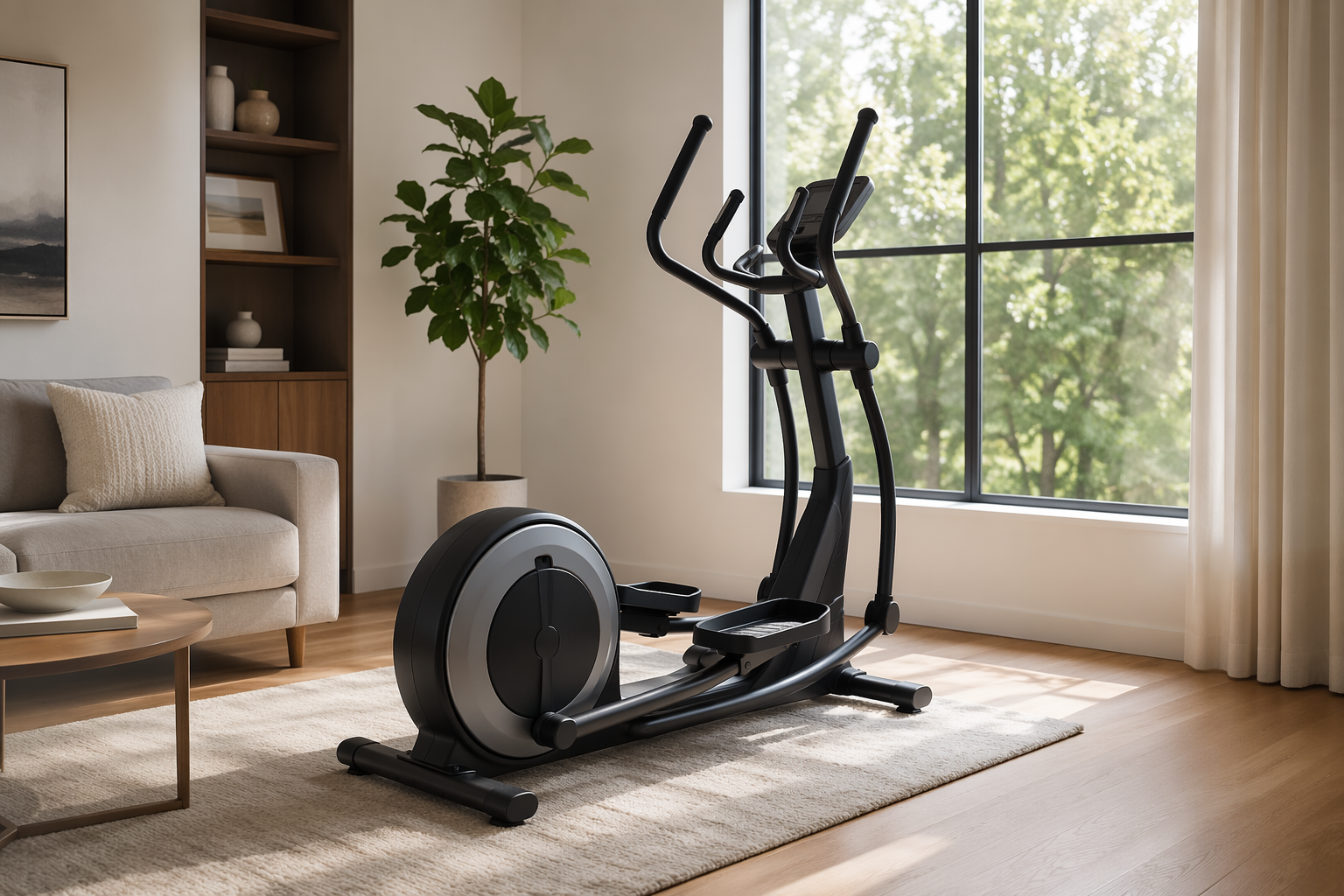
Start With the Room, Not the Console
A useful average: ellipticals occupy about 12 to 13 square feet, while treadmills average closer to 23 square feet in BarBend’s 2026 comparison.[1] That difference matters in apartments, shared bedrooms, and basement corners where the machine has to coexist with furniture, storage, pets, and people walking past it.
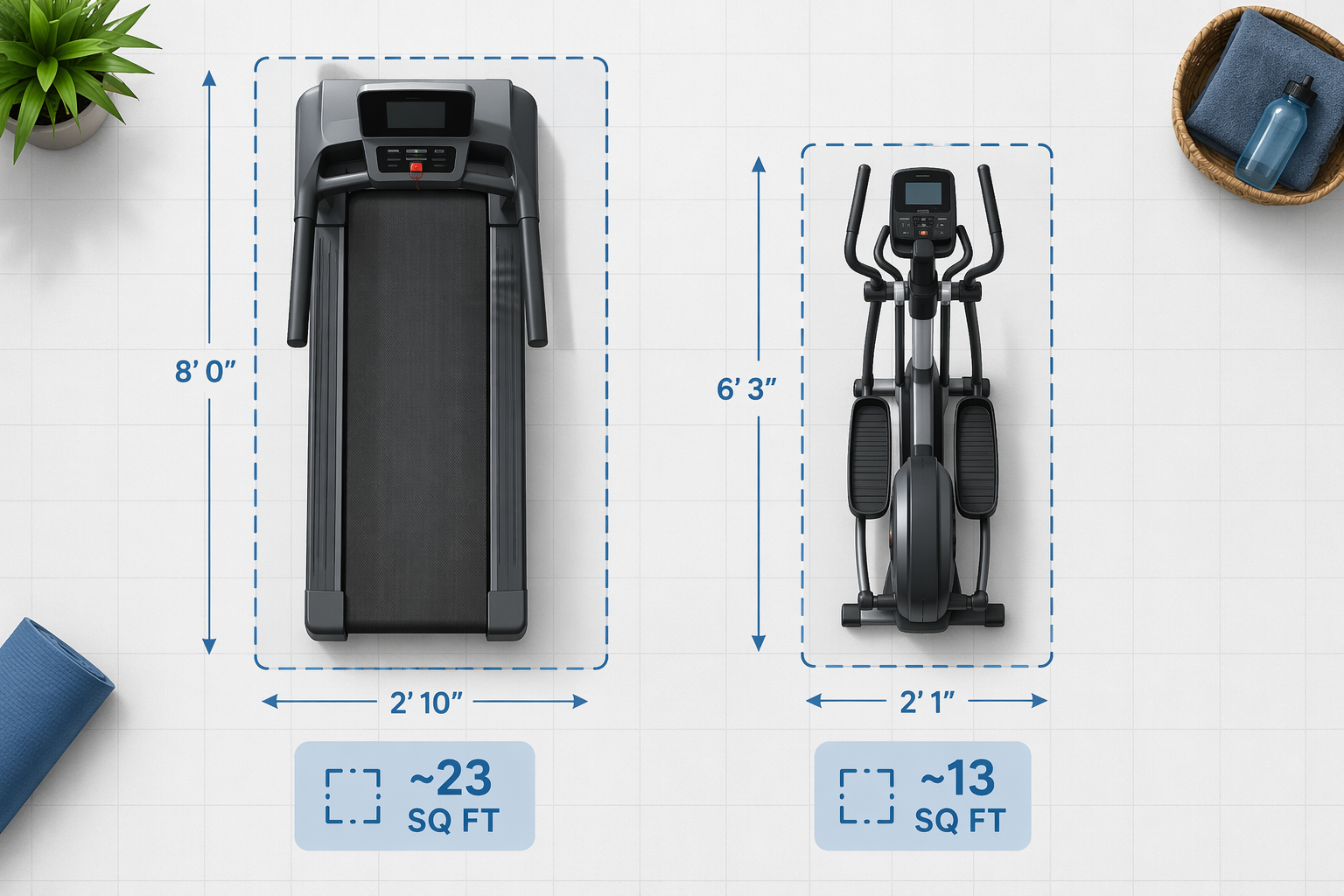
The footprint number is still only the rectangle on the floor. You also need clearance for your body to rise and fall, room to step on safely, and enough open space around the handles that you are not brushing a wall every stride. A rear-drive or front-drive elliptical may also feel longer in use than its listed footprint suggests because your legs travel forward and back through an oval path.
If you are still comparing cardio categories, the room test is simple: a treadmill usually asks for more floor length and creates more impact noise; an exercise bike asks for less space but gives you a seated workout; an elliptical sits between them, trading some space for a standing, full-body rhythm. For a broader small-space comparison before choosing a machine type, see our home gym cardio equipment for small spaces guide.
Why Ellipticals Often Make Sense for Knees and Neighbors
The low-impact appeal is real, but it needs careful wording. On an elliptical, your feet stay on the pedals, so the workout removes the repeated landing phase that comes with running. HSS physical therapist Darcy Reisman describes elliptical exercise as low impact because the feet remain in contact with the pedals, and Cleveland Clinic also frames elliptical training as a low-impact cardio option.[2][3]
For home use, that has two consequences. First, many people with sore knees or impact sensitivity find the motion easier to repeat than treadmill running, though that is not the same as a medical guarantee. Second, the lack of foot strike usually makes an elliptical quieter than a treadmill, which Consumer Reports identifies as one of the category’s home-gym advantages.[4]
There is a trade-off. Consumer Reports also notes that treadmill running may have a bone-density advantage because it is weight-bearing with impact, while an elliptical reduces impact.[4] If your priority is joint comfort, apartment noise, or beginner-friendly repeatability, that trade may be welcome. If your priority is running specificity or impact loading, an elliptical is not a treadmill substitute.
Calorie estimates are useful only as scale markers. Harvard Health estimates that a 155-pound person burns about 324 calories in 30 minutes on an elliptical trainer.[5] Your number can move substantially with body weight, intensity, age, conditioning, and how the machine calculates resistance, so it should not be treated as a promised result.
The Buying Framework: Six Constraints That Matter
Before comparing model names, sort your decision by constraints. This keeps you from buying a machine that wins a spec sheet and loses the room.
| Constraint | What to Check | Why It Changes the Purchase |
|---|---|---|
| Space | Footprint, step-up height, ceiling clearance, access around the machine | Compact models may save floor area but change the motion |
| Stride feel | Stride length and whether the path is horizontal, vertical, or hybrid | A short or steep stride can feel less like a full elliptical |
| Joint comfort | Smoothness, pedal spacing, resistance control, ability to move without jarring | Low impact is helpful only if the motion fits your body |
| Noise | No foot strike, but still listen for flywheel, rail, pedal, and frame noise | Apartment users need more than a quiet marketing claim |
| Budget | Upfront price, delivery, assembly, warranty, sale timing | A cheaper machine can be right, but not if it wobbles or feels cramped |
| Tech tolerance | Subscription requirement, app lock-in, screen usefulness | Guided classes can help consistency, but they change the real cost |
Space and Stride Are the Same Decision
This is where many home elliptical purchases go wrong. Shoppers look at the footprint, find a compact model, and assume the workout simply shrank. Sometimes it did not shrink; it changed shape.
A full-sized elliptical usually aims for a longer, smoother oval. A compact climber-style machine often makes the path shorter and more vertical. That can be efficient and space-saving, but it may feel more like stepping or climbing than gliding. If you have used a gym elliptical and liked the long, floating stride, do not assume a compact vertical unit will feel familiar.
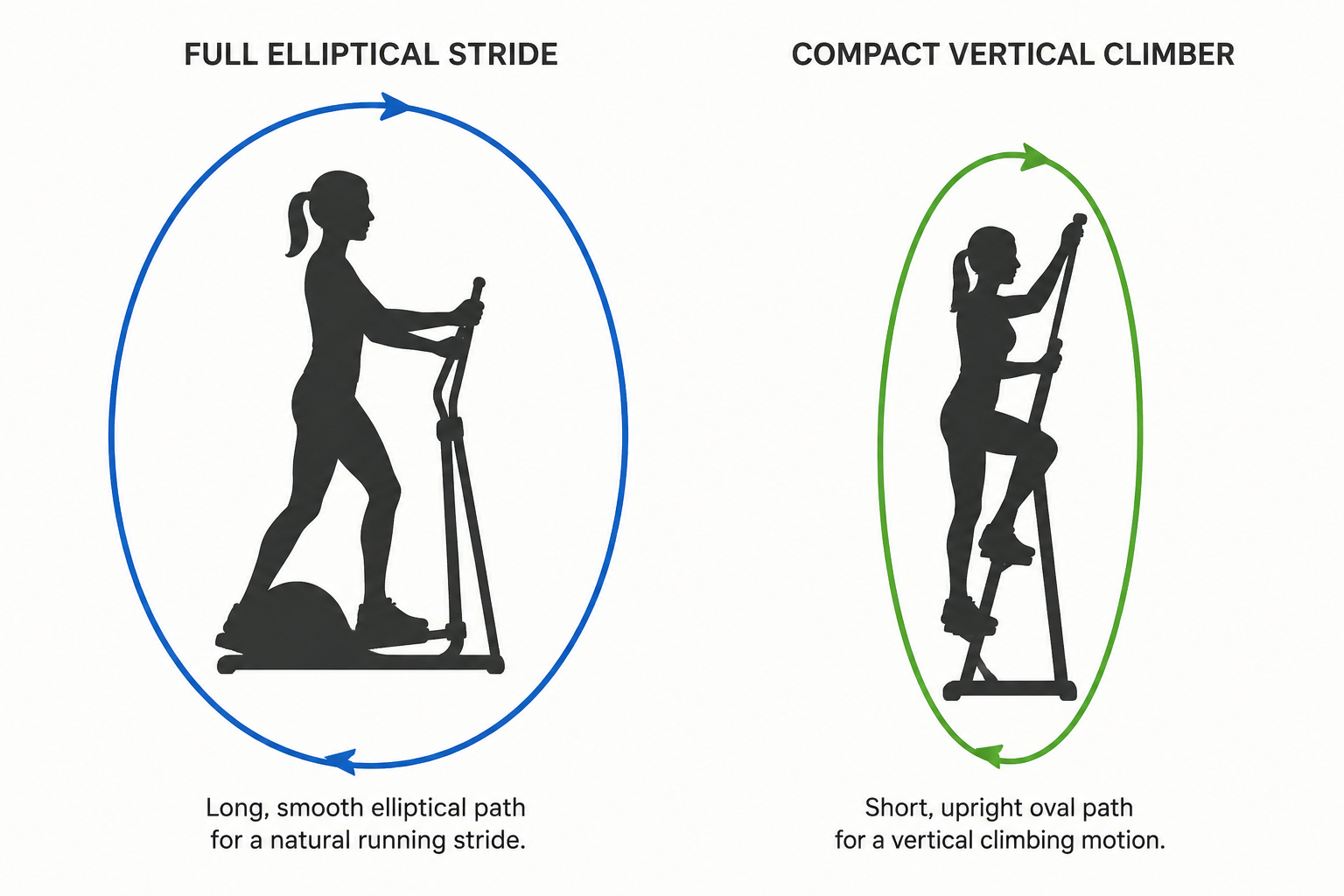
Stride length is the easiest spec to underrate. A 20-inch stride is commonly treated as a good fit range for many adults, including users roughly 5 feet 3 inches to 6 feet 5 inches, though comfort still depends on leg length and motion path.[6] Compact machines may come in shorter, often around the 15- to 18-inch range, which can be fine for shorter users or stepping-style workouts but restrictive for taller users or anyone expecting a long glide.
The YOSUDA EM1 shows the upside and the caveat clearly. Garage Gym Reviews measured its footprint at 5.84 square feet, with a 400-pound weight capacity and an 18.9-inch stride.[7] That is unusually space-efficient for a home cardio machine, but the buying question is not just “will it fit?” It is whether that motion feels good enough for the workouts you plan to repeat.
The Bowflex Max Trainer M6 is another compact-space candidate, with BarBend listing its footprint at 8.32 square feet.[1] Its appeal is not that it disappears into the room; it is that it uses a more upright, climber-like pattern to reduce the floor area. That can be a smart compromise for a small room, but it is not the same buying experience as choosing a conventional elliptical with a longer stride.
Apartment renters should also think beyond square footage: where the machine sits, whether a mat can reduce vibration, whether delivery can get through the doorway, and whether the machine must be moved after use. If those questions are bigger than the elliptical decision itself, our renter’s guide to a compact home gym is the better planning document.
Budget: Under $500 Is Possible, but It Is Not the Whole Market
A capable home elliptical does not have to cost $2,000, but the lowest acceptable price depends on what you can give up. Garage Gym Reviews identifies the Niceday CT11S at about $500 and the Sunny Health & Fitness SF-E3912 at about $480, while noting that broader elliptical market averages sit around $1,200 to $1,299.[8]
That spread is important. Around $400 to $500, you are usually buying basic resistance, a simpler console, fewer connected features, and a frame that may not feel as planted under heavier or faster use. That can be perfectly reasonable if your workouts are moderate, your budget ceiling is firm, and you would rather own a plain machine than finance a screen you do not need.
The Sunny Health SF-E3912 and Niceday CT11S belong in that conversation because they keep the entry price in reach. They are not the machines I would push toward someone who wants a health-club feel, a large integrated touchscreen, or the smoothest possible long stride. They make more sense for buyers who know the compromise and are trying to avoid spending three times more for features they will ignore.
The $900 to $1,500 range is where the decision becomes less about “can I get an elliptical?” and more about what kind. The Horizon EX-59, ProForm Carbon EL, and Sole E25 sit in this more comfortable home-use zone. You are paying for a more stable experience, stronger parts, better ergonomics, or better tech, depending on the model.
Available pricing data flags frequent sale periods, including Black Friday, Labor Day, and summer sales, where prices may drop by about $200 to $700. A model that looks overpriced in July may be reasonable during a major promotion, and a model that looks like a bargain may lose its advantage if delivery, assembly, or subscription costs are added.
Model Lanes: Which Elliptical Fits Which Constraint?
There is no universal best elliptical machine for home use because the best choice changes with the constraint. A downstairs-neighbor problem, a sore-knee problem, and a “I only have one corner of the living room” problem do not point to the same machine.
| Buyer Situation | Models to Consider | Main Caveat |
|---|---|---|
| Smallest practical footprint | YOSUDA EM1; Bowflex Max Trainer M6 | The motion may feel more compact, upright, or climber-like than a standard elliptical |
| Lowest workable price | Sunny Health SF-E3912; Niceday CT11S | Expect simpler consoles and fewer premium-feel parts |
| Knee-sensitive user wanting a fuller machine | Sole E25 | Still test stride comfort if possible; low impact is not medical advice |
| Beginner who may need to move the machine | Horizon EX-59 | Not tiny, but easier to reposition than its listed weight suggests |
| Guided workouts and screen motivation | NordicTrack AirGlide 14i; ProForm Carbon EL | Subscription costs can change the real price |
| Methodology-backed general pick | Schwinn 490 | A strong outside-tested anchor, not automatically right for every room |
For Compact Spaces: YOSUDA EM1 or Bowflex Max Trainer M6
If floor area is the hard limit, the YOSUDA EM1 is the sharper space play because of its 5.84-square-foot measured footprint.[7] Its listed 18.9-inch stride also makes it more plausible than many very short-stride compact units, especially for users who are not especially tall. The key is to treat it as a compact elliptical with its own motion, not as a shrunken gym machine.
The Bowflex Max Trainer M6 makes sense when you are open to a more vertical, high-effort pattern. It can save floor space, but buyers should be honest about whether they want a climbing sensation. People who dislike stairs may not love a machine that borrows from that pattern.
For Tight Budgets: Sunny Health SF-E3912 or Niceday CT11S
Budget buyers should separate “cheap enough to buy” from “sturdy enough to keep using.” The Sunny Health SF-E3912 and Niceday CT11S are useful because they keep the price near the $500 line in the available 2026 data.[8] They are better matched to steady home cardio than to users expecting studio-class smoothness or heavy sprint intervals.
If $500 is your whole home-fitness budget, also ask whether an elliptical should consume all of it. A resistance band setup, adjustable dumbbells, or a walking pad may serve you better depending on your goals. Our essential home fitness starter kit for under $500 can help if you are deciding between one large cardio purchase and a broader starter setup.
For Knee-Sensitive Buyers: Sole E25
The Sole E25 is the kind of machine I would put higher for someone who wants a more traditional elliptical experience and is buying partly because treadmill impact is not appealing. The low-impact category case is strong enough to consider it, but the individual fit still matters. Pedal spacing, stride path, and how your knees track through the motion can matter more than a brand’s joint-friendly language.
If you have a diagnosed injury, recent surgery, or persistent pain, the elliptical decision should sit below professional medical guidance. Low impact describes the mechanics of the machine; it does not predict what your knee, hip, ankle, or back will tolerate.
For Beginners: Horizon EX-59
The Horizon EX-59 is appealing for beginners because it is not trying to be the flashiest machine in the room. It is a more straightforward elliptical at a listed $999 in Garage Gym Reviews’ 2026 testing.[9] The detail that matters most at home is not just the price; it is the moveability.
Garage Gym Reviews lists the Horizon EX-59 at 145 pounds but found that when tilted, its felt weight was only 42 pounds.[9] That is exactly the kind of number that matters after delivery. A beginner who can reposition a machine without dread is more likely to keep it in a usable spot instead of banishing it behind a door.
If you are new enough that you are still unsure whether cardio equipment, strength equipment, or a mixed setup belongs at home, start with the home fitness decision guide for complete beginners before committing floor space to one machine.
For Tech-Motivated Users: NordicTrack AirGlide 14i or ProForm Carbon EL
Some people do use a machine more consistently when it gives them classes, routes, trainer prompts, and a screen that removes the burden of inventing every workout. If that is you, the tech is not fluff. It is part of the adherence plan.
Available 2026 pricing lists the NordicTrack AirGlide 14i at $1,599 and the ProForm Carbon EL at $999, with iFIT at $39 per month.[10] That monthly cost should be checked at purchase, because subscription terms and promotions can change, and the real ownership cost is different from the hardware price.
Bowflex’s JRNY ecosystem also adds a recurring cost, so the Max Trainer M6 should be judged as both a compact machine and a connected machine. If you would not keep paying for guided content, make sure the hardware still gives you enough manual functionality to be worth owning.
For a Broad Home-Gym Pick: Schwinn 490
Wirecutter’s Schwinn 490 recommendation is useful less because it declares a winner and more because of how the testing was built. Its 2026 elliptical guide used 24 testers ranging from 4 feet 9 inches to 6 feet 6 inches and up to 315 pounds, which gives the recommendation a wider body-size lens than a single-reviewer test can offer.[11]
That makes the Schwinn 490 a credible “best for many home gyms” anchor. It still does not override your constraints. A tested favorite can be wrong for a narrow room, a strict subscription-avoidance buyer, or a person who specifically needs the smallest footprint possible.
How to Decide Without Overbuying
Measure the room first, including the clearance you need to get on and off. Then decide which compromise you are actually buying.
- Buy compactness if the machine must live in a shared room and you accept a shorter or more vertical motion.
- Buy low price if you want repeatable moderate cardio and can live without premium screens, heavy frames, or studio polish.
- Buy full-stride comfort if you are taller, sensitive to awkward motion, or trying to replace the feel of a gym elliptical.
- Buy tech motivation if guided classes are what will make you return, not because a touchscreen automatically improves the machine.
- Buy moveability if the machine cannot stay in one permanent spot.
An elliptical is often a better home fit than a treadmill when joints, noise, and footprint are the main constraints. The right elliptical is the one whose compromise you can live with repeatedly: the compact model that feels more like a climber, the budget model with a plain console, the fuller machine that takes more room, or the connected machine that costs more over time.
Before buying in Q3 2026, confirm the current price, delivery terms, return policy, warranty, and subscription cost. Then check the stride style as carefully as the footprint. The machine that fits the room but not your body is the one that ends up folded, covered, or quietly avoided.
References
- Best Ellipticals (2026), Tested and Picked by Experts, BarBend, 2026.
- Elliptical Machine Workouts, Hospital for Special Surgery.
- 10 Elliptical Machine Benefits, Cleveland Clinic.
- Treadmill vs. Elliptical: Which Is Best for a Home Gym?, Consumer Reports.
- Calories Burned in 30 Minutes for People of Three Different Weights, Harvard Health Publishing.
- How to Find Your Ideal Stride Length, Sunny Health & Fitness.
- Expert-Tested: The Best Compact Ellipticals (2026), Garage Gym Reviews, 2026.
- Best Ellipticals Under $1,000 (2026), Garage Gym Reviews, 2026.
- The Best Ellipticals of 2026, Tested and Reviewed, Garage Gym Reviews, 2026.
- iFIT Membership, iFIT.
- The Best Elliptical Machines of 2026, Reviews by Wirecutter, 2026.
Comments
Join the discussion with an anonymous comment.