
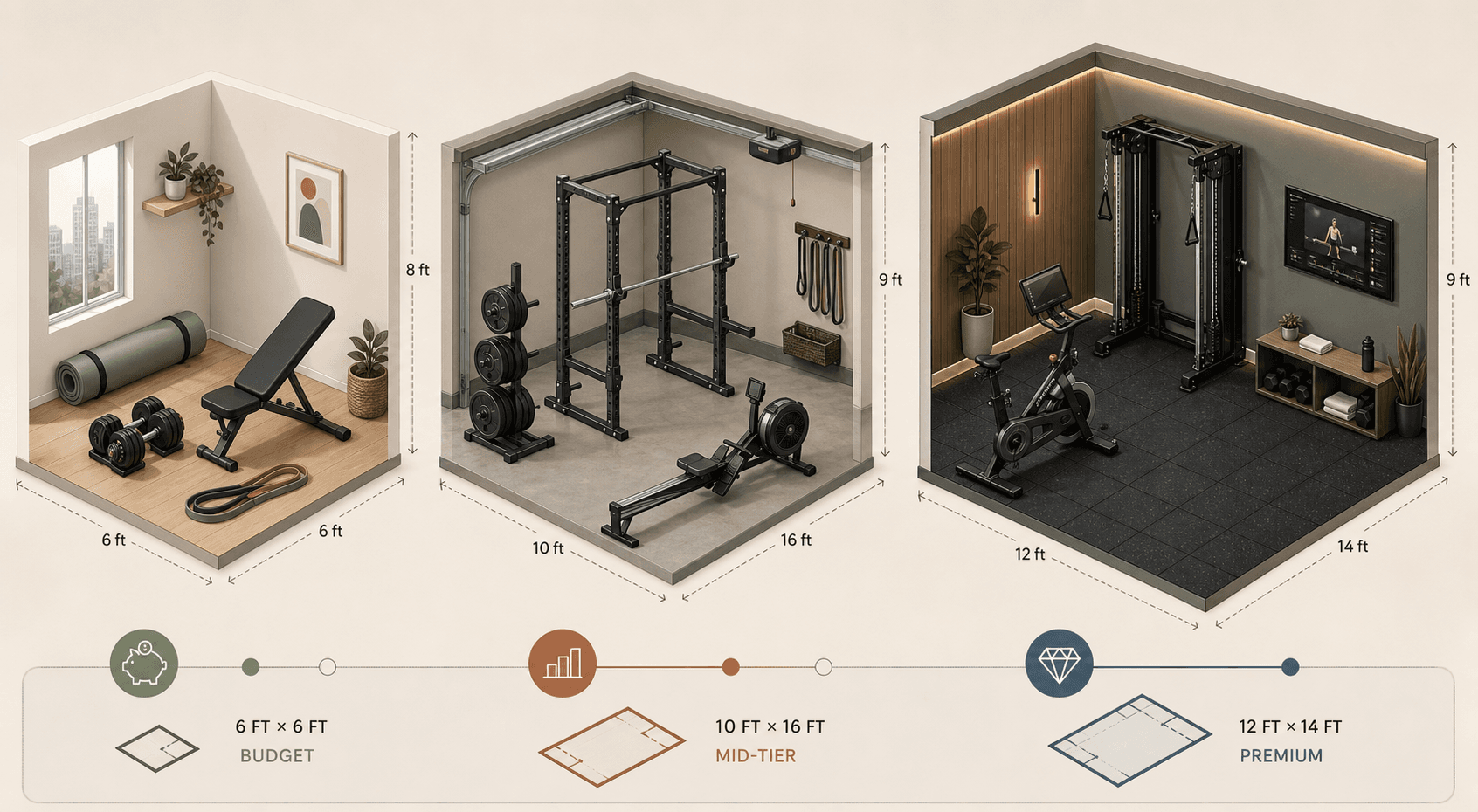
Why Budget Matters More for Beginners Than for Veterans
A common trap in the home fitness world is the belief that a bigger budget automatically means a better workout. In reality, a carefully selected $500 setup can deliver more consistent results than a $5,000 room full of impulse buys. The difference comes down to how well the equipment matches what you will actually do, day after day.
Beginners face a unique problem: they do not yet know their own habits. Will you prefer strength training, cardio, or a mix? Will you stick with it three times a week or lose interest after a month? Spending heavily before answering those questions often leads to expensive equipment that sits unused or fails prematurely. The Cleveland Clinic advises building slowly: "It's often better to add a little at a time, especially when you're figuring out the space and how often you're going to use your gym."
This guide is built around explicit dollar-value tiers — under $200, $200 to $500, and $500 to $1,000 — with specific product picks and, just as importantly, specific products to skip. The goal is to help you spend once and spend wisely, avoiding the cycle of cheap replacements that ultimately costs more than a quality piece bought from the start.
Under $200: The Minimum Viable Home Gym
If your budget is under $200, you are in the "start small and prove the habit" zone. This is not a permanent setup — it is a testing ground. The goal is to build consistency before committing to larger purchases. With discipline, this tier can support effective bodyweight and light resistance training for several months.
Here is what a functional under-$200 home gym looks like:
- A high-quality yoga or exercise mat ($20–$40). Provides cushioning for floor work and defines your workout zone.
- A jump rope ($10–$20). One of the most efficient cardio tools available. A few minutes of jumping rope elevates your heart rate as effectively as a longer run.
- A set of loop resistance bands ($15–$30). Useful for glute activation, lateral movements, and adding light resistance to bodyweight exercises.
- A pair of adjustable dumbbells or a single kettlebell ($50–$100). If you can stretch to a used set, this is the single best upgrade for this tier.
This combination covers the basics: cardio (jump rope), lower body (bands, bodyweight squats), upper body (push-ups, rows with bands), and core (planks, leg raises on the mat). It fits in a closet and costs less than two months of a typical gym membership.
$200–$500: The Sweet Spot for Value and Versatility
This is the budget range where a home gym transforms from a compromise into a genuinely capable training space. With $200 to $500, you can buy equipment that delivers years of reliable use and covers most strength and cardio needs. The key is choosing pieces that offer the highest versatility per dollar.
The following table summarizes the top picks in this tier, based on independent testing and verified specifications.
| Product | Price | Key Specs | GGR Score | Best For |
|---|---|---|---|---|
| TRX Home Suspension Trainer | $229.95 | 1.5 lbs, door anchor included, full-body resistance | 4.3 / 5 | Overall best value under $500 |
| PowerBlock Sport Series Adjustable Dumbbells | $409 | 5–50 lb range, expandable to 90 lbs, compact storage | N/A | Best weight set under $500 |
| Titan Fitness Wall-Mounted Pulley Tower V3 | $279 | 350-lb weight capacity, 18 adjustment points, 80.5-inch upright | N/A | Best cable machine under $500 |
| Fitness Reality 810XLT Super Max Power Cage | $249 | 800-lb capacity, survived 800-lb drop test, safety bars | N/A | Best power rack under $500 |
The TRX Home Suspension Trainer stands out because it packs a full-body strength and core workout into a 1.5-pound package. You can use it in a door frame, anchor it to a beam, or take it outdoors. It is the single most versatile piece of equipment under $500, earning a Garage Gym Reviews (GGR) score of 4.3 out of 5.
For those who prefer traditional strength training, the PowerBlock Sport Series Adjustable Dumbbells at $409 replace an entire rack of individual dumbbells. The 5-to-50-pound range covers most beginner and intermediate needs, and the expandable design lets you add weight later without buying a whole new set.
The Fitness Reality 810XLT Power Cage at $249 is a standout for safety. GGR founder Coop Mitchell tested it by dropping nearly 800 pounds onto the safety bars. The cage held up well, with only the safety bar bending — a remarkable result for a sub-$300 rack. This demonstrates that budget gear can be both effective and safe when designed properly.
$500–$1,000: Investing in Long-Term Performance
At the $500 to $1,000 level, you are no longer compromising on quality. The equipment in this tier is built to last for years, hold strong resale value, and deliver performance that rivals commercial gym machines. These are the pieces you buy once and keep for a decade.
| Product | Price | Key Specs | GGR Score | Best For |
|---|---|---|---|---|
| Concept2 RowErg | $990 | 57 lbs, vertical storage, 500-lb weight capacity, 4.6 GGR score | 4.6 / 5 | Best compact rowing machine |
| Ironmaster Super Bench Pro V2 | $499 | 1,000-lb flat capacity, 600-lb inclined capacity, compact fold | N/A | Best compact weight bench |
| X3 Bar | $549 | 17 lbs, 300 lbs resistance (600 with Elite Band), 4.4 GGR score | 4.4 / 5 | Best compact home gym for strength |
The Concept2 RowErg at $990 is the gold standard for home cardio. It weighs 57 pounds, stores vertically, and has a 500-pound weight capacity. Its GGR score of 4.6 out of 5 reflects decades of proven durability and a massive online community for workouts and challenges. If you want one cardio machine that will never feel obsolete, this is it.
The Ironmaster Super Bench Pro V2 at $499 is the bench to pair with any adjustable dumbbell or barbell setup. It supports 1,000 pounds flat and 600 pounds inclined, which means it will never be the weak link in your gym. It folds compactly for storage and includes attachments for leg work and preacher curls.
The X3 Bar at $549 is a different approach to strength: it uses heavy-duty resistance bands to generate up to 300 pounds of resistance (600 with the Elite Band). It weighs only 17 pounds and mounts to a floor plate, making it one of the most space-efficient strength tools available. GGR gives it a 4.4 out of 5.
These three pieces can be combined with items from the $200–$500 tier. For example, a Concept2 RowErg plus a set of PowerBlock dumbbells and an Ironmaster bench creates a complete gym for roughly $1,900 — but you can start with just the rower or just the bench and dumbbells and add the rest over time.
What to Absolutely Skip: Equipment That Wastes Your Money
Knowing what not to buy is just as important as knowing what to buy. The home fitness market is full of products that look appealing on a store shelf but fail in real-world use. Here are the categories to avoid, with specific reasoning.
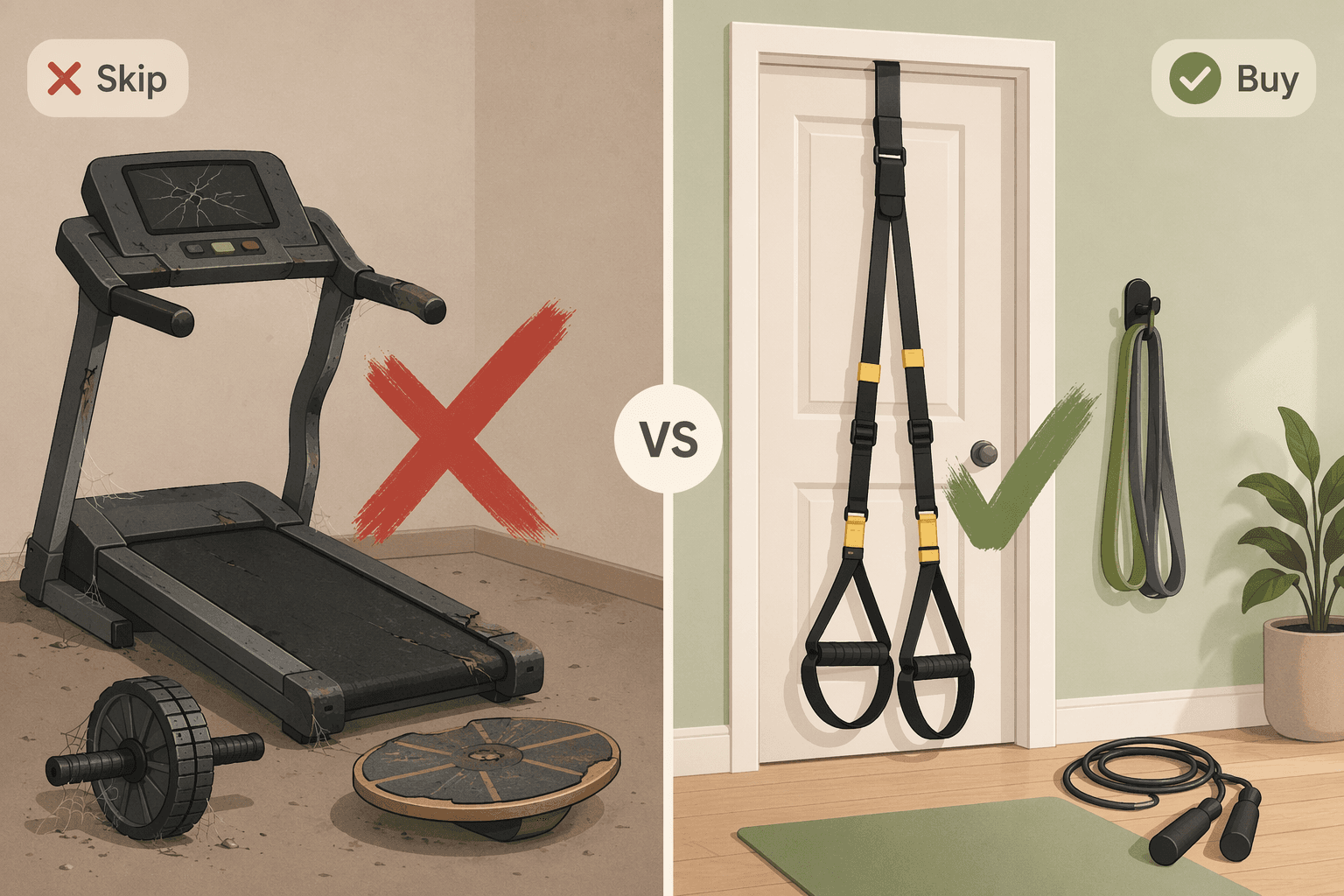
Treadmills Under $500
This is the single most common mistake in budget home gym buying. According to Fitness Outlet, which draws on 30 years of industry experience, budget treadmills under $500 are "almost universally built to standards not designed for consistent daily use." They wear out quickly, require frequent service, and often cost more in repairs than a quality machine would have cost in the first place. A cheap treadmill is not a bargain — it is a short-term rental that you pay for repeatedly.
Instead of a budget treadmill, buy a jump rope ($10–$20) for cardio and put the remaining $480 toward a Concept2 RowErg or a quality set of adjustable dumbbells. You will get better workouts and equipment that lasts.
Ab Rollers and Balance Boards as Primary Equipment
Single-purpose gadgets like ab rollers, balance boards, and vibrating platforms promise targeted results but deliver very limited stimulus. They take up space, gather dust, and do not replace the compound movements (squats, presses, rows, pulls) that drive real strength and fat loss. Fitness Outlet explicitly warns against these as primary equipment, noting they are "single-purpose gadgets" that fail to provide the comprehensive stimulus needed for a complete home gym.
If you want a strong core, do planks, dead bugs, and hanging knee raises on a pull-up bar. Those exercises cost nothing and outperform any ab gadget.
Resistance Bands as a Sole Strength Tool
Resistance bands are excellent for warm-ups, glute activation, and adding variable resistance to barbell movements. But relying on them as your only strength tool is a dead end. Bands provide non-linear resistance — they get harder at the top of the movement and easier at the bottom — which does not match the strength curve of most exercises. As you get stronger, you will need more bands, creating a bulky and inconsistent setup.
Use bands as a supplement, not a foundation. Your primary strength tools should be adjustable dumbbells, a suspension trainer, or a barbell and plates.
For a deeper look at common budget pitfalls, read our guide on 7 Costly Mistakes When Buying Affordable Home Gym Equipment.
How to Layer Your Home Gym Purchases Over Time
You do not need to buy everything at once. In fact, buying everything at once is a common mistake — you end up with equipment that does not match your actual training preferences. A phased approach lets you discover what you enjoy and what you actually use before committing more money.
Here is a recommended purchase sequence for a budget-conscious builder:
- Start with the most versatile piece. A TRX suspension trainer or a set of adjustable dumbbells covers the widest range of exercises. Use it for 4–6 weeks to confirm your commitment.
- Add a bench. The Ironmaster Super Bench Pro V2 or a similar sturdy bench unlocks pressing, rowing, and seated exercises that are awkward without one.
- Add a cardio machine. If you enjoy running, save for a quality treadmill (over $1,000). If you prefer low-impact cardio, the Concept2 RowErg or an exercise bike are better choices.
- Add specialty items last. Things like a cable attachment, a plyo box, or a pull-up bar are nice to have but not essential for the first 6–12 months.
This sequence follows the principle that one great piece of equipment is always a better investment than three mediocre ones. Each purchase should feel like a meaningful upgrade, not just another item in the corner.
If you have outdoor space, you might also consider an outdoor fitness setup for under $500 as a later expansion.
Home Gym vs. Gym Membership: The Real Cost Comparison Over 5 Years
One of the strongest arguments for a home gym is long-term cost savings. According to the 2024 U.S. Health & Fitness Consumer Report, cited by Garage Gym Reviews, the average gym membership costs roughly $65 per month. That figure does not include gas, time spent commuting, or the occasional smoothie or class upgrade.
The following table shows how a home gym purchase compares to paying for a membership over five years.
| Scenario | Year 1 Cost | Year 3 Cost | Year 5 Cost | 5-Year Total |
|---|---|---|---|---|
| Gym membership ($65/mo) | $780 | $2,340 | $3,900 | $3,900 |
| $500 home gym (one-time) | $500 | $500 | $500 | $500 |
| $1,000 home gym (one-time) | $1,000 | $1,000 | $1,000 | $1,000 |
A $500 home gym breaks even in under 8 months compared to a $65/month membership. A $1,000 setup breaks even in just over 15 months. After that, every workout is essentially free. And unlike a membership, your home gym does not raise its price, close for holidays, or require you to wait for a squat rack.
For readers who want a broader comparison of home gym machines beyond the budget tiers covered here, see our Best Workout Machine for Home: A Small-Space Decision Framework.
Comments
Join the discussion with an anonymous comment.