
Why the Store You Choose Matters as Much as the Equipment You Pick
The home fitness equipment market is valued at $11.84 billion in 2026, with 267 manufacturers in the U.S. alone and thousands of retailers vying for your business. That abundance of choice creates a paradox: the same treadmill, power rack, or exercise bike can cost 40% more or 70% less depending entirely on where you buy it, not what you buy.
Most first-time home gym builders make the same mistake: they pick a store first — the one with the best sale, the closest location, or the most familiar name — and then choose equipment from whatever that store carries. That approach routinely leads to overpaying for mid-tier gear at a specialty dealer, buying commercial-grade equipment you don't need from a big-box retailer that can't service it, or ordering a budget rack online only to discover the shipping cost eats your savings.
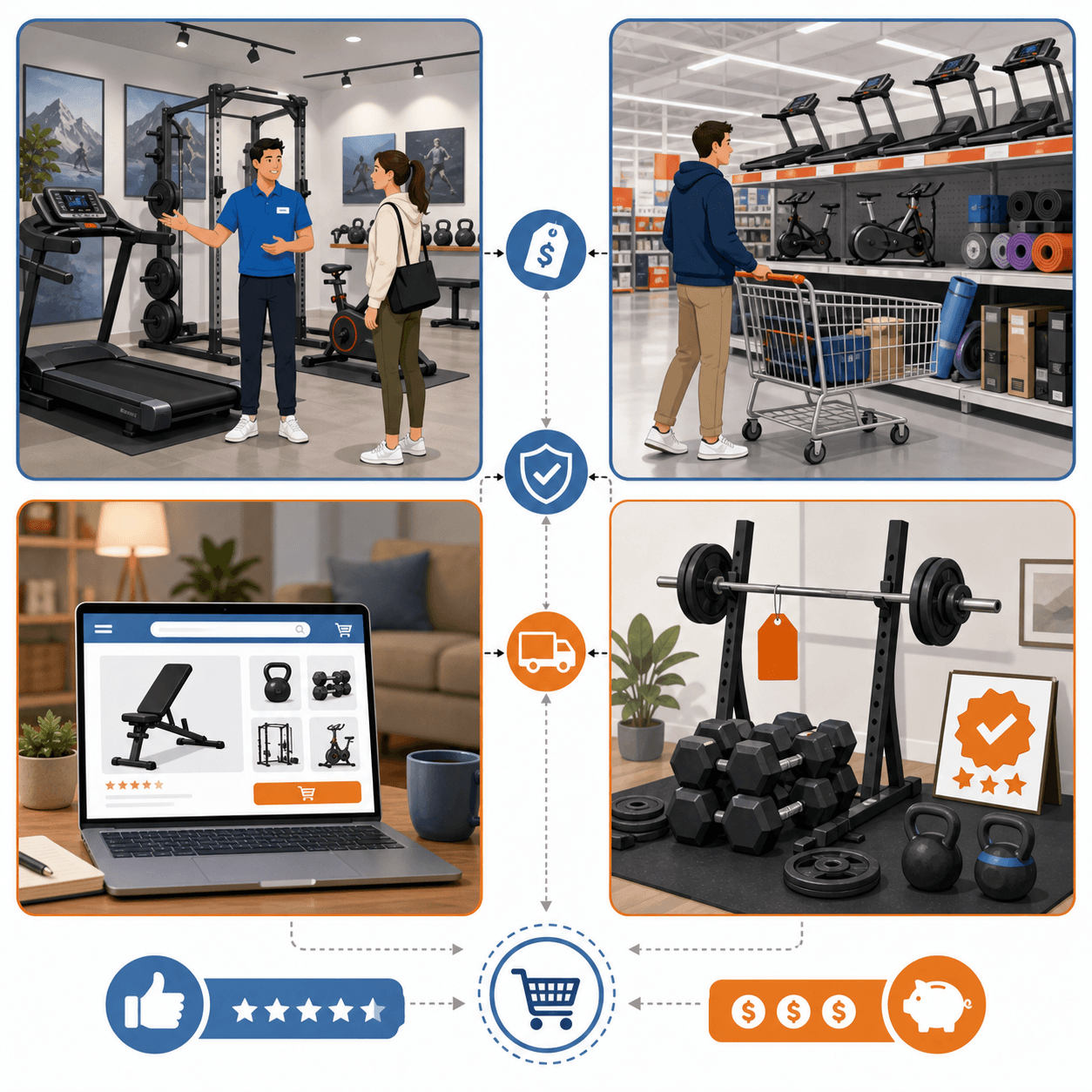
Fitness equipment retail has fragmented into four distinct channels, each optimized for a different buyer profile:
- Specialty dealers — white-glove service, unbiased brand advice, commercial-grade gear, premium pricing.
- Big-box retailers — convenience, easy returns, accessible brands, limited depth.
- DTC online brands — best value, direct warranties, no try-before-you-buy, shipping costs on you.
- Used and secondhand markets — maximum savings, no warranty, inspection skills required.
This guide breaks down each channel by price, service, selection depth, and risk so you can match the store type to your budget, experience level, and equipment needs — before you ever walk through a door or click "add to cart."
The Four Types of Fitness Equipment Retailers: An Overview
Before diving into each channel, it helps to see them side by side. The table below summarizes the core differences across the dimensions that matter most to home gym buyers.
| Dimension | Specialty Dealer | Big-Box Retailer | DTC Online Brand | Used / Secondhand |
|---|---|---|---|---|
| Examples | Johnson Fitness, Fitness Outlet, ConnectFit | Dick's Sporting Goods, Best Buy, Target | Rogue Fitness, REP Fitness, Titan Fitness, RitFit | Play It Again Sports, Facebook Marketplace, gym liquidations |
| Price Level | Premium (MSRP or near MSRP) | Mid-range (frequent sales, financing) | 40–60% below dealer pricing | 30–70% below new retail |
| Selection Depth | Deep — multiple brands, commercial & home lines | Shallow — top 2–3 brands per category | Brand-specific — deep within one ecosystem | Variable — depends on local inventory |
| Service & Support | In-house delivery, installation, long-term servicing | Basic assembly, limited post-sale support | Phone/email support, no local service | None — buyer beware |
| Return Policy | Restocking fees, narrow return windows | Generous — 30–90 days, easy in-store returns | Difficult — repackaging, high shipping costs, weeks-long process | As-is — no returns |
| Best For | Commercial-grade buyers, serious lifters, those wanting unbiased advice | First-timers, casual users, space-constrained buyers | Value seekers, experienced buyers who know what they want | Budget-conscious buyers, collectors, those willing to inspect |
Market data reinforces why this framework matters. Offline retail still captured 59.97% of sales in 2025, but online retail is projected to expand at a 9.37% CAGR through 2031. That means the channel you choose today may look very different in a few years — but the trade-offs between service, price, and risk will remain stable.
Specialty Dealers: White-Glove Service for Serious Buyers
Specialty dealers like Johnson Fitness, Fitness Outlet, and ConnectFit are the closest thing to a true fitness equipment advisor. Their business model depends on repeat local relationships, not one-time transactions, which creates a fundamentally different buying experience.
What You Get at a Specialty Dealer
The primary advantage is expertise and service depth. A well-run specialty dealer carries a wide product range — often 27 or more brand partners — and employs staff who can compare equipment across manufacturers without being limited to a single brand's lineup. Because their revenue comes from service contracts and repeat customers rather than manufacturer commissions, they can offer relatively unbiased recommendations.
The service package typically includes:
- In-house delivery and installation — most providers outsource this to customers or unvetted third parties, but specialty dealers keep it in-house.
- Long-term servicing and maintenance — the same team that installs your equipment can repair it years later.
- Independent relationships with manufacturers — they can advocate for warranty claims and source parts more effectively than a big-box store.
For buyers investing in commercial-grade equipment — a $3,000 treadmill or a $5,000 cable machine — the service package can justify the premium. A single in-home repair call from a third-party technician can cost $150–$300, and commercial-grade machines need regular maintenance that most buyers cannot perform themselves.
The Trade-Offs
Specialty dealers charge near MSRP. Discounts are rare, and negotiation is limited. Restocking fees on returns are common, and return windows are narrow — typically 7–14 days. If you buy a treadmill and decide three weeks later that you wanted a bike, you will likely pay a 15–25% restocking fee plus delivery costs.
This channel is best for buyers who know they want commercial-grade gear, need installation and ongoing service, and value expert advice over price. It is a poor fit for budget-conscious shoppers, first-timers who are still figuring out what they need, or anyone buying basic equipment like dumbbells and benches.
Big-Box Retailers: Convenience and Easy Returns, but Limited Depth
Dick's Sporting Goods, Best Buy, and Target have become major fitness equipment destinations, especially for first-time buyers and casual users. Their appeal is straightforward: you can see equipment in person, take it home the same day, and return it easily if it doesn't work out.
Where Big-Box Retailers Excel
- Accessible brands — you will find NordicTrack, Bowflex, Schwinn, and Sole, which cover the vast majority of home gym needs for beginners and intermediate users.
- Easy returns — 30- to 90-day return windows with in-store drop-off. No repackaging a 200-pound treadmill into its original box.
- Financing options — store credit cards and promotional financing (e.g., 12 months no interest) are standard.
- Convenience — same-day pickup for smaller items, predictable pricing, and frequent seasonal sales (Black Friday, New Year, Memorial Day).
Where They Fall Short
The biggest gap is expertise. Big-box fitness sales staff are generalists — they sell treadmills one aisle over from camping gear and televisions. They can tell you the price and screen size of a treadmill's console, but they cannot compare resistance types across brands or advise on progressive overload programming.
Selection is also limited. A big-box store typically carries two to three brands per equipment category, and those brands are almost always the mass-market lines. You will not find Rogue, REP, or Titan on the floor. You will not find commercial-grade Life Fitness or Precor. If you outgrow the equipment in a year, you will need to buy from a different channel the second time.
Assembly and post-sale support are minimal. Most big-box retailers offer basic assembly (often through a third-party contractor), but long-term maintenance is entirely your responsibility. If a motor fails or a cable snaps, you are calling the manufacturer directly.
DTC Online Brands: Best Value, Direct Warranties, No Try-Before-You-Buy
Direct-to-consumer brands like Rogue Fitness, REP Fitness, Titan Fitness, and RitFit have fundamentally changed the home gym market. By selling directly through their own websites and bypassing dealers, they offer commercial-grade quality at 40–60% less than traditional dealer pricing.
The Value Proposition
DTC brands compete on specs and community reputation. A REP PR-1100 power rack costs $380 with a 700-pound capacity from 14-gauge steel — a comparable rack from a dealer-sold brand would run $700–$900. Rogue's E-Coat kettlebells start at $44 for 9 pounds and go up to 88 pounds. CAP cast iron hex dumbbells can cost as little as $1 per pound. These are not budget compromises; they are the same materials and manufacturing standards as commercial equipment, sold without the dealer markup.
Warranties are often better than what you get through a dealer. REP offers a lifetime warranty on its QuickDraw adjustable dumbbells. Synergee's Games Cerakote barbell — under $200 with 190,000 PSI tensile strength — also carries a lifetime warranty. Because you buy directly from the manufacturer, warranty claims go straight to the source, not through a retailer who may or may not advocate for you.
The Hidden Costs
The DTC model shifts logistics costs to the buyer. Shipping heavy equipment — a power rack, a barbell and plate set, a cable machine — can add $100–$300 to your total. Freight delivery means the truck drops the pallet at your curb; you are responsible for moving it inside, unpacking it, and assembling it.
Returns are the biggest risk. Returning fitness equipment purchased online is notoriously difficult: repackaging large, bulky items into original packaging is challenging; there is risk of damage during return shipping when not properly repackaged; shipping costs are high due to weight and size; and the entire return process can take days or weeks. If you order a rack and discover it does not fit your space, you may be stuck with it.
There is also no try-before-you-buy. You cannot test the knurling on a barbell, feel the smoothness of a cable pulley, or sit on a bench before purchasing. For experienced lifters who know their preferences, this is manageable. For first-time buyers, it is a significant gamble.
Budget Tiers for DTC Shopping
DTC brands cover a wide budget range. The table below shows what you can expect at each tier.
| Budget Tier | What You Can Get | Example Products |
|---|---|---|
| Under $500 | Adjustable dumbbells, bench, resistance bands, kettlebells | CAP Hex Dumbbells (~$1/lb), Synergee Games Barbell ($200), RitFit bench |
| $500–$1,000 | Barbell + plate set, squat stands or compact Smith machine, basic rack | REP PR-1100 Rack ($380), Rogue E-Coat Kettlebells, RitFit compact Smith |
| $1,000–$1,500 | Full rack or Smith machine package with press, squat, pull, cable options | REP PR-4000 Rack, Titan Fitness cable attachment, RitFit Smith package |
| $1,500–$2,500 | Cable systems, attachments, stronger bench, multi-station setups | Rogue Monster Rack, REP Ares cable system, Titan multi-gym |
For buyers considering all-in-one machines from DTC brands, our All-in-One Home Gym Machines: A Complete 2026 Comparison Guide covers the specific trade-offs between DTC all-in-ones and dealer-sold systems.
Used and Secondhand Markets: Maximum Savings, Minimum Safety Net
The used equipment market — Play It Again Sports, Facebook Marketplace, Craigslist, and gym liquidations — offers the deepest discounts in fitness retail. Well-maintained used equipment typically sells for 30–60% of new retail price, and in some cases — particularly during gym closures or upgrades — you can find commercial-grade machines at 70% off.
What to Buy Used vs. New
Not all equipment ages equally. Some categories are nearly indestructible; others degrade quickly and are not worth the savings.
| Equipment Type | Buy Used? | Why |
|---|---|---|
| Cast iron dumbbells and plates | Yes — best used buy | Cast iron is built to last decades. Weigh plates for accuracy, but even mismatched sets are usable. |
| Barbells (reputable brands) | Yes — with inspection | Inspect for bending, worn knurling, and rust. Reputable brands (Rogue, Eleiko, American Barbell) hold value. |
| Kettlebells | Yes | Single-piece cast iron is virtually indestructible. Rogue E-Coat kettlebells are common on the used market. |
| Power racks and benches | Yes — with inspection | Check for frame cracks, bends, and rust. Welds should be clean. Bolted racks are easier to inspect than welded. |
| Concept2 RowErg | Yes — best used cardio | Legendary durability. Replaceable parts available directly from Concept2. Older models with fewer electronics are especially reliable. |
| Stationary bikes (commercial-grade) | Yes | Older bikes with fewer electronics are virtually indestructible. Magnetic resistance systems rarely fail. |
| Treadmills | Avoid | Motors break down, belts wear unevenly, and transport is expensive. A used treadmill is often a money pit. |
| Cable machines | Avoid | Cables fray, pulleys wear, and frames can be bent. Repairs often cost more than the machine is worth. |
| Resistance bands, yoga mats, suspension trainers | Buy new | Elastic degrades over time. Hygiene is a concern for mats and straps. These are cheap enough new. |
The Inspection Checklist
When buying used, you are your own quality control. Use this checklist before handing over cash:
- Frame — check for cracks, bends, and rust. Pay special attention to weld points on racks and benches.
- Moving parts — test for smooth, quiet motion. Jerky or grinding movement indicates worn bearings or bushings.
- Cables — look for fraying, flattening, or kinks. Cable replacement on a pulley machine costs $50–$150 in parts alone.
- Electronics — test all modes, displays, and connectivity. Console replacement can cost more than the machine.
- Hygiene — check for cracked pads, strong odors, and excessive rust. Some issues are cosmetic; others indicate neglect.
Gym Liquidations: The Hidden Gem
Gym liquidations offer the best value for commercial-grade equipment. When a fitness facility upgrades or closes, its entire equipment inventory is sold at auction or through liquidation companies. A commercial treadmill that retailed for $5,000+ can sell for $1,500–$2,500. Commercial-grade bikes, rowers, and plate-loaded machines are common finds.
The catch: you need to act fast, inspect thoroughly, and arrange your own transport. Liquidation sales are typically as-is with no returns. But for buyers willing to put in the legwork, the savings can fund an entire home gym.
Decision Matrix: Which Store Type Fits Your Buyer Profile?
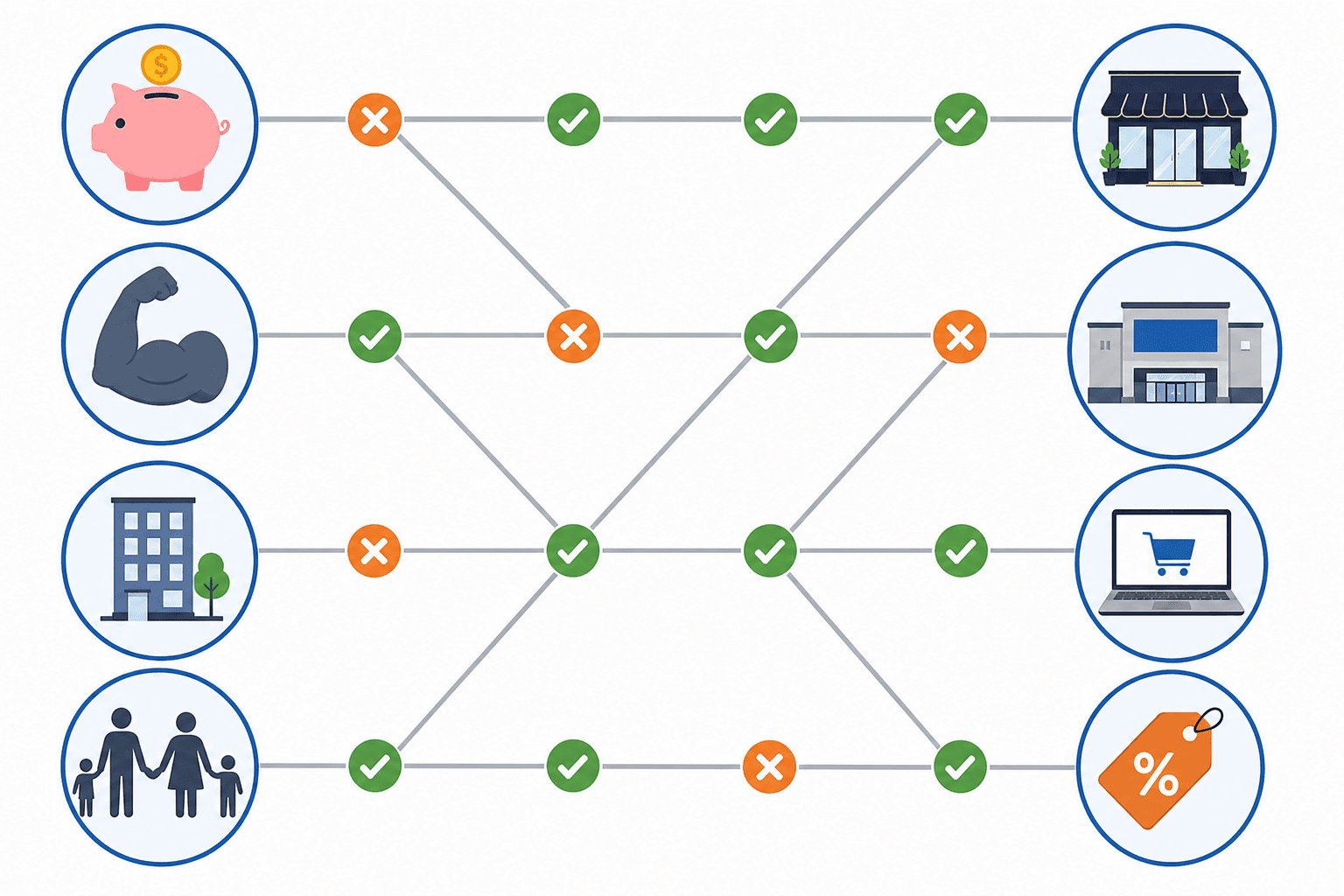
The right store type depends on who you are, what you are buying, and how much risk you can tolerate. The matrix below maps common buyer profiles to the recommended channel(s).
| Buyer Profile | Recommended Channel(s) | Budget Range | Best Equipment Categories |
|---|---|---|---|
| Budget-conscious first-timer | DTC online (under $500 tier) + used for plates/dumbbells | Under $500 | Adjustable dumbbells, bench, resistance bands, kettlebells |
| Serious lifter / strength athlete | DTC online (Rogue, REP, Titan) for rack/barbell/plates; specialty dealer for commercial cable machine | $1,000–$3,000 | Power rack, Olympic barbell, plate set, cable attachment |
| Apartment / small-space dweller | Big-box retailer for compact cardio; DTC online for folding rack; used for dumbbells | $500–$1,500 | Folding treadmill, compact exercise bike, adjustable dumbbells, resistance bands |
| Family / multi-user home gym | Specialty dealer for commercial-grade treadmill/bike; DTC online for rack and plates | $2,000–$5,000 | Commercial treadmill, exercise bike, multi-station cable machine, dumbbell set |
| First-timer (unsure of commitment) | Big-box retailer for easy returns; used for low-cost starter gear | $200–$800 | Basic treadmill, exercise bike, dumbbell set, yoga mat |
| Commercial-grade buyer (lifetime investment) | Specialty dealer for full setup with installation and service contract | $5,000+ | Commercial treadmill, elliptical, cable crossover, plate-loaded machines |
If you are still deciding what equipment to buy before choosing a channel, our Home Gym Equipment Types Explained guide breaks down each equipment category by training style, space requirements, and budget — so you can match gear to goals before matching stores to gear.
Red Flags by Store Type: What to Watch For
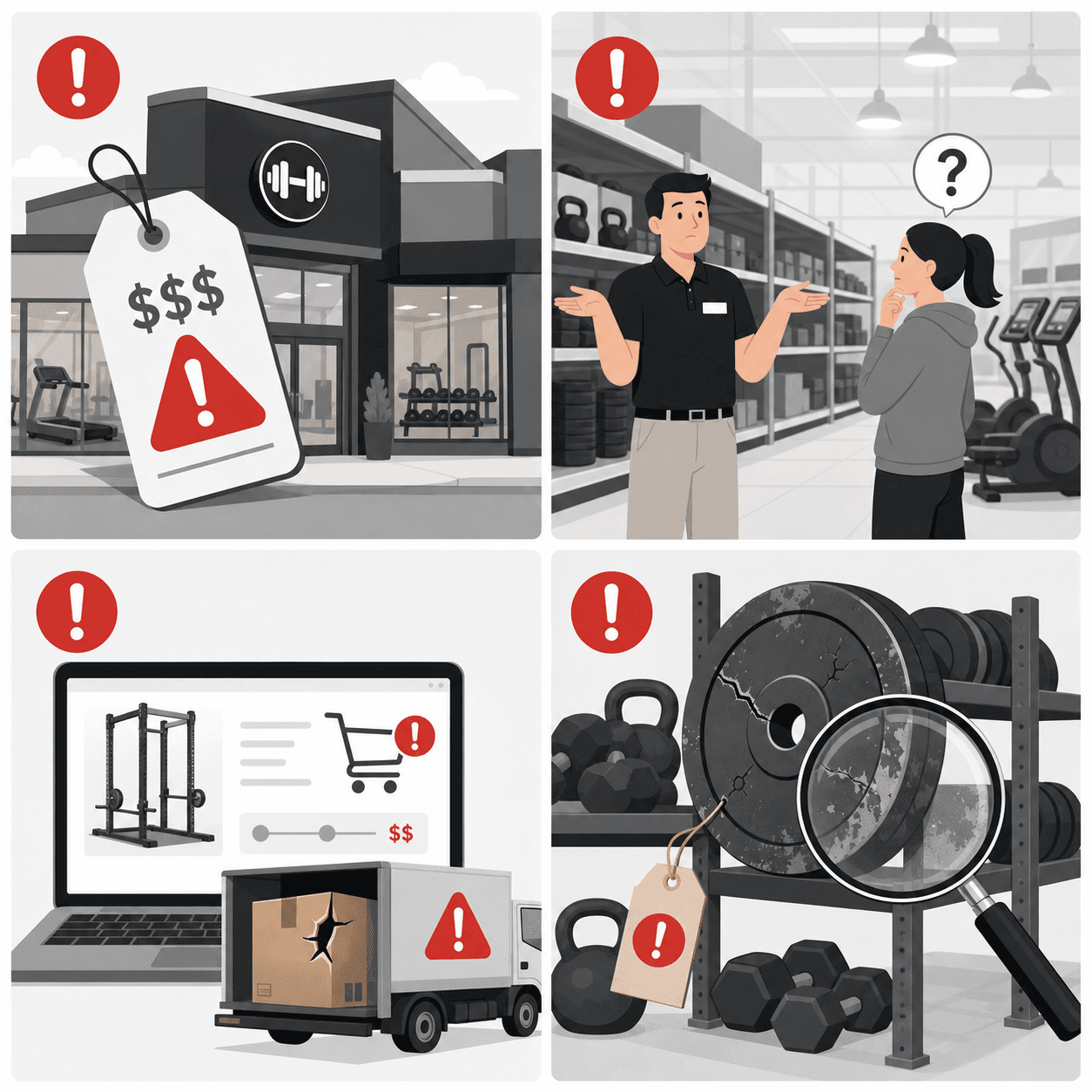
Every retail channel has its own failure modes. Knowing the red flags before you shop can save you from the most common and expensive mistakes.
Specialty Dealer Red Flags
- Pushy sales tactics — if the salesperson pressures you to buy today or offers a "one-time" discount, they are prioritizing commission over fit.
- No in-house service team — if they outsource installation and repairs to third parties, you lose the primary advantage of buying from a specialty dealer.
- Limited brand range — a dealer carrying only two or three brands cannot offer unbiased advice. They are effectively a brand showroom.
- Unclear warranty support — ask who handles warranty claims. If the answer is "call the manufacturer," you are not getting dealer-level service.
Big-Box Retailer Red Flags
- Unknowledgeable staff — if the salesperson cannot explain the difference between magnetic and friction resistance, or cannot compare two treadmills beyond price, you are on your own.
- Limited stock — floor models may be the only units available. If the model you want is online-only, you lose the try-before-you-buy advantage.
- No assembly support — some big-box stores sell equipment "in box" with no assembly option. For a treadmill or bike, that means hours of work or a $150+ third-party assembly fee.
- Expired or damaged floor models — equipment that has been on the sales floor for months may have worn belts, loose bolts, or dead console batteries. Ask how long the floor model has been in use.
DTC Online Brand Red Flags
- Unclear warranty and return policies — if the website buries the warranty terms or uses vague language like "limited lifetime," request the full policy in writing before purchasing.
- Excessive shipping costs — a $99 rack with $250 shipping is not a deal. Always check the total shipped price before comparing to other channels.
- No phone support — brands that only offer email or chatbot support are difficult to deal with when a shipment arrives damaged or a part is missing.
- No community or reviews — DTC brands thrive on community reputation. If a brand has no presence on Reddit, Garage Gym Reviews, or YouTube, there is a reason.
Used / Secondhand Market Red Flags
- Seller won't let you test — if the seller refuses to let you plug in a treadmill or test the full range of motion on a cable machine, walk away.
- Unusual noises — grinding, squeaking, or knocking sounds indicate worn bearings, bent frames, or failing motors. These are expensive to repair.
- Missing parts — a bench without the safety spotter arms, a rack without J-hooks, or a barbell without collars means additional cost and hassle to source replacements.
- DIY repairs — if the seller has painted over rust, welded a cracked frame, or replaced cables with non-standard parts, the equipment's structural integrity is compromised.
- No serial number — commercial-grade equipment has a serial number that can be used to verify the model year and original specs. Missing serial numbers may indicate stolen goods.
Comments
Join the discussion with an anonymous comment.