
The four-way test for a treadmill in an apartment
The online photo is usually the easiest part of buying a treadmill for home. The hard part is deciding whether the machine still makes sense when it is open, underfoot, and folded back into the room you actually live in.
| Type | Stored footprint | In-use footprint | Noise profile | Workout range |
|---|---|---|---|---|
| Walking pad | Very small; some models fit under a bed [1] | Low deck and low clearance needs, but still needs a clear walking lane [3] | Usually less imposing than a full treadmill, but footfall still matters [2] | Walking and light jogging rather than true running [1] |
| Compact folding treadmill | Folds smaller than a full-size deck; some still stand tall when stored [1] | More room than a walking pad, but can support real running if the room allows it [1] | Can be quiet enough for apartment use, but test results vary by floor and room [2] | Best compromise when running matters more than storage [1] |
| Full-size folding treadmill | Largest storage demand, even when folded [3] | Closest to a true running setup, with the clearance a real run needs [3] | Often the best bet for softer cushioning and lower perceived footfall [2] | Best for buyers who can accept the space cost [3] |
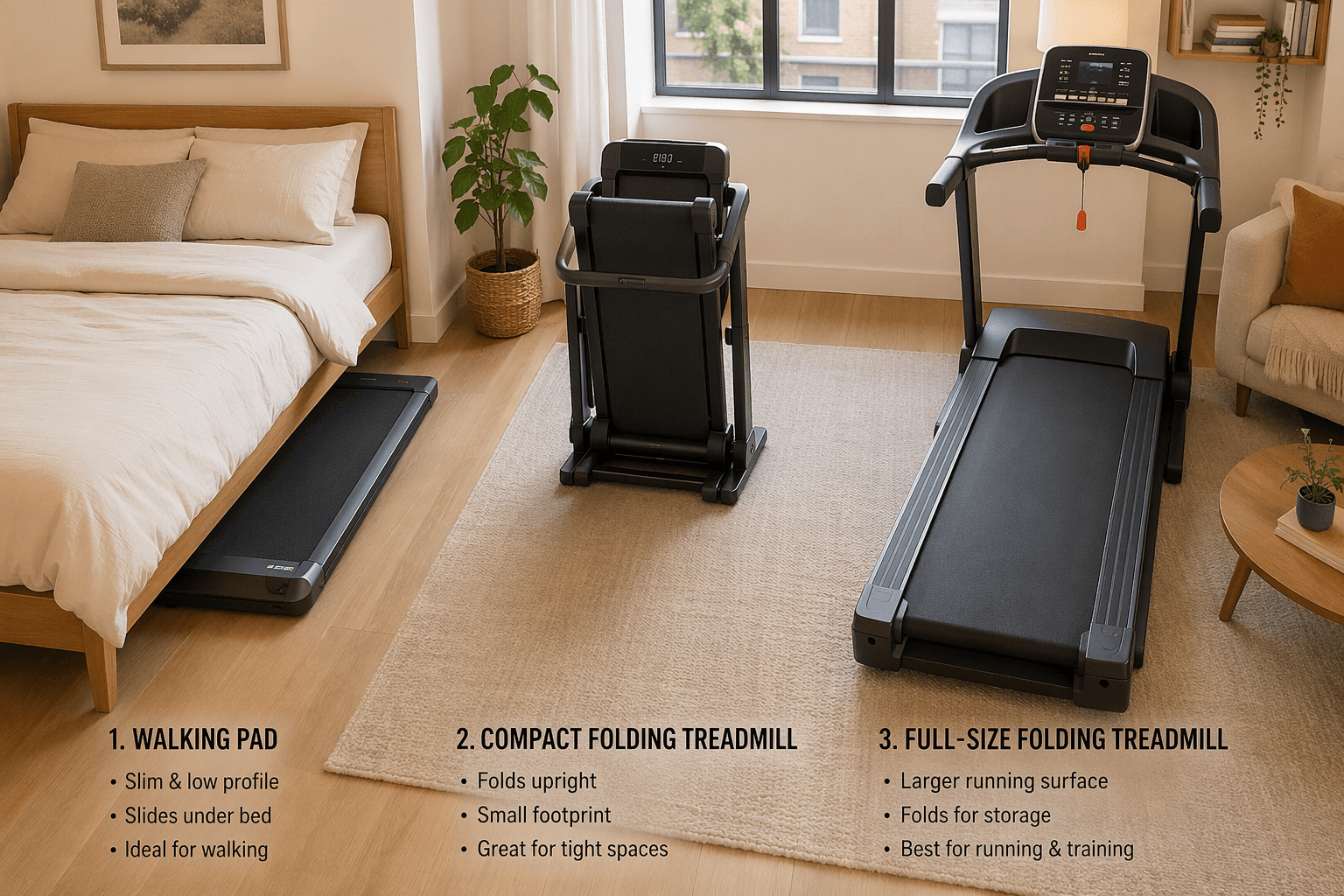
That is why the design details matter more than the label on the box. A WalkingPad X21 folds twice to 8.9 inches tall and can fit under most beds, but its 18-by-48-inch deck is built for walking or light jogging, not running [1]. The Echelon Stride-6s takes a different compromise: it folds to 10 inches tall, yet still offers a 3.0 HP motor and 12 mph speed, which is why it belongs in the compact-running category instead of the walking-pad category [1].
Room fit has two measurements, not one
A treadmill for home needs enough space when it is being used, and enough space when it is not. A standard home treadmill footprint is about 77 inches long by 35 inches wide, and safe use calls for at least 2 feet of clearance on each side and 6 feet behind the machine [3]. Ceiling height matters too: the practical formula is step-up height plus tallest user height plus 3 to 5 inches of headroom [3]. That is the part people skip when the listing says “compact,” then discover that a folded deck still blocks a doorway, a dresser, or the route they need every day.
Storage friction is not just about whether the treadmill disappears. It is about whether it becomes easy to move, easy to clear, and easy to keep out of the way without turning the apartment into a relay course. That is also where warranty terms become part of the room test: many manufacturers void warranties if treadmills are stored in non-climate-controlled garages, so a machine that seems space-saving on paper can become a bad fit in the wrong storage environment [3].
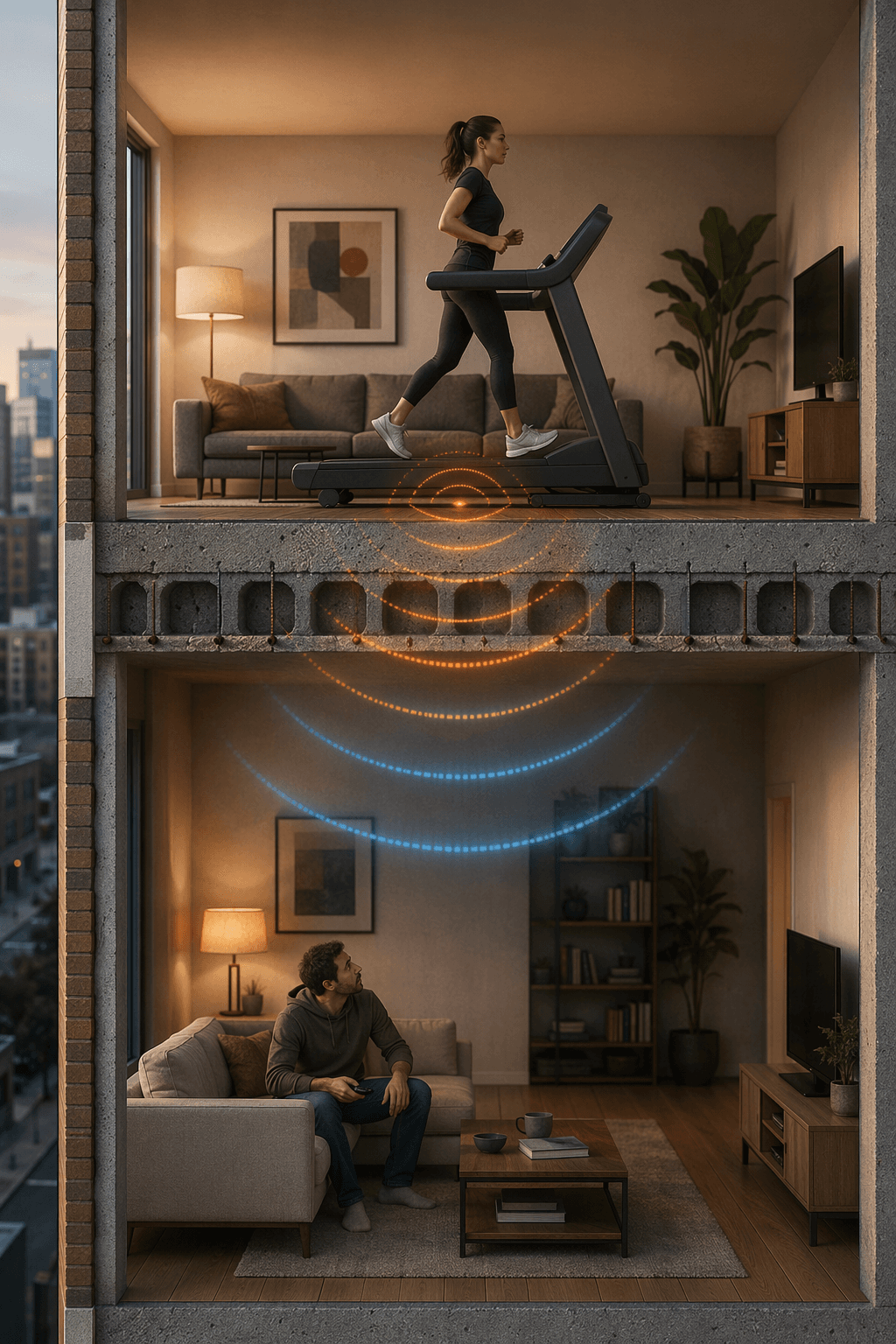
Noise is motor sound and footfall, not one number
The best quiet-treadmill data points are useful, but they are not universal promises. In third-party testing, the NordicTrack Commercial 1750 measured 50.8 dB at 3 mph, which is quieter than normal conversation, and its soft cushioning helps dampen footfall noise [2]. The Sole F80 measured 53.8 dB at walking speeds, and its Cushion Flex Whisper Deck is designed to reduce joint impact by 40% [2]. The Horizon 7.8 AT was noted for having the quietest motor in testing [2].
Those numbers help with relative comparison, but they do not freeze the result in place. Flooring type, room acoustics, pace, body weight, and the structure under the machine all change how a treadmill feels in an apartment. Motor noise and footfall noise behave differently, which is why a machine can sound fine in one room and feel intrusive in another even when the dB reading looks similar.
Workout capability is where the trade-off becomes obvious
The category choice becomes easier once the actual workout is named honestly. Walking pads win when the real goal is walking and the stored footprint has to stay minimal. Compact folding treadmills make sense when running is a genuine requirement, because they preserve more deck length and speed, but they still ask the buyer to live with a taller folded profile or a more complicated move in and out of storage. Full-size folding models are the strongest answer for serious running if the room can tolerate the space and the noise.
There is also a less obvious risk on the connected side of the market. Some compact treadmills tie core functions to an active membership; one example in the compact-running space is the Echelon Stride-8S, which is effectively unusable without the subscription layer [4]. That is not a reason to avoid every connected treadmill, but it is a reminder to treat ecosystem lock-in the same way you treat deck length or folded height: as part of the buying decision, not a surprise after delivery.
So the right choice is not the machine with the best all-around reputation. It is the one whose weakest compromise is the one you can actually live with. Choose a walking pad when storage and quiet walking matter most. Choose a compact folding treadmill when you want real running capability in a tight room. Choose a full-size folding model only when the clearance, ceiling height, and noise tolerance are honestly there.
References
- Best treadmill for home use guide — treadmillreviews.net — treadmillreviews.net
- Quietest treadmills noise-level testing — treadmillreviews.com — treadmillreviews.com
- Treadmill buying guide — garagegymreviews.com — garagegymreviews.com
- Best treadmill for running and closed vs open ecosystems article — runtotothefinish.com — runtotothefinish.com
Comments
Join the discussion with an anonymous comment.