
The best workout app for women who want to get stronger is the one that tracks weight progression and adjusts programming over time, not the one that cycles random daily workouts. For most home lifters, that makes Caliber the strongest all-around pick: it scored 4.6 out of 5 in Garage Gym Reviews’ women’s workout app testing, has a free-forever tier, offers Pro group coaching at $19 per month, and includes a library of more than 500 exercises.[1]
That does not make Caliber the right choice for every woman. Stronger By The Day is the better fit if you are committed to barbell strength and want powerlifting-style programming. Boostcamp is the best budget route if you want free access to established strength programs with real tracking. EvolveYou is better for someone who wants a polished, female-built training and nutrition ecosystem. TR[Ai]NER by Element 26 is useful if your equipment changes often and you want AI-generated plans, though its accountability score is weak.
What separates a strength app from a daily workout app
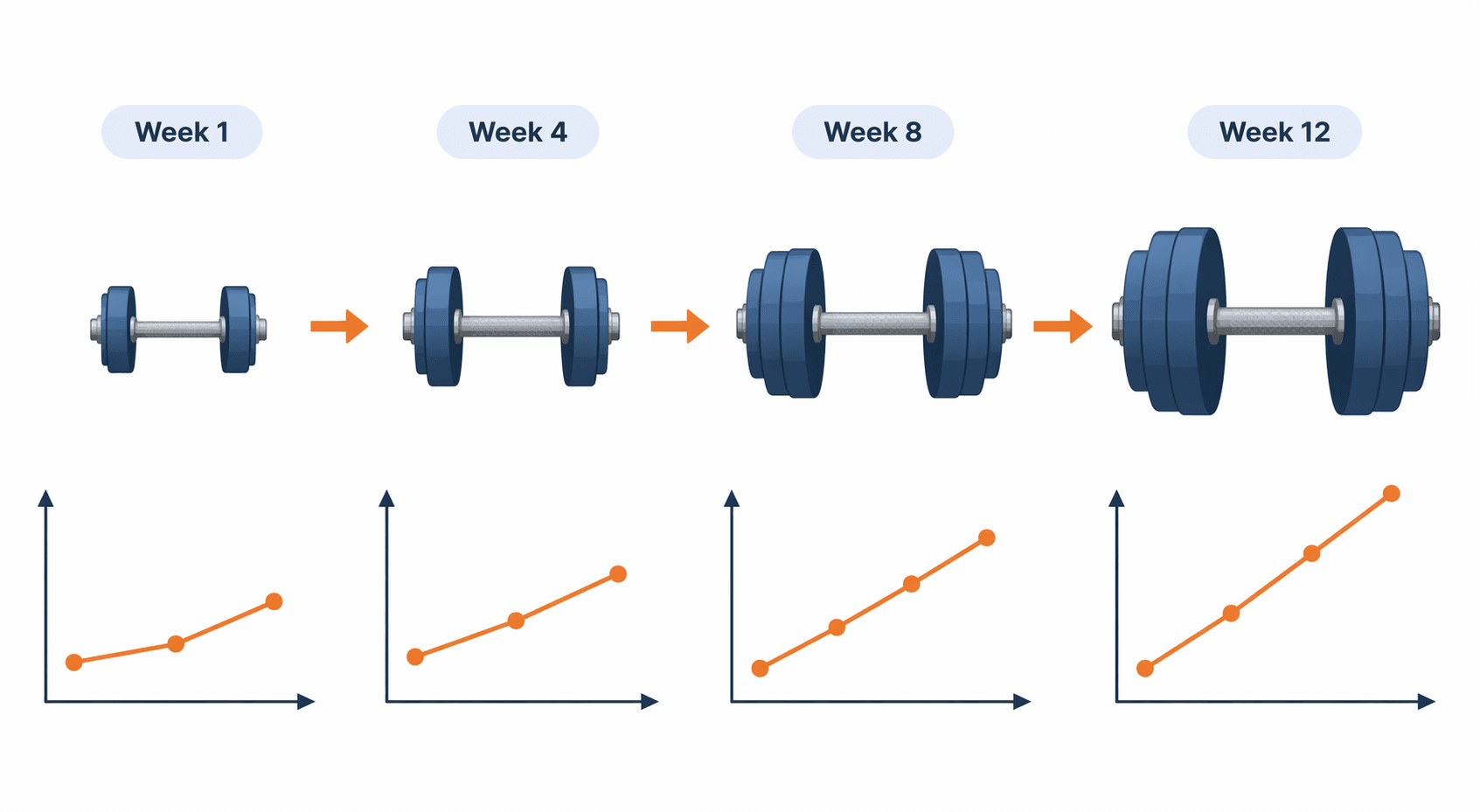
A strength app has to remember. If you goblet squatted 25 pounds for eight reps last week, the app should make that information useful: repeat the lift, add reps, add weight, adjust volume, or tell you when to hold steady. Without that loop, the app may still be good for movement, variety, confidence, or habit-building, but it is not doing the main job of strength programming.
Garage Gym Reviews makes this distinction explicitly, warning that some female-specific workout apps may not deliver the results users want and that progressive overload should come before gendered marketing when evaluating an app.[1] That is the right filter here. “For women” is only useful if it improves adherence, coaching clarity, exercise selection, or program fit. It does not replace the basic requirement that the training has to progress.
There is also a useful boundary to state plainly: the recurring view across major app roundups that women and men can train in broadly similar ways is expert editorial consensus, not a single experimental finding cited here. The safer conclusion is narrower. A woman who wants to get stronger should judge an app by the same programming questions any strength trainee would ask: does it track load, repeat lifts often enough, and give a reason for the next change?
Best workout apps for women, ranked by progressive overload quality
| Rank | App | Best for | Why it belongs here | Main limitation |
|---|---|---|---|---|
| 1 | Caliber | Most women strength training at home | 4.6/5 GGR score, free tier, optional $19/mo Pro group coaching, 500+ exercise library, and programming built around measurable progression.[1] | The best value is for users who will actually log workouts consistently. |
| 2 | Stronger By The Day | Women focused on barbell strength | $15/mo, powerlifting-focused programming from Meg Gallagher; CNET’s editor reported lifting more after pregnancy within one month of testing.[2] | Less ideal if you do not have barbell access or do not want strength to be the center of training. |
| 3 | Boostcamp | Budget-conscious lifters | Free plan, community and expert programs, 4.2 GGR score, and PR tracking plus volume analytics rated 5/5 by GGR.[1] | Program quality can depend on which plan you choose. |
| 4 | EvolveYou | A female-built training and nutrition ecosystem | $22.99/mo, Krissy Cela-led platform, 20+ programs ranging from 8 weeks to 67 weeks, plus customizable meal planning across 4 diet types.[2] | More ecosystem-driven than purely strength-specialized. |
| 5 | TR[Ai]NER by Element 26 | AI-customized home plans | $14.99/mo, AI-generated 4-week plans that adapt to available equipment.[1] | GGR scored it 1/5 on accountability, which matters if you need coaching pressure or check-ins.[1] |
Pricing changes often, and the figures above reflect reported pricing available in June 2026. Check the app’s current subscription screen before deciding, especially if an annual plan, trial, or coaching tier changes the effective monthly cost.
Caliber: best overall because the free tier still respects the training process
Caliber earns the top spot because it does not make strength progression a premium afterthought. The free-forever tier matters because many women deciding between apps are not trying to buy coaching on day one; they are trying to find out whether structured lifting will fit their week. Caliber lets that test happen without stripping the app down to a motivational shell.
Its 4.6 out of 5 Garage Gym Reviews score is not the only reason to choose it, but it supports the broader picture: Caliber combines structured programming, a large exercise library, and an optional coaching layer rather than relying on a rotating feed of workouts.[1] The 500-plus exercise library is useful for home training because equipment varies. A user with adjustable dumbbells, resistance bands, and a bench needs different substitutions than someone with only a pair of light dumbbells.[1]
The optional Pro tier at $19 per month adds group coaching, which is the right level of support for someone who does not need one-on-one personal training but does need feedback, structure, and a reason to stay with the plan when novelty wears off.[1] That is often where random workout apps fail. They can make the first two weeks feel fresh; they do less well when the question becomes whether your split squat, row, or deadlift pattern is actually improving.
Caliber is also the safest default if your home gym is still changing. If you are not sure whether you should choose a dumbbell-only plan, a barbell plan, or a mixed equipment setup, use a more equipment-specific decision process before subscribing. A separate guide to matching a strength training app to your home gym setup can help narrow that part of the decision.
Stronger By The Day: best if you want barbell strength to be the point
Stronger By The Day is less general-purpose than Caliber, and that is its advantage. It is a powerlifting-focused program from Meg Gallagher, priced at $15 per month in the cited CNET roundup.[2] If your goal is to build confidence under a barbell, improve the big lifts, and follow a plan that treats strength as the central outcome, it belongs above broader fitness apps with prettier interfaces.
The most concrete result in the available research is CNET’s personal test: an editor reported lifting more after pregnancy within one month of using Stronger By The Day.[2] That is a real case, not a general effectiveness claim. It does not prove that every user will gain strength in a month, and it does not separate the app’s programming from the tester’s prior training history, recovery, equipment access, or consistency. Still, it is the kind of observation that matters more than a vague claim about “toning.” The app was used for strength, and the reported change was strength.
The tradeoff is equipment and intent. If you train in an apartment with no barbell, Stronger By The Day may be more program than you can use well. If you do have a rack, plates, and enough training time, it is one of the clearest choices here because it does not have to pretend to be everything.
Boostcamp: best budget option when you are willing to choose the right program
Boostcamp’s appeal is not that it is the most hand-held app. It is that it gives budget-conscious users access to a large program marketplace without removing the tracking tools that strength training needs. Garage Gym Reviews gives Boostcamp a 4.2 score and rates its PR tracking and volume analytics 5 out of 5.[1]
That matters because personal records and volume are not vanity metrics in a strength app. They show whether the program is accumulating work in a way you can see. If your dumbbell Romanian deadlift moves from three sets of eight to heavier sets over time, the app should make that visible. If your pressing volume jumps too aggressively and your shoulders feel irritated, the app should help you notice the pattern before you assume you are simply “bad at upper body.”
The caution with Boostcamp is selection. A library of free programs can be a strength or a distraction. Choose a program with repeated lifts, clear progression, and a realistic schedule. If you keep switching plans every time a new coach or template looks interesting, the app cannot do the work of progressive overload for you.
EvolveYou: best when the ecosystem helps you stay consistent
EvolveYou is the strongest choice in this group for someone who wants a female-built platform that combines training, meal planning, and a polished app experience. CNET lists the Krissy Cela platform at $22.99 per month, with more than 20 programs ranging from an 8-week yoga program to a 67-week full strength program, plus customizable meal planning across four diet types.[2]
The long strength program is the detail that keeps EvolveYou in this article. A 67-week program at least signals that the app is not limited to short challenges and seasonal resets.[2] For a woman who wants training to sit inside a broader wellness routine, that can be more usable than a narrower lifting app.
It should not be mistaken for the most strength-specific pick, though. Nutrition planning, creator identity, and program variety can all improve adherence, but they do not automatically prove superior strength progression. Choose EvolveYou if the complete environment will make you follow the plan. Choose Caliber, Stronger By The Day, or Boostcamp if the main requirement is sharper load progression.
TR[Ai]NER by Element 26: best for equipment-aware customization, weaker for accountability
TR[Ai]NER by Element 26 is the most interesting pick for a common home-training problem: your equipment is not standard. You may have dumbbells but no bench, bands but no cable machine, or a hotel gym one week and a garage setup the next. The app offers AI-generated 4-week plans that adapt to available equipment and is listed at $14.99 per month in Garage Gym Reviews’ coverage.[1]
That customization is useful, but the accountability score is a real concern. Garage Gym Reviews rated TR[Ai]NER 1 out of 5 for accountability.[1] For a self-directed lifter who already logs workouts and rarely skips sessions, that may be acceptable. For someone who needs social pressure, coaching contact, or reminders with consequence, it is a poor match.
AI-generated programming should also be judged by what it does after the first plan is created. A plan that adapts to your equipment is helpful; a plan that adapts to your performance is more important for strength. Before paying, check whether the app makes your prior loads, reps, and completed sets part of future programming rather than only using your equipment list to build fresh workouts.
How to spot an app that only looks like strength training
A weak strength app usually reveals itself quickly. It may use strength language, show dumbbells in the preview photos, or promise lean muscle, but the weekly experience feels disconnected. Monday has squats, next Monday has a completely different lower-body circuit, and no one asks what you lifted last time.
- Look for repeated main movements. You cannot judge progress if every week is unrelated to the last.
- Check whether the app records weight, reps, sets, and personal records, not just calories or workout completion.
- Look for progression instructions. The app should tell you when to add weight, add reps, reduce rest, repeat a load, or deload.
- Be cautious with endless “daily burn” formats if strength is the goal. Variety can be motivating, but too much variety makes progression harder to measure.
- Check whether substitutions preserve the training effect. Replacing a heavy hinge with a light cardio move is not the same as adapting a strength session.
This is also why app store ratings are not enough for this decision. A highly rated app may be excellent for habit-building, beginner confidence, or short home workouts while still being weak for progressive overload. The question is not whether users enjoy it. The question is whether the app helps you lift more over time.
Which one should you choose?
Choose Caliber if you want the safest all-around strength app for home training, especially if you want to start free and add coaching only when you need it. Choose Stronger By The Day if you have barbell access and want a program organized around serious lifting. Choose Boostcamp if budget matters most and you are comfortable selecting a structured program from a larger library.
Choose EvolveYou if you are more likely to stay consistent inside a broader training and nutrition environment. Choose TR[Ai]NER if your equipment changes often and customization matters more than coaching accountability.
If you are an absolute beginner and still deciding whether you need strength, cardio, mobility, or habit support first, start with a broader orientation to the best fitness apps for beginners in 2026. If you already know you want home workouts but are choosing between zero-equipment and minimal-equipment plans, compare workout apps for women at home before committing. For a wider view across goals beyond strength, see the guide to the best exercise apps by training goal.
For strength, though, the decision is narrower. Pick the app that records what you did, repeats the lifts that matter, and gives you a credible next step. That is where an app starts behaving like a program.
References
- Best Workout App For Women 2026, Garage Gym Reviews
- Best Workout Apps for Women, CNET
Comments
Join the discussion with an anonymous comment.