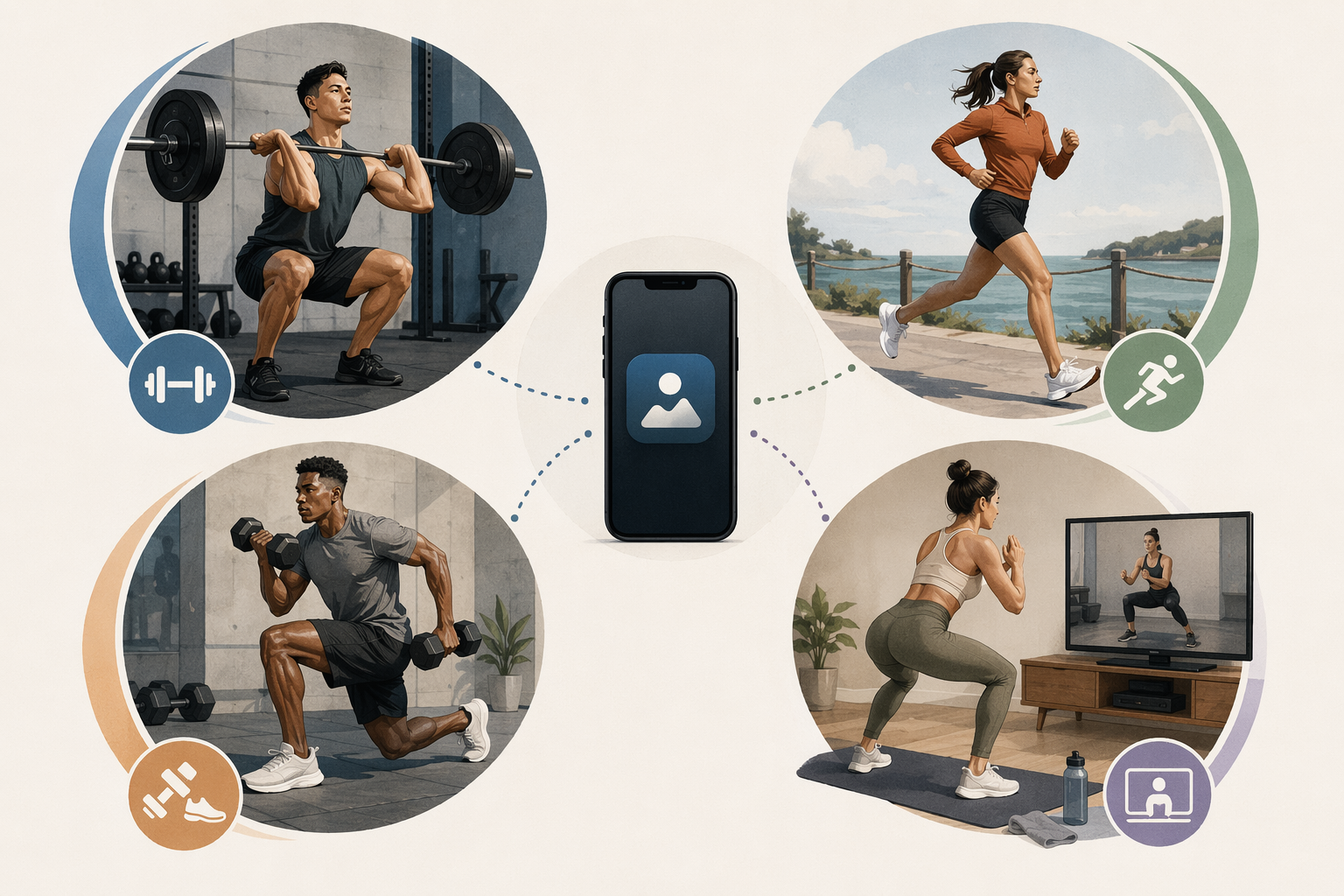
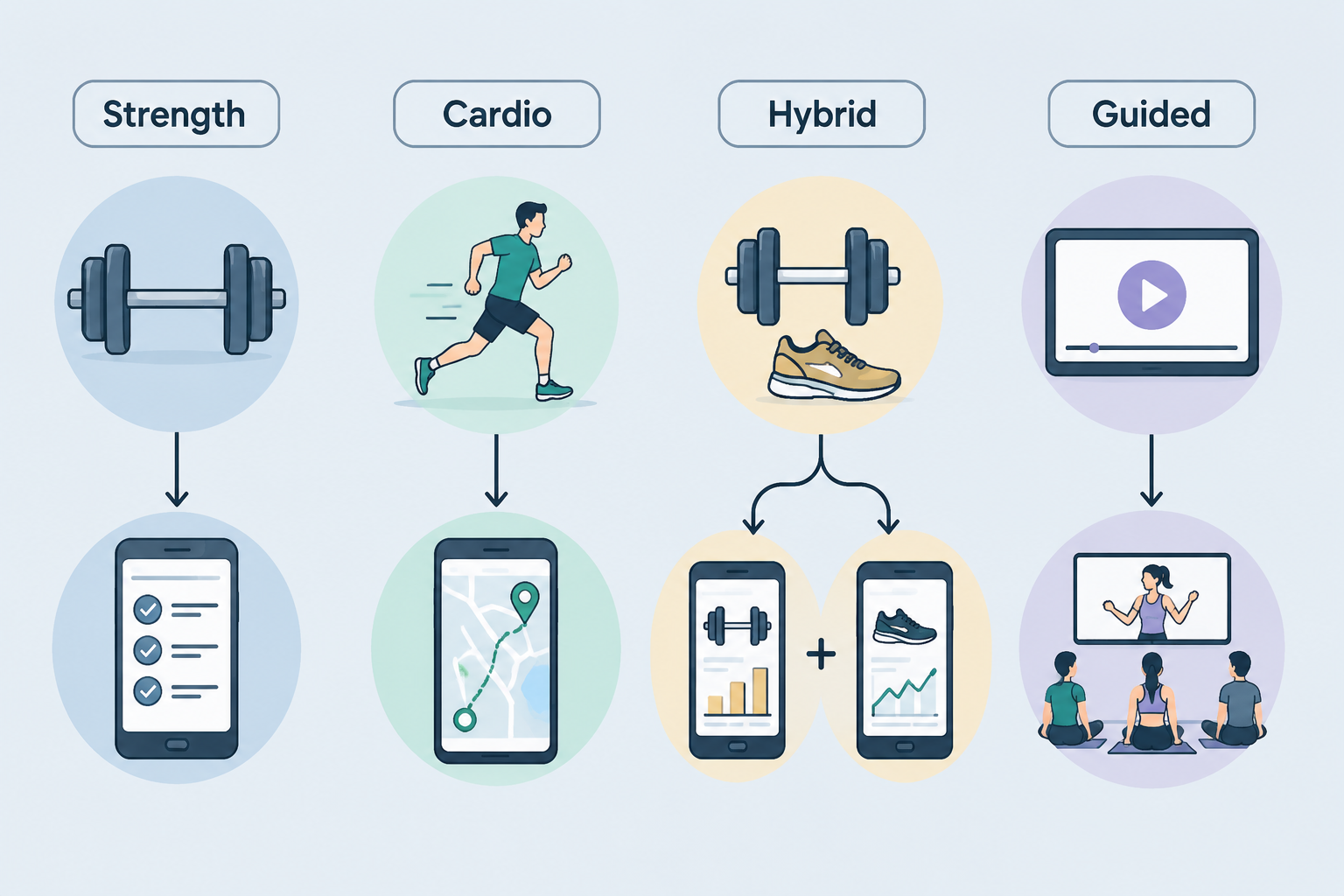
The fastest way to choose the wrong workout tracker app is to ask for the “best overall” one before deciding what you need it to track. A lifter needs fast set entry and useful history. A runner needs reliable GPS, route context, and device sync. A hybrid athlete may need two apps that are each good at one job. Someone following classes needs instruction more than granular logging.
That is why price and popularity come second here. A free app can still be a bad fit if it makes every squat session feel like data entry. A famous cardio platform can still be nearly useless as a barbell log. Start with your training style, then compare apps inside that lane.
| Training style | Best app type | Apps to start with | Logging depth | Instruction depth | Price position | Best for |
|---|---|---|---|---|---|---|
| Strength training | Strength logger | Hevy, Strong, JEFIT, Boostcamp, StrengthLog | High for sets, reps, exercises, routines, and history | Varies by app | Strong free and low-cost options exist | Lifters who care about repeatable sessions and progression |
| Running, cycling, endurance | Cardio tracker | Strava, Zwift, Map My Fitness | High for GPS, routes, segments, devices, and activity feeds | Low to moderate | Free and paid tiers vary | Outdoor runners, cyclists, and indoor riders who need route or ride context |
| Hybrid training | Specialist pairing or mixed-program app | Hevy plus Strava, or Fitbod | High if paired; moderate-to-high if using Fitbod | Moderate | Pairing can be low-cost; Fitbod has no true free tier | People who lift and do cardio every week |
| Guided workouts | Class platform | Nike Training Club, Apple Fitness+, Peloton App One, FitOn | Low for detailed strength logs | High | Nike Training Club and FitOn have strong free appeal; others are paid | People who want to be led through sessions |
If You Lift, Choose a Strength Logger First
Strength training exposes weak tracking design quickly. During a normal lifting session, the app has to stay out of the way while you repeat movements, change loads, adjust reps, swap accessories, and rest. If logging one back-off set takes more attention than the set itself, the app will probably not survive past the novelty phase.
Hevy and Strong sit at the front of this category because they are built around the thing lifters repeat most: entering sets. Hevy and Strong both carry 4.9 ratings across iOS and Google Play, with 500,000-plus and 125,000-plus reviews respectively, making them the strongest satisfaction signals among strength-specific trackers in the available comparisons.[1][2]
The difference is feel. Strong is the cleaner choice if you want the fastest possible logging screen and a minimalist interface. That matters more than it sounds. A strength app can have charts, templates, timers, and history, but the screen you touch between sets is the product. Strong’s own positioning emphasizes a simple, fast workout tracker, and that matches where it is most useful.[2]
Hevy is slightly more social and generous on the free side. Its free tier includes unlimited workouts, three-month history, and social features, while premium is listed at $2.99 per month in the comparison material.[1] For a lifter who wants a real log without immediately paying a typical subscription price, that is a meaningful distinction.
JEFIT goes in a different direction: breadth. Its library includes 1,400-plus exercises with equipment tagging, and the company reports 20 million-plus downloads and 12 million-plus community members.[3] Those user and download counts should be read as marketing figures rather than active-user proof, but the exercise-library advantage is still useful if your training includes machines, cables, dumbbells, substitutions, or less common accessory work.
Boostcamp is better treated as a programmed-routine app than as a blank notebook. If you want routines from established coaches and do not want to build every training block yourself, it belongs on the shortlist. That is a different problem from logging your own upper-lower split, and the app choice should reflect that.[1]
StrengthLog is the quiet value pick. It offers an ad-free free experience, 450-plus exercises, 200-plus training programs, and no routine caps.[4] That combination matters for lifters who hate feeling pushed into an upgrade the moment they create a second routine.
If you are still comparing strength apps by budget, it helps to separate logging from coaching. A cheap log can be excellent if you already know your plan. A more guided app may be worth paying for if programming is the part you keep avoiding. For deeper strength-only comparisons, the site’s best strength training app guide and limited-equipment home gym app guide are better next stops than another generic app ranking.
Strength App Shortlist
- Choose Hevy if you want a strong free tier, social features, and a modern strength log.
- Choose Strong if speed, minimalism, and low-friction set entry matter most.
- Choose JEFIT if exercise-library breadth and equipment filtering are central to your training.
- Choose Boostcamp if you want to follow programmed strength routines rather than write your own.
- Choose StrengthLog if you want an ad-free free experience with a large program library.
If You Run or Ride, the Tracker Is Mostly About Context
Cardio tracking has a different center of gravity. A runner or cyclist does not just need a record that a workout happened. They need distance, pace, route, elevation, segments, heart-rate device sync, and enough history to see whether the same loop is getting easier or just windier.
That is why Strava keeps showing up at the top of running and cycling recommendations. PCMag, CNET, and Garage Gym Reviews all identify Strava as the leading running and cycling tracker in their 2026 roundups, with segment leaderboards and social accountability repeatedly standing out for endurance athletes.[5][6][7]
The bigger practical advantage is the device ecosystem. Strava integrates with Garmin, Wahoo, Zwift, Peloton, Fitbit, Apple Watch, Oura, Polar, Suunto, Coros, and Amazfit, among others.[7] That matters because cardio data often starts somewhere else: a watch, a bike computer, a treadmill, a smart trainer, or a ring. The app becomes the place where those sessions land and make sense together.
Strava is not a great strength log, and it does not need to be. Its job is to make outdoor and endurance work visible: the route, the segment, the friend who rode the same climb, the weekly mileage that quietly crept up. For people who run or ride consistently, that context is not decoration. It is often the reason the app gets opened again.
Zwift is the better fit when the cardio problem is indoor boredom. It offers gamified indoor cycling and running across 11 virtual worlds.[7] That does not make it a general workout tracker; it makes it a strong environment for people whose real training happens on a trainer or treadmill and who need the session to feel less like staring at a wall.
Map My Fitness is the breadth play. Under Armour’s platform supports GPS tracking across 600-plus activities.[7] That makes more sense for the person who hikes, walks, runs, rides, rows, and occasionally records something that does not fit cleanly into a runner’s app. Breadth is the feature; depth depends on the activity.
Hybrid Athletes Should Not Be Afraid of Two Apps
If your week includes lifting and cardio, the neatest dashboard is not automatically the best system. A three-day lifting plan plus two runs asks for two very different kinds of tracking. One app needs to remember that your incline dumbbell press moved from 70s to 75s. The other needs to know where you ran, how fast, and what your watch recorded.
The clean specialist recommendation is Hevy plus Strava. Hevy’s own comparison guide explicitly recommends pairing Hevy for strength with Strava for cardio rather than forcing everything into an all-in-one tool.[1] That is not a defeat. It is often the least annoying setup because each app handles the part it was built for.
Fitbod is the more unified option if you want one app to generate mixed programming. It uses AI to create programs that integrate strength, cardio, and recovery, adjusting around available equipment and recovery state; Garage Gym Reviews gives it a 5 out of 5 for equipment demands.[7] The tradeoff is price and control: Fitbod has a three-workout trial and is listed at $15.99 per month, with no true free tier.[7]
That makes the hybrid choice fairly simple. If you already know what you are doing, pair specialists. If you want the app to make more programming decisions and you accept the subscription, try Fitbod. If you are comparing AI coaching, human programming, and pure tracking, the site’s AI vs. human vs. tracker strength app guide gives that decision more room.
Guided Workout Apps Are a Different Product
Guided platforms are useful, but they should not be graded like logs. Their value is the workout itself: the coach, the video, the pacing, the playlist, the decision relief. If you press play and follow along, you may not care that the app cannot preserve every set, load, rest time, and substitution.
Nike Training Club is the easiest recommendation for people who want guided sessions without a subscription. Since 2020, it has been fully free with no premium upsell, and it includes 300-plus guided workouts across strength, HIIT, yoga, Pilates, and mobility with certified trainers.[6][8] The catch is important: it is not a detailed strength logger. If your main goal is progressive barbell tracking, Nike Training Club is the wrong kind of good app.
Apple Fitness+ and Peloton App One are stronger if you want a paid class ecosystem. Apple Fitness+ offers 5,000-plus classes at $10 per month, while Peloton App One is listed at $13 per month with live and on-demand classes.[5][8] FitOn is notable because it provides free live classes, which keeps it relevant for people who want instruction before they want analytics.[8]
This is where a lot of “best workout tracker app” lists get messy. A class app can be excellent at getting you moving and still weak at performance logging. That is not a flaw if you want coaching. It is a problem only if you expected the app to behave like a training journal.
Why the App Market Feels More Confusing Than It Should
The category is crowded enough that rankings alone become noisy. Garage Gym Reviews tested 70-plus apps across 14 categories, Forbes Health evaluated 40-plus apps using its own methodology, and PCMag and CNET both published expert-tested 2026 roundups.[7][8][5][6] Those reviews are useful, but their scoring systems do not all reward the same thing. A class library, a wearable integration, and a fast barbell log are not interchangeable features.
There is also a real behavior signal behind tracking, even if it should not be overstated. A 2023 peer-reviewed study found that fitness tracking app users had nearly twice the odds of meeting aerobic activity guidelines, with an odds ratio of 1.91.[9] That is an association, not proof that downloading an app causes someone to train consistently. Still, it supports the common-sense idea that useful tracking and activity behavior often travel together.
Money explains some of the noise too. Business of Apps reported fitness app market revenue of $3.4 billion in 2025, up 24.5% year over year, while Grand View Research estimated the broader market at $12.1 billion.[10][11] In a market that large, apps have every reason to describe themselves broadly. The user has to be narrower.
Pricing also shifts. The figures here are current to the June 2026 material in the research set, but regional pricing, annual discounts, and promotions can change quickly. Garage Gym Reviews cites an average paid workout app cost of $34 per month, yet several strong options in this guide are free, under $5 per month, or usable without paying immediately.[7] Price matters after the app clears the fit test.
Choose the Lane Before the Logo
For most intermediate exercisers, the decision is not mysterious once the categories are separated. Lifters should start with Hevy, Strong, JEFIT, Boostcamp, or StrengthLog. Runners and cyclists should start with Strava, then look at Zwift for indoor training or Map My Fitness for broad activity tracking. Hybrid athletes should either pair a strength logger with Strava or accept Fitbod’s paid all-in-one model. Class followers should choose Nike Training Club, Apple Fitness+, Peloton App One, or FitOn without pretending those apps are detailed training logs.
No single workout tracker app wins across all four styles. The best choice is the one that still feels usable in week six, when the app is no longer new and the only thing that matters is whether it fits the training you actually do.
References
- HevyApp comparison guide, HevyApp.
- Strong Workout Tracker, Strong.
- JEFIT, JEFIT.
- StrengthLog, StrengthLog.
- Best Fitness Apps, PCMag, 2026.
- Best Workout Apps, CNET, 2026.
- Best Workout Apps, Garage Gym Reviews, 2026.
- Best Fitness Apps, Forbes Health.
- Fitness tracking app use and physical activity guideline adherence, PMC, 2023.
- Fitness App Revenue and Usage Statistics, Business of Apps, 2025.
- Fitness App Market Size, Grand View Research.
Comments
Join the discussion with an anonymous comment.