
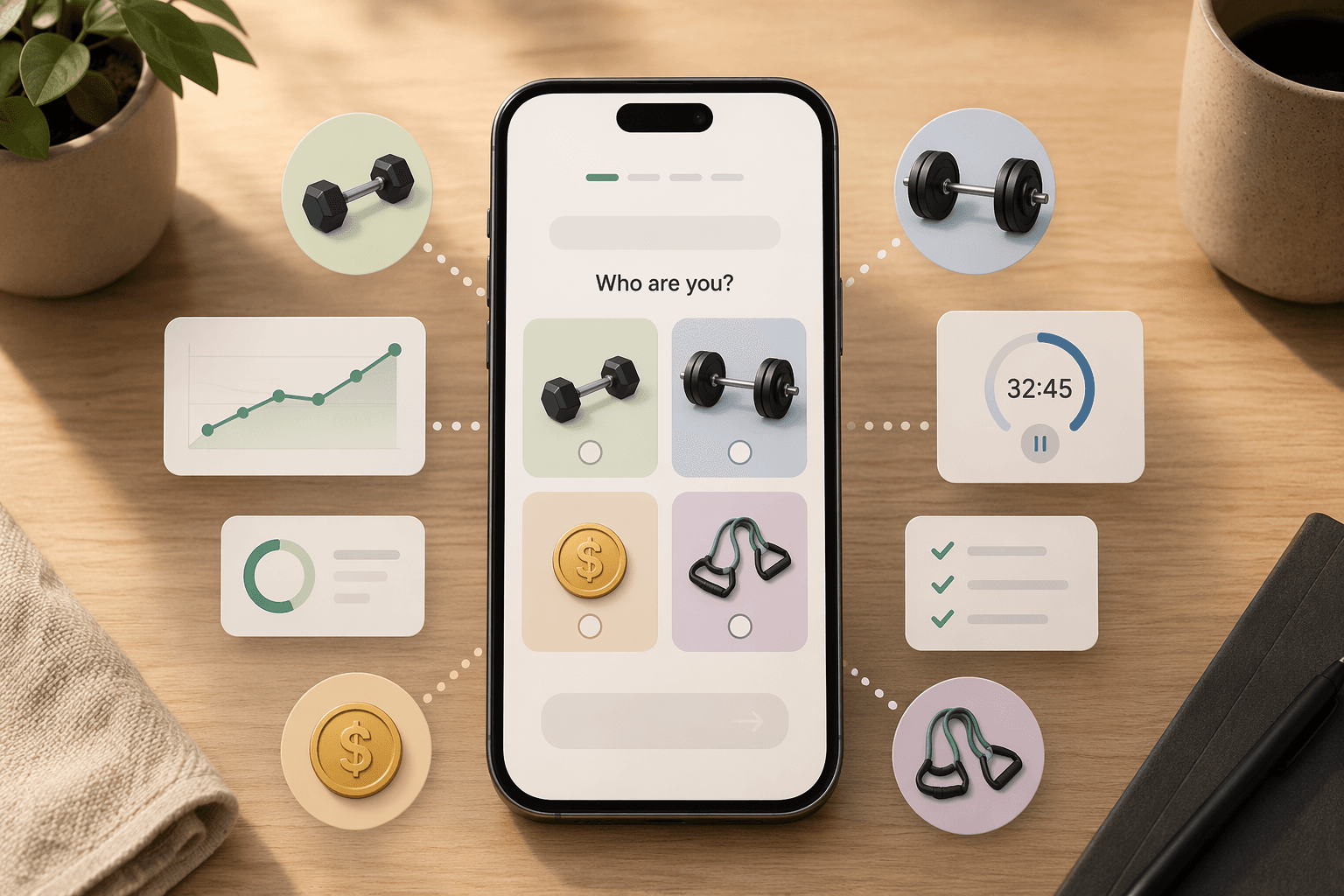
The best strength training app is not the one with the longest feature list. It is the one that still makes sense when you are tired, short on time, working with the equipment you actually own, and staring at a price screen you did not expect.
If you want the shortest defensible answer: Caliber and Shred App are the strongest all-around picks from major tester panels, but “all-around” does not mean “best for everyone.” Caliber earns that label because it pairs a useful free tier with optional coaching, while Shred App is a polished paid option for people who want structured workouts without buying into full human coaching. Garage Gym Reviews rated Caliber 4.6 out of 5 in its 2026 workout app testing and Shred App 4.28 out of 5 in its weightlifting app testing, with Shred priced at $9.99 per month in that review window.[1][2]
That still leaves a lot of people who should ignore the “best overall” label. An experienced lifter who already knows how to program may get more from Hevy’s free logging and progress graphs than from a guided app. A true beginner may need StrongLifts 5x5 because it removes choices instead of adding them. A barbell-focused lifter may be better served by JuggernautAI. Someone who wants accountability may need Future or Caliber Premium, which are closer to remote coaching than ordinary app subscriptions.
Start With Your Constraint, Not the App Ranking
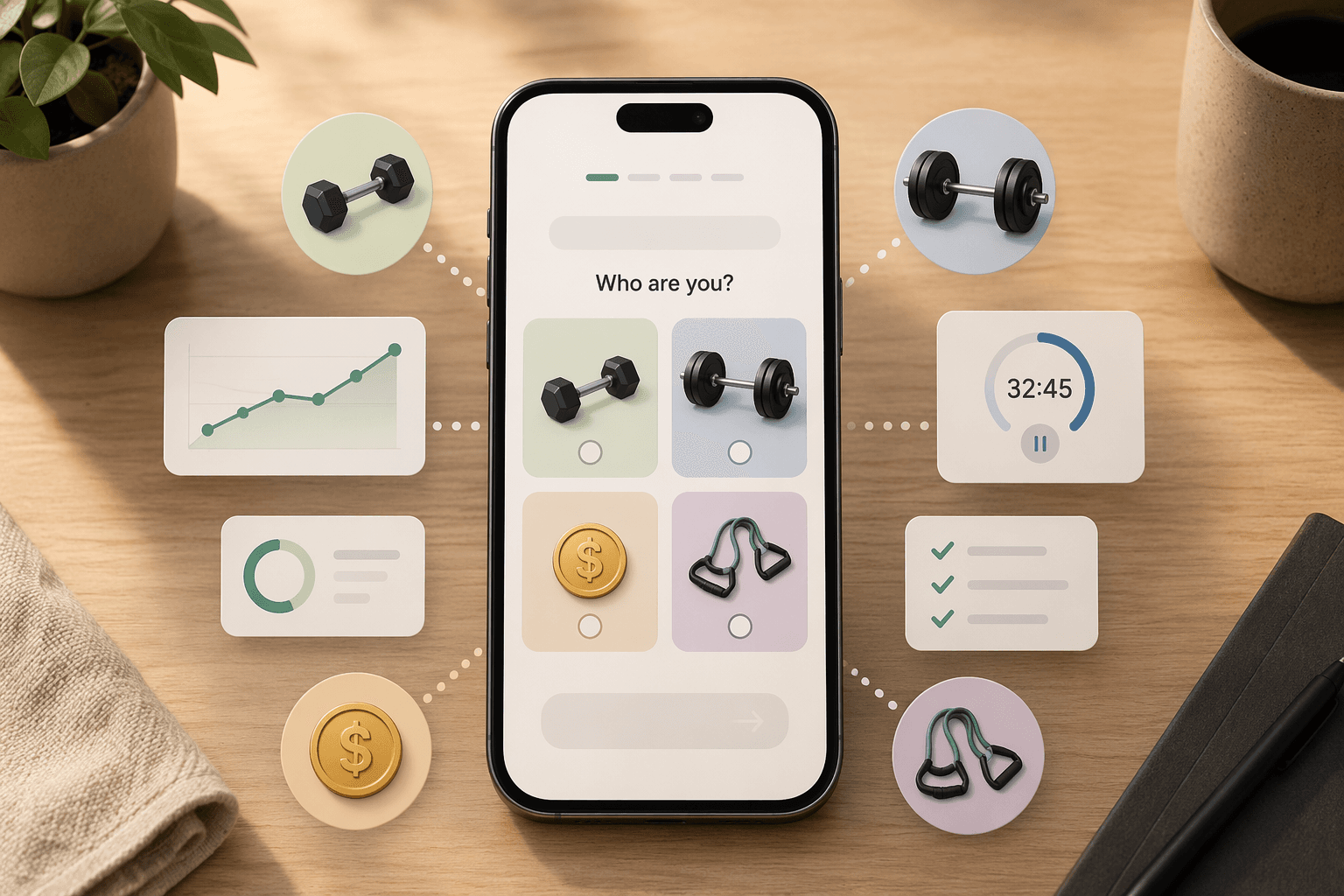
Most bad app choices start with the same mistake: comparing apps before naming the constraint. The important question is not “Which app has the most features?” It is “Which app removes the problem that keeps interrupting my training?”
| If this sounds like you | Start here | Why | Watch out for |
|---|---|---|---|
| You want the best all-around strength app | Caliber or Shred App | Both show up strongly in tester-panel recommendations; Caliber has a meaningful free tier and coaching options, while Shred is a lower-cost guided paid app | “Overall” only helps if the app’s guidance level and price match your routine |
| You already know how to train and mainly need a logger | Hevy | Its free tier covers workout logging, progress graphs, and social features | It is not mainly a beginner teaching system |
| You are new and want fewer decisions | StrongLifts 5x5 | It gives a simple linear progression around five barbell lifts | It has a clear shelf life once beginner progress slows |
| You want adaptive AI-style programming | Fitbod | It adjusts training volume around muscle recovery and has a large exercise library | Its recovery model can miss non-strength fatigue and specialized lifting needs |
| You are serious about barbell strength | JuggernautAI | It adjusts loads from daily fatigue, soreness, and motivation inputs | It expects access to a barbell, rack, and bench |
| You want accountability from a person | Future or Caliber Premium | These are closer to remote coaching than a simple tracker | The price is in a different category from ordinary apps |
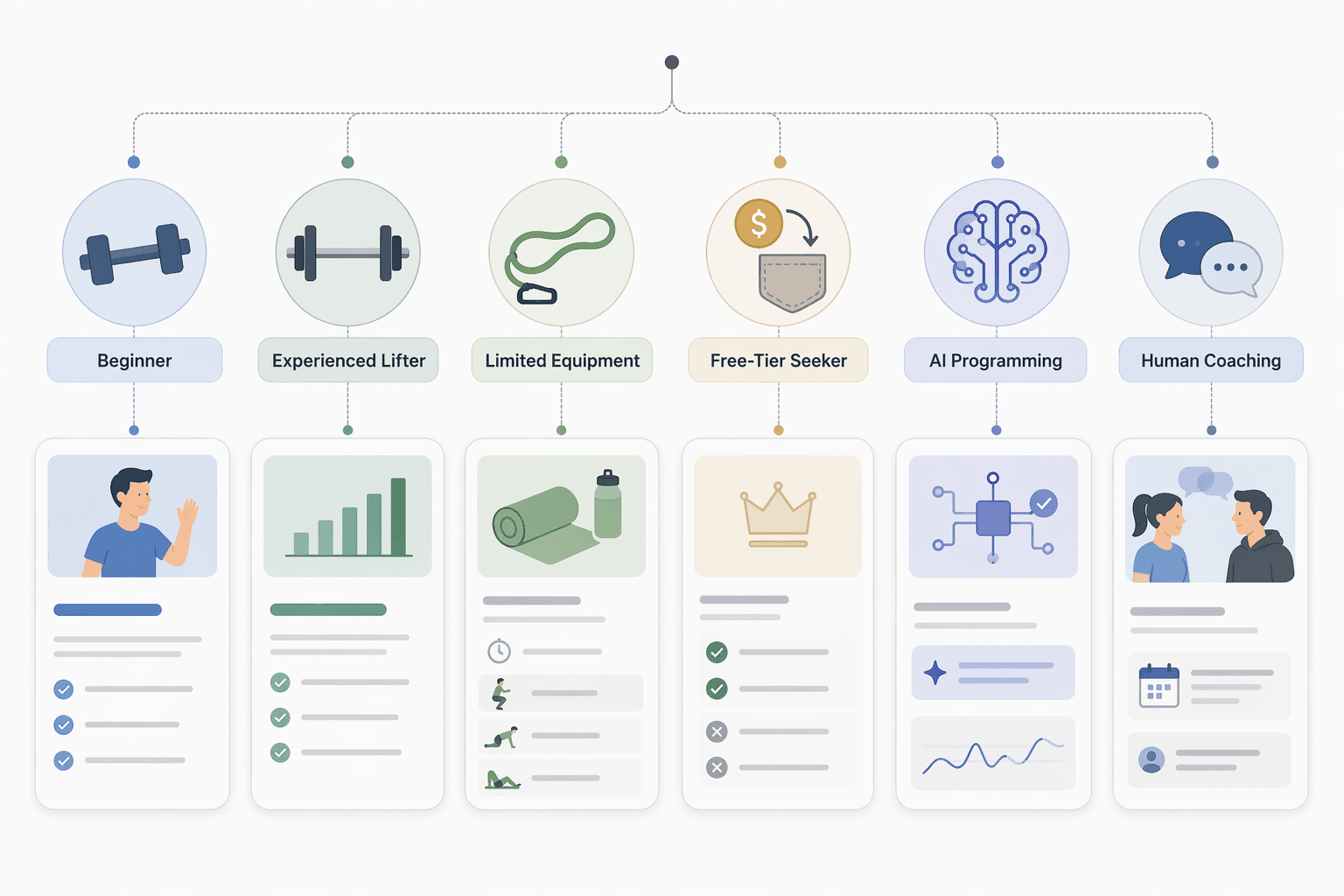
If you want a more formal way to sort those constraints, the companion guide on how to choose a strength training app is useful. For this comparison, the practical split is simpler: beginner versus experienced, free versus paid, limited equipment versus full gym, AI programming versus human coaching.
The Best Overall Picks: Caliber and Shred App
Caliber is the easier “best overall” pick to defend because it spans more user types. Its free tier gives users a real path into workout tracking and strength programming without immediately forcing a subscription, and its paid coaching tiers create a bridge for people who want more accountability. Garage Gym Reviews listed Caliber with a free tier and coaching options from $19 to $200 per month, depending on the level of support.[2]
That range matters. A $19 app subscription and a $200 coaching plan are not the same purchase, even if they live under the same brand. At the lower end, Caliber competes with structured app programming. At the upper end, Caliber Premium belongs in the same mental bucket as remote personal training, where the question becomes whether feedback, accountability, and plan adjustments justify the monthly cost.
Shred App is the cleaner pick for someone who wants a polished strength-training experience at a much lower monthly price than human coaching. GGR’s 2026 weightlifting app testing listed Shred at $9.99 per month and rated it 4.28 out of 5.[1] That makes it appealing for lifters who want direction without building every session from scratch, but who are not asking a coach to review their life, schedule, and recovery.
The tradeoff is that neither app escapes the usual “overall pick” problem. Caliber can be more app than a simple logger needs. Shred can be less individualized than a person who needs coaching imagines. If you already know your lifts, sets, and progression rules, paying for guided structure may feel like buying instructions you will ignore.
Best Free Option for Experienced Lifters: Hevy
Hevy is the app I would point to first for experienced lifters who are not looking for an app to teach them how to train. Its value is in logging workouts, tracking progress, reviewing graphs, and using social features. LoadMuscle and FindYourEdge both identify Hevy’s free tier as a strong free option, with Pro listed at $2.99 per month in the available testing material.[3][4]
That is a very different kind of recommendation than “best strength coach in your pocket.” Hevy is strongest when the user already has a plan or at least understands how to choose exercises, sets, and progression. In that case, the app’s job is to make the record easy enough that you actually keep it.
For a budget lifter, that can beat a more impressive paid app. A free logger that you open every session is worth more than an adaptive program you abandon after the trial. If your main need is free workout tracking, the broader guide to free workout apps for home training may be a better rabbit hole than another premium-app comparison.
Best Beginner Shortcut: StrongLifts 5x5
StrongLifts 5x5 is best understood as a beginner shortcut, not a forever training system. Its appeal is that it narrows the early lifting problem to a small set of barbell lifts and automatic linear progression. For someone who is overwhelmed by exercise libraries and program templates, that simplicity is the feature.
The same simplicity creates its expiration date. Tester reports describe a typical shelf life of about 3 to 6 months before many lifters need more nuance than automatic linear progression provides.[5] That does not make StrongLifts a bad app. It makes it a good app for a specific phase.
Beginners who are still deciding between very simple progression, guided workouts, and coaching should use a beginner-specific comparison rather than trying to decode advanced app features. The beginner strength training app guide is the better next step if you are still learning the lifts, not merely choosing software.
Best Adaptive AI Pick With Caveats: Fitbod
Fitbod is interesting because its promise matches a real training annoyance: deciding what to do when you are sore, under-recovered, or training with different equipment than usual. BarBend and GGR describe Fitbod as using adaptive programming around muscle recovery, with a library of more than 900 exercises and pricing in the $12.99 to $15.99 per month range in the cited testing windows.[1][6]
That mechanism can be useful. If you trained legs hard, the app can steer volume elsewhere. If you only have dumbbells, it can work inside that limitation. For home lifters who do not want to write a program but also do not want the same static routine every week, Fitbod has a clear job.
The caveat is that “adaptive” is not the same as omniscient. The testing summaries note blind spots around non-strength training load and Olympic lifting. If a hard run, poor sleep, sport practice, or technical barbell work changes what you can handle, the app may not interpret that as well as a skilled coach or an honest lifter would.[6]
This is where AI app marketing can get ahead of the evidence. Reviewer-reported outcomes are useful, but they are not controlled clinical proof that an algorithm produces better strength results for every user. If you are choosing between adaptive software and a coach, the AI versus human strength coach comparison is the more focused decision point.
Best for Serious Barbell Training: JuggernautAI
JuggernautAI is not trying to be the easiest app for someone with one pair of adjustable dumbbells. Its strength is more specific: barbell-focused programming that changes based on daily inputs such as fatigue, soreness, and motivation. In GGR tester Amanda Capritto’s year-long review, JuggernautAI was priced at $35 per month and required access to a barbell, rack, and bench.[7]
That equipment requirement is not a footnote. It decides whether the app belongs on your shortlist at all. If you train in a garage gym with a rack, bench, plates, and a clear strength goal, JuggernautAI’s seriousness is a benefit. If you train in a small apartment with bands and dumbbells, the app may be asking you to live in a gym you do not have.
Equipment-constrained readers should not force a barbell app into a limited setup just because the programming sounds better. Use an equipment-first comparison instead, such as the guide to strength apps by equipment or the separate guide for limited-equipment strength training apps.
When the App Is Really a Coach: Future and Caliber Premium
Future and Caliber Premium belong in a different category from Hevy, Shred, or a basic Fitbod subscription. Future is listed at $199 per month, while Caliber Premium reaches $200 per month in the available review data.[2][8] At that point, you are not merely buying a better interface. You are paying for human involvement.
That can be worth it for the right person. If you need a coach to look at your schedule, notice when you are skipping sessions, adjust training around travel, or keep you from constantly rewriting your plan, the comparison should be against remote coaching or personal training, not against a $3 logger.
It is also the easiest place to overspend. Coaching only has value if you use the feedback loop. If you ignore messages, avoid check-ins, or already know exactly what you are doing, the monthly price can become an expensive reminder that accountability cannot be fully outsourced.
For a deeper cost breakdown, the strength training app ROI analysis and the 2026 real-cost guide to workout apps are better places to compare subscriptions, annual billing, coaching tiers, and what those prices replace.
A Note on Price, Testing Panels, and Affiliate Rankings
Prices change often in this category. GGR’s analysis of more than 70 workout apps found an average price of $34 per month as of mid-2026, but that number is a snapshot, not a permanent benchmark.[2] Trials, annual discounts, coaching add-ons, and app-store promotions can change the real cost quickly.
Tester panels are still useful because they put real people through the apps instead of only summarizing store descriptions. They are not perfect. Some review sites in the available research, including LoadMuscle and FindYourEdge, disclose affiliate relationships with apps they rank or recommend.[3][4] That does not make their observations worthless, but it is a reason to care more about the described use case than the final badge.
The Pick I Would Make by User Type
- Choose Caliber if you want the strongest all-around fit with a useful free entry point and the option to move into coaching later.
- Choose Shred App if you want a polished guided strength app at a lower monthly cost than human coaching.
- Choose Hevy if you already know how to train and mainly want free logging, progress graphs, and social features.
- Choose StrongLifts 5x5 if you are a beginner who wants a simple barbell progression and accepts that you may outgrow it.
- Choose Fitbod if you want adaptive programming around recovery and equipment, while staying aware of its blind spots.
- Choose JuggernautAI if you have the barbell setup and seriousness to match its programming model.
- Choose Future or Caliber Premium if what you are really buying is human accountability, not just software.
The best strength training app is the one whose cost, equipment demands, and guidance level match the way you will actually train. If an app solves the problem that keeps breaking your lifting habit, it is doing its job. If it adds a new problem—too much choice, too much cost, too much equipment mismatch—it is the wrong app, even if someone else ranked it first.
References
- Expert-Tested: Best Weightlifting Apps (2026), Garage Gym Reviews
- Best Workout Apps of 2026, Garage Gym Reviews
- Hevy App Review, LoadMuscle
- Best Workout Tracker Apps, FindYourEdge
- StrongLifts 5x5 tester reports
- Fitbod App Review, BarBend
- JuggernautAI review, Garage Gym Reviews
- Best Workout Apps, CNET
Comments
Join the discussion with an anonymous comment.