
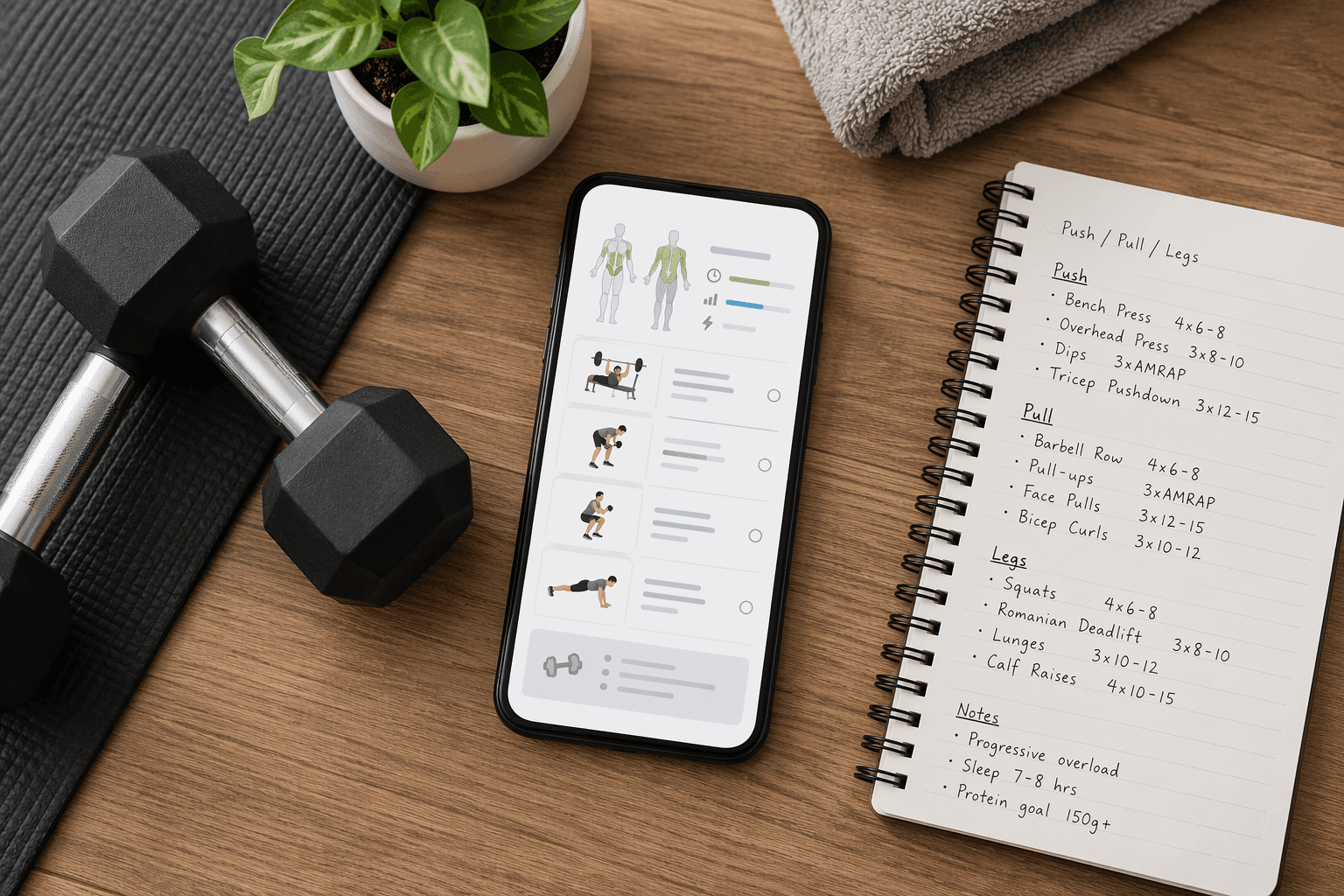
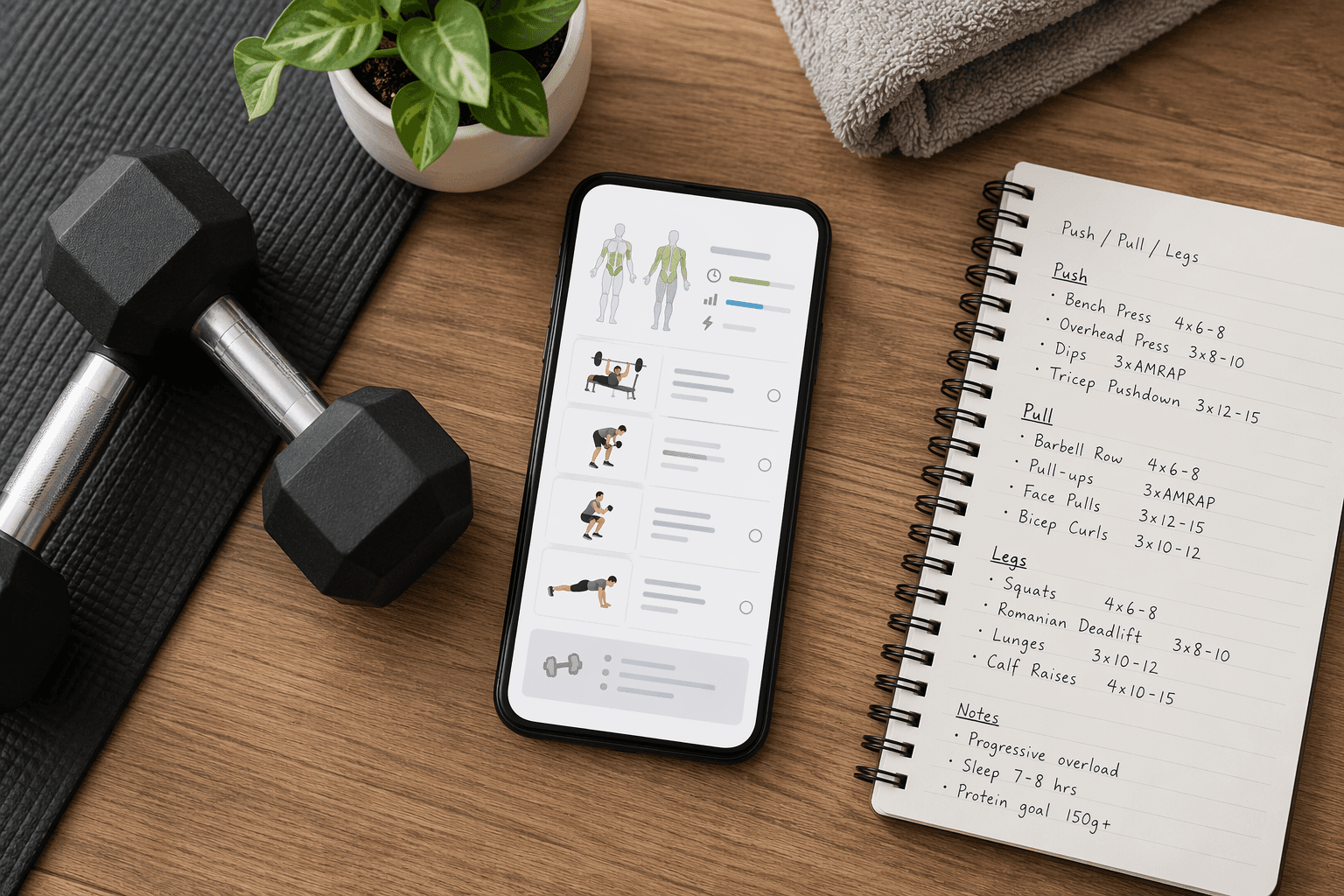
The best strength training app is the one that removes your actual bottleneck. For some lifters, that means a free log that remembers last week’s sets. For others, it means an app that writes the next block because guessing at progression has started to waste time. For a smaller group, it means paying a real coach because the problem is no longer information; it is accountability, form review, and someone noticing when training disappears for ten days.
Start with four constraints before you look at app-store badges: coaching model, budget, equipment, and experience level. If those do not match, a polished app becomes another subscription you ignore.
| If your real problem is... | Look first at... | Likely budget range | Good starting points |
|---|---|---|---|
| You know what to train but need to track it | A workout logger or free tracker | $0-$5/month | Hevy, Strong, Caliber Free |
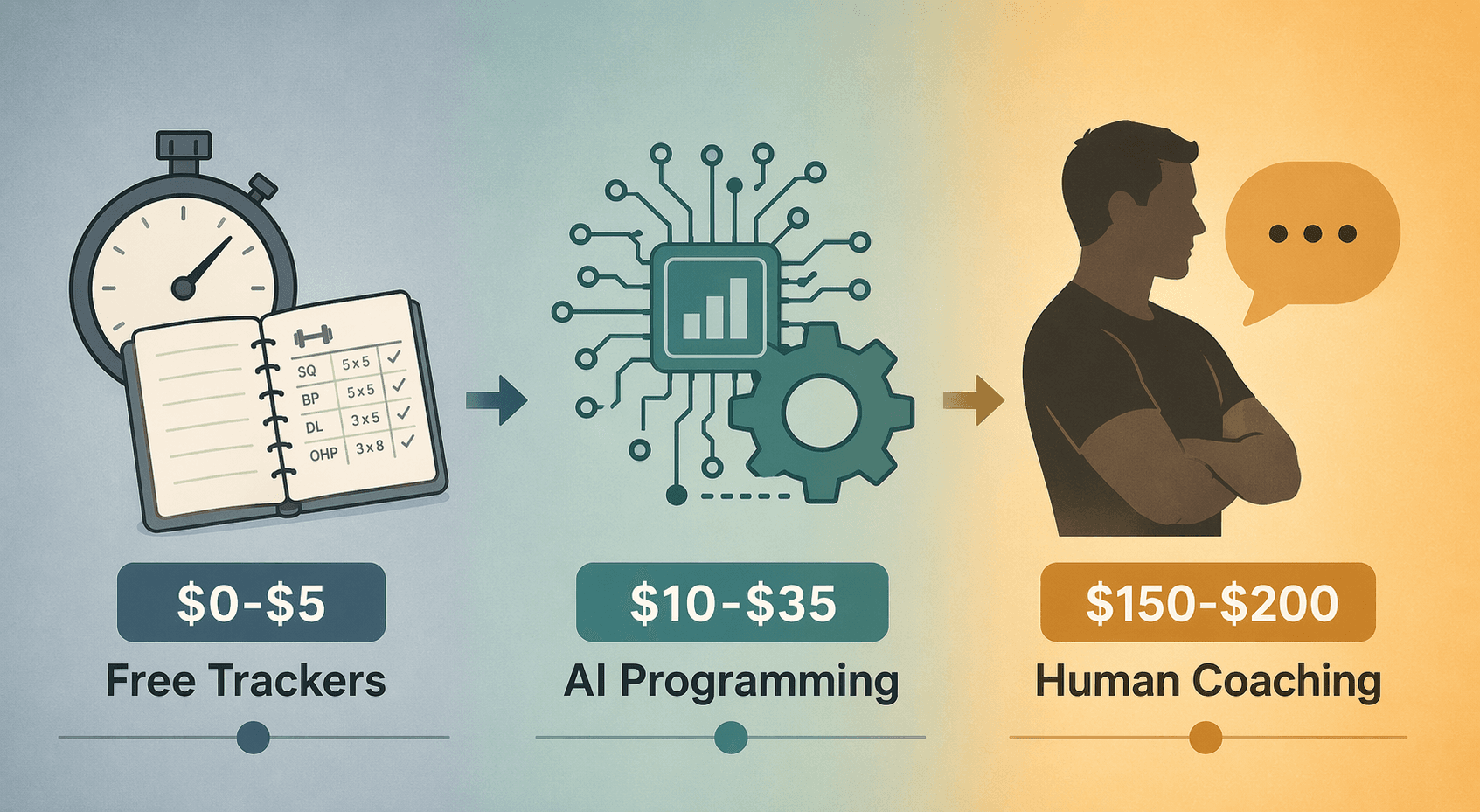
| You train consistently but want programming help | AI or algorithmic programming | $10-$35/month | Fitbod, Shred, Boostcamp, JuggernautAI if you have barbell equipment |
| You need someone checking in and adjusting the plan | Human coaching | $150-$200/month | Future, Caliber 1:1 coaching |
| You are new and need simple guided sessions | Beginner-friendly guided workouts | Free-$15/month | Nike Training Club, Caliber Free, Peloton if classes motivate you |
Garage Gym Reviews’ 2026 testing found an average cost of $34 per month across more than 70 workout apps, but that average is only useful as a warning label: it blends free trackers, mid-priced programming apps, and premium human coaching into one number that no real lifter actually shops by.[1]
PCMag’s 2026 workout-app testing also separates the market by what the app actually does: some apps mainly log workouts, some deliver guided classes, some generate plans, and some connect users to coaches.[2] That distinction matters more than whether an app has a 4.8 rating from people who already liked it enough to download it.
Choose the coaching model before the brand
Strength training apps do not compete on one clean ladder from cheap to good. They solve different problems. A free tracker can be the right tool for a self-programmed lifter and the wrong tool for a beginner who needs exercise selection. A $199 coaching app can be worth it for someone who keeps skipping sessions and excessive for someone who only needs a deadlift log.
Free and low-cost trackers: enough when you already know the work
Hevy and Strong belong in the first pile: apps for logging sets, reps, exercises, and progress. They are not trying to be your coach in the full sense. That is the point. If you already follow a program, write your own training, or just need a clean record of what happened last Tuesday, paying for a more elaborate coaching layer may not change a single set you perform.
Hevy’s free tier is especially useful for lifters who can live within its limit of three routines, while Caliber Free offers substantial programming without forcing a paid coaching commitment at the start.[4] Nike Training Club is also fully free and has a bodyweight-friendly library, which makes it more useful for beginners than many paid apps that assume you have a rack, bench, cable stack, and perfect confidence.[4]
This is where free apps are not consolation prizes. If your current failure point is consistency with simple sessions, or remembering what you lifted last time, a free app can be the right answer. The upgrade only makes sense when the missing piece becomes more specific than “I need an app.”
AI and algorithmic apps: useful when programming is the bottleneck
The middle tier is where many intermediate home lifters should spend the most time comparing. Fitbod, Shred, Boostcamp, and JuggernautAI sit closer to the $10-$35 monthly range in the research set, depending on the app and plan.[1] They are for lifters who are training often enough that random workouts no longer cut it, but who do not need a person texting them after a missed session.
This tier can be genuinely helpful, but it deserves a plain reading. AI programming can suggest exercises, arrange sessions, and adjust around available equipment. It cannot watch your knees cave on a heavy squat unless the product includes some separate form-review feature, and it cannot know whether you are avoiding split squats because of pain, boredom, or pride unless the app collects and uses that information well.
Fitbod and Shred both scored 5 out of 5 for equipment flexibility in Garage Gym Reviews’ weightlifting-app testing because users can select setups ranging from a full gym down to bodyweight-only training.[3] That matters in a garage gym. A smart program that assumes unavailable machines is not smart in practice.
Human coaching: expensive, and sometimes exactly the missing piece
Human-coached apps are a different purchase. Future and Caliber’s 1:1 coaching sit around the $199-per-month level in the cited testing, which is not a small upgrade from a free tracker or a $15 programming app.[1] That price only makes sense when the human part changes behavior: you need accountability, feedback, plan adjustments, or a coach who notices patterns you keep explaining away.
Caliber is notable because it offers a rare progression path in one ecosystem: a free tier, group coaching at $19 per month, and 1:1 coaching at $199 per month in Garage Gym Reviews’ testing.[1] That structure is useful because many lifters do not know at the beginning whether they need coaching or just a clearer plan. Starting free and upgrading only when the friction proves real is better than buying accountability as a personality makeover.
Your equipment should disqualify apps quickly
Home lifters get burned when reviews talk about “great programming” without asking what equipment the program expects. A barbell plan is not wrong. It is just wrong for someone training with adjustable dumbbells and a pull-up bar.
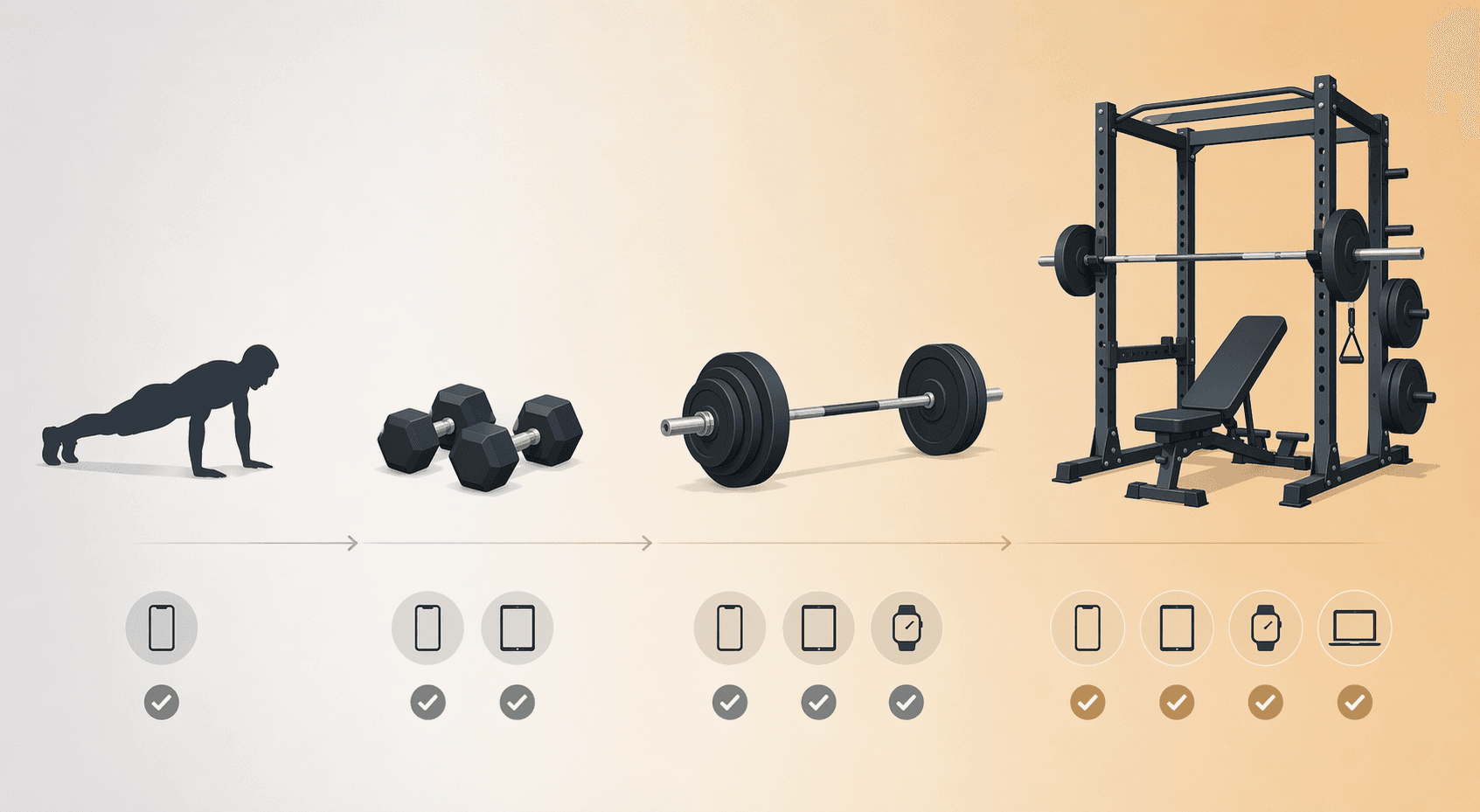
Bodyweight-only users should look first at Nike Training Club, Fitbod, Shred, or another app that explicitly lets them filter equipment down to nothing. Dumbbell-only users need the same filter, plus enough exercise variety that the app does not keep prescribing barbell lifts with weak substitutions. Garage Gym Reviews’ testing is useful here because it treats equipment flexibility as a scored category rather than a footnote.[3]
Barbell lifters can consider more specialized tools. JuggernautAI, for example, is built around serious strength programming, but Garage Gym Reviews notes that it requires a barbell, squat rack, and bench and rated it 4 out of 5 for equipment demands.[3] That is a fair trade if you have the setup and want powerlifting-style structure. It is a bad match if your “home gym” is a mat beside the couch.
| Your setup | Apps to check first | Apps to be cautious with |
|---|---|---|
| Bodyweight only | Nike Training Club, Fitbod, Shred | Barbell-first strength apps |
| Adjustable dumbbells | Fitbod, Shred, Caliber Free | Apps with weak substitution controls |
| Barbell, rack, bench | JuggernautAI, Boostcamp, Caliber, Fitbod | Class-first apps if progressive loading is your main goal |
| Full gym access | Most mid-tier programming apps become viable | Overpaying for coaching if logging and programming are already solved |
If equipment is your main constraint, it is worth using a more detailed equipment-first filter before choosing. A deeper companion guide on which strength training app fits your home gym setup can help after you know whether you are shopping for bodyweight, dumbbell, barbell, or full-gym programming.
Match the app to your experience level, not your ambition
Beginners usually need fewer features than app pages suggest. They need clear exercises, realistic sessions, basic progression, and a low-friction way to keep showing up. Nike Training Club’s free bodyweight library and Caliber Free’s substantial programming make sense here because the first win is not optimization; it is getting through repeatable sessions without needing a spreadsheet and a second browser tab.[4]
Experienced lifters often need less coaching, not more. If you already understand your lifts, know how to warm up, and follow a program from a coach, book, team, or your own planning, the best app may be a tracker. The app should make previous performance obvious, keep notes accessible, and stay out of the way between sets.
Intermediate lifters are the messy middle. They know enough to train hard but not always enough to plan the next eight weeks. They may be strong enough that random soreness feels like progress, but inconsistent enough that overload disappears. That is where Fitbod, Shred, Boostcamp, or another programming-focused app can earn its subscription, provided the equipment filters and progression logic fit the way they actually lift.
A practical short list by situation
Most home lifters do not need a list of twenty apps. They need two or three worth testing for their situation.
- If you are new, training at home, and want free guidance: start with Nike Training Club or Caliber Free. Add Hevy only if logging becomes important.
- If you already have a program and just need records: start with Hevy or Strong. Do not pay for coaching until your actual training decisions are the problem.
- If you have dumbbells or mixed home equipment and want the app to build sessions: test Fitbod and Shred first because equipment flexibility is central to the experience.
- If you have a rack, bench, and barbell and care about powerlifting-style progression: consider JuggernautAI, while recognizing that its equipment assumptions are part of the deal.
- If you keep falling off despite knowing what to do: compare Caliber coaching and Future. The premium is for accountability and human review, not magic programming dust.
For a broader comparison that includes non-strength goals, the top-level best workout apps decision framework is a better place to sort cardio, classes, habit tracking, and general fitness alongside strength.
When to upgrade
Upgrade when the next paid feature changes a normal training week. That is the cleanest test.
Move from no app or a class library to a tracker when you start asking, “What did I lift last time?” more than once a week. That is not a motivational problem. It is a recordkeeping problem, and a free or cheap logger usually solves it.
Move from a tracker to AI or algorithmic programming when you are consistent but unsure what to do next. If every session becomes a negotiation with yourself about exercises, sets, or progression, a mid-tier programming app may reduce decision fatigue enough to be worth the monthly fee.
Move from AI programming to human coaching when the issue is no longer the written plan. If you skip sessions, ignore deloads, push through questionable pain, or need form feedback that an app cannot responsibly infer from numbers alone, the premium tier finally has a job.
The reverse is also allowed. If a coach gets you through a rough patch and you become self-sufficient, dropping back to a programming app or tracker is not failure. It is matching the tool to the current bottleneck.
What app-store ratings cannot tell you
High ratings are not useless, but they are not controlled testing. They reflect self-selected users, pricing tolerance, design preferences, and whether the app annoyed people enough to leave a review. They do not tell you whether a dumbbell-only lifter can run a sensible progression for twelve weeks or whether a beginner can tell what to do after the first session.
The cited app comparisons are also not clinical trials. Garage Gym Reviews’ strength and workout app coverage relies on expert comparative testing, including certified personal trainer observations, not controlled outcome studies proving one app builds more strength than another.[1][3] That is still more useful than a download badge, as long as the conclusion stays narrow: these tests help compare usability, pricing, coaching model, and equipment fit.
If you want to inspect the feature layer after narrowing your options, the next useful read is a guide to strength training app features that actually matter, especially progressive overload, recovery handling, and equipment flexibility.
The final cut
If you want the safest starting point, pick from the smallest group that matches your constraint.
- Beginner with little or no equipment: Nike Training Club or Caliber Free.
- Self-directed lifter who needs a log: Hevy or Strong.
- Intermediate home lifter who wants programming: Fitbod or Shred; add JuggernautAI only if you have the barbell setup it expects.
- Lifter who needs accountability more than features: Caliber coaching or Future.
Test one app through enough sessions to feel the friction: setup, substitutions, logging, progression, and whether you actually open it before training. If the app solves the thing that was stopping you, it is doing its job. If it mostly adds screens between you and the first set, move on.
References
- Expert-Tested: The Best Workout Apps (2026), Garage Gym Reviews
- The Best Workout Apps We've Tested for 2026, PCMag
- Best Weightlifting App, Garage Gym Reviews
- Best Workout App for Beginners, Garage Gym Reviews
Comments
Join the discussion with an anonymous comment.