
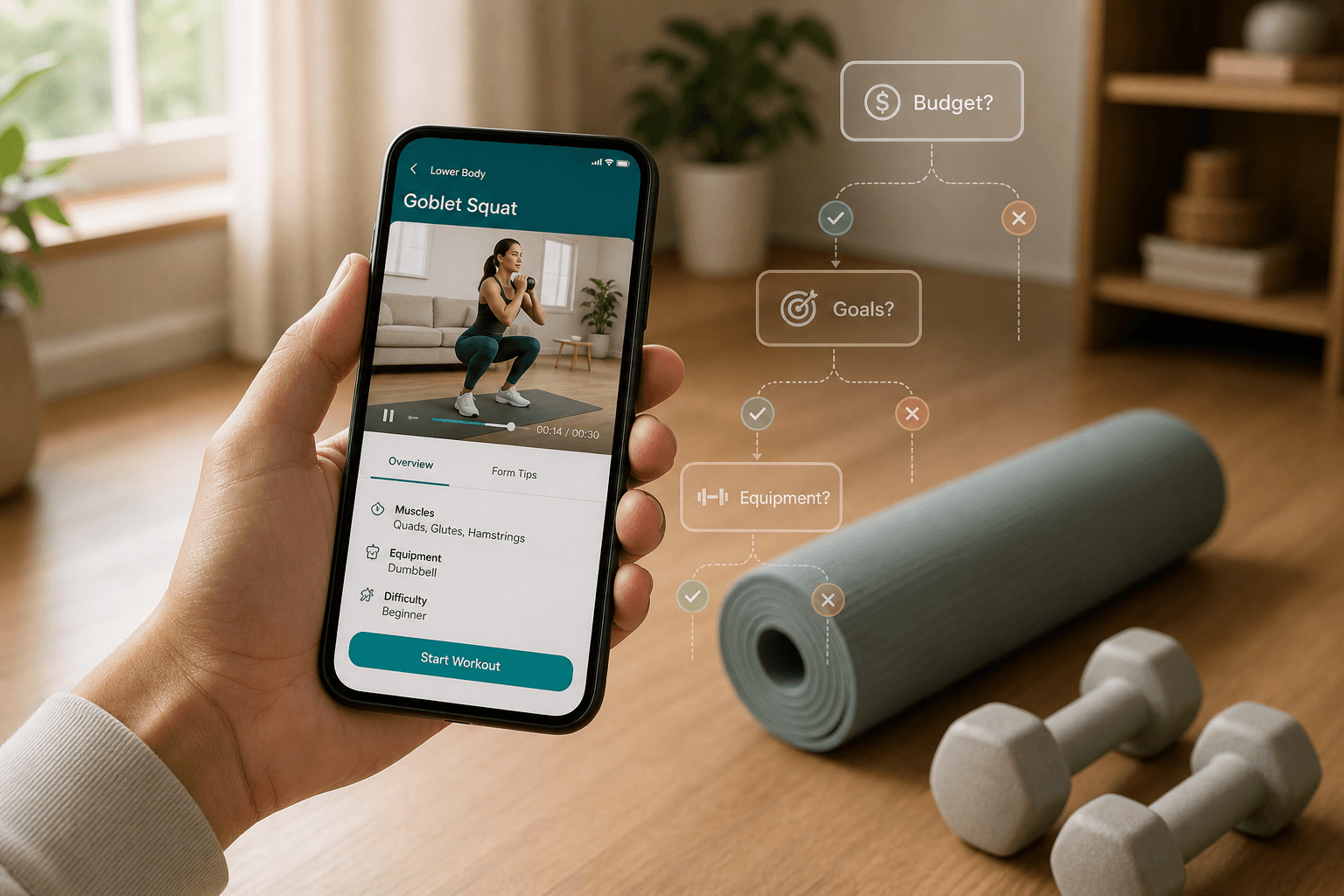
Sixty-nine percent of people who download a fitness app stop using it within three months. That statistic — from Lucid.now's retention analysis — changes the math on “cheap per workout.” If you’re statistically likely to quit inside a quarter, paying upfront isn’t frugal — it’s a gamble against the house. The house wins most of the time.
Health and fitness apps pulled in close to $6 billion in 2025, 80% of it from subscriptions (Business of Apps). The industry has a strong incentive to make you believe paid is better. But the gap between free and paid workout apps for beginners is narrower than the marketing suggests.
Free Apps: Full Libraries, Not Trials
The common assumption is that free apps are limited trials. For several major apps, that is simply not true. Nike Training Club offers more than 300 workouts across 10+ categories at a permanent cost of $0 (Forbes). Caliber's free-forever tier includes a library of 500+ exercises (Garage Gym Reviews). FitOn's free version unlocks all workouts — no paywall for the good stuff (Forbes). And Alo Wellness Club, which used to cost money, became completely free in December 2025, adding 3,000+ classes at no charge (Good Housekeeping).
A quick comparison of what's on the free table:
| App | Free tier content | Permanent free? | Best for |
|---|---|---|---|
| Nike Training Club | 300+ workouts, 10+ categories | Yes | General fitness, variety |
| Caliber (free) | 500+ exercises, strength tracking | Yes | Strength training |
| FitOn | All workouts (1,000+ classes) | Yes | Full-access without paywall |
| Alo Wellness Club | 3,000+ classes, yoga, meditation, fitness | Yes | Yoga + fitness mix |
| Map My Fitness | 600+ activities, GPS tracking | Yes | Running/walking tracking |
But here's the catch: a library of hundreds of workouts does not mean all of them are beginner-appropriate. Nike Training Club's catalog includes advanced HIIT and high-intensity strength that a newcomer should not jump into. The same is true for Alo's yoga flows — not all are labeled by level. When you browse a free app, filter by “beginner” or look at the duration first. Fifteen to twenty-five minutes is the ideal starting length (Daily Burn).
What Paid Apps Add — and Do You Need It?
Paid apps exist because they offer features free tiers do not: structured multi-week programs, human or AI coaching, nutrition integration, offline downloads, and accountability nudges. The question is whether those features matter to someone who has not yet completed four consecutive weeks of training.
The budget tier ($5–15/month) includes apps like Apple Fitness+ ($10/month, 5,000+ workouts — CNET), Peloton App One ($13/month — GGR Best), and Aaptiv ($14.99/month, 8,000 workouts — GGR Best). These add guided programs with progression and variety. The premium tier ($19–30/month) brings coaching: Caliber Pro ($19/month) adds group coaching, Sweat ($25/month) has 13,000 workouts across 50 programs (GH). At the top, concierge apps like Future ($199/month) pair you with a personal coach who builds your plan (GH, GGR Best).
But here is the thing: bodyweight workouts done three times a week for three months produce real fitness gains in previously untrained individuals (Daily Burn). That means free apps — which provide exactly that — can already deliver measurable progress. You do not need advanced periodization to see results in the first 12 weeks. You need consistency. And you don't need to pay for accountability you haven't yet proven you'll use.
The Honest Cost-Per-Workout Math
This is where the marketing gets fuzzy. “It's only $0.83 per workout” sounds great — but that math assumes you train 3x/week for 52 weeks. What if you drop out after three weeks?
| App | Annual price | Cost per workout if consistent (3x/week, 52 weeks) | Cost per workout if quit after 4 weeks (12 workouts) |
|---|---|---|---|
| Peloton App One | $130/yr | $0.83 | $10.83 |
| Apple Fitness+ | $80/yr | $0.51 | $6.67 |
| Sweat | $135/yr | $0.87 | $11.25 |
| Future | $2,388/yr | $15.31 | $199.00 |
| NTC (free) | $0 | $0 | $0 |
The honest math: free covers the first 8 weeks. If you're still training after two months and you hit a specific gap — like you need a structured program or a coach — then upgrade. Until then, save your money.
Comments
Join the discussion with an anonymous comment.