Most people do not leave a fitness app because one class was bad. They leave when the app keeps asking them to care about the wrong thing. That is the real fork in the Peloton app vs Apple Fitness Plus decision: Apple Fitness+ tries to make your own effort visible enough that you want to come back, while Peloton tries to make other people, instructors, and live events feel present enough that skipping feels less natural.
That sounds like a small distinction until you are deciding what will get you onto the mat on a Tuesday when no one is watching. Apple leans on private feedback: heart rate, Activity Rings, Burn Bar, and, as of 2026, Custom Plans that generate schedules around goals such as Stay Consistent, Push Further, and Get Started.[1] Peloton leans on social voltage: live classes, visible participation, badges, challenges, high-fives, instructor recognition, and class stacking.[2]

Neither model is morally superior. But they are not interchangeable. If you buy the app that motivates a different person than you are, the workout quality may not matter.
The Quick Difference Before Price Gets In The Way
Apple Fitness+ is at its most persuasive when paired with Apple Watch. The watch turns a class into a feedback loop: your heart rate, calories, ring progress, and Burn Bar position can appear on screen during the workout.[1][2] Without Apple Watch, Fitness+ still gives you workout videos on iPhone, but it loses much of the on-screen data that makes the service feel personal.[1]
Peloton’s app is almost the opposite. App-only users can get programming, instructors, outdoor audio, community features, and live-class energy, but they do not get the full Peloton performance-metrics experience unless they are using Peloton hardware. Consumer Reports, Mashable, and user reports all describe the app-only experience as lighter on on-screen metrics than the Bike or Tread experience.[2][3]
| Question | Apple Fitness+ | Peloton app |
|---|---|---|
| Core motivation | Personal feedback from watch metrics, rings, Burn Bar, and plans | Live classes, instructor presence, badges, challenges, and community |
| Best with | Apple Watch | Peloton hardware for full metrics; app alone for classes and community |
| Live classes | No live classes | Daily live classes |
| What app-only users may miss | Without Apple Watch, the strongest metric layer is reduced | Without Peloton hardware, on-screen performance data is limited |
This is why a plain feature checklist can mislead. The important question is not just what each service has. It is whether the motivating part of the product is actually available to you.
Apple Fitness+ Motivates By Reflecting Your Effort Back To You
Apple’s bet is that consistency improves when effort feels legible. A Fitness+ class paired with Apple Watch does not just show an instructor moving through intervals. It shows your heart rate, your Activity Ring progress, and, for eligible workouts, the Burn Bar, which compares your calorie burn with others who have taken the same workout.[1][2]
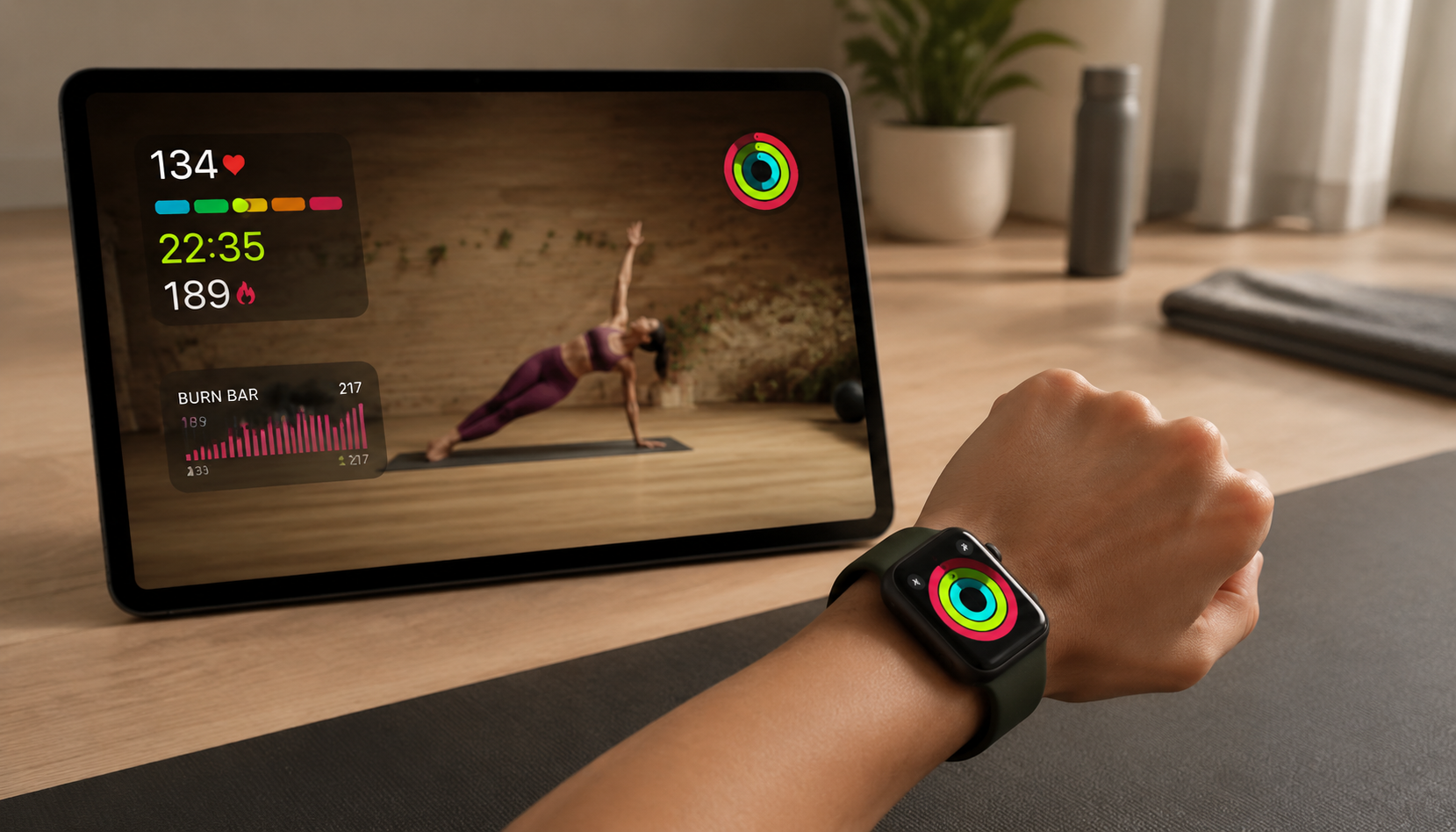
The useful part is not that the data is fancy. It is that the data removes some of the negotiation. You can see whether you are coasting, whether you are pushing, whether today’s short workout still moved your rings, and whether your effort is landing somewhere comparable to other people who took the same class. For someone who responds to quiet proof, that can be more motivating than a louder instructor.
The Burn Bar is the most interesting piece because it is competitive without turning the room into a public arena. You are not chasing a live leaderboard full of names. You are getting a private comparison point, folded into your own screen, while the class continues. That suits people who like a nudge but do not want a performance.
Activity Rings do a different kind of work. They make partial effort visible. A 10-minute core class or a short walk can still become part of the day’s completion story. For home fitness, that matters. Many failed routines are not destroyed by one missed heroic workout; they are thinned out by days that feel too small to count. Apple’s system is good at making small sessions feel like they belong to the same habit.
The 2026 Custom Plans feature pushes that habit design further. Apple says Fitness+ can generate workout plans based on goals such as Stay Consistent, Push Further, and Get Started, using behavior to shape the schedule.[1] That does not prove the plans will work for every person, and the available sources are product and review materials rather than controlled adherence studies. Still, it shows where Apple is aiming: less browsing, more prescribed next action.
That “what do I do next?” problem is underrated. A large workout library can become another decision chore. A plan that tells you today’s session, shows your body responding, and gives you a clean completion signal is not glamorous, but it fits the user who needs friction removed more than excitement added. If you are comparing broader options, that same adherence lens is useful in a workout tracker app buyer’s framework, because progress tracking only helps when it changes tomorrow’s behavior.
Apple also has quieter ecosystem pieces that match this philosophy. Time to Walk, for example, uses audio walking content with well-known personalities, including Dolly Parton in Consumer Reports’ coverage, as a way to make movement feel scheduled and companionable without turning it into a class event.[2] It is not the centerpiece of Fitness+, but it shows the same habit instinct: attach movement to a format that can survive ordinary days.
Peloton Motivates By Making The Room Feel Populated
Peloton’s strongest motivational feature is not any single workout type. It is the feeling that a class is happening with or around you. Consumer Reports describes Peloton as offering daily live classes, real-time participant presence, milestone and birthday shout-outs, high-fives, annual and monthly challenges, and program-specific badges.[2] That is a very different kind of accountability from closing a ring.
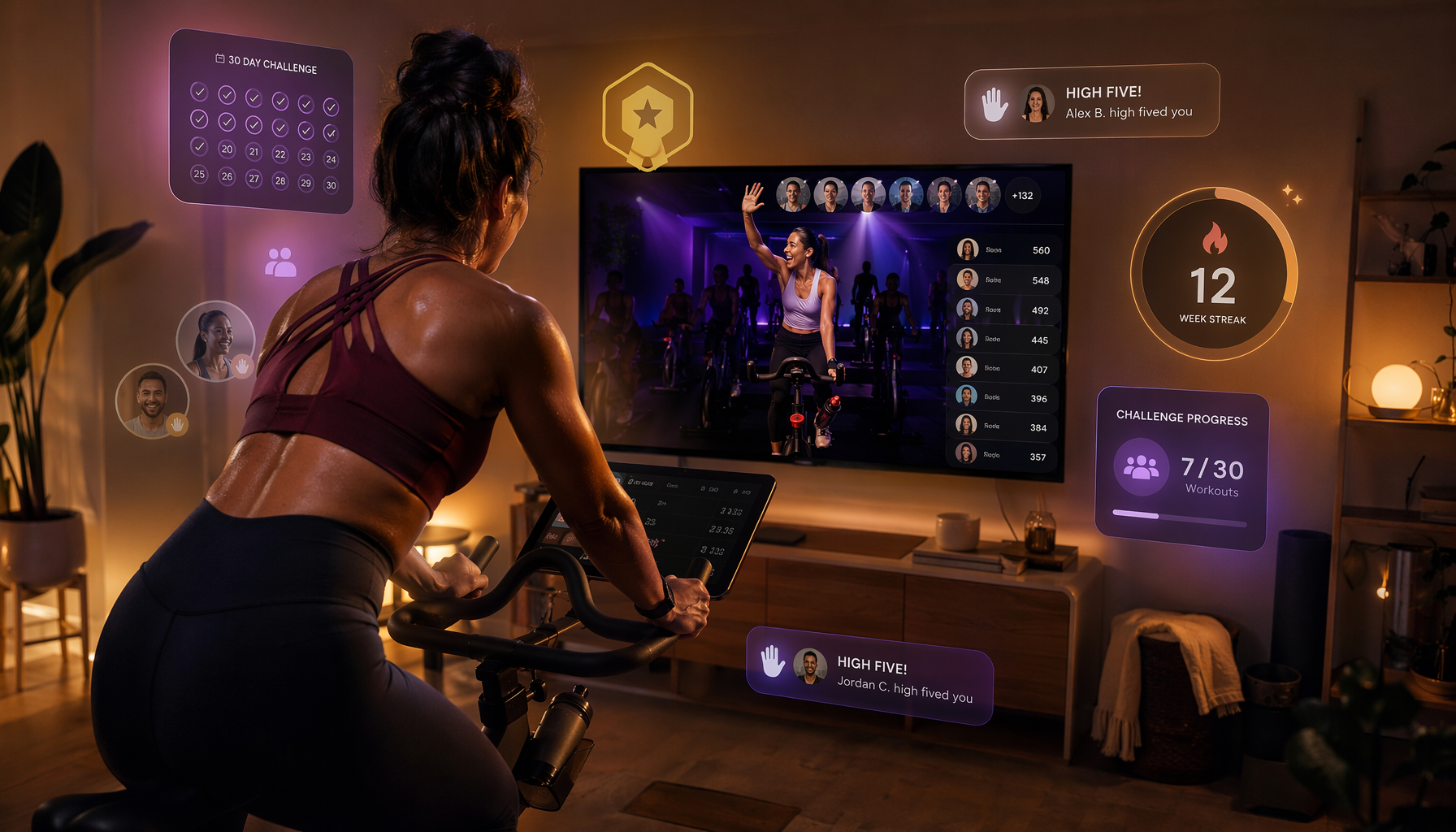
Live classes create a deadline. The class starts whether you are ready or not. That alone can change behavior for someone who treats an on-demand library like an endlessly postponable promise. A scheduled class, a familiar instructor, and the knowledge that other people are taking it now can turn “I should work out later” into “I am joining this one.”
The instructor relationship is also more central in Peloton than in Apple Fitness+. The Finance Therapist’s 2026 comparison describes Fitness+ instructors as skewing older and more credentialed, while Peloton’s instructors skew younger with more of a party or life-coach tone.[4] That is not a quality ranking. It is a fit issue. Some users want calm competence. Others want the feeling that a charismatic person is pulling them through the last interval.
Badges and challenges do another job: they make attendance visible over time. Peloton’s annual challenge, monthly challenges, and program badges give the user something external to collect and protect.[2] If your brain likes streaks, public-ish accomplishments, or the small thrill of being recognized, that can matter more than a cleaner interface.
Stacking classes fits the same pattern from a different angle. Peloton lets users queue up to 10 classes back-to-back, reducing the pause where a person finishes one session, opens the library, and accidentally leaves.[2] Stack is not motivational in the emotional sense. It is motivational because it protects momentum. Once the next class is already waiting, the workout has fewer exit ramps.
Peloton’s app can also work well for people who train beyond the bike. Reviewed.com notes Peloton app use across formats such as strength, yoga, running, walking, and outdoor audio, and discusses device compatibility beyond a single Peloton machine.[5] If the deciding factor is equipment and space rather than motivation style, a broader home fitness app comparison by equipment needs may be the better first filter.
The Asymmetry Most Comparisons Skip
The easy framing is that Peloton is the competitive one and Apple is the polished one. That misses the awkward middle. Apple can be more personally data-rich for a watch owner taking a living-room workout than Peloton is for an app-only subscriber doing the same. Peloton is socially richer, but without Peloton Bike or Tread hardware, app users do not get the same on-screen performance layer associated with the full Peloton experience.[2][3]
That distinction matters because “competition” can mean two different things. Apple’s Burn Bar gives a private comparison against others who have taken the workout.[1][2] Peloton’s social ecosystem gives live participation, recognition, and community signals, but the app-only experience does not turn every workout into a hardware-style metrics dashboard.[2][3]
So a user who says, “I want Peloton because I want data and competition,” should separate those desires. If the real desire is social energy, Peloton fits. If the real desire is to see heart rate and ring progress on screen during a non-hardware workout, Apple Fitness+ with Apple Watch may actually be the more direct path.
Price Is Part Of The Motivation System
Cost belongs here because it changes which version of the motivation system you actually get. Apple Fitness+ can be used without Apple Watch in a limited way, but the full identity of the product depends on Apple Watch metrics. If you do not already own one, that entry point starts at $199 or more before the subscription itself.[1]
For an Apple Watch owner, Fitness+ feels like an extension of a system already on the wrist. For someone outside Apple’s wearable ecosystem, it asks for a hardware buy-in before its best motivational features make sense. That does not make it overpriced; it makes the decision less like choosing an app and more like choosing a tracking environment.
Peloton has its own tier problem. PeloBuddy’s tier launch breakdown described Peloton App One and App+ as separate app plans, with App+ originally listed at $24 per month, while Peloton’s own membership materials can show higher app pricing in some purchase contexts, including $28.99 per month for App+.[6][7] The safer reading is that Peloton’s app cost depends on tier and purchase route, and the cheaper tier may not include everything a comparison shopper imagines when they hear “Peloton.”
This is where budget and motivation meet. A lower monthly price is not automatically cheaper if it gives you a weaker version of the accountability you need. A higher hardware requirement is not automatically wasteful if the device is what makes the habit visible enough to continue. If paid tiers and “free” fitness options are part of the decision, it is worth separating sticker price from the features that are actually locked away; a transparent breakdown of whether free workout apps are really free can help with that.
Who Should Choose Apple Fitness+
Apple Fitness+ is the more natural fit if you respond to private progress. You like seeing your heart rate. You care that a short workout still moved your rings. You want a plan to reduce daily choosing. You are more motivated by clean feedback than by being seen.
- Choose Apple Fitness+ if you already own an Apple Watch and like your workouts connected to Activity Rings, heart rate, and daily movement goals.
- Choose Apple Fitness+ if live classes make you feel pressured rather than energized.
- Choose Apple Fitness+ if your main failure point is deciding what to do next, not finding enough intensity.
- Choose Apple Fitness+ if you prefer a calmer class environment where the data and schedule do more of the motivational work.
The watch requirement is the caveat. Without Apple Watch, Fitness+ becomes much less distinctive. You still have workouts, but the product’s strongest habit loop—body data turning into visible progress—gets thinner.
Who Should Choose Peloton
Peloton is the better fit if effort increases when the room feels alive. You want a class time, a familiar instructor, a challenge to join, a badge to earn, or the sense that other people are in motion with you. You may not need every metric on screen if the social structure is what gets you to start.
- Choose Peloton if live classes and instructor personality make you more consistent.
- Choose Peloton if badges, challenges, high-fives, and milestone recognition make workouts feel worth returning to.
- Choose Peloton if stacking classes helps you continue once you have already started.
- Choose Peloton if you care more about community energy than on-screen Apple Watch-style metrics.
The hardware caveat is real here too. The Peloton app can be socially motivating on its own, but app-only use is not the same as the full Peloton Bike or Tread metrics experience.[2][3] If your picture of Peloton motivation includes a leaderboard and richer performance data, make sure the tier and device you plan to use actually deliver that experience.
A Small Note On Uncertainty
There has been speculation that Apple could eventually fold Fitness+ into a broader health service, but that is not confirmed in the materials used here and should not drive a current subscription decision. The more dependable question in Q3 2026 is simpler: do you want your workouts organized around your own metrics, or around social presence?
The same caution applies to “best app” rankings and class-library comparisons. CNET’s 2026 workout subscription coverage places both services in a broader app market, but the practical decision between these two still turns less on who has more classes and more on which accountability mechanism you will actually feel.[8] If strength training is the main goal, a dedicated strength training app comparison may be more useful than choosing between two broad fitness ecosystems.
The Choice Rule
Choose Apple Fitness+ if your consistency improves when your watch, rings, heart rate, Burn Bar, and planned schedule reflect effort back to you. It is especially compelling if you already own an Apple Watch and want a quieter, metrics-driven system that makes small workouts count.
Choose Peloton if you show up because a class is live, an instructor feels familiar, badges matter, and other people’s presence changes your effort. It is especially compelling if social recognition and scheduled energy do more for you than private graphs.
The practical gate may decide it. Without Apple Watch, Fitness+ loses much of its motivational identity. Without Peloton hardware, Peloton’s app remains socially motivating but lighter on performance metrics. The better app is the one whose version of accountability you are actually buying.
References
- Apple Fitness+ Official Page, Apple
- Consumer Reports Face-Off, Consumer Reports, February 2021
- Peloton app review no-bike experience, Mashable
- Apple Fitness vs Peloton Apps Review: Who Wins?, The Finance Therapist
- Peloton workout app review, Reviewed.com
- Peloton App One/App+ tier details, PeloBuddy
- Peloton App Membership, Peloton
- Best workout subscription apps 2026, CNET
Comments
Join the discussion with an anonymous comment.