
Hevy costs $2.99 a month. Future costs $199 a month. In Garage Gym Reviews’ testing, Hevy scores 1 out of 5 for progressive overload and accountability. Future scores 5 out of 5 on both. If you stopped at that table, you’d probably assume Future is the better app. You’d be wrong.
The comparison is structurally meaningless because these apps do not belong to the same category. Hevy is a pure workout tracker — it logs what you lift, shows you graphs, and gets out of your way. Future is a human-coached platform — a real trainer designs your program, checks your form, and messages you daily. Asking which is “better” is like asking whether a hammer is better than a saw. It depends entirely on what you are building.
The strength training app market has fragmented into four distinct categories. Yet most roundups lump a free tracker next to a $199 coaching service and call it a comparison. The average app cost of $34 a month sounds like a useful benchmark — until you realize it averages free apps, $9.99 AI planners, $35 powerlifting programs, and $199 human coaching. It tells you more about the range than the user experience.
What this article does instead: defines the four categories, helps you figure out which fits your situation, and picks the best value within that category. There is no single “best overall” because there shouldn’t be.
The Four Categories – What They Are and Who They're For
Each category occupies a different slot on the experience–autonomy–budget grid. Here’s what they are, with a representative app from Garage Gym Reviews’ testing.
These categories aren't airtight — Caliber's free tier, for example, straddles the line between tracker and AI planner. But the boundaries are clear enough to guide your first decision.
Which Category Fits You? A Decision Flowchart
Before reading any app profile, answer three questions about yourself:
- Experience level: Are you a beginner, intermediate, or advanced lifter?
- Budget: Do you want to spend $0, $5–$15 a month, or $15+ a month?
- Goal: General fitness, strength/powerlifting, or muscle building?
Run those through the flow below and you will land on one or two categories.
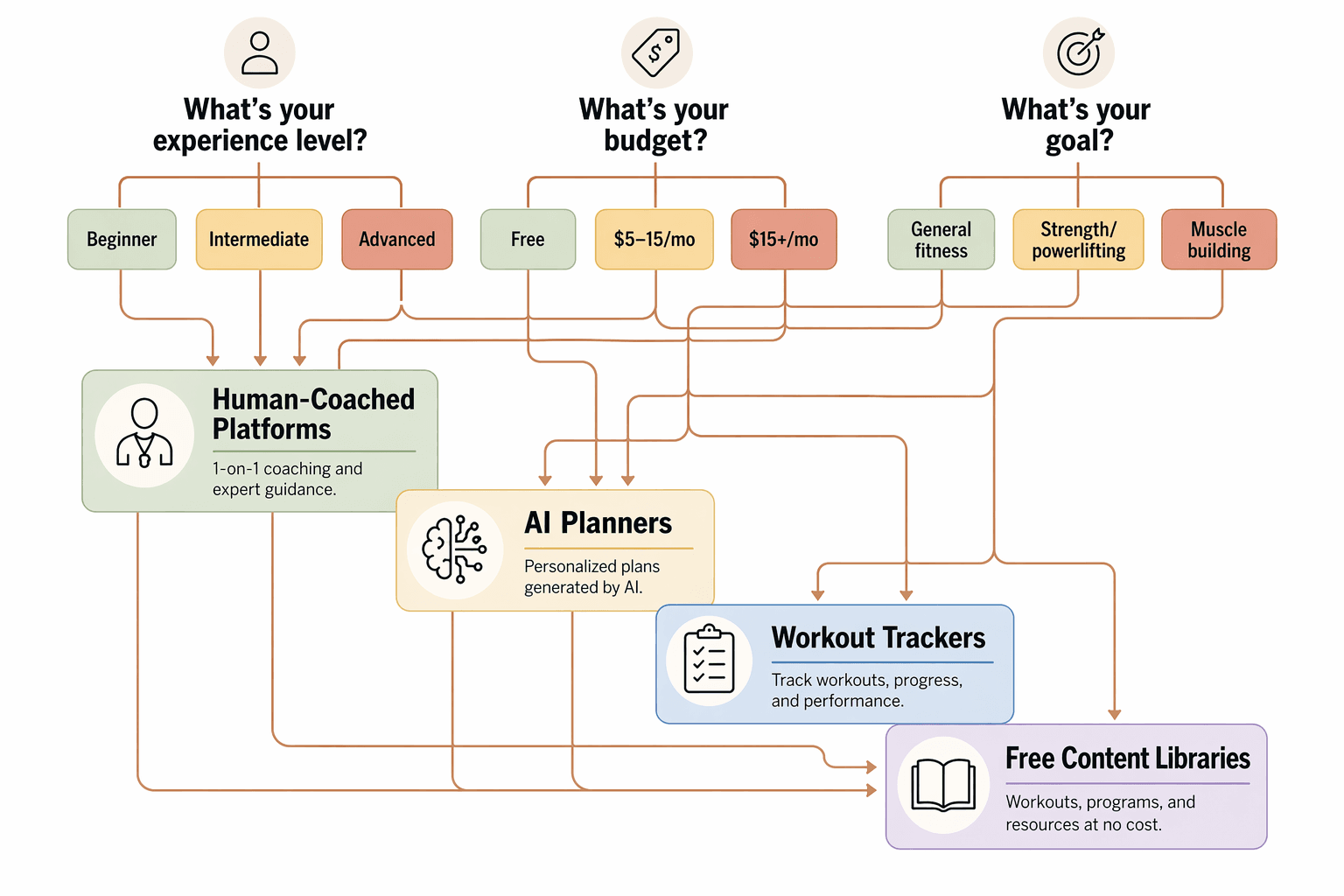
If you land in two categories simultaneously (for example, you are an experienced lifter with a program but also want a coach for accountability), consider pairing two specialized apps rather than looking for one app that tries to do everything. Beginners unsure where to begin can start with the decision framework for first workout apps.
AI Planners: Best for Intermediate Lifters Who Want Programming Without a Human Price Tag
If you are an intermediate lifter — you know the basic lifts, you have run a linear progression, but you are tired of writing your own programs — AI planners hit the sweet spot. Two apps dominate this space:
| App | Cost | GGR Overall | Progressive Overload | Variety | Ease of Use | Best for |
|---|---|---|---|---|---|---|
| Shred | $9.99/mo | 4.28/5 | 5/5 | 4/5 | 5/5 | General strength, value seekers |
| JuggernautAI | $35/mo | 4/5 | 5/5 | 3/5 | 4.5/5 | Powerlifting, powerbuilding |
Shred costs $9.99 a month — far below the $34 average. It earns perfect marks for instruction, equipment demands, and ease of use. If you are not a powerlifter and want a straightforward AI coach, this is the most efficient use of your money.
JuggernautAI is purpose‑built for powerlifting. Its AI adjusts daily based on how sore you are, how well you slept, and how motivated you feel — a level of responsiveness that human coaches cannot match at scale. The tradeoff is variety (3/5). If you enjoy trying new exercises every cycle, JuggernautAI will feel repetitive.
Workout Trackers: Perfect for Experienced Lifters Who Already Have a Program
I have seen experienced lifters sign up for expensive coaching apps because they assume a paid app must be better. If you already know what you want to lift each week, a tracker is all you need. The category's two best examples are Hevy and Caliber's free tier.
Hevy costs $2.99 a month (or free with ads) and scores 1 out of 5 for progressive overload. Most reviews treat that as a flaw. For an experienced lifter who already uses a periodized plan, the last thing you need is an app trying to override your program. Hevy's job is to log, graph, and get out of the way — and it does that perfectly. Its instruction score (3/5) is acceptable because you do not need form cues for movements you have run for years.
Caliber Strength Training offers a free‑forever version with a 500+ exercise library, video demos, and step‑by‑step instructions. Despite being free, it earns a GGR score of 4.6/5 with perfect marks for instruction, progressive overload, accountability, and value. Why? Because its free tier includes structured guidance — it selects the right exercise and tells you how many sets and reps to do — so it straddles the line between tracker and AI planner. For the lifter who wants more structure than a blank log but does not want to pay, Caliber Free is the strongest option.
For a deeper dive into what the free tiers actually include, read our best free workout apps comparison.
Human-Coached Platforms: Worth the Price When Accountability Is Your Bottleneck
$199 a month is a lot. But for a subset of lifters, it is the only category that works.
Future earns a GGR score of 4.3/5 with perfect 5/5 marks for accountability, workout variety, progressive overload, and equipment demands. The GGR founder has used Future weekly since September 2020. Multiple staff members have maintained subscriptions for years — a retention record that no other app in this comparison can claim.
Caliber offers a similar structure at the same price point with its Premium tier ($200/month). If you are trying to decide between Future and Caliber Premium, the choice often comes down to coach chemistry — both platforms let you interview trainers before committing.
Free Content Libraries: The Best Starting Point for Beginners on a Budget
If you are new to strength training and not ready to spend money, the best investment you can make is zero dollars — Boostcamp.
Boostcamp provides over 1,000 training programs from elite coaches like Dr. Eric Helms, Dr. Swole, and Jim Wendler. Its free‑forever version is robust enough that many intermediate lifters use it permanently. The app includes a heat‑mapped anatomy chart that shows which muscle groups have accumulated volume — a feature that helps prevent redundant targeting. GGR gives it 5/5 for progressive overload and equipment demands, but only 2/5 for accountability — which is expected for a library model. There is no coach prompting you; you have to show up yourself.
For beginners, this is the most efficient path: follow a program from a proven coach, learn proper technique from the video demos, and upgrade only when you feel the need for more personalized feedback. Our guide to free workout apps by goal and best apps for beginners have more details.
Side-by-Side: All 9 Apps on the Metrics That Matter
Below is a consolidated view of the six apps we feature in depth, plus three others from the full GGR test panel (StrongLifts 5×5, Muscle Booster, and Fitbod) that did not land in the top category picks but are worth comparing if your needs are specific. The scores and prices come from GGR’s independent testing (updated June 2026).
| App | Category | Price | GGR Score | Progressive Overload | Accountability | Equipment Demands | Platform |
|---|---|---|---|---|---|---|---|
| Hevy | Tracker | $2.99/mo | — | 1/5 | 1/5 | 3/5 | iOS, Android |
| Caliber (Free) | Tracker/PL | Free | 4.6/5 | 5/5 | 5/5 | 4/5 | iOS, Android |
| Shred | AI Planner | $9.99/mo | 4.28/5 | 5/5 | 4/5 | 5/5 | iOS, Android |
| JuggernautAI | AI Planner | $35/mo | 4/5 | 5/5 | 3/5 | 4/5 | iOS, Android |
| Future | Human Coach | $199/mo | 4.3/5 | 5/5 | 5/5 | 5/5 | iOS, Android |
| Boostcamp | Content Lib | Free/$14.99 | 4.2/5 | 5/5 | 2/5 | 5/5 | iOS, Android |
| StrongLifts 5×5 | Tracker | Free/$12.99 | — | — | — | — | iOS, Android |
| Muscle Booster | AI Planner | $9.99/mo | — | — | — | — | iOS, Android |
| Fitbod | AI Planner | $12.99/mo | — | — | — | — | iOS, Android |
Final Verdict: Pick Your Category First, Then Your App
By now you should have your category. Here is the short version for each persona:
If you still feel torn, revisit the decision flowchart or check out our guide to pairing two specialized apps. Strength training apps are a tool, not an identity. Pick the one that fits your category, not the one with the highest composite score.
Comments
Join the discussion with an anonymous comment.