
Why 'Best' Is the Wrong Question
Every month, someone types "best strength training app" into a search bar and gets back a ranked list. The problem is that a single ranking cannot account for the variables that actually determine whether an app will work for you: your experience level, your monthly budget, the equipment you own, and the coaching style you respond to. An app that earns a 4.6/5 from a reviewer who trains in a fully equipped gym with a $200/month coaching budget will feel like a poor fit for a beginner with a pair of dumbbells and $10 to spend.
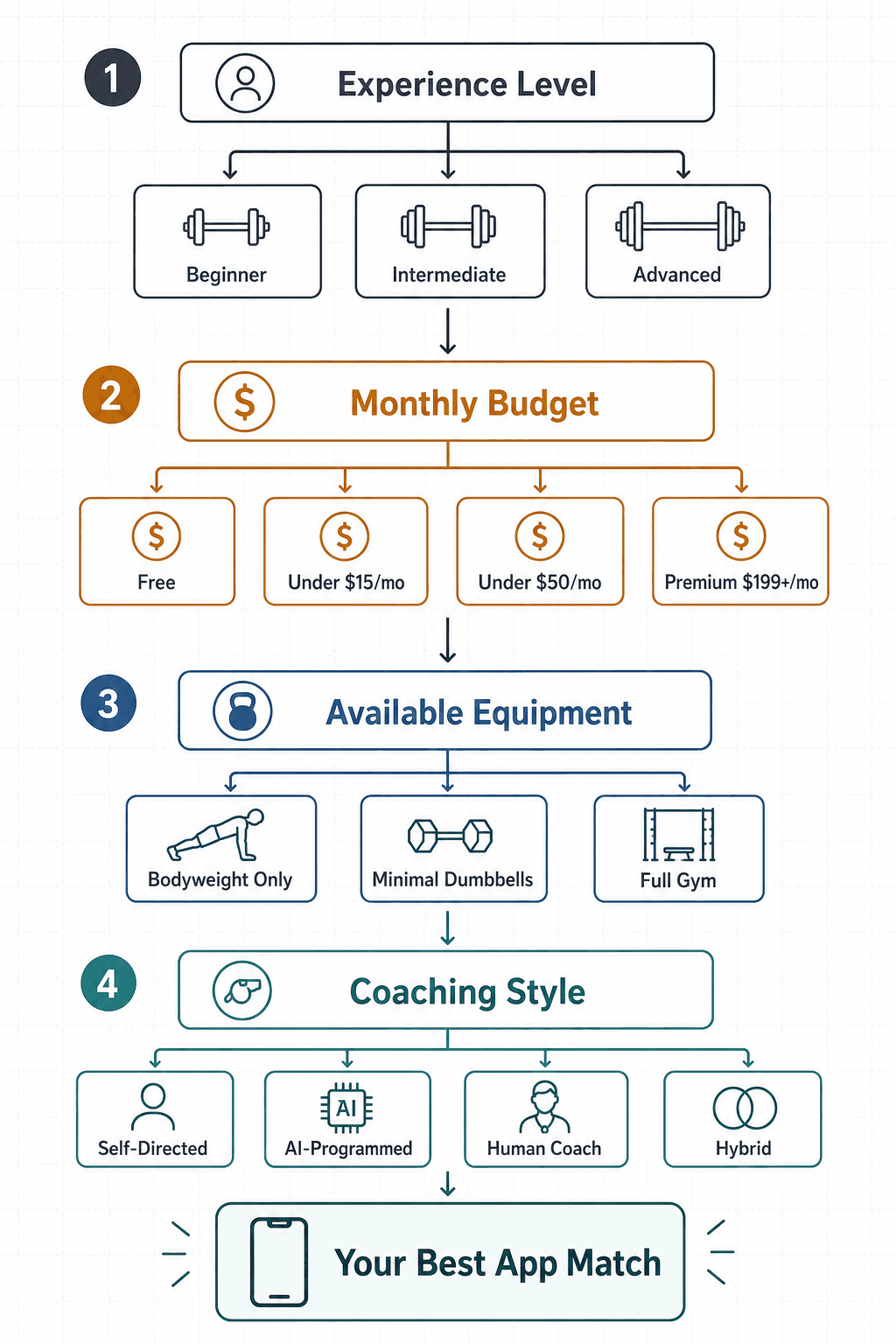
This guide replaces the ranked-list approach with a four-axis decision framework. Instead of asking "which app is best?," you will ask four targeted questions:
- What is my experience level?
- What is my monthly budget?
- What equipment do I have available?
- What coaching style keeps me consistent?
By the end of this article, you will have a clear app recommendation based on your specific combination of constraints, not a generic top-ten list. The decision matrix in section six brings all four axes together into a single reference table.
Axis 1: Experience Level — Beginner, Intermediate, or Advanced?
Your experience level determines how much guidance you need from an app. A beginner benefits from structured programs that teach movement patterns and manage load selection. An intermediate lifter needs variety and progressive overload without hand-holding. An advanced lifter wants tracking precision and programming autonomy.
Best Apps for Beginners
If you are new to strength training, look for apps that provide clear instruction, automatic progression, and minimal setup decisions. Muscle Booster ($14.99/month) earned a 4/5 overall score from Garage Gym Reviews, with perfect 5/5 marks for progressive overload and equipment demands — it tells you exactly what to do each session. Caliber Strength Training scored 4.6/5 overall and offers a genuinely useful free version that includes form-check video reviews and a structured beginner program. StrongLifts 5x5 is the simplest option — a single, proven program with no distractions. Nike Training Club (NTC) is completely free with 185+ workout videos and trainer-led sessions, making it a zero-risk starting point.
Best Apps for Intermediate Lifters
Once you can perform the major lifts with reasonable form and understand basic programming concepts like sets, reps, and rest periods, you need an app that offers program variety and intelligent load management. Boostcamp (free core, $14.99/month Pro) provides access to programs designed by elite coaches like Dr. Mike Israetel and Jeff Nippard, with auto-progression built in. Fitbod ($12.99–$15.99/month range depending on source) uses an AI algorithm that analyzes every set you log and adjusts subsequent workouts based on performance, recovery, and muscle group balance — its exercise library now exceeds 1,600 movements. Shred ($9.99/month) earned the highest overall score (4.28/5) from Garage Gym Reviews across 13 testing categories, with perfect 5/5 marks for ease of use, instruction, and equipment demands. Its adaptive AI progression responds to your difficulty ratings and recovery, making it a strong middle-ground option.
Best Apps for Advanced Lifters
Advanced lifters typically need two things that beginner-focused apps do not provide: the ability to customize every variable in a workout and sophisticated programming that accounts for periodization and accumulated fatigue. JuggernautAI ($35/month, 14-day free trial) earned a perfect 5/5 for progressive overload from Garage Gym Reviews and is designed specifically for lifters who understand training cycles and want an AI coach that adjusts volume and intensity based on their performance data. Strong (approximately $9.99/month or $59.99/year) is described as "the fastest, cleanest logging experience available" — it is purely a tracker with no workout generation, which is exactly what advanced lifters who design their own programs need. Hevy Pro ($2.99/month or $23.99/year) offers a generous free tier that covers "everything most lifters need: exercise logging, progress charts, one-rep-max calculations, and routine templates," and its Pro tier adds AI-generated workouts through the Hevy Trainer feature.
For a deeper breakdown of apps sorted purely by experience level, see our complete guide to strength training apps by experience level.
Axis 2: Monthly Budget — From Free to Premium Coaching
The average workout app subscription costs $34/month according to Garage Gym Reviews' internal pricing benchmark. But the range is enormous — from completely free to $200/month for 1-on-1 coaching. Your budget is not just about what you can afford; it is about what level of service you actually need.
| Budget Tier | Monthly Price | Apps in This Tier | What You Get |
|---|---|---|---|
| Free | $0 | NTC, Hevy basic, Caliber basic | Full workout libraries (NTC: 185+ videos), unlimited logging (Hevy), structured beginner programs (Caliber) |
| Under $15/mo | $2.99–$12.99 | Hevy ($2.99), Shred ($9.99), Fitbod ($12.99), Strong (~$9.99) | AI programming or premium tracking with no human coaching |
| Under $50/mo | $12.99–$19 | Boostcamp Pro ($14.99), Caliber Pro ($19), Peloton App ($12.99) | Expert-designed programs, group coaching, live classes |
| Premium Coaching | $199–$200 | Future ($199), Caliber Premium ($200+) | Dedicated human coach, personalized programming, regular check-ins |
The free tier landscape is stronger than most people realize. Hevy's free version includes unlimited workout logging, full exercise library access, routine templates, and progress charts — no paywall for the core tracking features. Caliber's free tier includes a structured beginner program and form-check video reviews. NTC is fully free with no subscription at all. If your budget is zero, you can still get a high-quality strength training experience.
At the premium end, Future ($199/month) and Caliber Premium ($200+/month) place you with a dedicated human coach who designs your programming and checks in regularly. Future earned a 4.3/5 overall score from Garage Gym Reviews with perfect 5/5 marks for accountability and equipment demands. These services replace the cost of a personal trainer, not the cost of a workout app.
Axis 3: Available Equipment — Bodyweight, Dumbbells, or Full Gym?
An app that requires a barbell, squat rack, and cable machine is useless if you train in a 10x10 apartment corner with a single pair of adjustable dumbbells. Equipment compatibility is the most overlooked filter in app selection, and it is the one that causes the most subscription cancellations.
Bodyweight-Only Compatible
If you have no equipment at all, look for apps that are designed around bodyweight training or that offer robust bodyweight program options. BetterMe (4.5/5 overall, $14.99/month) is built around bodyweight and minimal-equipment workouts. NTC offers bodyweight, HIIT, yoga, and core workouts — all free. Fitbod earned a perfect 5/5 for equipment demands from Garage Gym Reviews because its algorithm adjusts exercise selection based on what you tell it you own — if you mark "bodyweight only," it will never suggest a movement you cannot perform.
Minimal Dumbbells or Resistance Bands
Most strength tracking apps work well with a basic dumbbell setup. Caliber and Hevy let you log any exercise with any equipment — they do not restrict your exercise library based on what you own. Shred also earned a perfect 5/5 for equipment demands, meaning its adaptive AI can generate effective programs with minimal gear. If you have a set of adjustable dumbbells and a bench, you can run most of these apps without issue.
Full Gym Required
Some apps assume access to a fully equipped gym. JuggernautAI is designed around barbell training — squats, deadlifts, bench press, and their variations — and its programming loses value if you cannot perform those lifts. Boostcamp hosts programs from elite coaches, many of which assume barbell and rack access. Check the program description before subscribing.
Axis 4: Coaching Style — Self-Directed, AI, Human, or Hybrid?
The coaching style axis is the one most people overlook, yet it often determines whether an app becomes a daily habit or a forgotten subscription. According to Garage Gym Reviews' testing of 50+ training platforms, only about 21% of top apps offer human coaching. The rest fall into self-directed tracking, AI programming, or hybrid models.
Self-Directed Trackers
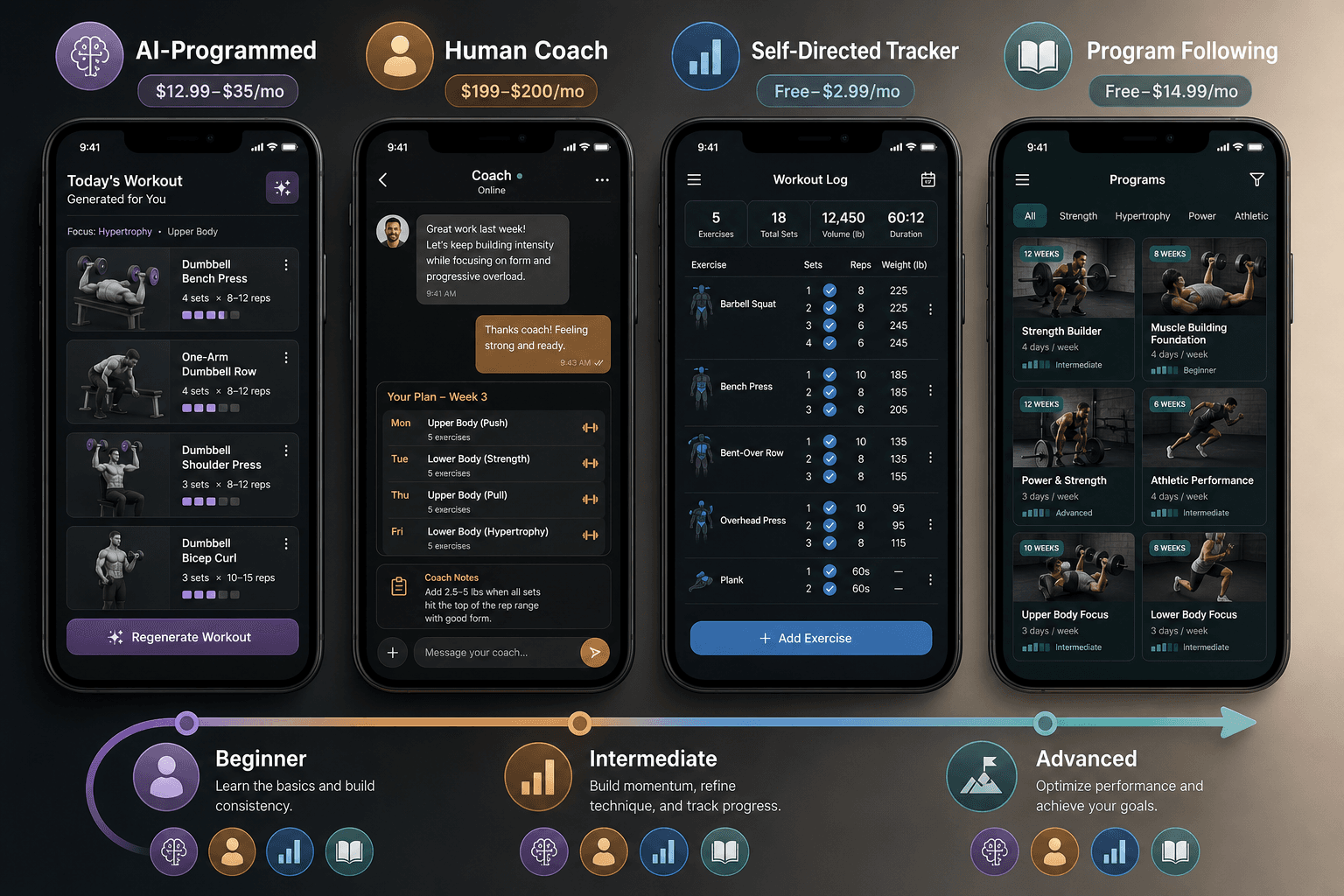
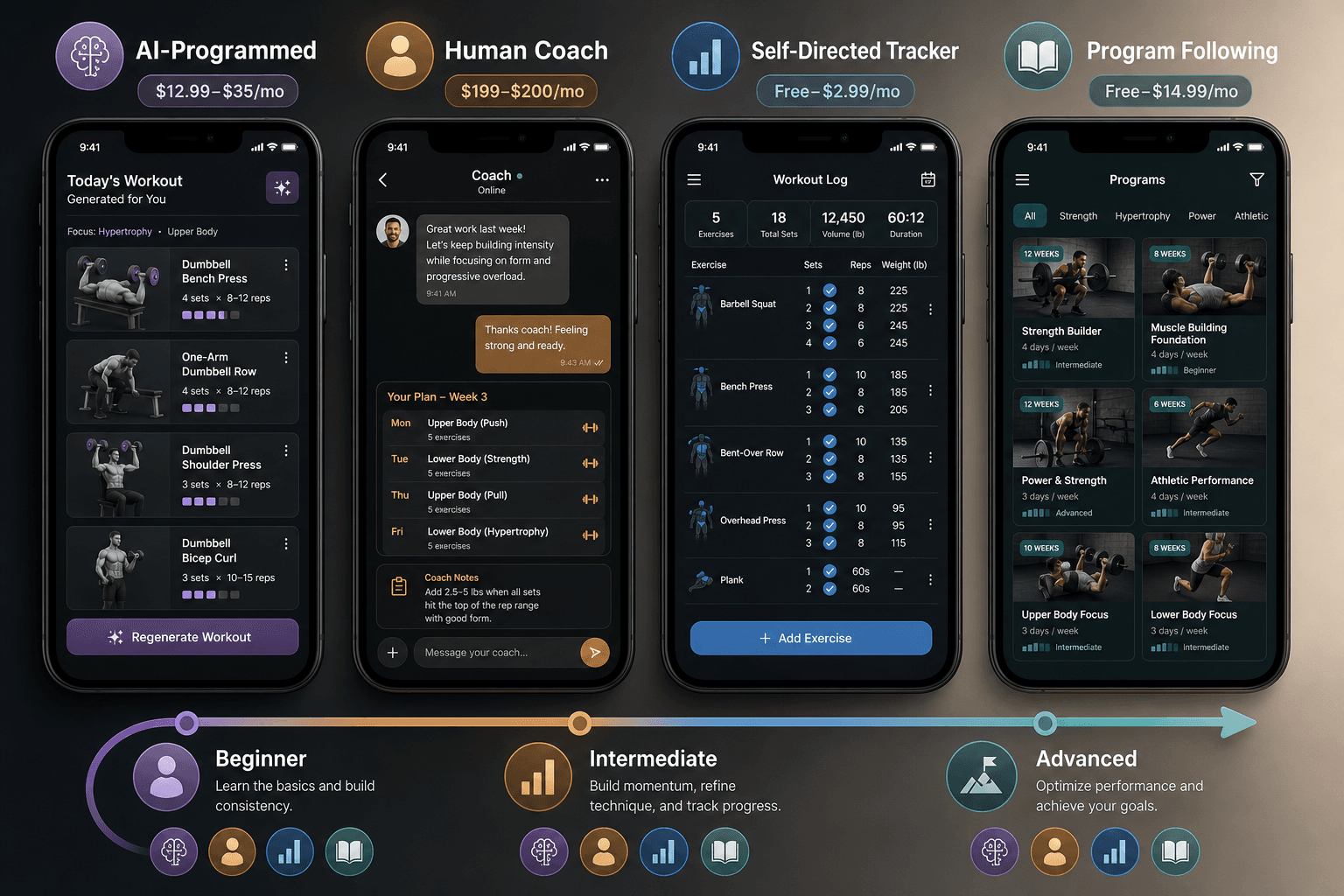
These apps are digital training logs. They track sets, reps, weight, and rest times, but they do not generate workouts or provide coaching. Strong is the fastest logging experience available, with an Apple Watch companion app, but it is "purely a logger" — no workout generation, no coaching. Hevy offers a similar experience with the addition of a social feed for community accountability and, in its Pro tier, AI-generated workouts through Hevy Trainer. Self-directed trackers are ideal for experienced lifters who already know their programming and just need a clean logging tool.
AI-Programmed Apps
AI-programmed apps generate workouts algorithmically based on your logged performance, recovery feedback, and stated goals. Fitbod analyzes every set you log and adjusts future workouts to balance muscle group volume and recovery. Shred uses adaptive AI progression that responds to your difficulty ratings and recovery status. JuggernautAI applies a more sophisticated model that accounts for training cycles, accumulated fatigue, and periodization principles. These apps are best for lifters who want intelligent programming without the cost of a human coach.
Human-Coached Platforms
Human-coached platforms pair you with a real coach who designs your programming, reviews your form, and checks in on your progress. Future ($199/month) earned a perfect 5/5 for accountability from Garage Gym Reviews. Caliber Premium ($200+/month) offers 1-on-1 coaching with form-check video reviews. These platforms replace the experience of working with an in-person personal trainer and are best for people who need external accountability and personalized programming.
Hybrid Group Coaching
A middle ground exists. Caliber Pro ($19/month) provides group coaching — you get access to a coach who reviews your form and answers questions, but you share that coach with other members. Boostcamp sits between self-directed and AI programming: you follow programs designed by expert coaches, but the app handles auto-progression and logging. Hybrid models are a strong option for lifters who want more than a tracker but cannot justify $200/month for 1-on-1 coaching.
For a detailed comparison of AI, human, and self-directed coaching philosophies, read our 2026 strength training app landscape analysis.
Decision Matrix: Find Your Best App Match
The table below cross-references all four axes. Find your experience level, budget, equipment, and preferred coaching style in the columns, then scan the rows to identify your best match.
| App | Best For (Experience) | Price (Monthly) | Equipment Needed | Coaching Style | Key Strength |
|---|---|---|---|---|---|
| Shred | Intermediate | $9.99 | Minimal to full gym | AI-programmed | Highest overall GGR score (4.28/5); adaptive AI progression |
| Fitbod | Intermediate | $12.99–$15.99 | Bodyweight to full gym | AI-programmed | 1,600+ exercise library; adjusts by muscle group balance |
| Hevy | All levels | $2.99 (Pro) / Free tier | Any (user-defined) | Self-directed + AI (Pro) | Most generous free tier; unlimited logging at no cost |
| Caliber | Beginner to intermediate | Free / $19 (Pro) / $200+ (Premium) | Minimal to full gym | Hybrid (Pro) / Human (Premium) | Best overall beginner score (4.6/5); three-tier pricing |
| Boostcamp | Intermediate to advanced | Free / $14.99 (Pro) | Full gym preferred | Self-directed + expert programs | Programs from elite coaches (Israetel, Nippard) |
| Future | All levels | $199 | Minimal to full gym | Human coach (1-on-1) | Perfect 5/5 accountability score |
| JuggernautAI | Advanced | $35 | Full gym (barbell required) | AI-programmed | Perfect 5/5 progressive overload; periodization-aware |
| NTC (Nike Training Club) | Beginner | Free | Bodyweight | Self-directed (guided videos) | 185+ free trainer-led workouts; zero cost |
| Strong | Advanced | ~$9.99 | Any (user-defined) | Self-directed tracker | Fastest logging UX; Apple Watch app |
| Muscle Booster | Beginner | $14.99 | Minimal to full gym | AI-programmed | Perfect 5/5 for progressive overload and equipment demands |
Frequently Asked Questions
How do I switch apps without losing my progress data?
Most strength tracking apps do not offer direct data export to competitors. The practical workaround is to export your data as a CSV file if the app supports it (Strong and Hevy both offer CSV export), then manually import or reference it in your new app. For most users, the simpler approach is to keep your old app installed for historical reference while starting fresh in the new app. Your historical data matters less than your current training maxes — log those in the new app as your starting point and move forward.
Can I cancel a free trial before being charged?
Yes, but you must cancel before the trial period ends. Most apps process billing through the Apple App Store or Google Play Store, so cancellation must happen through your device's subscription settings — not through the app itself. Set a calendar reminder for two days before the trial expires. JuggernautAI offers a 14-day free trial. Peloton offers a 30-day trial for its app-only tier. Apple Fitness+ includes a 1-month free trial with some device purchases. Always verify the trial length and cancellation window in the app's terms before starting.
Should I use two apps together?
Yes, and many experienced lifters do. A common pairing is a program-following app (Boostcamp, JuggernautAI) for workout structure combined with a dedicated tracker (Hevy, Strong) for logging. The program app tells you what to do; the tracker records what you did. Some users also add a wearable-compatible app like SensAI ($6.99/month) that analyzes HRV and recovery data from their fitness tracker to inform training readiness. If you are considering a dual-app strategy, read our guide on pairing two specialized trackers for practical setup advice.
What if I have a fitness tracker — which apps sync with it?
Tracker sync compatibility varies significantly. Apple Watch users have the widest options: Strong, Hevy, and Fitbod all offer Watch apps for logging workouts directly from the wrist. SensAI integrates with HealthKit to pull HRV and sleep data for adaptive coaching. Garmin users have fewer direct app integrations — most strength training apps do not sync natively with Garmin Connect. Whoop and Oura users will find that most strength training apps do not pull recovery data from these devices, though some newer apps like Vora and Slate are beginning to offer this capability. Check the app's tracker sync documentation before subscribing if this is a priority.
Comments
Join the discussion with an anonymous comment.