
A new tracker arrives. Three weeks later it's in a drawer.
You fasten the band, swipe through setup, wear it to bed. Then the screen goes dark. Maybe it slid off during a deadlift. Maybe you forgot to charge it. Maybe the novelty just wore off. The drawer is where most trackers end up. Not because of a 2% heart-rate error. Because of inconvenience.
The global fitness tracker market is projected at $187.2 billion by 2032 – a number that counts how many units ship, not how many still get worn. That's the number that matters.
I've watched people buy a shiny smartwatch, then leave it on the nightstand because they don't want to charge it before bed. Or buy a ring and find out they can't deadlift in it. The reason isn't brand loyalty or sensor accuracy. It's the shape – what the device demands from you every single day. Pick the wrong shape and you'll abandon it. The brand won't save you.
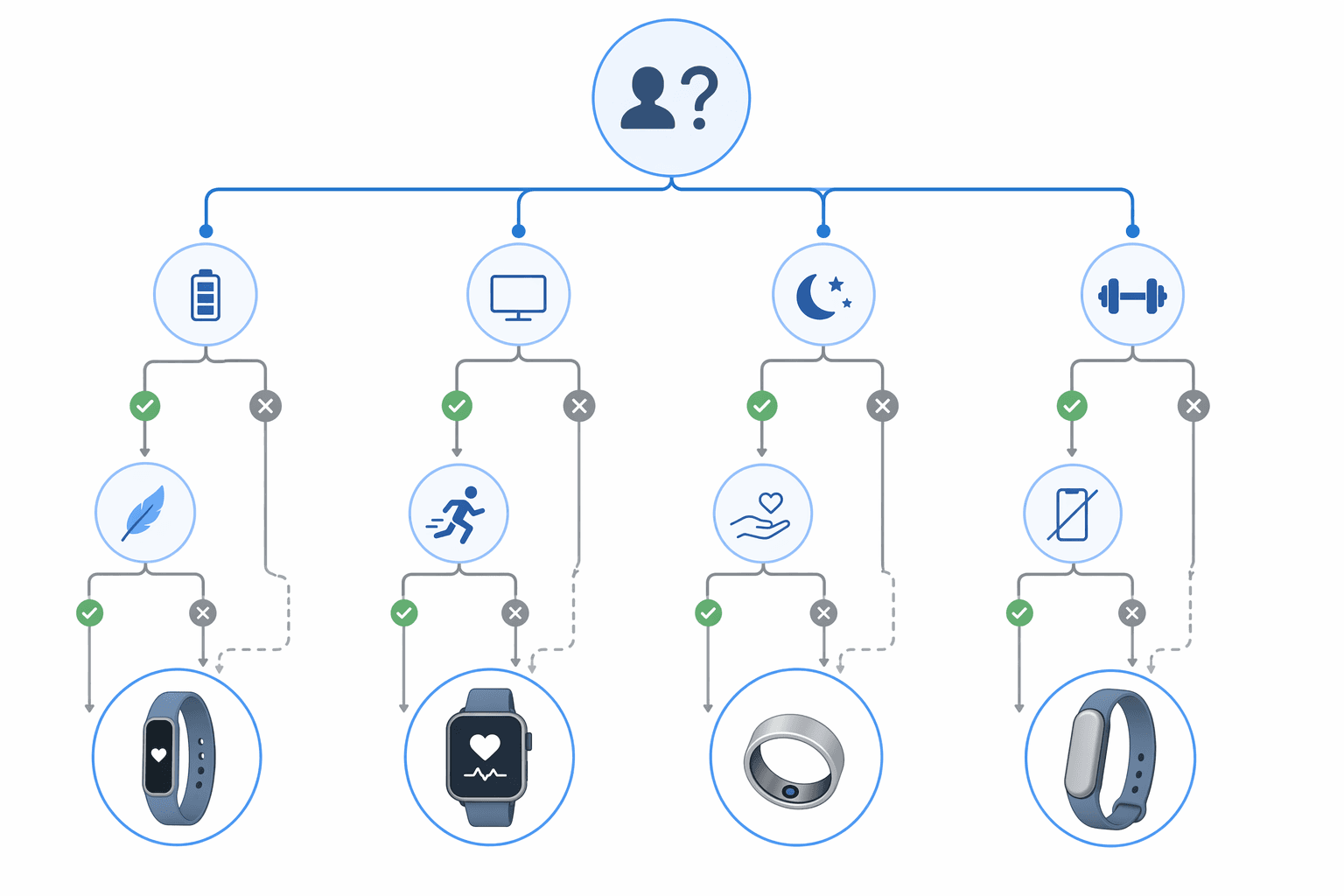
Two questions eliminate most trackers
Forget the spec sheet. Ask yourself:
- Will I wear it while sleeping?
- Can I charge it every day?
Answer those and you've already narrowed the field. If you need sleep tracking and can't charge daily, a smartwatch is out. Every smartwatch I've tested – Apple Watch SE 3 at 46 hours, Pixel Watch 4 at 30 hours – forces a nightly charge. That means sleep tracking stops. A slim band or screenless band with 7–14 days of battery stays on your wrist round the clock.
If you lift heavy – barbells, dumbbells, pull-ups – a ring is a non-starter. The Oura Ring 5 cannot be worn during heavy lifting because grip pressure damages the sensor or makes the ring painful. So that ring comes off during deadlifts. If your gym day includes gripping, you need something on your wrist.
Run through the tree: answer “yes” to sleep and “no” to daily charging → slim band or screenless. Answer “yes” to charging → smartwatch. Answer “no” to lifting → ring becomes possible. The shape that survives both questions is the one you should buy.
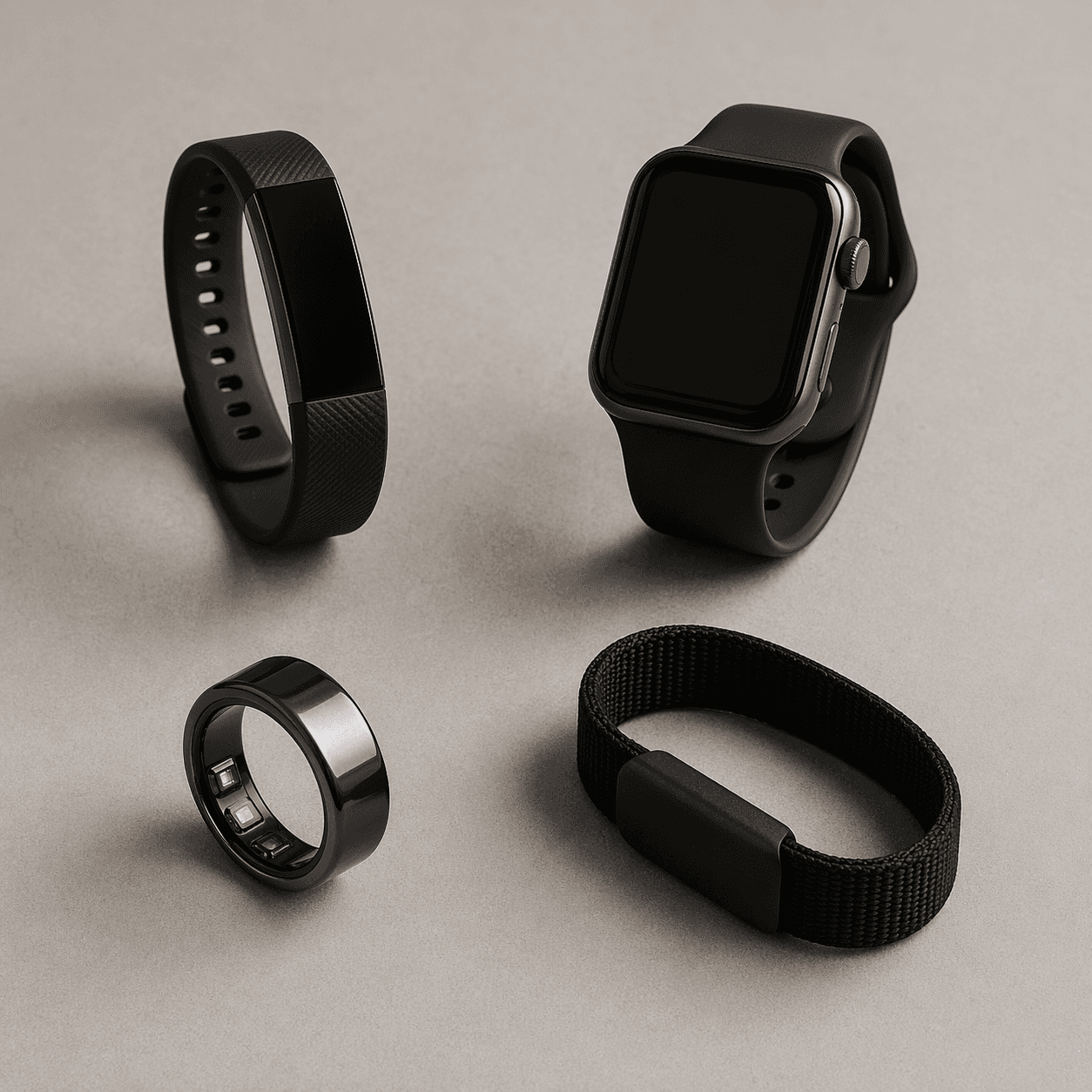
The four shapes in 2026 – what you actually trade
Every fitness tracker on the market today fits into one of four categories. The trade-offs aren't between brands; they're between battery life, phone dependency, and whether you can lift in it. Here's how they stack up:
| Form factor | Battery (typical days) | Phone dependency | Worn during lifting | Data timing |
|---|---|---|---|---|
| Slim band | 7–14+ | Low (after workout sync) | Yes | Mostly retrospective |
| Smartwatch | 1–2 (24–46 hrs) | None (all on wrist) | Yes | Real-time |
| Ring | 5–9 | Low (after workout sync) | No | Retrospective |
| Screenless band | 7–14 | High (all real-time data via phone) | Yes | Retrospective (life) / phone-dependent (workout) |
Slim bands: forget it's there, but don't expect wrist feedback
If you landed here from the decision tree, you want something you can put on and ignore. Slim bands deliver. The Fitbit Inspire 3 costs under $100 and tested at 8.5 days of battery with near-daily workouts (Wirecutter). The Xiaomi Smart Band 10 goes for roughly $53 and exceeds 14 days. The Fitbit Charge 6 adds built-in GPS and 40 exercise modes for a bit more weight – 1.02 ounces – and lasts 7 days (Wirecutter).
What you give up: a screen you can actually use mid-workout. The Inspire 3 has a small color touchscreen, but you won't read lap splits or check rep counts on it. The band records everything and syncs later. You wear it constantly, but you don't interact with it while you're moving. That's fine for runs, bodyweight, and dumbbell work. The one place it falls short is if you want real-time pace or heart-rate display during a run – that requires a smartwatch.
Sleep tracking is where this shape wins. Because you keep the band on for days, you get consistent nightly data. No gaps from forgotten charges. The Garmin Vivosmart 5 is another option if you prefer Garmin's ecosystem. All of them are comfortable enough to sleep in – lighter and thinner than a smartwatch.
Smartwatches: richest data, but you charge every night
You chose daily charging. In return you get the best real-time workout data: GPS without a phone, onboard music, bright display, app ecosystem, VO₂ max estimates. The Apple Watch SE 3 (PCMag, 46 hours, $199) and Apple Watch Series 11 (WIRED, 24 hours) deliver the most polished experience. But that battery cap means you take it off before bed. Sleep tracking? Inconsistent at best.
The exception is the Garmin Vivoactive 6 (WIRED): 11-day battery, Body Battery, Morning Report, no subscription. It's still a smartwatch – notifications, payments, AMOLED display – but its battery rivals slim bands. It even has nap detection, which most smartwatches can't do because they're on the charger while you nap. That makes it the standout in this category.
If you're still leaning toward a smartwatch, read our deeper dive on the watch vs. smartwatch form factor for more.
Rings: best sleep tracker, but no deadlifts
The ring is the most invisible tracker. The Oura Ring 5 is 40% smaller than the Ring 4 and lasts up to 9 days (WIRED). No screen, no vibrations, no waking you up. It's the best sleep tracker in this comparison because you never take it off – except during lifting.
That's the catch. Testers noted grip interference with Oura Ring 4 (Garage Gym Reviews), and the Ring 5 carries the same limitation. Barbell deadlifts, pull-ups, kettlebell swings – anything requiring a firm grip – forces the ring off. You lose workout data for those sessions.
So who is the ring for? Someone who doesn't lift heavy. If your training is running, yoga, cycling, or bodyweight circuits without gripping, the ring works fine. All data is retrospective – no live display, no rep counting. You see how your session went after it ends. The Oura Ring 4 tested at 7.25 days battery (PCMag). The Ultrahuman Ring Air is another option without a subscription. Both share the same core trade-off: best for sleep, fine for light workouts, non-starter for strength.
Screenless bands: maximum comfort, maximum phone dependence
The newest shape in 2026: a small pod or slim tube with no display. Google's Fitbit Air launched in May 2026 at $100 with 7-day battery and 12 grams (Wareable, PCMag, WIRED). Whoop 5.0 has been around longer: up to 14 days battery, free band with a $199–$359/year subscription (Wirecutter).
The selling point is comfort and focus. No screen means no notifications, no glanceable data, no reason to look at your wrist. The downside? All real-time information requires your phone. Run without your phone? You won't see your pace until after the run. Strength training? No live rep counting. The Fitbit Air uses Google Health Coach for AI insights, but those come later, not mid-set.
If you want life tracking – sleep, recovery, readiness – without workout distractions, screenless bands excel. If you want to monitor pace or heart rate during a workout, you'll be pulling out your phone constantly. That's the hidden cost the marketing doesn't emphasize.
For a full breakdown, see our guide to the screenless trend.
The one question that settles it
After all that, the choice comes down to a single question: which compromise can you live with?
No shape does it all. The slim band is the closest to universal – long battery, light, lifting-safe, sleep-friendly – but its small screen limits on-wrist feedback. The smartwatch gives you the richest workout experience but demands a nightly charge and kills sleep consistency. The ring is invisible and great for sleep but cannot handle strength training. The screenless band is the most comfortable but prices convenience behind a phone glance.
Pick the shape that fits your life first, then worry about the brand. The best fitness tracker is the one you still wear three months from now.
Comments
Join the discussion with an anonymous comment.