
Best Fitness Trackers for Women in 2026: A Tiered Comparison by Wrist Size, Cycle Tracking, and Style
A structured buying guide for women comparing fitness trackers across three often-overlooked constraint axes: physical wrist fit, depth of female-specific health tracking (cycle, fertility, pregnancy), and style versatility. Recommendations are tiered by which trade-off the reader prioritizes, with detailed accuracy caveats and methodology disclosure.
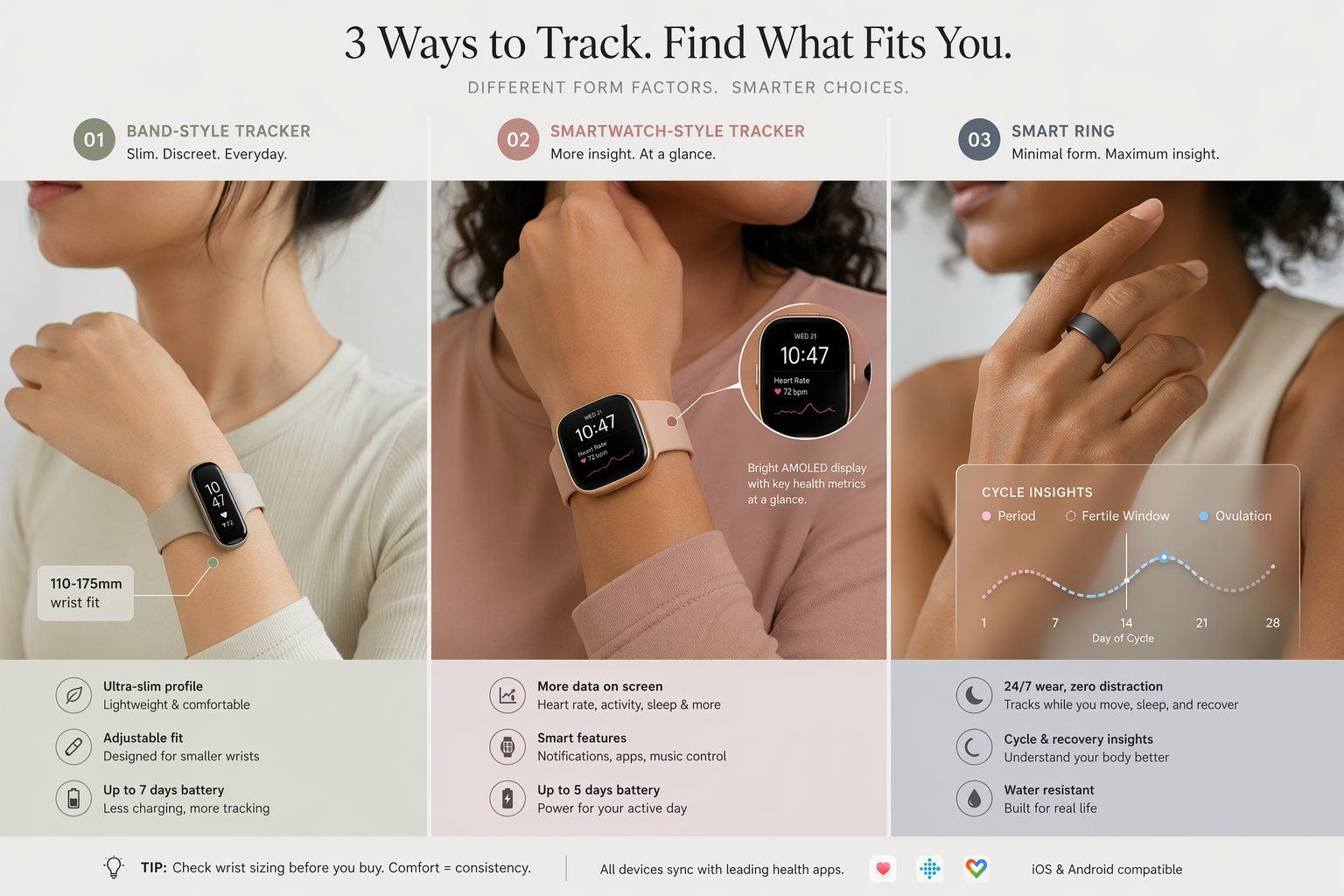
Why Women Need a Different Fitness Tracker Buying Guide
Most fitness tracker roundups treat women as a single demographic and recommend one "best for women" device. That approach collapses under the weight of three real-world constraints that vary dramatically from person to person: physical wrist fit, the depth of female-specific health tracking, and style versatility. A tracker that excels at cycle tracking may be too bulky for a 5-inch wrist. A device that looks like jewelry may lack the GPS accuracy a runner needs. A ring that offers fertility tracking may guess incorrectly for someone with irregular cycles.
This guide takes a different approach. Instead of declaring a single winner, it tiers recommendations by which trade-off you prioritize. If wrist size is your primary constraint, you land in Tier 1. If you want the deepest female health data, you land in Tier 3. If recovery metrics matter most, Tier 4. The goal is to match you to the device that fits your actual constraints — not the one that looks best on a generic list.
The Three Constraint Axes: Fit, Female Health Features, and Style
Before diving into specific recommendations, it helps to understand the three axes this guide uses to evaluate every device. Each axis represents a real trade-off: no single tracker in 2026 scores top marks on all three.
Axis 1: Physical Fit
Wrist circumference, case size, band width, and total weight determine whether a tracker is comfortable for all-day and all-night wear. A device that is too large for your wrist will slide, shift, and produce less reliable sensor readings. Wirecutter notes that "how a tracker is worn — how it's positioned on the wrist, how tight the band is cinched — can affect readings." For women with wrists under 5.5 inches, this is not a minor consideration; it is the primary determinant of whether the device will be useful.
Axis 2: Female Health Tracking Depth
Not all cycle tracking is created equal. Some devices offer basic period logging. Others track ovulation windows, irregular cycles linked to PCOS, pregnancy stages, and the menopause transition. Tom's Guide reports that Garmin offers "some of the most detailed women's health insights," while Apple Watch uses FDA-cleared cycle tracking with wrist temperature sensing. The depth you need depends on whether you are tracking for general awareness, trying to conceive, managing a condition, or navigating pregnancy.
Axis 3: Style Versatility
A tracker you do not want to wear is a tracker that does not collect data. Style versatility matters because it determines whether you keep the device on from workout to work to dinner. Options range from jewelry-like bands (Fitbit Luxe) and patterned hidden displays (Garmin Lily 2) to screenless bands (Whoop 5.0) and rings (Oura Ring 4) that look like everyday accessories.
| Device | Wrist Fit | Female Health Depth | Style Versatility |
|---|---|---|---|
| Garmin Lily 2 | Excellent (110-175mm) | High (cycle, fertility, pregnancy) | High (patterned lens, hidden display) |
| Fitbit Luxe | Good (5.3-7.1 in small band) | Moderate (period tracking) | High (jewelry-like design) |
| Fitbit Charge 6 | Moderate (standard band) | Moderate (period, ovulation) | Moderate (sporty band) |
| Apple Watch Series 11 | Good (41mm fits 5.1-6.3 in) | High (FDA-cleared, wrist temp) | High (customizable bands) |
| Garmin Vivoactive 6 | Moderate (standard) | Very High (cycle, pregnancy, menopause) | Moderate (sporty) |
| Oura Ring 4 | Excellent (no wrist bulk) | High (Natural Cycles BBT) | High (ring form factor) |
| Whoop 5.0 | Good (26.5-28g, no screen) | None (no cycle tracking) | High (screenless, band options) |
| Amazfit Active 2 | Moderate (44mm case) | Moderate (basic cycle) | Moderate (sporty) |
Tier 1: Best for Small Wrists and Style
If your wrist circumference is under 5.5 inches or you prioritize a device that transitions seamlessly from a workout to a dinner table, this tier is your starting point.
Garmin Lily 2
The Garmin Lily 2 is the slimmest fitness tracker with meaningful women's health features. Its band width is 14mm, and it fits wrists from 110mm to 175mm (4.3 to 6.9 inches), according to La Petite Poire. Forbes Vetted called it "the smallest tracker I tested" and highlighted its fertility tracking, Body Battery, and muscle mapping features. The patterned lens hides the display when not in use, giving it the look of a fashion watch rather than a fitness device.
Fitbit Luxe
The Fitbit Luxe is the jewelry-like alternative. Its tracker body measures approximately 35mm long by 15mm wide, and the small band fits wrists 5.3 to 7.1 inches. La Petite Poire notes that on a 5-inch wrist, the Luxe "sits on my wrist without leaving too much of a gap on either side." It offers period tracking and up to 5 days of battery life, but lacks built-in GPS and has a smaller feature set than the Charge 6. It is best for women who prioritize aesthetics and wrist fit over deep health data.
- Garmin Lily 2: ~$250, 14mm band, 110-175mm wrist fit, fertility tracking, no built-in GPS
- Fitbit Luxe: ~$150, jewelry-like design, 5-day battery, period tracking, no built-in GPS
Tier 2: Best All-Around with Cycle Tracking
For most women who do not have extreme constraints on wrist size or style, the Fitbit Charge 6 is the default pick. It balances cycle tracking, built-in GPS, strong accuracy, and a 7-day battery at a reasonable price.
Fitbit Charge 6
The Charge 6 earned top marks from multiple testing sources. Wirecutter measured a 1.3% step count error and found it was -0.02 miles off in a 1-mile distance test. Forbes Vetted reported that during high-intensity intervals, the Charge 6 matched the Polar H10 chest strap within approximately 1-2 BPM during a 30-second to one-minute window from 160 BPM down to 120 BPM. Women's Health rated it Best Overall, noting its 30g slim case, 24mm case size, period and fertility tracking, up to 7-day battery, and 50m water resistance at $160.
The Charge 6 comes with a 6-month Fitbit Premium trial. After that, advanced cycle insights and other premium features require a subscription. This is a meaningful ongoing cost that should factor into your total ownership calculation.
| Feature | Fitbit Charge 6 |
|---|---|
| Price | ~$160 |
| Battery Life | Up to 7 days |
| Built-in GPS | Yes |
| Step Accuracy | 1.3% error (Wirecutter) |
| HR Accuracy | ~1-2 BPM vs Polar H10 (Forbes) |
| Cycle Tracking | Period, ovulation windows |
| Subscription Required | Fitbit Premium after 6-month trial |
| Wrist Fit | Standard band (24mm case) |
Tier 3: Best for Accuracy and Deep Health Data
If you want the most accurate heart rate data available from a wrist-worn device and the deepest female health tracking features, this tier is where you should focus. Both devices here are more expensive and have trade-offs in battery life or wrist fit, but they deliver data quality that lower-tier options cannot match.
Apple Watch Series 11
In CNET's 30-mile lab test against the Polar H10 chest strap, the Apple Watch Series 11 had the lowest average heart rate error of any device tested: 0.98% (approximately 1.40 BPM). It also averaged 0.99 miles per test on a 400m track, within a tenth of actual distance. The Series 11 offers FDA-cleared cycle tracking with wrist temperature sensing for ovulation and fertile window estimates, plus FDA-cleared sleep apnea detection. Women's Health notes the 42mm model weighs 30.3g and the 46mm model weighs 37.8g, with a 24-hour battery life.
Garmin Vivoactive 6
The Garmin Vivoactive 6 is the best option for women who want the most comprehensive female health tracking available. Tom's Guide reports that Garmin's women's health suite covers cycle phases, irregular periods due to PCOS, pregnancy (including gestational age estimates and prenatal nutrition recommendations), menopause transition, and blood glucose logging. The Vivoactive 6 adds a sleep coach, smart wake alarm, Body Battery, and an 11-day battery life. Women's Health rated it Best for Sleep at approximately $340.
| Female Health Feature | Apple Watch Series 11 | Garmin Vivoactive 6 |
|---|---|---|
| Cycle Tracking | FDA-cleared, wrist temp sensing | Cycle phases, irregular periods, PCOS |
| Fertility / Ovulation | Wrist temp estimates ("just estimates" per Tom's Guide) | Ovulation windows, fertility tracking |
| Pregnancy Mode | No dedicated mode | Gestational age, prenatal nutrition, blood glucose |
| Menopause Tracking | No | Yes |
| Sleep Apnea Detection | FDA-cleared | No |
| Battery Life | ~24 hours | ~11 days |
| Price | ~$399 | ~$340 |
Tier 4: Best for Recovery-Obsessed
If your primary interest is recovery metrics — HRV, sleep quality, strain, and readiness — and you are willing to pay an ongoing subscription for deep analysis, this tier is for you. Both devices here are screenless or ring-form, which means they also score well on style versatility.
Oura Ring 4
The Oura Ring 4 packs 18 sensors into a ring weighing 3.3 to 5.2 grams with up to 8 days of battery life. Women's Health notes it has clinically validated sleep tracking and integrates with Natural Cycles for temperature-based fertility tracking. The ring costs $349 plus a $6/month membership. For women with regular cycles, the BBT-based ovulation detection is effective. However, the same source cautions that for irregular cycles, the algorithm "sometimes guesses at an ovulation date that didn't actually happen just because enough time has passed."
For a deeper dive into Oura's accuracy across sleep, HRV, and heart rate, see our Oura Ring Accuracy: What 8 Peer-Reviewed Studies Actually Say article. For a broader comparison of smart rings, see our Fitness Tracker Rings in 2026: A Buying Guide for Home Gym Enthusiasts.
Whoop 5.0
The Whoop 5.0 is a screenless band focused entirely on strain, recovery, and sleep metrics. It weighs 26.5 to 28 grams and offers a 14-day battery life. Women's Health rated it Best Non-Display at $199 per year. Whoop does not offer cycle tracking, so it is best suited for women who prioritize recovery data over female-specific health features.
- Oura Ring 4: $349 + $6/mo, 18 sensors, 8-day battery, Natural Cycles BBT fertility tracking, no wrist bulk
- Whoop 5.0: $199/yr, 14-day battery, strain/recovery focus, no screen, no cycle tracking
Budget Pick: Amazfit Active 2
At approximately $100, the Amazfit Active 2 is the best budget option with women's health tracking. Women's Health reports it offers a 10-day battery, 160+ workout modes, and heart rate tracking comparable to the Fitbit Charge 6 in testing. The 44mm case size may be large for very small wrists, so it is best suited for women with standard or larger wrists who want solid features without a subscription commitment.
- ~$100 — no ongoing subscription required
- 10-day battery life
- 160+ workout modes
- 44mm case — may be large for wrists under 5.5 inches
How Each Tracker Handles Female Health Tracking
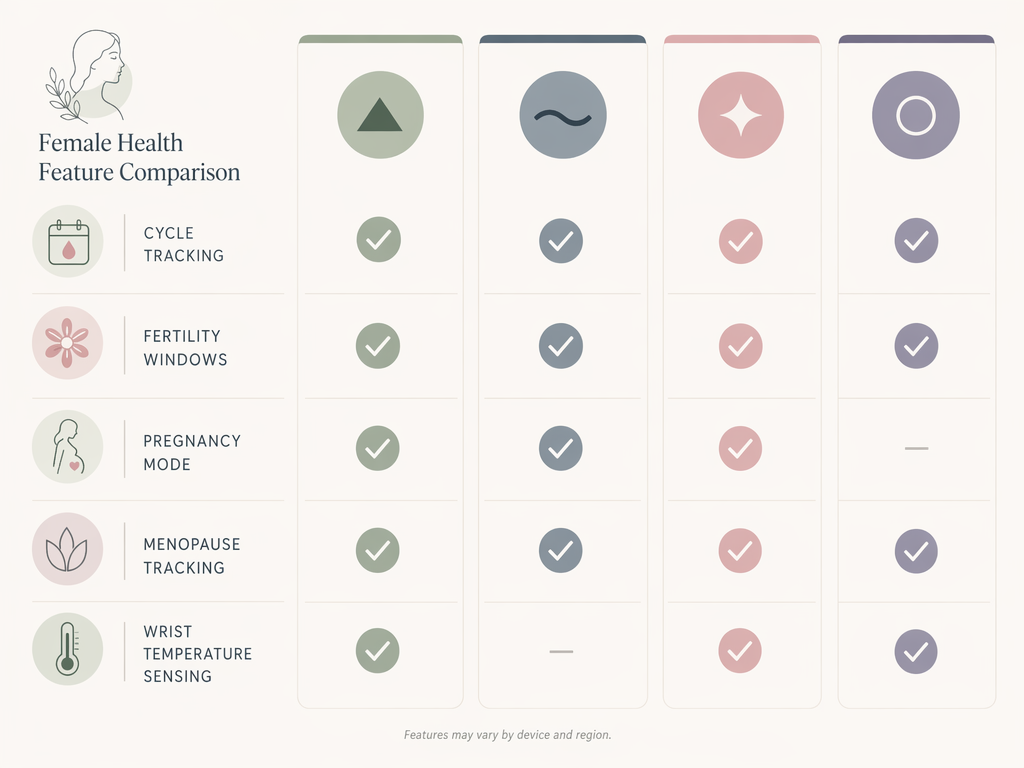
The depth of female-specific health tracking varies significantly across brands. Here is how each platform approaches it.
| Brand | Cycle Tracking | Fertility / Ovulation | Pregnancy | Menopause | Unique Features |
|---|---|---|---|---|---|
| Garmin | Cycle phases, irregular periods, PCOS logging | Ovulation windows | Gestational age, prenatal nutrition, blood glucose | Yes | Most comprehensive lifecycle coverage |
| Fitbit | Period tracking, ovulation windows | Basic ovulation estimates | Basic pregnancy mode | No | 6-month Premium trial included |
| Apple Watch | FDA-cleared cycle tracking | Wrist temperature sensing for estimates | No dedicated mode | No | FDA-cleared sleep apnea detection |
| Oura Ring | Natural Cycles integration (BBT) | Temperature-based fertility tracking | No | No | Best for regular cycles; less reliable for irregular |
Fit and Comfort: Case Sizes, Band Widths, and Weight
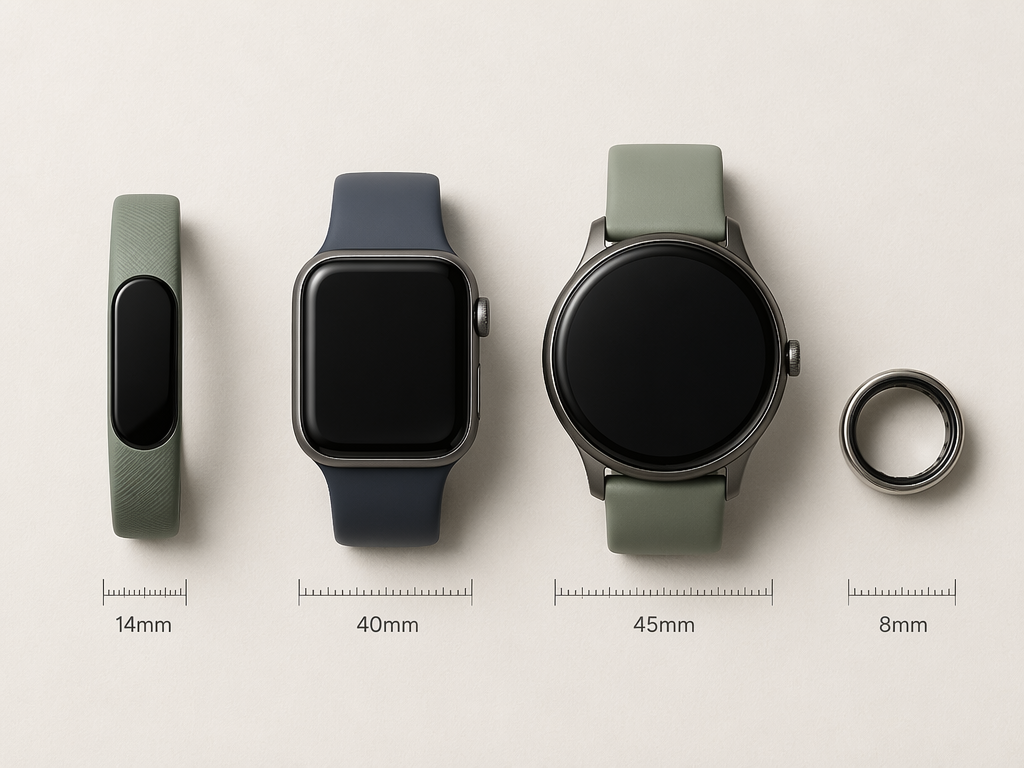
Physical dimensions determine whether a tracker is comfortable for all-day wear. The table below compiles manufacturer specs and independent measurements from La Petite Poire and Women's Health.
| Device | Case Size | Band Width | Weight | Wrist Fit Range |
|---|---|---|---|---|
| Garmin Lily 2 | ~35mm | 14mm | ~25g | 110-175mm (4.3-6.9 in) |
| Fitbit Luxe | ~35mm x 15mm | ~15mm | ~26g | 5.3-7.1 in (small band) |
| Fitbit Charge 6 | 24mm case | Standard | 30g | Standard |
| Apple Watch Series 11 (41mm) | 41mm | Standard | 30.3g | 5.1-6.3 in (small band) |
| Garmin Vivoactive 6 | ~42mm | Standard | ~40g | Standard |
| Oura Ring 4 | Ring (sizes 6-13) | N/A | 3.3-5.2g | Finger size dependent |
| Whoop 5.0 | N/A (band only) | Standard | 26.5-28g | Standard |
| Amazfit Active 2 | 44mm | Standard | ~35g | Standard (may be large for <5.5 in) |
Accuracy Caveats Every Buyer Should Know
Wrist-worn fitness trackers are remarkably good at some things and notably poor at others. Understanding these limitations will help you set realistic expectations and avoid over-relying on any single metric.
- Calorie burn estimates are unreliable across all brands. A 2022 systematic review of 65 studies published in PubMed found that the mean absolute percentage error (MAPE) for energy expenditure was greater than 30% for all brands, "showing poor accuracy across devices."
- Wrist-based trackers overestimate energy expenditure during low-intensity exercise and underestimate it during high-intensity exercise. This finding comes from both N'Namdi Nelson, CSCS at NYU Langone (quoted in Women's Health) and the Mayo Clinic.
- Optical heart rate sensors can be affected by skin tone, tattoos, and body hair. Wirecutter notes that "studies into skin tone, specifically, have to date had mixed findings," meaning the research is not yet conclusive.
- Sleep tracking is generally accurate for total sleep time and sleep fragmentation, but less accurate for sleep architecture (distinguishing between sleep stages). This assessment comes from Aric A. Prather, PhD at UCSF, as quoted by Wirecutter.
- Step count accuracy is generally strong. Wirecutter found the Fitbit Inspire 3 had just 0.32% step error over a 2-day period. CNET found that none of the 5 smartwatches tested deviated by more than 11 steps from a manual tally counter in a 2,500-step test.
Frequently Asked Questions
Can I use a fitness tracker during pregnancy?
Yes, but the level of support varies. Garmin has a dedicated pregnancy mode that includes gestational age estimates, prenatal nutrition and exercise recommendations, and blood glucose logging. Apple Watch offers FDA-cleared cycle tracking but does not have a dedicated pregnancy mode. Fitbit has a basic pregnancy mode. Always consult your healthcare provider before using any tracker data to guide pregnancy-related decisions.
Do I need a subscription for cycle tracking?
It depends on the device. Fitbit requires a Premium subscription (after the 6-month trial) for advanced cycle insights. Oura requires a $6/month membership for Natural Cycles integration and detailed cycle analysis. Garmin and Apple include basic cycle tracking for free with no subscription required.
Which tracker is best for very small wrists under 5.5 inches?
The Garmin Lily 2 is the best option, with a 14mm band and a wrist fit range of 110-175mm (4.3-6.9 inches). The Oura Ring 4 is also an excellent choice because it eliminates wrist bulk entirely. The Fitbit Luxe is a good alternative if you prefer a band-style device with a jewelry-like look.
How accurate is wrist-based sleep tracking for women?
According to Aric A. Prather, PhD at UCSF (quoted by Wirecutter), most wearable devices are "capable of accurately estimating total sleep time and sleep fragmentation, but this is less true when it comes to sleep architecture." This means total sleep duration is generally reliable, but the breakdown of light, deep, and REM sleep stages should be taken with a grain of salt.
Methodology and How We Chose These Trackers
This guide is based on analysis of multiple published reviews from Women's Health, CNET, Wirecutter, Forbes Vetted, Tom's Guide, and La Petite Poire, supplemented by peer-reviewed studies from PubMed and manufacturer specifications. We prioritized sources that conducted independent testing (CNET's 30-mile lab test, Wirecutter's decade of testing, Forbes Vetted's trainer-verified testing) over sources that rely solely on manufacturer claims.
This result comes from one real apartment under the stated conditions — it is a strong signal, not a guarantee your space will measure identically.
Builds this evidence supports
No build currently links to this specific test. Browse all builds with a matching tag.
Spot something off?
If this result didn't match your own space, let us know — floor-damage and noise claims carry real deposit-risk consequences if we get them wrong.