
The best fitness tracker for women is not the one with the prettiest period calendar. It is the one whose health features match the life stage you are actually in: casually watching symptoms, trying to identify ovulation, pregnant, perimenopausal, training around cycle phases, or dealing with irregular cycles where confident-looking predictions deserve extra skepticism.
Current as of June 2026, the short version is this: Garmin has the broadest reproductive life-stage coverage; Apple Watch is strongest for iPhone users who want temperature-backed retrospective ovulation estimates; Oura is the best ring-style option if you accept the subscription and algorithm limits; Whoop is specialized for cycle-phase training guidance if you are not on hormonal birth control; Fitbit is mostly a basic menstrual logging and prediction option.
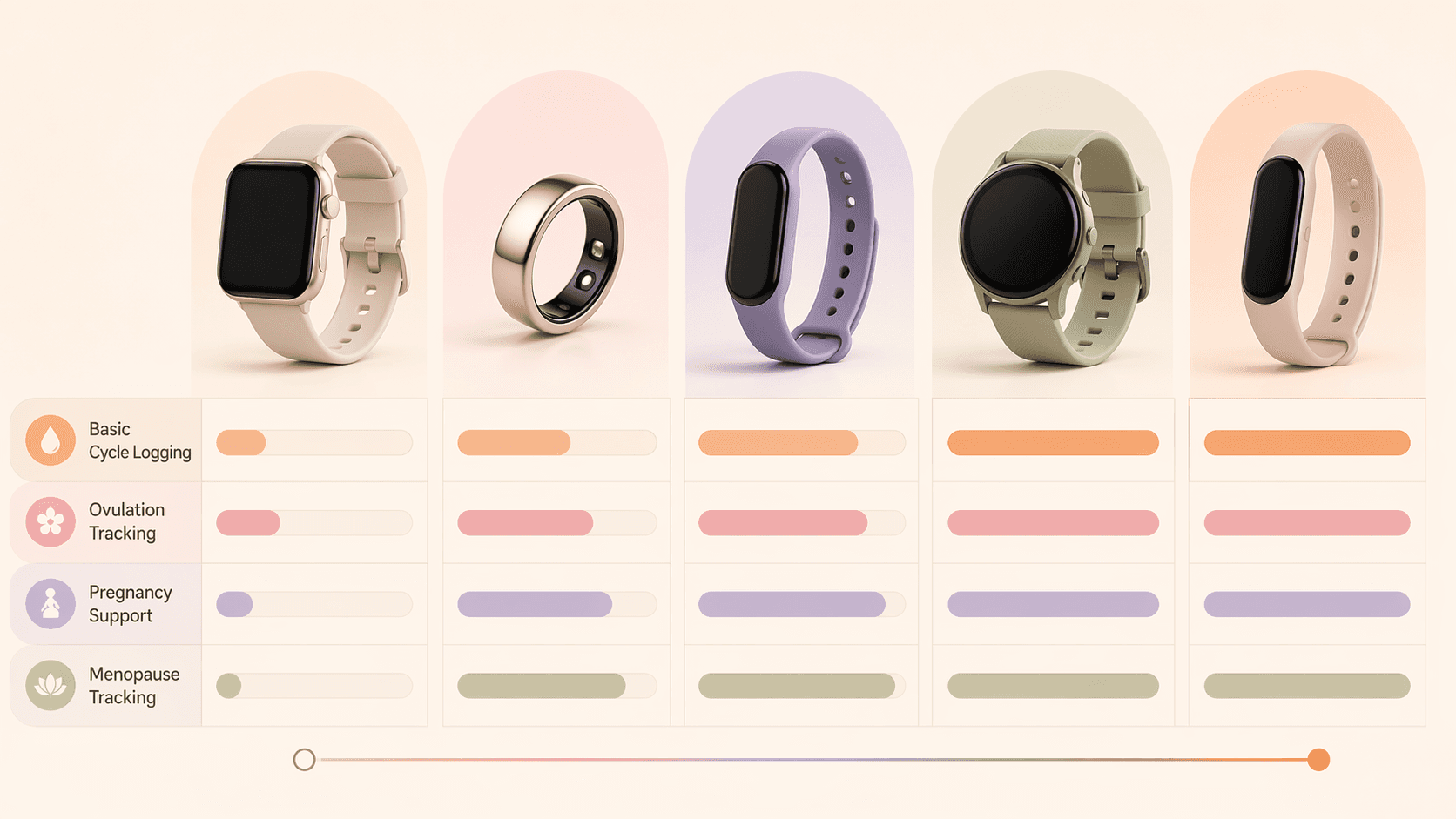
| If this is your main need | Start with | Why |
|---|---|---|
| Full reproductive life-stage support | Garmin | It covers menstrual tracking, ovulation estimates, pregnancy tools, and menopause tracking, with pregnancy features such as gestational age, weight gain targets, prenatal tips, and a contraction timer.[1] |
| Apple ecosystem plus temperature-backed ovulation estimates | Apple Watch Series 8 or newer | Wrist temperature sensing supports retrospective ovulation estimates, alongside period logging and fertile-window predictions. |
| Ring form factor and temperature trends | Oura Ring | It uses temperature patterns for period prediction and has pregnancy insights, but the useful experience depends on paying for membership and accepting less manual control. |
| Training and recovery coaching by cycle phase | Whoop | Its Menstrual Cycle Coaching adjusts strain and sleep guidance by phase, but it excludes users on hormonal birth control and does not offer pregnancy features. |
| Basic period logging | Fitbit | It can log periods and show cycle predictions, but it is not the strongest choice for pregnancy support or deeper reproductive life-stage tracking. |
This is a fitness-tracker purchase guide, not medical advice. If you are trying to conceive, pregnant, managing PCOS, seeing major cycle changes, using hormonal birth control, or having symptoms that concern you, use the device as a logging tool and bring the pattern to a qualified healthcare provider.
The feature comparison that actually matters
| Platform | Period logging | Fertile window or ovulation support | Pregnancy support | Menopause support | Hormonal birth control limits | Subscription for these health features | Best read |
|---|---|---|---|---|---|---|---|
| Garmin | Yes | Ovulation estimates | Dedicated pregnancy tracking with gestational age, weight gain targets, prenatal nutrition and exercise tips, and contraction timer.[1] | Yes | Not framed as a cycle-phase coaching product that excludes hormonal birth control users | No subscription required for these health tracking features | Most complete life-stage coverage |
| Apple Watch Series 8+ | Yes | Fertile-window predictions and retrospective ovulation estimates using wrist temperature | Some pregnancy-related insight through Apple Health integrations, but no dedicated pregnancy mode | Not a standout menopause platform in this comparison | Hormonal birth control can affect cycle and ovulation interpretation | No subscription required for Apple’s health tracking features | Best for iPhone users who want temperature-backed retrospective estimates |
| Oura Ring | Yes | Temperature-based period prediction using frequent daily temperature readings | Pregnancy insights mode added in 2025 | Not the strongest menopause choice here | Hormonal birth control may affect cycle interpretation; users with irregular cycles should be cautious | About $71.88 per year after the trial | Best ring option if subscription and adjustment limits are acceptable |
| Whoop | Yes, as part of cycle coaching | Cycle-phase guidance for training, strain, and sleep rather than fertility-focused ovulation confirmation | No dedicated pregnancy features | No dedicated menopause support in this comparison | Menstrual Cycle Coaching works only for users not on hormonal birth control | About $360 per year, mandatory | Best for training guidance by cycle phase |
| Fitbit | Yes | Cycle predictions | No pregnancy mode; pregnant users may need to manually disable period-related notifications | Not a standout menopause platform in this comparison | Hormonal birth control can affect prediction usefulness | Premium is optional at about $120 per year for deeper health insights | Best only if basic logging is enough |
The table makes one thing hard to ignore: “cycle tracking” can mean anything from a calendar reminder to a life-stage-aware health experience. Those are not the same purchase.
Garmin is what full coverage looks like
Garmin is the platform to beat if the question is not just “Can it log my period?” but “Does it understand that reproductive health changes over time?” Its women’s health features span menstrual cycle tracking, ovulation estimates, pregnancy tracking, and menopause tracking. The pregnancy side is unusually concrete: Garmin lists gestational age, baby size updates, weight gain targets, prenatal nutrition and exercise tips, and contraction timing among its pregnancy tracking tools.[1]
That breadth matters because pregnancy mode is not a decorative extra. A tracker that keeps nudging someone to log a period while they are pregnant is asking the user to babysit the software. A tracker that changes the context — weight trends, symptom logging, exercise guidance, and contraction timing — has at least mapped the situation it claims to support.
Garmin also benefits from not charging a separate subscription for these health tracking features. If you are already comparing expensive wearables, the absence of a required monthly fee changes the real cost over two or three years. That does not make every Garmin watch the right physical object for every wrist, especially if you want a smaller device or a ring, but it does make Garmin the cleanest recommendation for reproductive life-stage depth.
Apple Watch: strong sensors, especially if you already live on iPhone
Apple Watch Series 8 and newer models added wrist temperature sensing, which supports retrospective ovulation estimates. The word “retrospective” is doing important work. This is not the same as telling you in advance that ovulation is about to happen; it is an estimate after the fact, based partly on temperature shifts.
For many Apple users, that is still useful. The Health app can combine period logging, cycle history, fertile-window predictions, and temperature-backed estimates without adding a new subscription. The experience is also convenient if your workouts, sleep, heart rate, medications, and health records already live in Apple Health.
The limitation is that sensor sophistication can feel more certain than it is. Wearable menstrual tracking performs worse when cycles are irregular, and that caveat matters for anyone with PCOS, inconsistent cycle lengths, recent postpartum changes, perimenopausal changes, or other patterns that do not look like a tidy monthly rhythm. A 2025 Nature Digital Medicine study found that wearable detection accuracy drops significantly for irregular menstrual cycles.[2] A 2024 JMIR study also reported lower ovulation detection accuracy for irregular cycles on Apple Watch.[3]
So Apple Watch is a good answer for an iPhone user who wants a mainstream smartwatch with temperature-backed cycle insights. It is not a reason to treat the watch like a fertility monitor, and it is not the most complete option if dedicated pregnancy or menopause support is the reason you are shopping.
Oura is appealing if you want a ring, but the subscription is part of the product
Oura’s advantage is form factor and temperature emphasis. A ring is easier to sleep in than many watches, and Oura’s health experience leans heavily on overnight trends, readiness, resting heart rate, HRV, sleep, and temperature. If you are choosing between a ring and a wrist device, the form factor question is not cosmetic; it affects whether you will actually wear the thing consistently. For a broader comparison, see Fitness Tracker vs Smart Ring vs Screenless Band: Which Form Factor Is Best for Women?.
For cycle tracking, Oura uses temperature patterns for period prediction and now includes pregnancy insights mode. That makes it much more serious than a basic calendar-style tracker. It also means Oura can be tempting for someone who cares less about smartwatch features and more about sleep, recovery, and subtle body-temperature changes. If recovery tracking is the bigger priority, How Oura Ring Tracks Recovery: Readiness Score, HRV Accuracy, and What the Science Says is the more focused read.
The catch is ownership cost and control. Oura’s membership is about $5.99 per month, or roughly $71.88 per year, after the trial. User-reported issues around irregular cycles and limited manual adjustment also matter because a cycle algorithm that cannot easily be corrected can leave the user doing mental cleanup outside the app.
Oura makes the most sense if you want a ring first, value temperature and recovery trends, and are comfortable paying for the ongoing software experience. If you need the richest pregnancy and menopause feature set, Garmin is still ahead.
Whoop is for training around your cycle, not full reproductive health tracking
Whoop’s Menstrual Cycle Coaching is more specialized than the others. It is not trying to be a pregnancy tracker or a menopause tracker. It is trying to adjust strain and sleep recommendations around cycle phase, which can be useful if your real goal is training guidance rather than fertility or symptom journaling.
The eligibility limit is the deciding detail: Whoop’s cycle coaching works only for users who are not on hormonal birth control. That is not a minor footnote. If you are on hormonal birth control, the feature that makes Whoop interesting for this article may not apply to you.
Cost is also unusually direct. Whoop’s model is subscription-first, at roughly $30 per month or about $360 per year. If you love Whoop’s recovery, strain, and coaching system, that may be worth it. If you are shopping mainly for menstrual, pregnancy, or menopause support, the same money buys a lot of capability elsewhere. For a deeper cost comparison across devices, see Best Fitness Tracker for Women: The Hidden Subscription Costs That Change Which One to Buy.
Fitbit is fine for basics, thin for life-stage support
Fitbit can handle menstrual health logging and cycle predictions. For someone who wants a familiar app, basic reminders, and general activity tracking, that may be enough.
The problem is what happens when “cycle tracking” needs to become pregnancy-aware or more nuanced. Fitbit does not stand out for dedicated pregnancy tracking in this comparison, and pregnant users may need to manually disable period-related prompts. That is the kind of gap that rarely shows up in a generic spec table but becomes annoying immediately in real use.
Fitbit Premium is optional and costs roughly $120 per year for deeper health insights. That does not automatically make Fitbit a poor value, especially if you already prefer the app and only need basic tracking. It does mean Fitbit should not be the first stop for someone buying specifically for pregnancy, menopause, or more advanced ovulation-related features.
Accuracy: regular cycles get the best deal
Cycle predictions are usually most comfortable when your body behaves like the training data wants it to behave. Regular cycles, consistent wearing habits, and clear temperature patterns give trackers a better chance. Irregular cycles, PCOS, hormonal contraception, postpartum changes, illness, travel, poor sleep, and perimenopause can all make a neat app prediction look cleaner than reality.
The Nature Digital Medicine finding is the caution that should sit next to every ovulation or fertile-window claim: wearable detection accuracy drops significantly for irregular menstrual cycles.[2] That does not make the data useless. It means the data should be treated as a pattern-tracking aid, not a final answer.
For trying to conceive, that distinction matters. A wearable may help you notice temperature shifts, cycle length changes, sleep disruption, or recurring symptoms. It should not be your only source of truth if timing is important, cycles are irregular, or you have a known reproductive health condition. Bring the logs to a clinician rather than letting the app’s confidence do all the talking.
The real price is not just the device
| Platform | Extra cost for the relevant health experience | How it changes the decision |
|---|---|---|
| Garmin | No required subscription for these health tracking features | Stronger long-term value if pregnancy, menopause, and cycle tracking are central |
| Apple Watch | No required subscription for Apple’s health tracking features | Good value for iPhone users who already want a smartwatch |
| Oura | About $71.88 per year after trial | The ring experience is tied to ongoing membership |
| Whoop | About $360 per year, mandatory | Best justified if training, strain, and recovery coaching are the real reason to buy |
| Fitbit | Premium optional at about $120 per year for deeper health insights | Basic logging remains accessible, but deeper insights may add cost |
This is where many “best fitness tracker for women” lists get too generous. A device that looks cheaper at checkout can become less appealing after two years of subscriptions. A more expensive watch with no required health subscription can be the better buy if you will keep it for several upgrade cycles.
Privacy is a buying criterion, not a panic button
Menstrual, fertility, pregnancy, and menopause data is sensitive. Before relying on any platform, check what is stored, what syncs to cloud services, what can be shared with third-party apps, and what privacy settings are available. This is especially important if you connect your tracker to nutrition apps, training apps, health portals, or partner apps.
The practical move is simple: turn off sharing you do not need, review connected apps periodically, and be cautious about exporting reproductive health data into services whose privacy model you have not read. The best tracker is still the wrong tracker if its data flow makes you uncomfortable.
Decision map
- Choose Garmin if life-stage depth matters most: menstrual tracking, ovulation estimates, pregnancy tools, and menopause support in one ecosystem.
- Choose Apple Watch Series 8 or newer if you are already in the Apple ecosystem and want temperature-backed retrospective ovulation estimates without an added health subscription.
- Choose Oura if you want a ring, care about temperature and recovery trends, and accept the membership cost and limited manual correction.
- Choose Whoop if cycle-phase training guidance is the point, you are not on hormonal birth control, and the subscription cost makes sense for your recovery routine.
- Choose Fitbit only if basic menstrual logging and cycle predictions are enough.
References
- Pregnancy tracking with Garmin smartwatches, Garmin
- The diagnostic accuracy of wearable digital technology in menstrual tracking, Nature Digital Medicine, 2025
- JMIR study on Apple Watch ovulation detection accuracy for irregular cycles, 2024
Comments
Join the discussion with an anonymous comment.