
The health and fitness tracker market has stopped behaving like one market. The useful split in 2026 is not between cheap bands, smartwatches, and rings. It is between devices built to improve workouts and devices built to notice health patterns over time.
One industry market analysis puts the shift in plain numbers: 38% of users now wear devices primarily for health monitoring or chronic disease management, compared with 32% for pure fitness tracking. That source is a manufacturer content-marketing piece, not a neutral clinical study, so the numbers should be treated as directional rather than definitive. Still, the direction matches what buyers see on the shelf: more rings, more recovery scores, more sleep dashboards, and more devices that talk less about split pace and more about readiness, stress, and trends. [1]
So the first question is not “Which wearable is best?” It is: What are you trying to change? If the answer is your training, buy around workouts. If the answer is your sleep regularity, recovery patterns, stress load, or longer-term health awareness, buy around continuity. A device can count steps in either camp. That does not make a health-first ring and a running watch interchangeable.
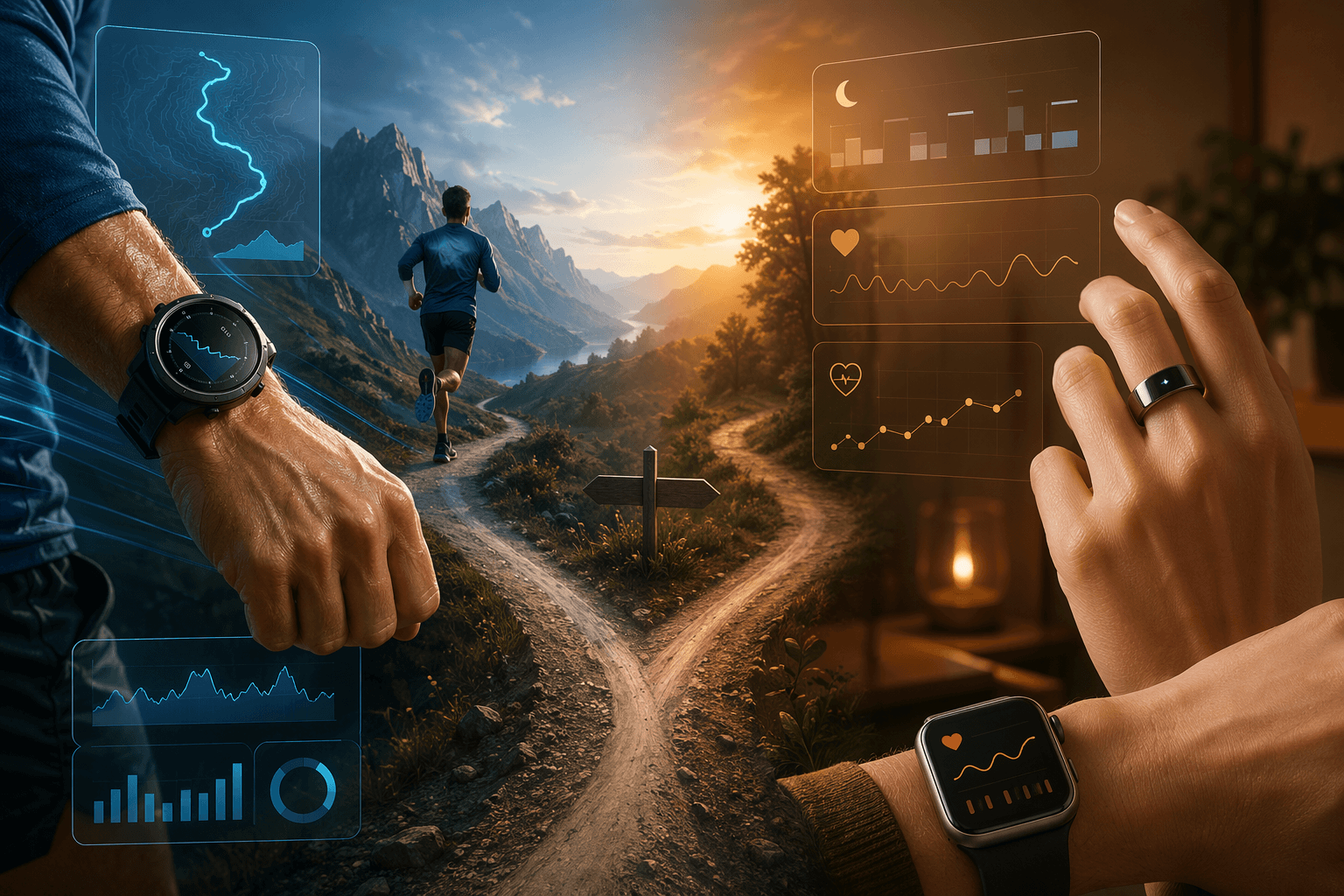
The Choice Starts With the Data You Will Actually Use
A fitness-first wearable is designed around a workout session. Garmin, Polar, and Coros watches tend to make the most sense when the wearer cares about GPS tracks, pace, heart-rate zones, VO2 max estimates, training load, running power, and how today’s session compares with the plan. The best screen is the one you can glance at mid-run or between intervals without digging through a wellness dashboard.
A health-first wearable is designed around the hours when you are not training. Whoop, Oura, Fitbit with Premium, and Apple Watch lean harder into sleep, heart-rate variability, SpO2, skin temperature, readiness, stress, ECG where available, and longitudinal trend lines. Their value depends less on whether they can record a jog and more on whether they can stay on your body long enough to build a useful baseline.
That baseline is the whole point. A running watch can tell you whether today’s tempo run was faster than last week’s. A health-first device is trying to tell you whether your resting signals, sleep timing, or recovery pattern have drifted. That is a different job. It also asks for a different kind of patience from the wearer.
| If your main goal is... | Prioritize... | Be cautious about... |
|---|---|---|
| Improving workouts | GPS accuracy, workout modes, training load, battery life, readable screens | Pretty recovery scores that do not change how you train |
| Noticing health patterns | 24/7 wear comfort, sleep tracking, HRV trends, temperature or SpO2 trends, app clarity | Sport features you will never open |
| General motivation | Simple goals, reminders, reliable app experience | Buying the most data-rich device because it looks more serious |
This is where many buyers get trapped by spec sheets. More metrics can make a wearable look more capable, but the useful device is the one whose data changes a decision. Did you slow down because your training load was too high? Did you move bedtime because your sleep timing kept sliding? Did you notice a recovery pattern after late alcohol, travel, or hard sessions? If the answer is no, the extra dashboard is decoration.
Fitness-First Wearables Are Built Around the Session
A good fitness-first watch earns its keep during movement. It should lock GPS reliably, make heart-rate zones easy to read, separate workout types cleanly, and keep enough battery that a long ride, hike, or week of training does not turn into charger management. The device is not trying to be invisible. It is trying to be useful when your hands are sweaty and your attention is limited.
That design priority explains why Garmin, Polar, and Coros feel different from a ring or a screenless band. Their watches are larger because the screen, buttons, GPS antenna behavior, and battery all matter during training. The tradeoff is obvious: you may get stronger workout tools, but you may not want to sleep in the thing every night. If you take it off at bedtime, its sleep and recovery analysis becomes less complete, no matter how impressive the menu looks.
The cost structure is also cleaner in this camp. Wareable’s 2026 tracker guide lists Garmin and Amazfit among devices that do not require a subscription for core use, while several health-first platforms attach their richer analysis to annual or monthly plans. Pricing varies by market and tier, but the difference matters before checkout, not six months later. [2]
That does not mean every fitness-first device is automatically the better buy. A serious runner may need advanced training load and GPS tools. Someone doing three home strength sessions a week may need a simpler tracker that logs workouts consistently and stays out of the way. Fitness-first only works when the “fitness” part matches the actual training, not the imaginary version of the buyer who appears in product photography.
Health-First Wearables Need to Stay on Your Body
Health-first devices have a different burden: they need compliance. Sleep, HRV, skin temperature, resting heart rate, and recovery trends are weaker when the device sits on a nightstand. This is why rings and screenless or low-screen wearables have become more important. Their pitch is not that they are better sports watches. Their pitch is that you might actually wear them overnight.
Jointcorp’s market analysis, citing Sahha, describes smart rings as the fastest-growing wearable segment at 32.5% CAGR and points to 98% overnight wear compliance for rings versus 67% for smartwatches. Again, that is industry-sourced data rather than a controlled independent study, so it should not be treated as settled science. But the practical idea is sound: sleep tracking depends on the boring fact of whether the device is still on your body at 2 a.m. [1][3]
The strongest health-first products usually make their best case in the app, not on the device face. They show trends, deviations from baseline, readiness scores, and sometimes coaching prompts. That can be useful if the app explains what changed and lets the user connect it to behavior. It can also become a fog machine of colored scores if it never tells the wearer what to do differently.
This is also where subscriptions show up most aggressively. Wareable lists WHOOP memberships at about $199–$359 per year, Fitbit Premium around $80–$100 per year, and Oura around $70 per year, depending on plan and market. Those fees may be worth paying if the app becomes the place where you actually review sleep, strain, recovery, and trends. They are much harder to defend if you only wanted step counts and a nudge to move. [2]
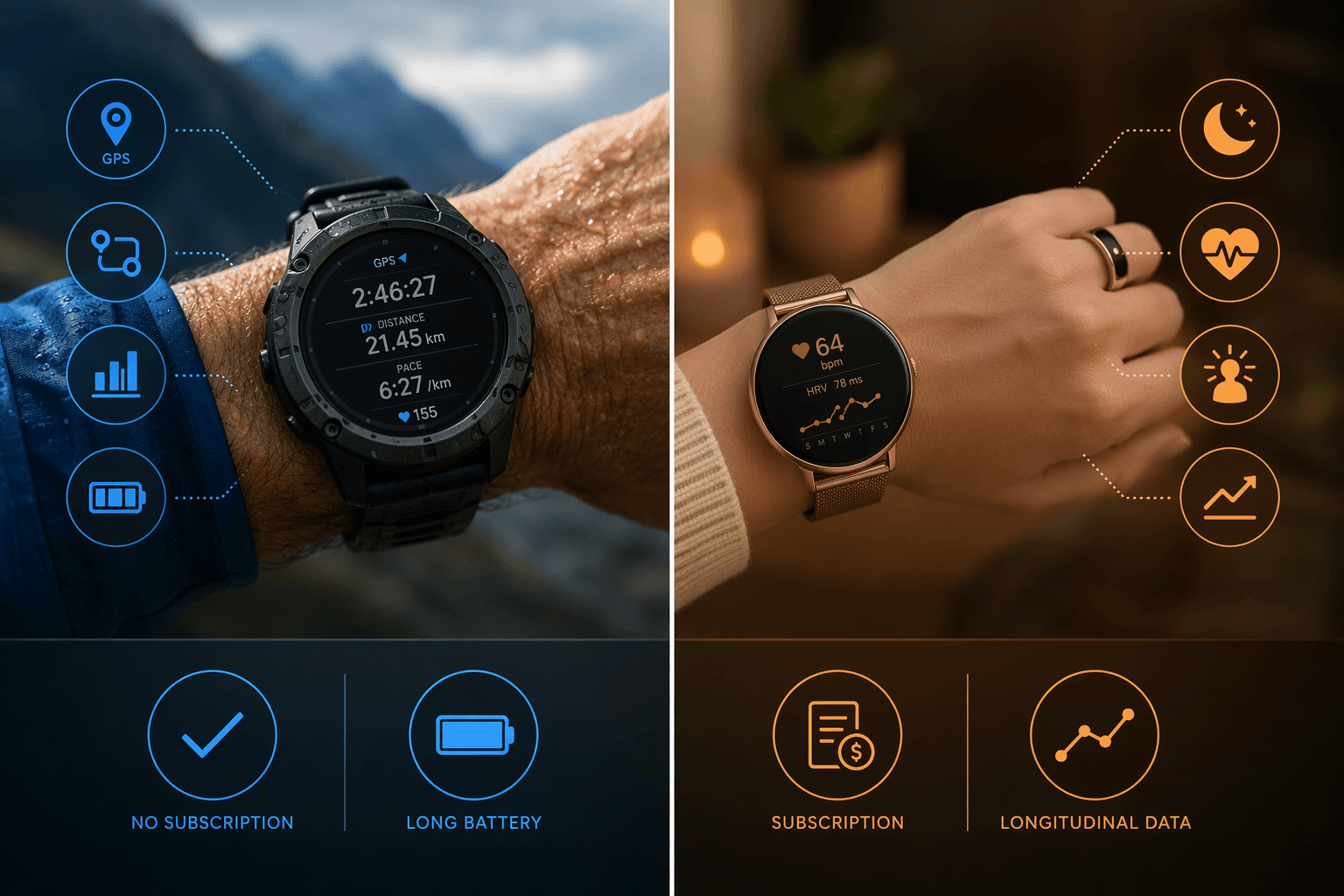
The Fuzzy Middle Is Where Bad Purchases Happen
The split is useful, but it is not perfectly clean. Apple Watch and Fitbit can track workouts well while leaning heavily into health features. Garmin’s Venu line and other lifestyle sports watches add sleep, stress, and wellness metrics to devices that still come from a fitness-watch tradition. A wearable can straddle both sides.
The problem is when a device straddles both sides badly. That usually looks like a watch that promises deep training insights, rich sleep coaching, wellness scoring, smart notifications, and a polished lifestyle experience, then makes the user hunt through a busy app for the two numbers they care about. The muddled middle often sells breadth. Buyers need usefulness.
A practical test helps: open the app store listing, screenshots, or a demo review and look for the weekly screen you would actually check. For a fitness-first buyer, that might be training load, workout history, pace trends, or time in zones. For a health-first buyer, it might be sleep consistency, HRV trend, resting heart rate, readiness, or symptom-adjacent notes. If the product’s most prominent screen is not your decision screen, the hardware specs are doing too much of the selling.
Wareable’s editor puts the app problem bluntly: “A cheap tracker is useless if its app is a confusing mess of numbers you never open.” That applies just as well to expensive trackers. A premium sensor stack cannot rescue a daily experience that feels like homework. [2]
Battery Life and Form Factor Are Not Side Details
Battery life is not glamorous, but it shapes behavior. Fitness-first watches commonly advertise multi-day battery life, with typical Garmin, Polar, and Coros-style expectations around 7–15 days. That kind of range makes sense for people who record outdoor workouts, travel, or hate charging small electronics every night.
Health-first devices can win in a different way. A ring with no screen gives up mid-workout readability, but it may be comfortable enough for sleep. A screenless band gives up glanceable smartwatch convenience, but it may reduce distraction. An Apple Watch-style device gives you apps, notifications, health features, and workout tracking, but asks you to accept a more active charging routine and a more general-purpose interface.
None of those tradeoffs is minor. If you remove the wearable for charging at the same time every evening, it may miss the very wind-down window you wanted to understand. If you hate sleeping with a large watch, its recovery score will be built on gaps. If you cannot read the display while running, the workout features you paid for may stay theoretical.
Subscriptions Change the Real Price
The cheapest-looking health and fitness tracker is not always the cheapest tracker to own. Subscription pricing changes the math because many of the most useful health-first features live behind the service layer: long-term trends, readiness interpretation, coaching, deeper sleep analysis, or comparative insights. The device may be the entry ticket; the app is the ongoing bill.
| Device track | Typical cost pattern | Buyer question |
|---|---|---|
| Fitness-first watches | Often no required subscription for core training features | Are the workout tools worth the higher upfront hardware cost? |
| Health-first rings and bands | Often rely on paid memberships for richer trend analysis | Will you review the app often enough to justify the recurring fee? |
| Hybrid smartwatches | May combine hardware cost, ecosystem lock-in, and optional services | Are you buying health insight, workout tracking, or phone convenience? |
The subscription is not automatically a trap. A well-designed paid app can be the reason a health-first device works. If it turns raw signals into a clear pattern you use every week, the service has a job. The warning sign is vaguer: paying every month for a dashboard you opened enthusiastically for two weeks and then ignored.
Before buying, price the device over the period you realistically expect to keep it. A tracker with a lower upfront price and a paid membership can pass a no-subscription watch quickly. Wareable’s listed annual ranges for WHOOP, Fitbit Premium, and Oura are wide enough that the exact total depends on the plan, but they are not small enough to ignore. [2]
How to Pick Your Track
Choose the fitness-first path if your main frustration is performance: you do not know whether you are training too hard, too easy, too inconsistently, or without enough structure. Prioritize reliable workout capture, usable displays, physical controls if you train outdoors, GPS behavior, battery life, and training metrics you can act on. A stronger fitness watch should make the next workout decision easier.
Choose the health-first path if your main frustration is pattern blindness: you do not know how sleep, stress, recovery, travel, illness, or routines are showing up in your body over time. Prioritize comfort, overnight wear, trend clarity, app design, and whether the service explains deviations from your own baseline. A stronger health wearable should make recurring patterns harder to miss.
If you want both, be honest about which one gets first claim. A hybrid device can make sense, but one side still has to win when tradeoffs appear. Bigger screen or better sleep comfort. More workout controls or less distraction. No subscription or richer coaching. Longer battery or more smartwatch features. The device that tries to satisfy every possible version of you can easily serve none of them well.
- If you review workout history every week, buy around training metrics.
- If you review sleep and recovery trends every week, buy around 24/7 health tracking.
- If you mainly want reminders and step counts, do not pay for a complex recovery platform by accident.
- If you hate subscriptions, check which features remain after the free tier ends.
- If the app looks confusing before purchase, assume you will open it less after purchase.
The right health and fitness tracker in 2026 is the one aligned with the change you are actually trying to make. If your goal is stronger workouts, choose the fitness-first path. If your goal is to notice health patterns over time, choose the health-first path. Neither category is better in the abstract. The wrong choice is usually the one that looks richest on paper and gets opened least in real life.
Comments
Join the discussion with an anonymous comment.