
You are doing a bodyweight circuit in your living room at 6 a.m. You want to know if your heart rate is actually spiking during burpees, and later tonight you want to see how well you slept. One device sits on your wrist. The other wraps around your finger. Which one do you trust for which job? That is the question this article exists to answer — not by declaring a winner, but by showing why the answer changes depending on what you are trying to measure.
What your finger knows that your wrist doesn’t
Most people shopping for a fitness tracker ring assume it does everything a wrist tracker does, just in a smaller package. It does not. A smart ring is not a workout tracker. It is a recovery tracker that happens to sit on your finger. The sensor placement alone — finger vs. wrist — creates a fundamental division of labor that no amount of algorithm tuning can fully erase.
Take a typical home gym session: thirty minutes of bodyweight strength, a few sets of dumbbell work, maybe a short HIIT finisher. During that block you want real-time heart rate, movement intensity, and possibly GPS if you step outside. After the session, you want to know how well you recovered overnight. The wrist device is designed for the first job. The ring is designed for the second. Asking one device to do both well is like asking a chef’s knife to also work as a bread knife — possible, but the compromise shows.
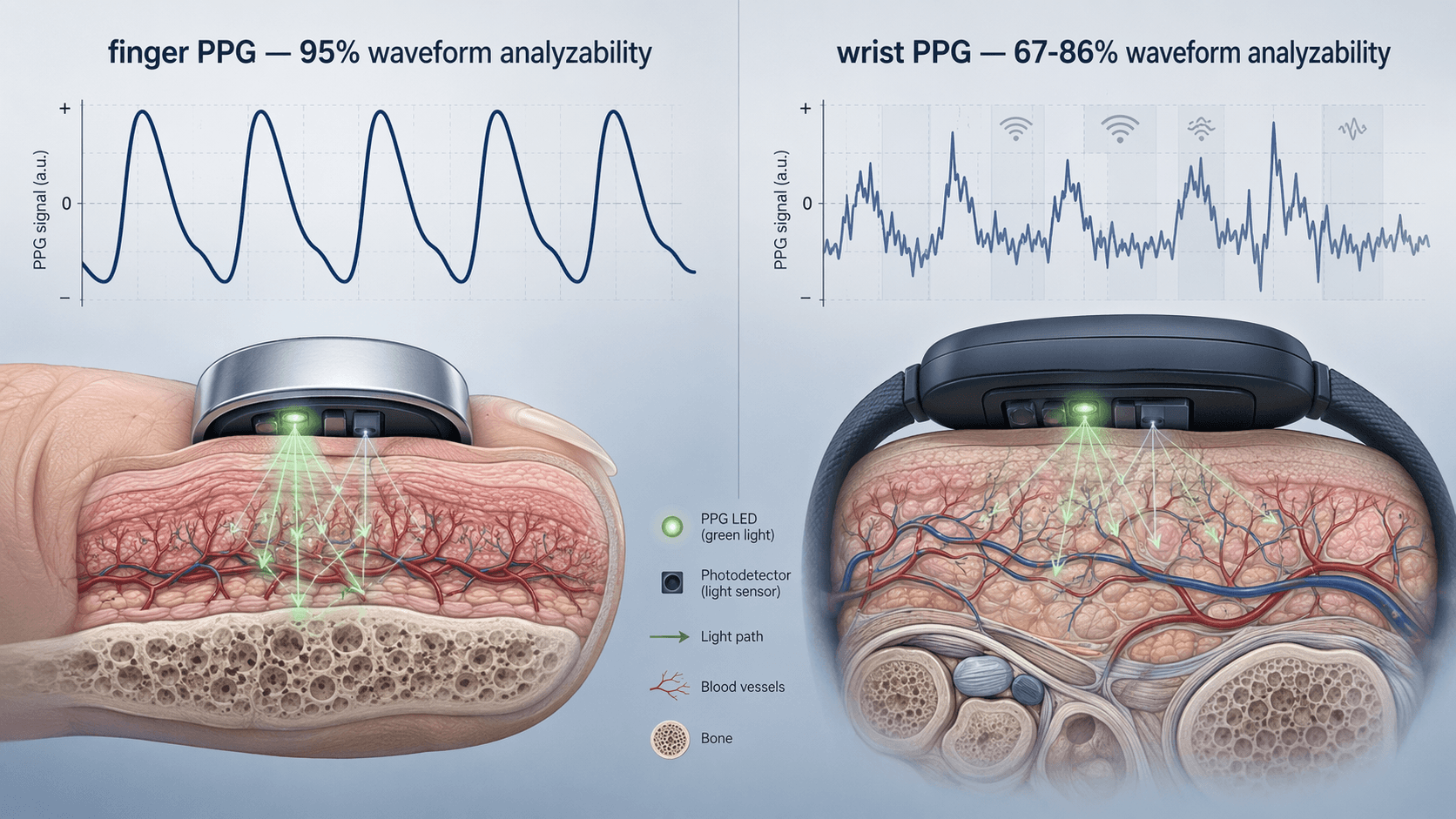
The reason rings dominate sleep and HRV tracking is physiological, not just a matter of software. Your finger has higher vascular density and sits relatively still during the night. A wrist device, by contrast, moves with every arm adjustment, and the PPG sensor there has to contend with more motion artifact and a less perfused site. That is why a 2025 systematic review in PMC found that finger-based PPG achieves 95% waveform analyzability compared to 67–86% for wrist measurements. The raw signal from your finger is cleaner for resting metrics like heart rate variability and sleep staging.
I want to stop right there and flag something: 72% of the studies in that review used Oura rings. Those impressive numbers — heart rate correlation of r²=0.996 and HRV correlation of r²=0.980 compared to medical-grade ECG at rest — reflect one brand’s sensor architecture, not the entire ring category. Treat them as a best case, not a guarantee.
The numbers — and what they don’t tell you
Here is the head-to-head. I have flagged source limitations because several numbers come from a manufacturer’s website (jointcorp.com, a B2B company that sells wrist-tracker components) or from the Oura-heavy PMC review. Use them as directional guides, not gospel.
| Metric | Smart Ring | Wrist Tracker (Fitness Band / Smartwatch) | Notes |
|---|---|---|---|
| Sleep detection (awake vs. asleep) | 93–96% sensitivity | 84–91% accuracy (various) | Ring figures from PMC review (mostly Oura); wrist figures from jointcorp (B2B source) |
| Sleep staging accuracy | ~53% (limited) | Similar limitations | Neither form factor is reliable for sleep stage breakdown |
| Step counting accuracy | 85–92% | 96–98% | Jointcorp data; favors wrist due to arm swing detection |
| Exercise HR (active) | Weak: no GPS, lower sampling rate | Strong: real-time HR, GPS, gyroscope | Rings are not designed for active workout tracking |
| Battery life | 4–12 days (varies by model) | 1–21 days (sport smartwatches up to 48 days with solar) | RingConn Gen 2 Air tested at 10 days; Oura Ring 4 at 5–8 days; Galaxy Ring at 6.5 days |
| Subscription required | Oura $72/year; others free | Whoop $30/month; Garmin/Fitbit optional; Apple Watch free | Subscription cost is a major hidden cost for some rings |
| Overnight wear compliance | 98% (ring) vs. 67% (watch) — jointcorp | Jointcorp data; note self-selection bias in ring users |
A few things stand out. The ring’s overnight wear compliance figure of 98% sounds dramatic, but keep in mind that ring buyers are a self-selected group — people who shell out $200–$400 for a ring are highly motivated to wear it. The wrist-watch figure of 67% comes from jointcorp, which has a clear commercial interest in promoting wrist devices. I would not hang a buying decision on that gap alone.
Battery life is one area where editorial testing gives a clearer picture. The RingConn Gen 2 Air tested at 10 days from both PCMag and Wareable, costs $199, and has no subscription. The Oura Ring 4 ranges from 5–8 days depending on features ($349 + $72/year). The Samsung Galaxy Ring lands at 6.5 days and $399. If long battery life and no subscription matter to you, the RingConn Gen 2 Air is a clear alternative.
Three home gym scenarios
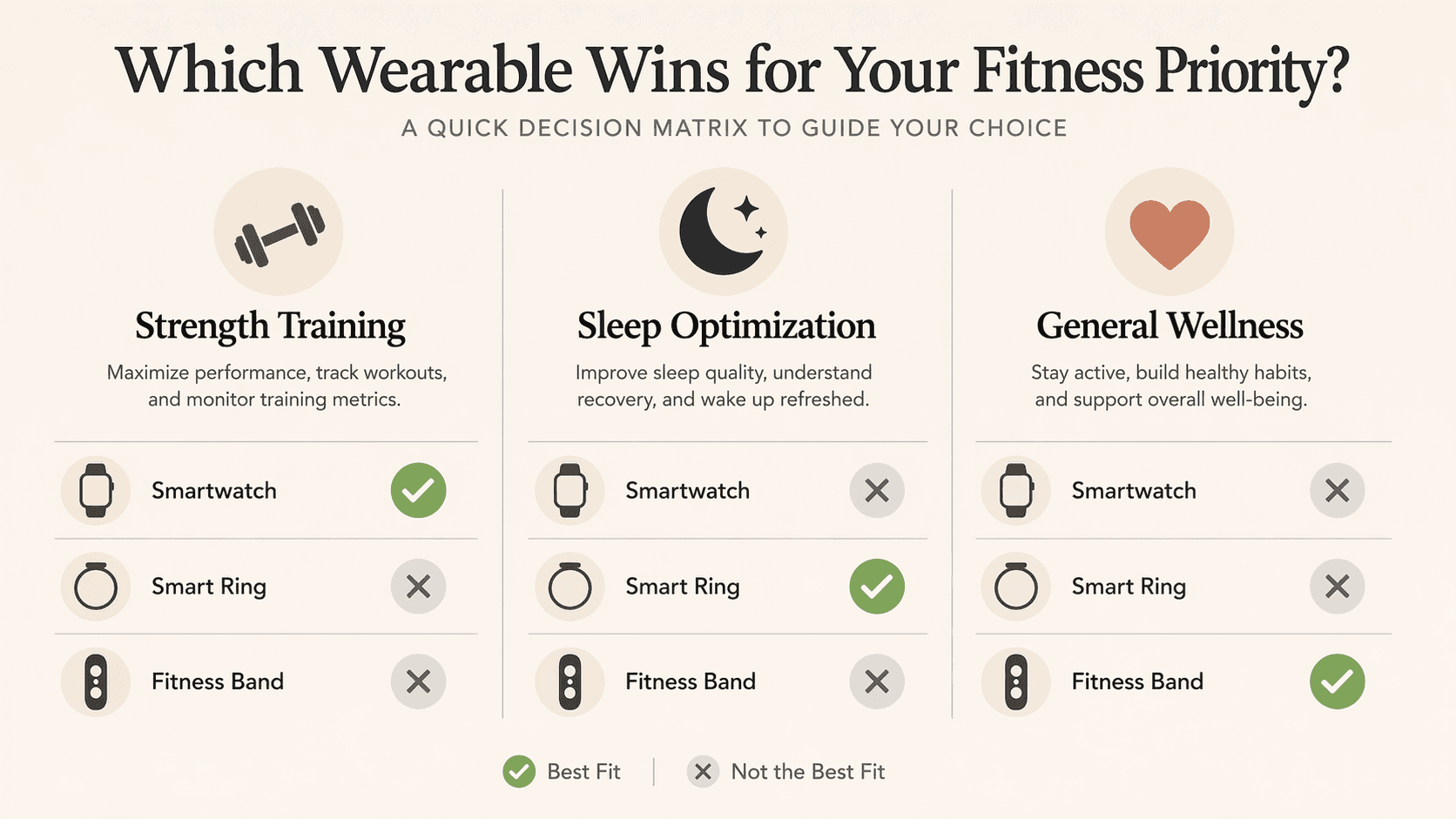
The head-to-head numbers are useful, but the real question is: what do you actually do in your home gym? The ideal device changes depending on whether you prioritize performance metrics, recovery optimization, or general wellness.
- Strength training and HIIT: A wrist tracker wins here. Real-time heart rate, GPS for outdoor runs, and gyroscopes for movement detection are what you need. A ring will miss the spikes and leave you guessing your session intensity. If you train for performance, stick with a wrist device. For a deeper breakdown of which tracker works for your specific workout type, see this guide.
- Sleep optimization and recovery: The ring is your device. Its overnight wear compliance, even accounting for self-selection, is genuinely higher because the form factor is more comfortable for sleeping. Combined with high-quality HRV and sleep detection, the ring gives you the data to guide your training readiness. If your primary goal is better sleep and recovery, the ring is the clear choice.
- General wellness (yoga, walking, light strength): A fitness band or even a ring can work. For slow, steady-state activities like yoga or a brisk walk, the ring’s HR tracking is adequate — its limitations are less noticeable. But if you want step counting to be accurate, a wrist band is still the better bet. A ring can be a fine companion for low-intensity home practice.
Should you wear both? The real cost
The thesis of this article — that a ring and a wrist tracker serve different jobs — naturally leads to the idea that the ideal setup is both. And for some people, it is. But I want to be honest about what that actually costs, because most articles that recommend dual-device setups quietly ignore the friction.
Monetary cost: A ring like Oura costs $349 plus $72/year for full features. A decent wrist tracker might be another $150–$300. If you choose Whoop instead of a Garmin, that is another $30/month. You are easily looking at $500–$700 upfront plus ongoing subscriptions. The RingConn Gen 2 Air at $199 with no subscription is a cheaper entry, but still adds to your total.
Attentional cost: Two devices to charge, two apps to check, two sets of data that do not automatically sync. The PMC review found that adherence to a single smart ring dropped from 80% at 3 months to 43% at 12 months. If people stop wearing one device, how many will keep maintaining two? The ring’s overnight wear compliance is high, but that is partly because ring buyers are a self-selected group who are motivated to wear it.
If you do decide to run both, the Oura Ring for recovery and a wrist tracker for workouts can work well together. The Oura Ring fitness tracking assessment covers exactly which exercises the ring handles adequately and where it falls short. And for a full picture of the subscription trap, read this comparison of Oura vs. subscription-free rings.
Pick one, or pick two — but know why
The decision matrix above already gives you a visual summary, but here is the plain-text version:
| Your primary goal | Best device | Why |
|---|---|---|
| Strength training / HIIT / running | Wrist tracker (smartwatch or fitness band) | Real-time HR, GPS, movement detection — a ring cannot keep up |
| Sleep optimization / recovery / HRV | Smart ring | Superior overnight metrics, high wear compliance, accurate HRV at rest |
| General wellness (yoga, walking, light strength) | Fitness band or ring (depending on budget) | Either works; a ring offers sleep data, a band offers step accuracy |
| Both performance and recovery (high budget, high discipline) | Ring + wrist tracker | Best of both, but only if you can handle the cost and charging routine |
If you have decided on a ring, the Fitness Tracker Ring Buyer's Guide 2026 covers the four trade-offs first-time buyers overlook — sizing, subscription costs, sensor accuracy, and compatibility. If you are leaning toward a wrist tracker, the home workout tracker guide will help you match the device to your specific training style.
The takeaway is not that rings are bad or wrist trackers are outdated. It is that each form factor is optimized for a different job. Pick the device based on what you actually do in your home gym, not on what the marketing says. If you train for sleep and recovery, get the ring. If you train for performance metrics, get the wrist tracker. If you want both and have the budget and discipline, get both — but know the hidden costs going in.
Comments
Join the discussion with an anonymous comment.