
Why 'For Women' Usually Means 'We Changed the Strap Color'
The fitness tracker industry has a well-worn playbook for marketing to women: take a unisex device, offer it in rose gold or lavender, swap the band for something thinner, and call it a day. The poster child for this approach is the Garmin Lily 2. It has a slim, jewelry-like design that PCMag rated as 'best for women,' and it is frequently the first recommendation in roundups targeting female buyers. But look past the aesthetic, and the tradeoffs are substantial: the Lily 2 lacks built-in GPS, relies on a grayscale display, and costs $249.99. It is a fashion accessory first and a fitness tool second.
This pattern is not limited to Garmin. Across the market, 'for women' lists routinely lead with color options and slim profiles while ignoring the metrics that actually affect a woman's training and health data. They rarely ask whether the optical heart rate sensor maintains consistent skin contact on a smaller wrist, whether the cycle tracking feature is sensor-driven or just a manual log, or whether the battery can sustain overnight wear for sleep tracking without needing a charge every day and a half.
If you are looking for a neutral, tiered guide that covers wrist size and cycle tracking without the critical framing, we have that too. Our Best Fitness Trackers for Women in 2026: A Tiered Comparison by Wrist Size, Cycle Tracking, and Style guide is a solid starting point if you want a straightforward comparison. But if you want to understand why most 'for women' recommendations are broken and how to pick a tracker based on what actually matters, keep reading.
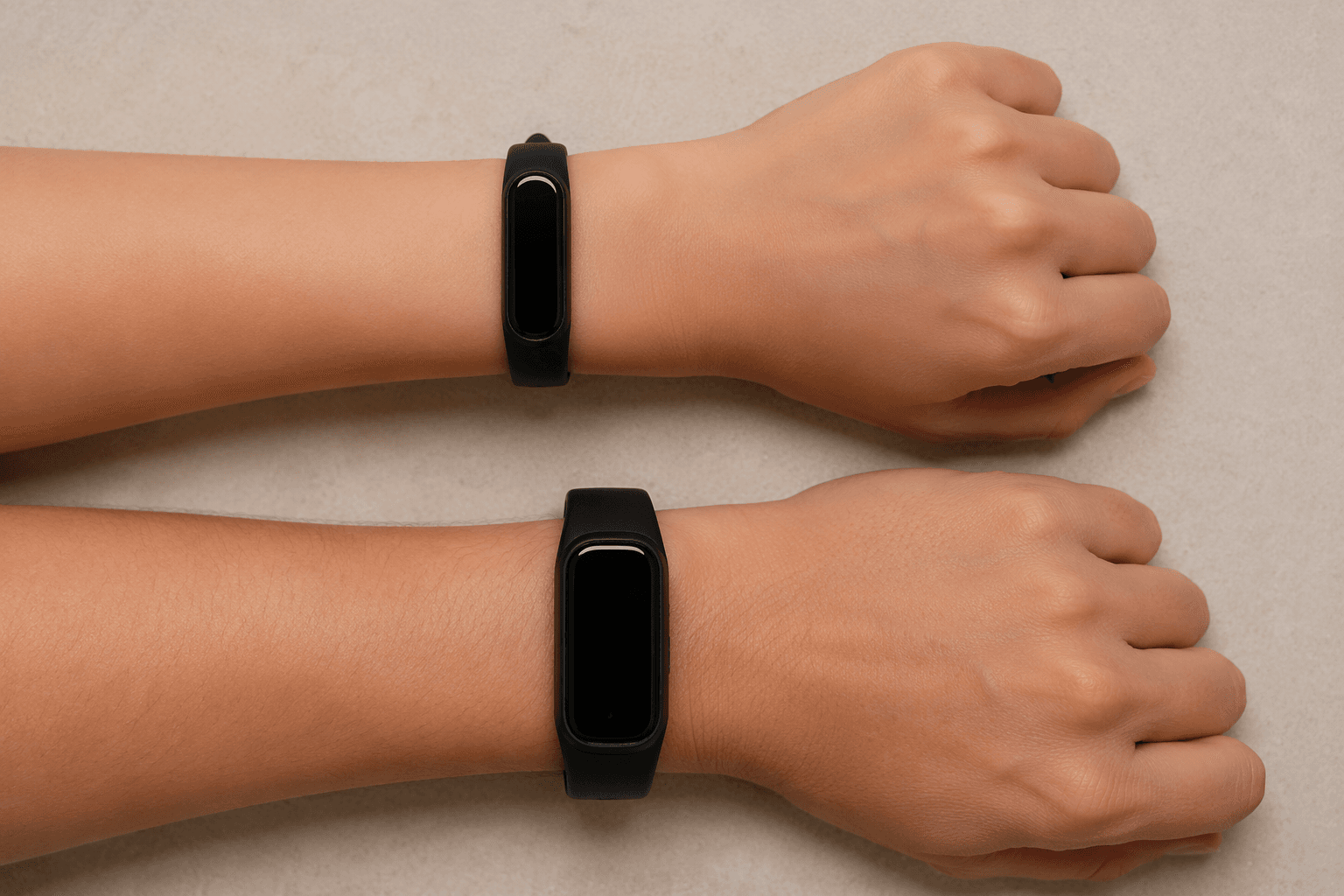
Wrist Size Reality Check: Band and Case Measurements Compared
The average female wrist circumference is 5.7 to 6.2 inches, compared to 6.5 to 7.2 inches for men, according to data compiled by La Petite Poire. That 0.8- to 1.0-inch difference is not trivial when you are strapping a rigid case and sensor array to your arm. A tracker that fits a man's wrist comfortably may overhang, slide, or fail to maintain consistent optical sensor contact on a smaller wrist — and inconsistent sensor contact means unreliable heart rate and SpO2 readings.
Below is a comparison of band and case measurements for the most popular trackers that accommodate smaller wrists natively. These figures come from manufacturer specifications and third-party testing.
| Tracker | Band Fit Range | Case Size | Wrist Fit Notes |
|---|---|---|---|
| Garmin Lily 2 | 4.3 – 6.9 inches | 35mm | Best native fit for sub-5.5" wrists; slim, lightweight design |
| Fitbit Luxe | 5.3 – 7.1 inches | 35mm long x 15mm wide | Wearable on 5" wrists but snug; some gap reported |
| Apple Watch Series 11 (41mm) | 5.1 – 6.3 inches (small band) | 41mm | Small band fits most wrists down to 5.1"; case may still overhang on very small wrists |
| Garmin Venu 3S (41mm) | Approx. 5.3 – 7.0 inches | 41mm | Comfortable on small wrists per Good Housekeeping testers; smaller version of Venu 3 |
| Garmin Forerunner 265S | Approx. 5.2 – 6.8 inches | 42mm | Recommended for 'petite-wristed persons' by The Verge; good running watch option |
| Fitbit Inspire 3 | Approx. 5.5 – 7.5 inches | 37mm | Slim band design; works for most wrists but may be loose on sub-5.5" wrists |
| Oura Ring 4 | Ring sizes 6–13 (US) | N/A (ring) | No wrist overhang; sizing kit available; suitable for very small fingers |
The key takeaway: if your wrist circumference is under 5.5 inches, your options narrow considerably. The Garmin Lily 2 and the Oura Ring 4 are the most reliable choices for very small wrists. The Fitbit Luxe fits, but La Petite Poire's testing found it leaves a gap on a 5-inch wrist, and the tracker itself is 35mm long — it does not sit flush. The Apple Watch 41mm with the small band fits down to about 5.1 inches, but the case itself is still 41mm wide, which means it may extend past the edges of a very narrow wrist.
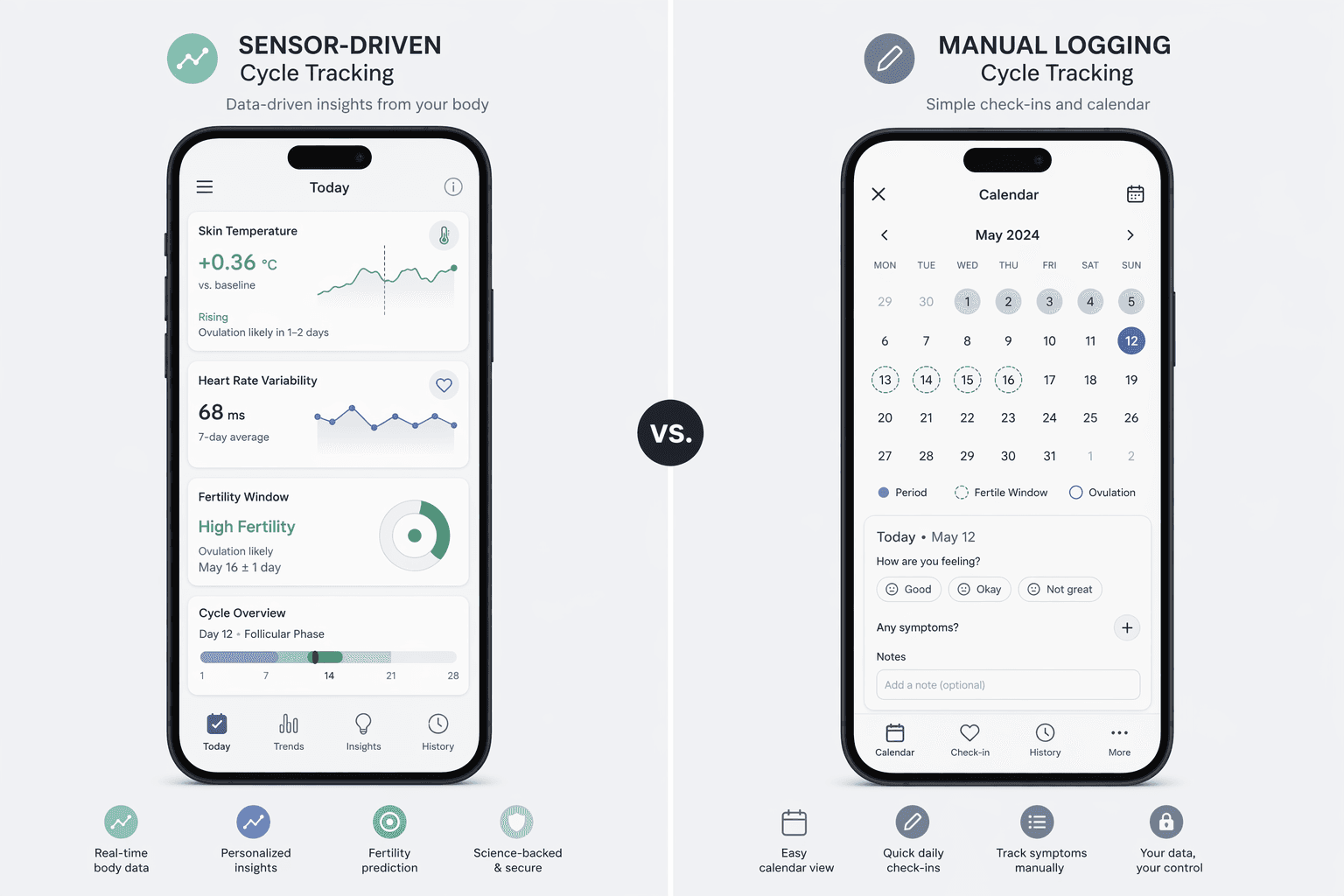
Cycle Tracking Depth: Sensor-Driven vs. Manual Logging
Every major fitness tracker now offers some form of menstrual cycle tracking. But there is a wide gulf between a feature that simply lets you log your period start date and one that uses physiological sensors to predict fertile windows, estimate ovulation, and adjust insights based on your unique cycle patterns.
The table below breaks down the cycle tracking capabilities of the leading brands, distinguishing between sensor-driven features and manual logging.
| Tracker | Cycle Tracking Type | Fertile Window Estimates | Temperature Sensing | HRV Trend Integration | Pregnancy Insights |
|---|---|---|---|---|---|
| Oura Ring 4 | Sensor-driven (Natural Cycles integration) | Yes | Yes (nighttime skin temperature) | Yes | Yes |
| Apple Watch Series 11 | Sensor-driven (wrist temperature) | Yes (retrospective ovulation estimates) | Yes (nighttime wrist temperature) | Yes | Yes |
| Garmin Lily 2 / Venu 3S | Manual logging + cycle tracking app | Yes (based on logged data) | No | No (basic HRV only) | No |
| Fitbit Charge 6 / Inspire 3 | Manual logging + menstrual health | Yes (based on logged data) | No (basic skin temperature on Charge 6) | No | No |
| Fitbit Premium (add-on) | Enhanced cycle insights | Yes (with Premium subscription) | No | No | No |
The Oura Ring 4 and Apple Watch Series 11 are in a different league here. Oura's integration with Natural Cycles — the only FDA-cleared fertility tracking app — gives it clinically validated fertile window estimates based on nighttime skin temperature and HRV trends. CNET rated the Oura Ring 4 8.5/10, noting its cycle insights, fertile window estimates, and pregnancy insights. The Apple Watch Series 11 uses wrist temperature sensing to provide retrospective ovulation estimates, which is useful for confirming ovulation after it has occurred.
Garmin and Fitbit, by contrast, offer menstrual cycle logging that is essentially a digital calendar. You tell the app when your period starts and ends, and it predicts your next cycle based on your average length. There is no sensor input. Garmin's Lily 2 does offer fertility tracking, but it is based on the logged data, not on physiological measurements. Fitbit's Charge 6 has a basic skin temperature sensor, but it is not used for cycle tracking in the way Oura and Apple use theirs.
For a deeper dive into the clinical validation behind Oura's cycle tracking, read our Oura Ring Accuracy: What 8 Peer-Reviewed Studies Actually Say About Sleep, HRV, Heart Rate, and Recovery Tracking guide.
Heart Rate and Sleep Accuracy Across Menstrual Cycle Phases
A woman's resting heart rate and HRV fluctuate predictably across the menstrual cycle. Resting heart rate tends to rise in the luteal phase (after ovulation) and drop during menstruation. HRV follows the opposite pattern. These are well-documented physiological responses, yet most fitness trackers do not adjust their algorithms to account for them. They treat every day as physiologically identical, which means a woman's 'readiness score' or 'training status' may be artificially depressed during certain phases of her cycle — not because she is overtrained, but because her body is operating in a different hormonal state.
The trackers that handle this best are those that integrate cycle phase data into their HRV and sleep analysis. Oura Ring 4 and Apple Watch Series 11 both use cycle tracking data to contextualize HRV trends. If your HRV drops during the luteal phase, Oura's algorithm recognizes this as a normal pattern rather than flagging it as a recovery problem. Garmin and Fitbit, by contrast, do not currently integrate cycle phase into their HRV or sleep scoring algorithms.
On raw accuracy, the data is clear. CNET's lab testing, which involved running 30 miles across five smartwatches compared against a Polar H10 chest strap, found that the Apple Watch Series 11 had the lowest average heart rate error of 0.98% — about 1.40 beats per minute. Forbes Vetted's testing, also using a Polar H10 as reference, rated the Garmin Venu 3 as the most accurate overall across all metrics tested. The Fitbit Charge 6 was praised for its heart rate accuracy during high-intensity workouts, tracking closely with the Polar H10.
| Tracker | Heart Rate Accuracy (vs. Polar H10) | Cycle-Aware HRV/Sleep Analysis | Source |
|---|---|---|---|
| Apple Watch Series 11 | <1% error (0.98%) during intense exercise | Yes (cycle phase integration) | CNET lab testing |
| Garmin Venu 3 | Most accurate overall across all metrics | No (no cycle phase integration) | Forbes Vetted testing |
| Fitbit Charge 6 | Accurate during high-intensity workouts | No (basic HRV, no cycle integration) | Forbes Vetted testing |
| Oura Ring 4 | Good for resting/light activity; less tested for intense exercise | Yes (cycle phase integration) | CNET review, multiple studies |
For more detail on Apple Watch accuracy, see our Apple Watch Fitness Tracking Accuracy: What the Data Says About Heart Rate, Steps, and Calories guide. For a broader look at recovery-focused trackers, see Best Fitness Trackers for Recovery in 2026: Ranked by Sleep, HRV, and Readiness Accuracy.
Battery Life vs. Size Tradeoffs for Women Who Sleep-Track
There is a fundamental engineering tradeoff in wearable design: smaller devices have smaller batteries. This is a direct problem for women who want to track sleep, because sleep tracking requires wearing the device overnight. If the battery dies by 8 p.m., you are either skipping sleep data or charging during the day and losing daytime activity tracking.
The table below compares battery life across form factors that fit smaller wrists, along with charging speed.
| Tracker | Form Factor | Claimed Battery Life | Tested Battery Life | Charging Speed |
|---|---|---|---|---|
| Garmin Lily 2 | Watch (35mm) | Up to 5 days | Not independently tested | Standard (1-2 hours to full) |
| Fitbit Inspire 3 | Band (37mm) | Up to 10 days | 8.5 days (Wirecutter 2025 testing) | Standard |
| Oura Ring 4 | Ring | 5–8 days | 7.25 days (PCMag testing) | Standard (ring charger) |
| Apple Watch Series 11 (41mm) | Watch (41mm) | Up to 18 hours | Not independently tested | Fast charging (0-80% in ~45 min) |
| Garmin Venu 3S (41mm) | Watch (41mm) | Up to 10 days (smartwatch mode) | Not independently tested | Standard |
| Fitbit Air | Screenless clip/band | Up to 5 days (estimated) | Not independently tested | 5-minute charge for almost a full day |
The Fitbit Inspire 3 is the standout for continuous sleep tracking on a budget. Wirecutter's testing found it lasted 8.5 days in 2025, close to its advertised 10 days. That means you can wear it overnight for over a week without needing to charge during waking hours. The Oura Ring 4, at 7.25 days tested, is also excellent for sleep tracking — and because it is a ring, it is less intrusive to wear overnight than a watch or band.
The Apple Watch Series 11 is the weakest option here for sleep tracking. Its 18-hour battery life means you need to charge it daily, and if you wear it overnight for sleep tracking, you will need to find a charging window during the day. This is a real friction point for women who want continuous data.
The Fitbit Air, released in May 2026, is a new screenless option that addresses this tradeoff differently. Wareable reports it has a 5-minute charge that provides almost a full day of use. If this holds up in independent testing, it could be a game-changer for women who want continuous tracking without the bulk of a watch.
Subscription Trap Audit: Which Brands Paywall Women's Health Features
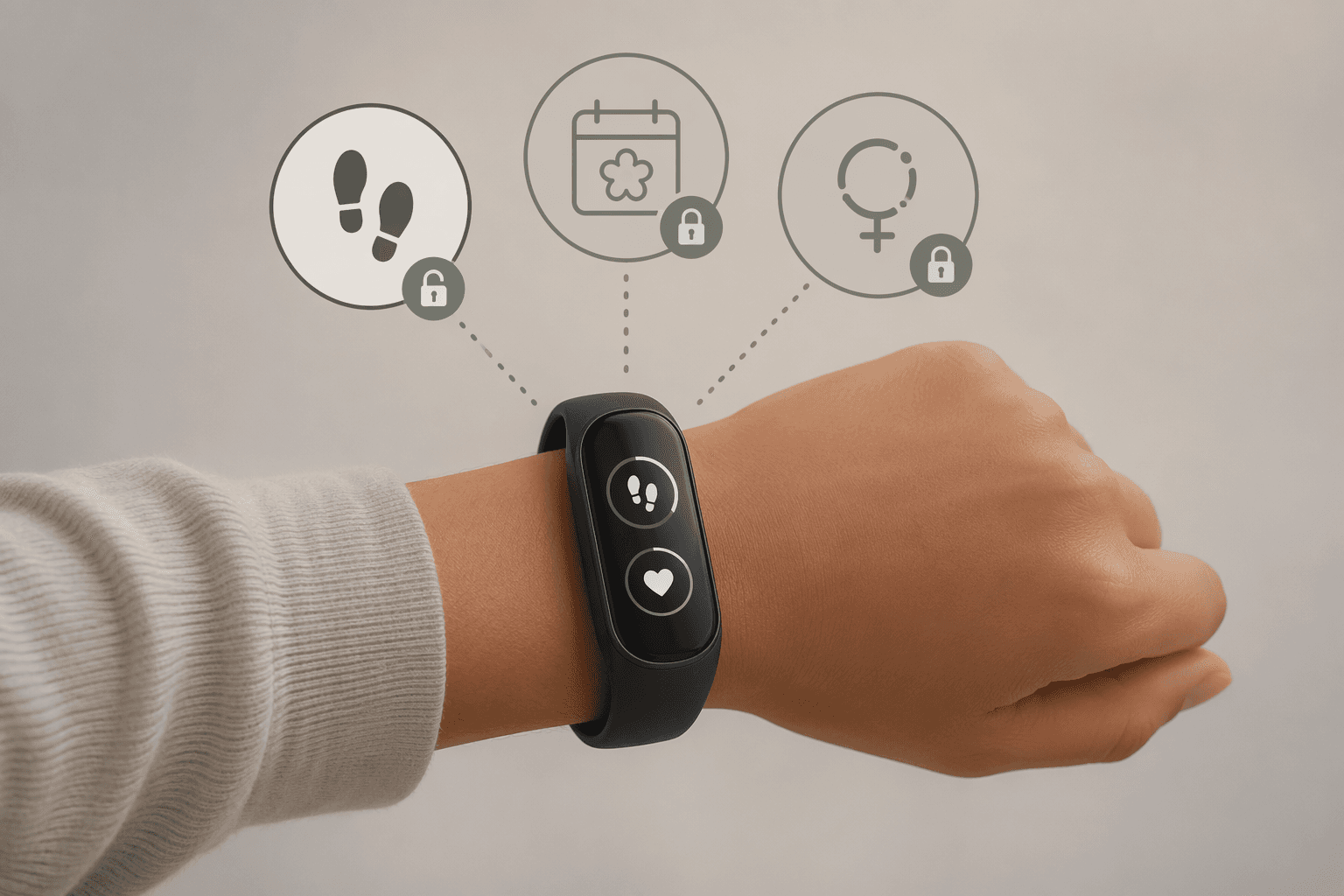
One of the most frustrating patterns in the 'for women' tracker market is the subscription paywall. A device is marketed as having cycle tracking, fertility insights, or advanced sleep analysis — but when you dig into the fine print, those features require a monthly or annual subscription on top of the already significant hardware cost.
The table below audits the subscription costs for accessing women's health features across major brands.
| Brand / Tracker | Hardware Cost | Subscription Required for Women's Health Features? | Subscription Cost | What's Locked Behind Paywall |
|---|---|---|---|---|
| Oura Ring 4 | $349 | Yes | $6/month or $70/year | Cycle insights, fertile window estimates, pregnancy insights, detailed sleep/HRV data |
| Fitbit Charge 6 / Inspire 3 | $99.95 / $99.95 | No (basic); Yes (advanced) | Fitbit Premium: $10/month | Advanced menstrual health insights, AI coaching, deeper sleep analysis |
| Apple Watch Series 11 / SE 3 | $399 / $249 | No | Free (with Health app) | All cycle tracking features are free; no subscription required |
| Garmin Lily 2 / Venu 3S | $249.99 / $449.99 | No | Free (with Garmin Connect) | All cycle tracking and fertility features are free; no subscription required |
| Whoop 4.0 | $239 (first year) + $24/month | Yes (membership required for all features) | $24/month (annual commitment) | All features, including cycle tracking and HRV analysis |
The pattern is clear: Garmin and Apple offer the most generous free access to women's health features. You buy the hardware, and the cycle tracking, fertility insights, and sleep/HRV data are included at no additional cost. Oura Ring 4 and Fitbit, by contrast, put their most valuable women's health features behind a subscription. Oura's $70/year membership is required for cycle insights, fertile window estimates, and pregnancy insights. Fitbit's Premium tier ($10/month) unlocks advanced menstrual health insights and deeper sleep analysis.
This is not just a cost issue — it is a trust issue. When a company markets a device as having 'advanced cycle tracking' but requires a subscription to access it, that is a deliberate choice to obscure the true cost of the feature. For women who are already paying a premium for hardware that fits smaller wrists, the added subscription fee feels like a penalty.
Tiered Recommendations: The Trackers That Actually Deliver
Based on the analysis above — wrist fit, cycle tracking depth, HRV/sleep accuracy, battery life, and subscription costs — here are our tiered recommendations. Each pick is supported by the data from the preceding sections.
- Best Overall: Garmin Venu 3S (41mm). Forbes Vetted testing confirmed the Venu 3 as the most accurate overall tracker against a Polar H10 chest strap. The 3S is the smaller version that fits wrists down to about 5.3 inches. It has built-in GPS, up to 10 days of battery life, and all cycle tracking features are free — no subscription required. The tradeoff is that its cycle tracking is manual-logging based, not sensor-driven.
- Best for Small Wrists: Garmin Lily 2. With a band fit range of 4.3 to 6.9 inches, it is the best native fit for very small wrists. It offers fertility tracking and energy monitoring. The caveats are significant: no built-in GPS (relies on smartphone GPS), grayscale display, and $249.99 price. It is a tradeoff between fit and functionality.
- Best for Cycle Tracking: Oura Ring 4. The combination of Natural Cycles integration, nighttime skin temperature sensing, and HRV trend analysis makes it the most clinically validated option for cycle tracking. It also fits any finger size. The downsides are the $349 hardware cost plus $70/year subscription, and it is less accurate for high-intensity exercise heart rate tracking.
- Best Budget: Fitbit Inspire 3. Wirecutter's decade-long testing (52 trackers) found it had only 0.32% step count error and costs under $100. It has up to 10 days of battery life (8.5 days tested) and basic menstrual health tracking is free. The tradeoff is no built-in GPS and no sensor-driven cycle tracking.
- Best for Runners: Garmin Forerunner 265S. The Verge recommends it as the best running watch for 'petite-wristed persons.' It has built-in GPS, multi-band satellite reception, and advanced running dynamics. It fits wrists down to about 5.2 inches. All cycle tracking features are free.
- Best Screen-Free: Fitbit Air or Oura Ring 4. The Fitbit Air (released May 2026, $99.99) is a screenless clip/band with automatic activity detection and a 5-minute charge for almost a full day. The Oura Ring 4 is a ring with no screen, 7+ days of battery, and comprehensive health tracking. Both are excellent for women who want to minimize wrist bulk.
For a more detailed comparison that includes workout-type matching and Polar H10-tested accuracy data, see our Best Fitness Tracker Watch for Women: Tested Picks by Workout Type, Wrist Size, and Feature Priority guide.
Decision Framework: Match Your Primary Use Case to the Right Tracker
Use the table below to match your primary use case to the recommended tracker from the tiered list above.
| Your Primary Priority | Recommended Tracker | Why This One |
|---|---|---|
| Overall accuracy and free cycle tracking | Garmin Venu 3S | Most accurate overall (Forbes Vetted); all cycle features free; good battery life |
| Very small wrist (under 5.5") | Garmin Lily 2 | Best native fit for sub-5.5" wrists; fertility tracking included |
| Sensor-driven cycle tracking | Oura Ring 4 | Natural Cycles integration; temperature sensing; HRV trend analysis |
| Budget under $100 | Fitbit Inspire 3 | 0.32% step error (Wirecutter); 8.5-day battery; basic cycle tracking free |
| Running and training | Garmin Forerunner 265S | Built-in GPS; petite wrist fit; advanced running dynamics |
| Screen-free / minimal wrist bulk | Fitbit Air or Oura Ring 4 | No screen; automatic tracking; long battery life |
If you are still unsure, our Best Fitness Tracker 2026: A Decision-Matrix Guide by User Type (Not a Generic Roundup) provides a broader framework that covers all user types, not just women-specific considerations.
For women over 35 who are particularly interested in recovery, HRV, and sleep tracking for strength training, our Best Fitness Tracker for Women Over 35: Recovery, HRV, and Sleep Tracking for Strength Training guide covers that specific use case in depth.
And if you are considering a ring-style tracker, our Fitness Tracker Rings in 2026: A Buying Guide for Home Gym Enthusiasts provides a comprehensive comparison of all the major ring options.
Comments
Join the discussion with an anonymous comment.