
You glance down mid-run, mid-ride, or between sets, and your heart rate fitness tracker says something that does not quite match how you feel. Maybe the number is stuck too low during the hard part of an interval. Maybe it jumps after you already slowed down. Maybe it looks suspiciously calm while your breathing says otherwise.
The useful answer is not that wrist heart rate is fake, and it is not that every watch is a medical-grade instrument. Wrist-based optical heart rate is usually good enough for steady cardio, broad training zones, resting patterns, and day-to-day trends. It becomes less dependable when the signal gets messy: fast intervals, lifting, cycling wrist positions, cold weather, loose fit, tattoos or poor optical contact, and in some studies, darker skin tones.
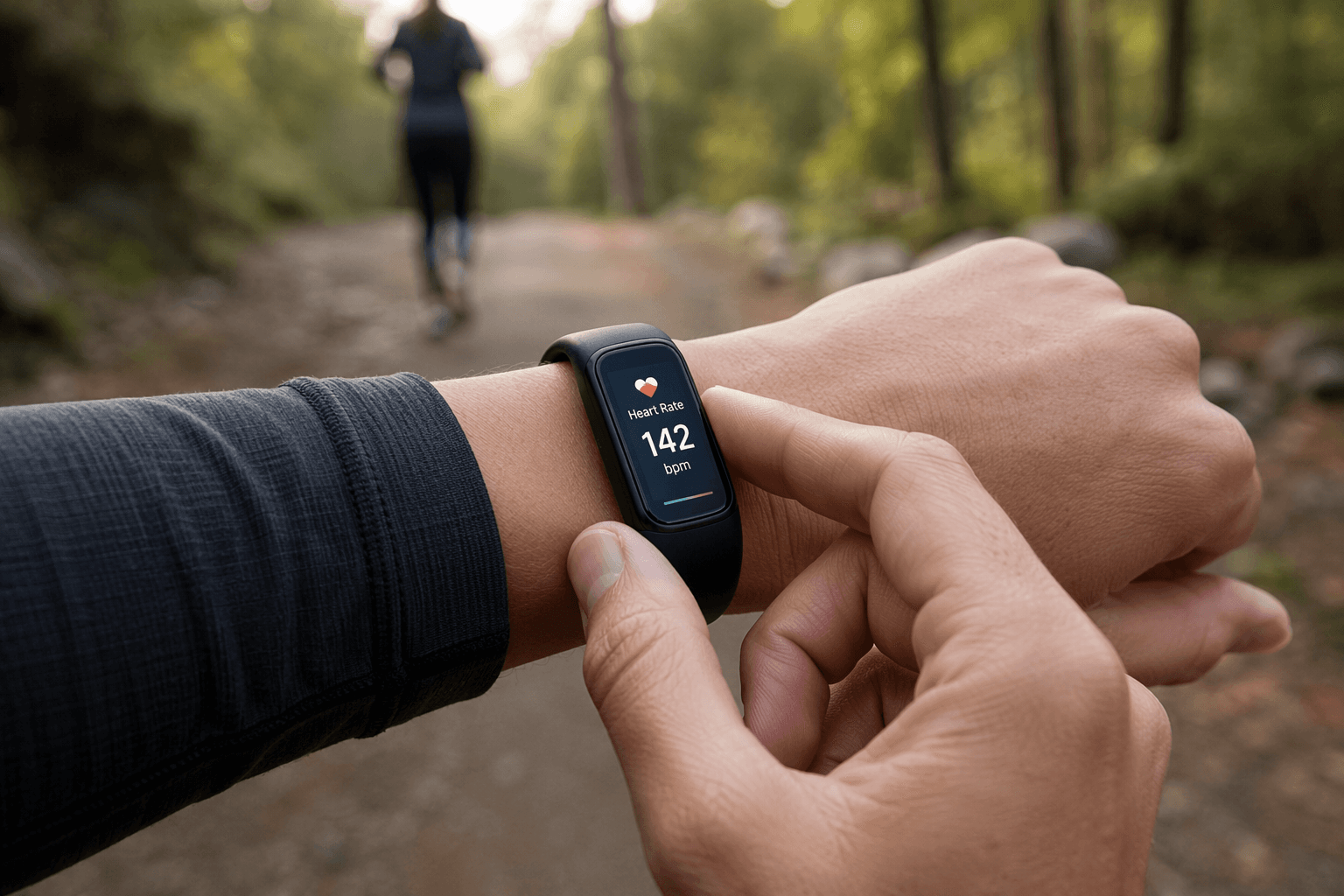
That distinction matters more than brand loyalty. A number can be accurate enough to show that your easy runs are getting easier, yet not accurate enough to pace a short interval set or decide whether a medical symptom is harmless. The same device can be useful in one moment and misleading in the next.
What the sensor is actually measuring
Most wrist trackers use optical heart rate sensing, often called photoplethysmography or PPG. The watch shines light into the skin and measures changes in reflected light as blood volume changes with each heartbeat. It is an inference from blood-flow changes near the wrist, not a direct reading of the heart’s electrical activity.
That is why the watch can be excellent in calm conditions and frustrating during messy ones. If the watch shifts, the wrist bends sharply, the arm muscles tense, blood flow to the skin drops in the cold, or the optical signal is harder to read through skin or ink, the algorithm has less clean information to work with.
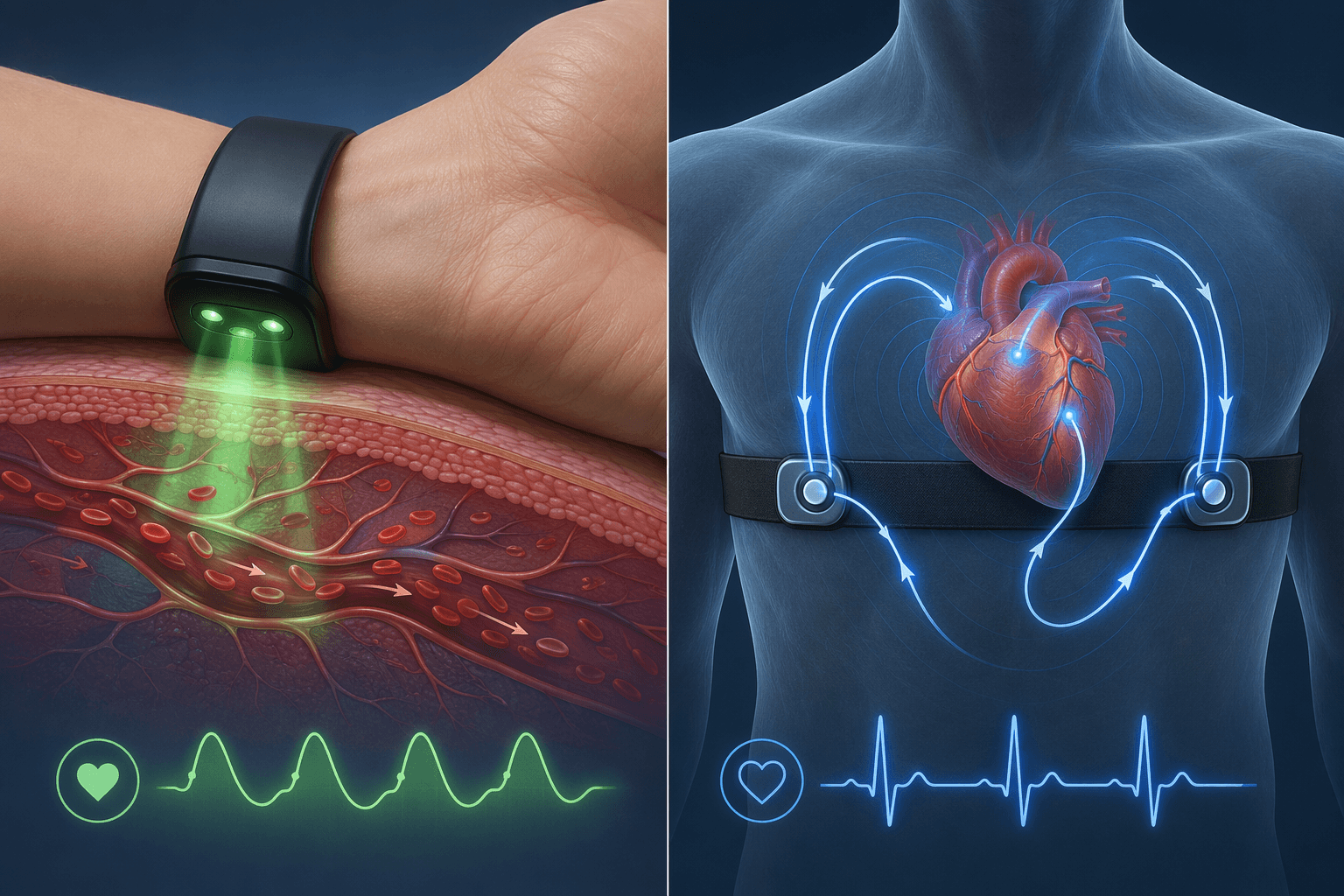
Chest straps work differently. ECG-based straps detect the heart’s electrical signal through electrodes on the chest, which is why they tend to handle hard intervals and arm-heavy movement better than wrist optical sensors. A widely repeated 99.6% chest-strap accuracy claim should be treated as a manufacturer-side benchmark, not as a universal peer-reviewed guarantee. The more important point is the mechanism: an electrical chest signal is simply less exposed to the wrist-specific problems that trouble optical sensors.
For steady exercise, the better watches are closer than many people think
The strongest evidence discussed here is for Apple Watch, not for every wearable on the shelf. A 2026 living systematic review and meta-analysis in Nature included 82 studies and more than 430,000 participants. For heart rate, Apple Watch had a pooled mean bias of -0.27 beats per minute, with limits of agreement from -7.19 to 6.64 bpm. [1]
The average bias is the tempting number, because -0.27 bpm sounds almost perfect. But the limits of agreement are the part you should actually carry into a workout. They mean an individual reading can reasonably land several beats above or below the reference, even when the overall average looks excellent. If your easy run is sitting around a comfortable zone, that kind of error may not change the decision. If you are trying to hold the top edge of a narrow interval target, it might.
The same review also found that newer Apple Watch hardware improved. Third-generation sensors, identified in the review as Series 6 and later, had narrower limits of agreement, from -3.68 to 2.59 bpm. [1] That is a real hardware story, not just a software-dashboard story. Sensors, LEDs, case design, and algorithms have changed, and the evidence does not support treating a current flagship watch as if it were the same as an early wrist tracker.
| What you are using the number for | How much confidence to give wrist HR |
|---|---|
| Resting heart rate trends over weeks | Usually useful, especially when measured consistently |
| Easy-to-moderate steady cardio | Usually good enough for broad zones and pacing feedback |
| Short intervals or rapid intensity changes | Use caution because wrist sensors can lag behind the effort |
| Lifting, cycling, or workouts with wrist flexion | Use caution because movement and pressure can disrupt the optical signal |
| Racing, medical concern, or a decision where a few beats matter | Cross-check with a chest strap or another method |
The cleanest way to read this evidence is practical: wrist heart rate can be very good for trend monitoring and steady-state training, while still being the wrong tool to settle every moment-by-moment question.
Accuracy drops when the workout stops being sensor-friendly
A fitness tracker does not fail randomly. Most bad wrist readings have a reason. Once you know the common failure modes, the data becomes less mysterious and less annoying.
Intervals: the watch may be late to the party
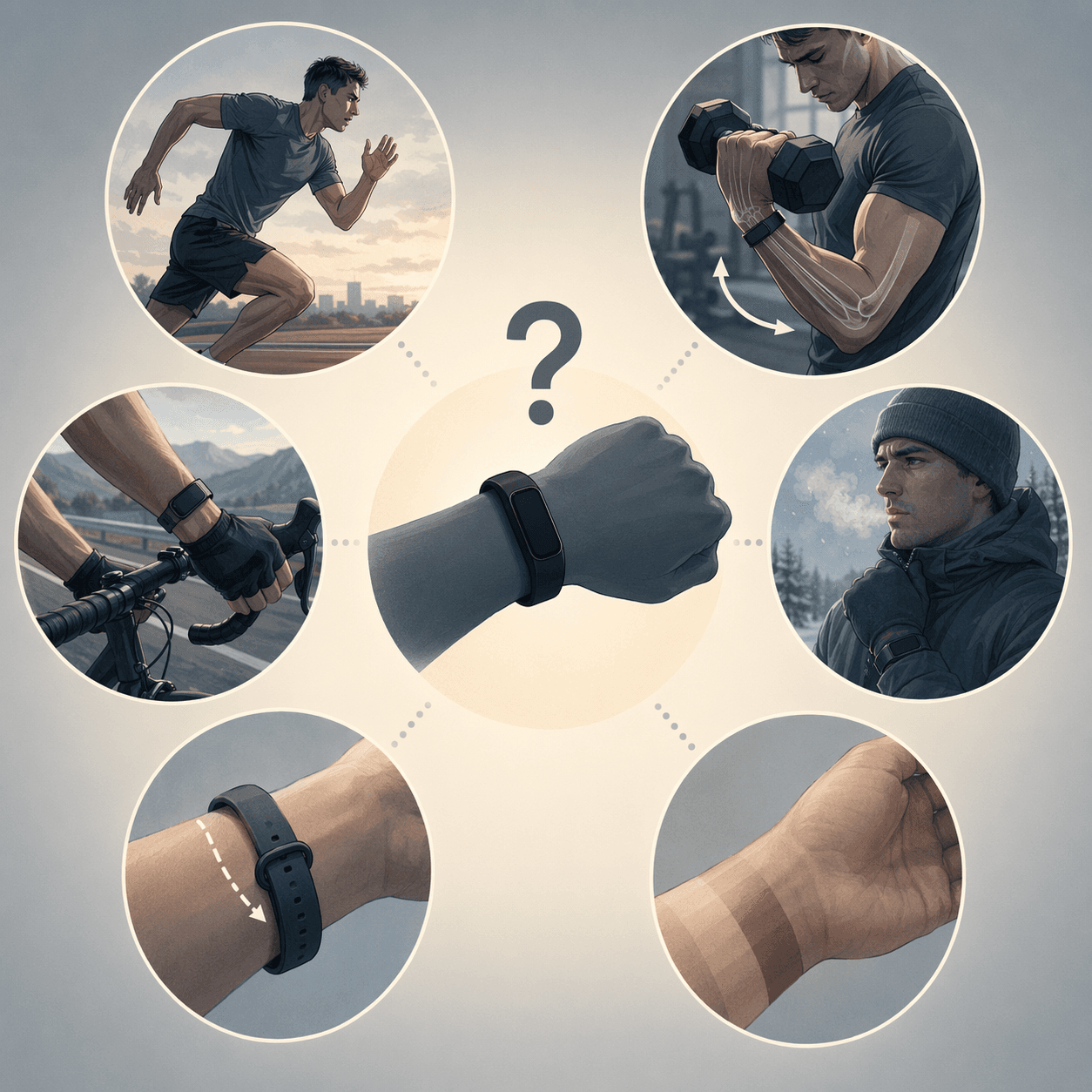
During high-intensity intervals, your heart rate can rise and fall faster than the wrist sensor and smoothing algorithm can display cleanly. The watch may show the previous effort while your body has already moved into the next one. That lag is not harmless if you are using the screen to decide whether to push, back off, or extend a recovery.
For interval work, perceived exertion, breathing, pace, power, and a chest strap often tell a clearer story together than the wrist number alone. If this is the workout type where your tracker feels most wrong, the more specific breakdown in Top-Rated Fitness Trackers and Heart Rate Accuracy: What Changes When You Lift or Do HIIT is the better next stop.
Lifting and cycling: your wrist is not a quiet measurement site
Weightlifting gives wrist optical sensors several problems at once. Grip pressure changes, tendons move, the wrist bends, and the watch may lift or press unevenly against the skin. A set of rows, push-ups, kettlebell swings, or heavy carries can produce readings that reflect contact quality as much as cardiovascular effort.
Cycling can create a similar issue for a different reason. Hands stay fixed on the bars, the wrist angle changes, vibration enters the signal, and circulation near the wrist may not behave like it does during a relaxed run. This is one reason riders who train by zones often prefer a chest strap or arm-based optical sensor paired to a bike computer or watch.
Cold weather: less skin blood flow means a weaker optical signal
In cold conditions, the body constricts blood vessels near the skin to preserve heat. For a wrist sensor that depends on detecting blood-flow changes near the surface, that can make the signal harder to read. A watch that behaves well on an indoor treadmill may become jumpy on a cold outdoor run, especially early in the session before your hands and wrists warm up.
Fit: boring, but often decisive
A loose watch is one of the easiest ways to turn a decent sensor into a poor one. The sensor needs stable contact, not a tourniquet. For workouts, the watch usually performs better when it sits slightly above the wrist bone and snug enough that light does not leak under the case with every arm swing.
If the number drops sharply during a hard effort, spikes during an easy walk, or locks onto a cadence-like rhythm, check the fit before blaming the entire device. A small change in placement can be the difference between useful and nonsense.
Skin tone deserves more than a footnote
Optical heart rate sensing depends on light entering and returning from the skin. Melanin can absorb green light, which is why skin tone is not a cosmetic variable in this discussion. It can affect the signal the sensor receives.
A 2022 systematic review on wrist-worn devices and skin tone found that 4 of 10 included studies reported statistically significant reduced heart-rate accuracy in darker-skinned participants. One included Mio Alpha study reported mean error rising from 3 bpm in Fitzpatrick type 1 skin to 16 bpm in Fitzpatrick type 6 skin. [2]
That does not prove that every current watch performs poorly on darker skin. The review is from 2022, and newer devices may use improved sensors, multiple LED wavelengths, and better algorithms. It does show that the issue is real enough to belong in the main accuracy conversation, not hidden in small print.
For a darker-skinned user, the practical advice is not to assume failure. It is to compare. If the watch’s readings consistently mismatch effort during workouts where fit and conditions are controlled, cross-check with a chest strap, a compatible external sensor, or manual pulse checks during steady efforts.
Do not judge heart rate and calories by the same standard
Heart rate is one of the better measurements a modern wrist tracker can make. Calories are a different story. In the same Apple Watch meta-analysis, 10 of 11 reviewed studies found mean absolute percentage error under 10% for heart rate during exercise, while energy expenditure error was 20% or higher in all six studies that calculated it. [1]
So if your heart rate graph looks plausible but the calorie estimate feels oddly generous or stingy, that is not a contradiction. Estimating energy expenditure requires more assumptions about body size, metabolism, movement efficiency, and activity type. For calories, the evidence is weaker.
Brand comparisons: useful, but easy to overreach
The Apple Watch has the strongest evidence discussed here, especially because the 2026 meta-analysis pools a large body of studies. That does not automatically make every Apple Watch reading correct, and it does not tell you exactly how a Garmin, Fitbit, Samsung, Whoop, Oura Ring, or budget tracker performs in the same workout.
If your question is brand-specific, use brand-specific evidence. Garmin users can continue with Garmin Fitness Tracker Accuracy: What the Science Says About Steps, Heart Rate, Sleep, and Calories. Whoop users should read Whoop Accuracy: What the Peer-Reviewed Research Actually Says vs the Marketing Claims. If you are considering a ring for training, Oura Ring as a Fitness Tracker is the more relevant form-factor discussion.
Budget devices deserve the same caution. A lower price does not automatically mean useless heart-rate data, but cheaper hardware and simpler algorithms can narrow the situations where the number deserves confidence. If that trade-off is what you are trying to sort out, see What You Actually Lose With a $50 Fitness Tracker.
When to trust the wrist number, and when to verify it
Trust wrist heart rate most when the measurement conditions are stable and the consequence of small error is low. That includes resting heart rate trends, easy walks, steady runs, moderate indoor cardio, and broad training-zone awareness. In those situations, the direction of change usually matters more than whether one reading is off by a few beats.
Verify it when the number changes the decision. That includes interval sessions, racing, threshold testing, lifting sessions where the watch behaves erratically, unusually high or low readings that do not match how you feel, and any situation involving symptoms or medical concern. A fitness tracker is not the right tool to rule out a health problem.
- If the reading is only helping you notice a weekly trend, the wrist sensor is usually enough.
- If the reading is controlling the next rep, interval, race effort, or recovery decision, cross-check it.
- If the reading repeatedly disagrees with your breathing, effort, or pace, troubleshoot fit and conditions before replacing the device.
- If accuracy during hard workouts is the priority, consider a chest strap or a tracker that pairs reliably with external monitors.
For most people, the best upgrade is not a more dramatic dashboard. It is knowing when to add a better sensor. The guide Chest Strap vs. Wrist Heart Rate: When to Upgrade and Which 2026 Trackers Work With External Monitors covers that decision more directly. If you realize your current device simply does not fit your training, How to Choose an Exercise Tracking Watch is the cleaner buying path.
The calmer rule is simple: use wrist heart rate for continuity, trends, and steady exercise; use a chest strap or another check when speed, movement, cold, skin-signal limitations, or consequences make the wrist number too important to take on faith.
Comments
Join the discussion with an anonymous comment.