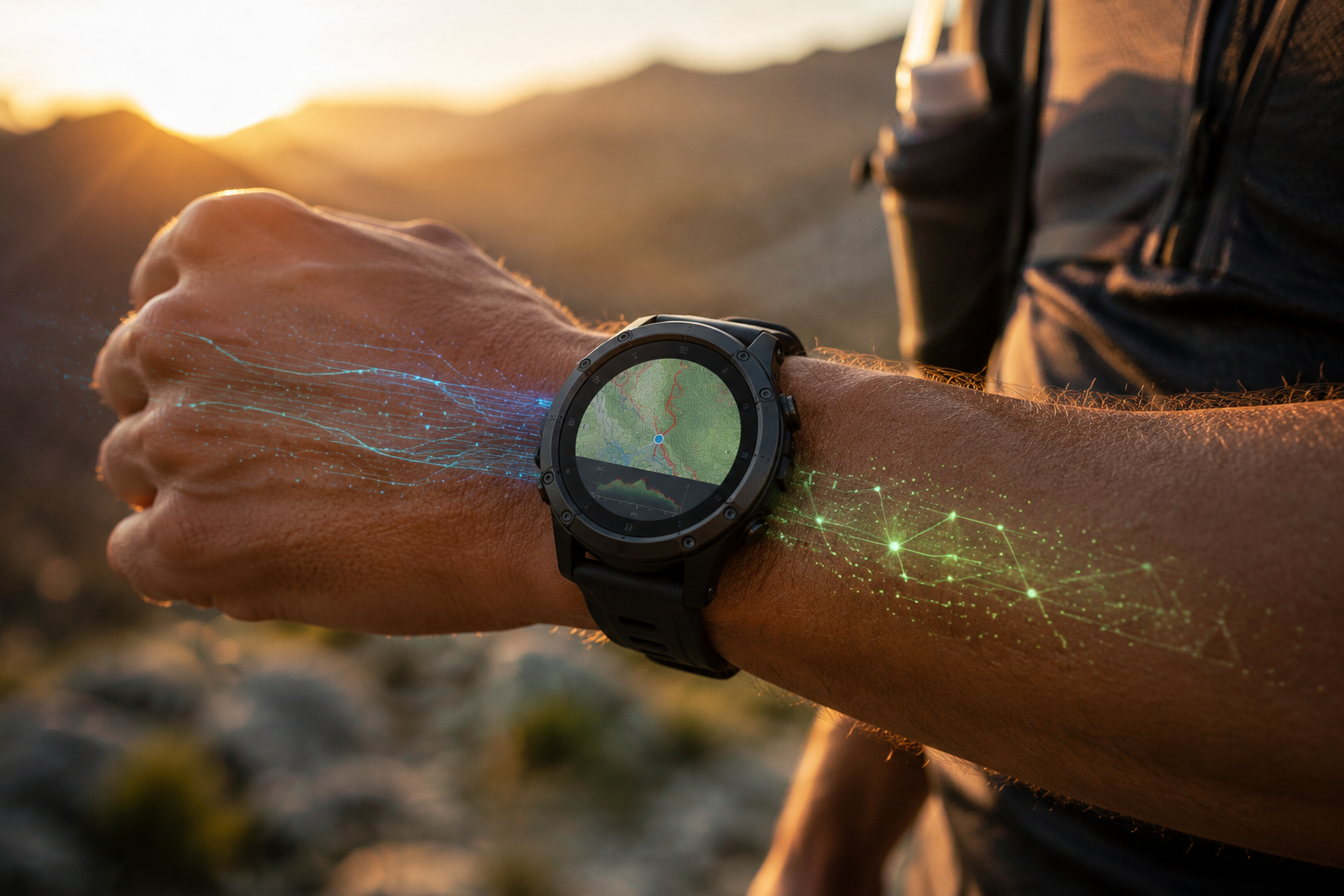
A Garmin fitness tracker is most accurate when it is doing the job Garmin is famous for: recording outdoor movement. GPS distance, pace, route mapping, navigation, running dynamics, workout structure, and training-load context are the reasons many runners and hikers keep choosing Garmin even after trying sleeker wellness wearables. The caveat starts when the same watch turns wrist optical data into recovery advice. HRV, sleep stages, and heart rate during hard intervals deserve a different level of trust.
The cleanest answer is metric by metric. Trust Garmin most when the signal comes from satellites, movement context, and sport-specific modeling. Treat Garmin’s wrist-based recovery metrics as useful trends, not precise physiological measurements. If a training decision depends heavily on HRV, sleep staging, or interval-level heart rate, sensor location matters enough that a ring, chest strap, or dedicated HRV workflow may be the better tool.
The Accuracy Question Depends on the Signal
| Metric | How much to trust Garmin | Best use |
|---|---|---|
| GPS distance, pace, route tracking | High | Outdoor runs, hikes, rides, route navigation, pacing decisions |
| Running dynamics and training context | High to useful | Workout review, load trends, race preparation, structured training |
| Resting heart rate and steady efforts | Useful | Trend tracking and moderate aerobic sessions |
| High-intensity wrist heart rate | Caution | Confirm with a chest strap when intervals or zones matter |
| HRV and recovery scores | Directional | Watch trends, but avoid treating one score as a training command |
| Sleep duration | Useful | Bedtime consistency and broad sleep-debt patterns |
| Sleep stages | Weak for precision | Do not treat light, deep, and REM breakdowns as lab-grade |
That split is not a loophole. It is the whole story. A watch can be excellent at outdoor training and still be limited as a recovery sensor. GPS and wrist photoplethysmography are solving different problems in different environments. One uses satellite and movement data to reconstruct where you went. The other tries to infer cardiovascular timing from light reflected through skin, tissue, tendon, and motion at the wrist.
For shoppers comparing Garmin with Oura or Whoop, the mistake is to ask which brand is “more accurate” as if accuracy were a single score. Garmin’s advantage is strongest when the device is used as a training watch. Oura’s advantage is strongest when the signal comes from the finger during sleep. Whoop sits closer to the recovery-wearable category, with different tradeoffs around display, training navigation, and subscription design. Those differences matter more than a leaderboard.
HRV Is Where the Gap Becomes Hard to Ignore
Heart rate variability is attractive because it appears to compress recovery into a number. Garmin surfaces HRV through HRV Status and feeds related signals into Body Battery and Training Readiness. That can be helpful when a trend lines up with how you feel, how you slept, and how training has been going. The problem is that HRV is also exactly the kind of measurement where wrist placement makes life harder.
A 2025 synthesis discussing the Sinichi et al. study reported 536 participant-nights and found Garmin Fenix 6 HRV concordance of 0.87 with ECG, compared with 0.99 for Oura Gen 4. The useful takeaway is not simply “Oura beat Garmin.” It is that the finger gives an optical sensor a cleaner measurement environment than the wrist, especially during overnight recovery measurement when small timing differences matter. [1]
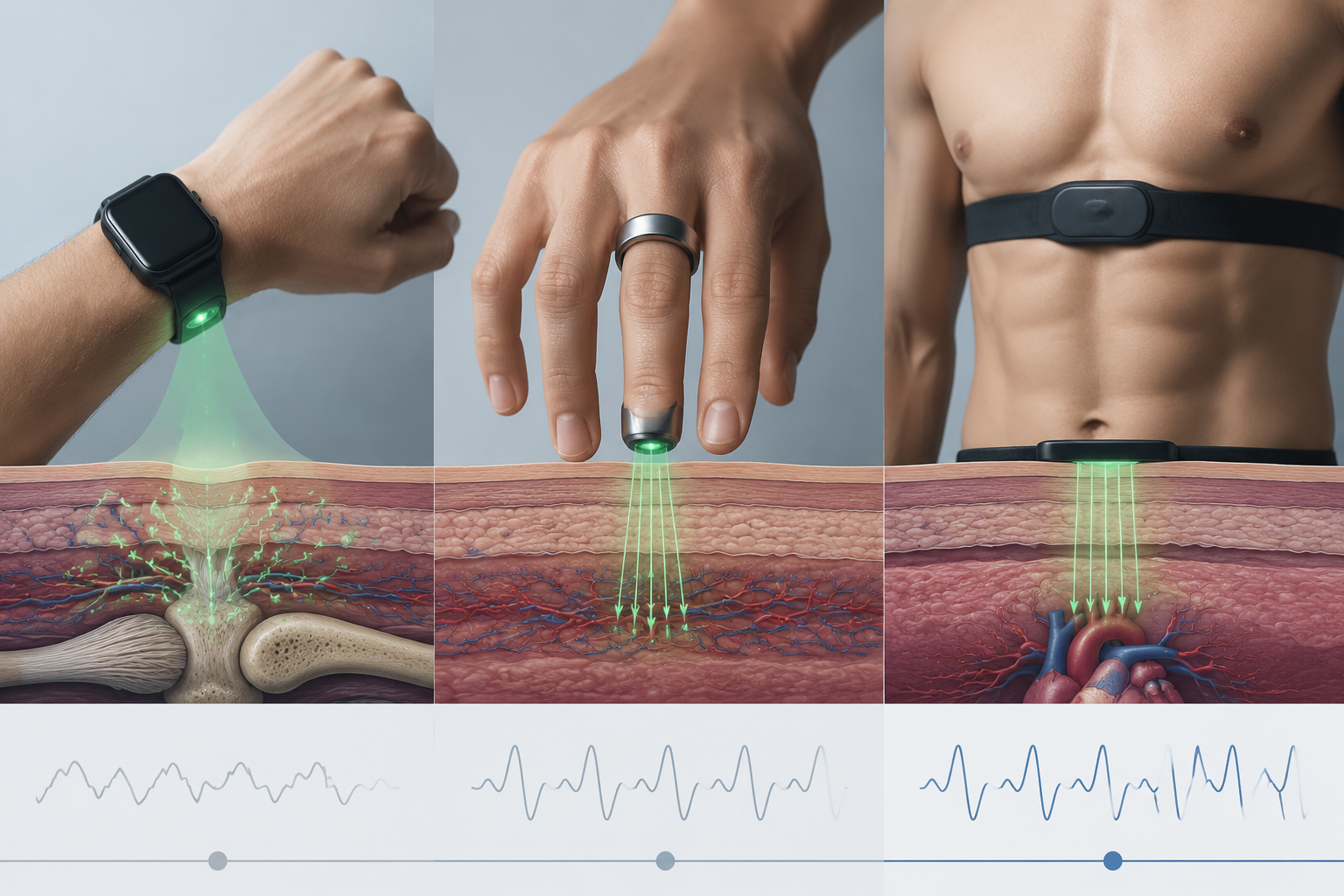
That distinction matters because it keeps the criticism fair. Garmin is not careless because its HRV is weaker than a finger-based ring. It is trying to pull a recovery-grade signal from a noisier location. The wrist has bone, tendon, strap-pressure variation, hair, skin-tone effects, movement, and fit changes. A ring sits around the finger, where blood-flow detection is generally easier for optical sensing. A chest strap does something different again: it measures electrical activity more directly, which is why chest straps remain the reference tool for many heart-rate comparisons.
There is an important hardware caveat. Older validation work does not automatically prove that every current Garmin with a newer Elevate sensor behaves the same way. Garmin has changed sensor generations, and a Fenix-era or Vivosmart-era result should not be stretched into a final verdict on every 2026 model. But the location problem does not disappear just because the sensor improves. The more precise the recovery decision, the more the measurement site matters.
That is also why broad device-level critiques are relevant without being the whole case. The5krunner’s 2026 analysis argued that HRV accuracy problems appear across 62 Garmin devices when compared with clinical ECG, framing the issue as systemic to Garmin wrist PPG rather than a single bad model generation. That kind of analysis should not be treated as a controlled lab result for every watch on every wrist, but it does support the narrower point that Garmin HRV deserves caution when used for recovery-grade decisions. [2]
Recovery Scores Are Interpretations, Not Raw Measurements
Garmin’s recovery features are most tempting when they sound coach-like. Body Battery gives a charge-and-drain metaphor. Training Readiness suggests whether today is a good day to push. HRV Status turns overnight variability into a baseline comparison. Those features are not useless; they can catch patterns a tired athlete might rationalize away. The risk is treating the number as if it came straight from the body instead of through a stack of sensor readings, smoothing decisions, baselines, and proprietary formulas.
The proprietary part is not a minor detail. Users can see the score, but they cannot inspect exactly how Garmin weights HRV, sleep, recent load, stress, resting heart rate, or algorithm updates. If Training Readiness drops after a poor night, that may reflect a real physiological shift. It may also reflect how the watch interpreted sleep, how the strap sat overnight, or how the software weights a particular input. The interface rarely makes those layers visible.
A sensible way to use Garmin recovery metrics is to look for agreement. If HRV Status is suppressed, resting heart rate is elevated, sleep duration is short, and your warm-up feels flat, Garmin is adding useful confirmation. If one recovery score looks dramatic but the rest of the picture does not support it, the score should start a check-in, not end the decision.
Sleep Duration Is More Useful Than Sleep Stages
Garmin sleep tracking is most defensible when it is used for simple questions: Did you sleep less than usual? Did your bedtime drift? Did a travel week or late workout shorten your night? Duration trends can still be valuable even when stage classification is imperfect.
The weaker claim is precise sleep staging. Garmin has not published validation comparable to Oura’s polysomnography-facing claims, and available comparisons place Oura sleep-stage accuracy at 85–91% against polysomnography while describing Garmin as weaker among the major recovery wearables. That supports a cautious conclusion: Garmin can help track sleep habits, but its light, deep, and REM estimates should not be treated as a sleep-lab substitute. [1]
For many athletes, that is still enough. If the watch shows five short nights in a row, the exact REM percentage is not the important part. The useful decision is probably to reduce load, protect bedtime, or stop pretending the weekend long run will fix a week of poor sleep. Precision matters more when someone is making sleep-stage-driven training changes or comparing interventions in detail.
Heart Rate Is Usually Fine Until the Workout Gets Messy
Wrist heart rate can be perfectly serviceable for resting trends, easy runs, and steady aerobic work. The failures tend to show up when the signal environment gets chaotic: intervals, hill repeats, cold weather, loose fit, rapid arm swing, strength circuits, and activities where the wrist bends or grips.
CNET’s 2026 fitness tracker testing compared the Garmin Venu 4 with a Polar H10 chest strap and reported higher average heart-rate error than the Apple Watch Series 11, which measured under 1% error in that testing. That does not mean every Garmin heart-rate reading is bad, and it does not turn one Venu 4 test into a verdict on the whole lineup. It does show that newer Garmin hardware has not made wrist heart-rate limitations vanish. [3]
This is the easiest Garmin caveat to solve. If heart-rate zones determine the session, pair the watch with a chest strap. Garmin remains the workout computer, GPS recorder, and training log; the strap supplies the cleaner heart-rate signal. For threshold work, short intervals, or any session where a lagging wrist reading changes the workout, that setup is more reliable than asking the watch to do everything from the wrist.
Where Garmin Still Deserves Its Reputation
None of the recovery caveats erase Garmin’s strengths. For a runner, cyclist, hiker, skier, or backpacker, the watch often earns its place before HRV ever enters the conversation. Mapping, battery life, route tools, structured workouts, pace fields, lap behavior, sport profiles, navigation, and post-run analysis are practical advantages. They affect what happens during training, not just how a morning score looks.
This is also where a lot of wellness-focused comparisons become unfair to Garmin. A ring may be better for overnight recovery measurement, but it will not replace a Forerunner or Fenix for following a route, checking split pace mid-race, navigating a trail junction, or managing a structured workout from the wrist. A Whoop may be built around recovery behavior, but it is not trying to be the same outdoor instrument.
So the buying question is not whether Garmin is accurate enough in the abstract. It is whether Garmin is accurate enough for the decisions you actually make. If your decisions are mostly about route, pace, effort distribution, workout completion, and long-term training load, Garmin is one of the strongest primary devices available. If your decisions are mostly about sleep-stage experiments, HRV-led rest days, or recovery optimization, Garmin alone is a weaker fit.
The Practical Setup Decision
A Garmin-only setup makes sense when the watch is mainly a training and outdoor navigation tool. That includes runners who care about GPS pace, route history, workouts, race pacing, hill profiles, training load, and battery life. It also fits hikers and multisport athletes who would rather have one rugged device than a cleaner overnight HRV signal from a second wearable.
A Garmin-plus-Oura setup makes sense when outdoor training still matters, but recovery data has to be cleaner. In that pairing, Garmin handles the run, ride, hike, or race. Oura handles overnight HRV and sleep trends from the finger. That division is more honest than trying to make one device win every category.
A Garmin-plus-Polar-H10 setup makes sense when heart-rate precision matters during workouts. The Garmin still gives the screen, GPS, lap structure, and training ecosystem. The chest strap supplies the signal for intervals, threshold work, or testing. For morning HRV routines, a chest strap paired with an app such as HRV4Training can also keep recovery measurement separate from the watch’s proprietary readiness layer.
- Choose Garmin alone if your main needs are GPS, pacing, navigation, structured workouts, and training-load context.
- Add Oura if sleep and overnight HRV are central to how you plan training.
- Add a Polar H10 if workout heart-rate accuracy changes your zones, intervals, or test results.
- Treat Body Battery, Training Readiness, and HRV Status as trend prompts, not orders.
For broader context, the companion Garmin accuracy article, “Garmin Fitness Tracker Accuracy: What the Science Says About Steps, Heart Rate, Sleep, and Calories,” is the better place to look at general sensor performance beyond this HRV-focused comparison. The “Fitness Tracker Accuracy Report 2026” is more useful if you want cross-brand context. If you are considering a two-device setup, the Oura-focused guides on recovery and whether Oura can replace a fitness tracker are the natural next stop. For the broader wrist-sensor problem, the heart-rate accuracy article is the piece to read before assuming the issue is unique to Garmin.
The Bottom Line
Garmin is the right primary watch when your training life is built around outdoor workouts, GPS distance, pace, navigation, running metrics, and durable sport features. It is not the right sole authority when fine-grained recovery decisions depend on HRV, sleep stages, or high-intensity heart rate from the wrist.
Use the strongest signal for the decision. Trust Garmin most when the measurement comes from GPS, movement context, and sport-specific training data. Treat wrist recovery metrics as directional. When the decision truly depends on HRV, sleep staging, or interval-level heart rate, use a better sensor location.
References
- Whoop vs Oura vs Garmin, athletedata.health
- Garmin HRV Accuracy, the5krunner.com, February 18, 2026
- The Best Fitness Trackers of 2026, CNET
Comments
Join the discussion with an anonymous comment.