
You already know you do not want another tiny screen asking for attention during a workout. The harder question is what kind of invisible coach you want: a low-maintenance band that covers the basics, a demanding performance system that expects you to check in every day, or a ring that quietly watches sleep and recovery trends while workouts take a back seat.
For most people shopping for a screenless fitness tracker in 2026, Fitbit Air is the best value: it costs $99, does not require a subscription, and covers enough wellness, sleep, and activity tracking to make the cheaper choice feel practical rather than stripped down. WHOOP 5.0 is the better pick if you train hard enough to act on strain and recovery feedback daily. Oura Ring 4 is the one to choose if sleep comfort, HRV, temperature trends, and a ring form factor matter more than workout-tracking depth.
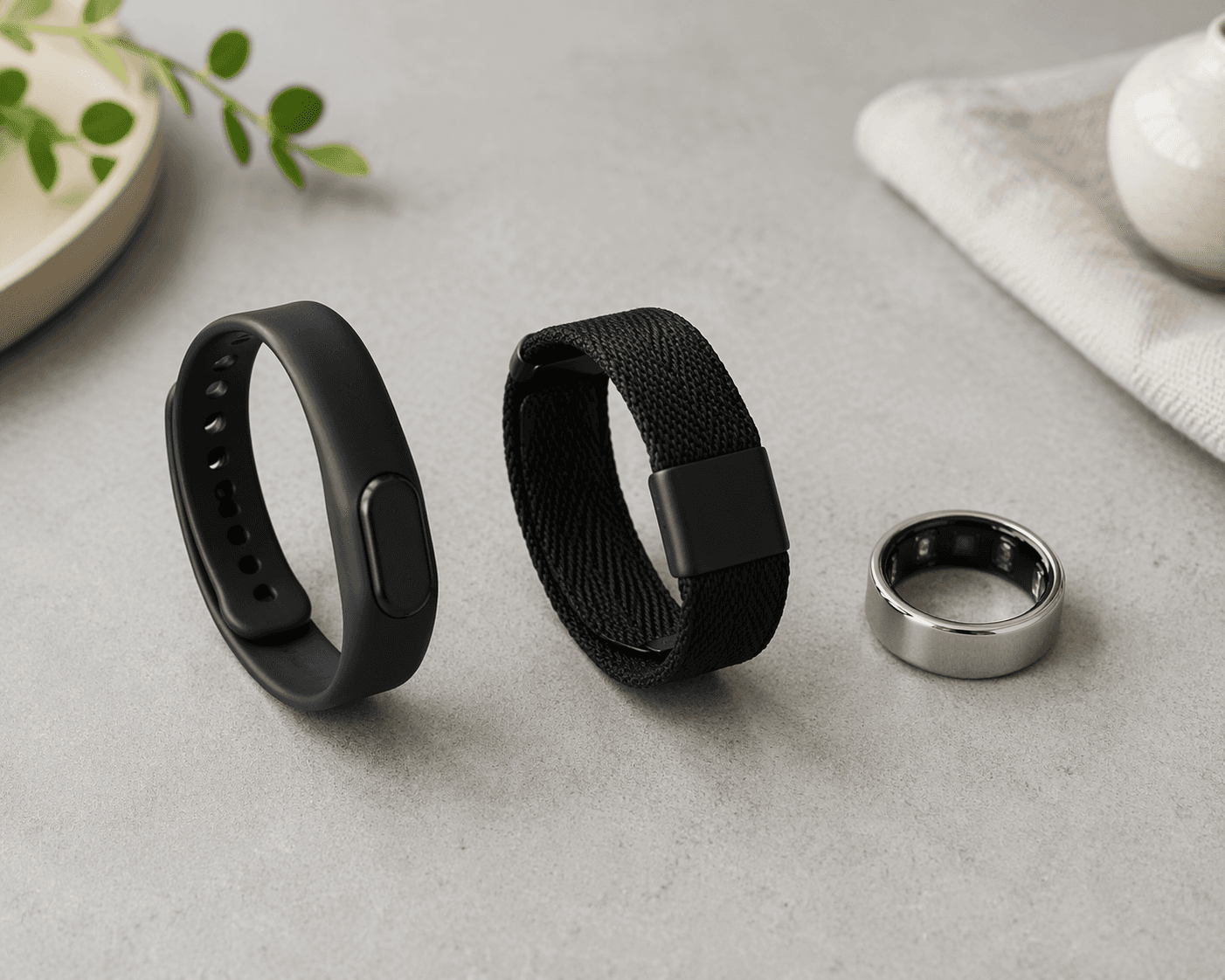
| Device | Upfront price | Estimated 3-year cost | Subscription requirement | Battery life | Best fit | Main limitation |
|---|---|---|---|---|---|---|
| Fitbit Air | $99 | $99 without Premium; up to $396 with Premium | No required subscription | 7 days | Most people who want a screenless wrist band for general wellness, sleep, and activity | New May 2026 launch with maturing software, including reported GPS failures and AI quirks |
| WHOOP 5.0 | Subscription-based | Roughly $597–$1,077 depending on plan tier | Yes | 14 days | Athletes who will use strain, recovery, and coaching feedback every day | Expensive if you mostly want passive tracking |
| Oura Ring 4 | $349 plus membership | Roughly $565 | Yes for full app value | About 7 days | Sleep-first users who want ring comfort, HRV, and temperature trends | Workout tracking is secondary, especially compared with wrist-worn devices |
The price tells you what each tracker expects from you
Fitbit Air’s $99 price is not just a discount-bin argument. It changes the relationship. You can buy it, wear it, ignore Premium if you want, and still have a functioning screenless tracker. Add Fitbit Premium at $99 per year and the three-year cost rises to about $396, but the subscription remains optional rather than the toll booth you must pass through to use the product. [1]
WHOOP is the opposite philosophy. The hardware is only the entry point into a paid training system, with three-year cost estimates running roughly $597 to $1,077 depending on plan tier. That can be reasonable if you use the app the way WHOOP wants you to use it: checking strain, recovery, sleep, and behavior feedback often enough that it changes how you train. It is much harder to justify if you simply want a quiet band that records activity in the background. [1]
Oura Ring 4 sits in the middle financially but not philosophically. The ring starts at $349, then depends on a $5.99-per-month membership for the fuller experience, putting the three-year estimate around $565. [1] That is still far below the higher WHOOP tiers, but it is not a one-time purchase in the way Fitbit Air can be.
This is why total cost matters more than the launch price. Over three years, Fitbit Air can remain a $99 purchase. WHOOP asks you to keep paying because the coaching system is the product. Oura asks you to pay for a long-term body-trend dashboard built around a ring you are supposed to keep on almost constantly.
If the WHOOP number is the only thing making you hesitate, the better question is not whether the subscription is “expensive” in the abstract. It is whether you will use the feedback often enough for it to affect training decisions. For a deeper look at that math, see our WHOOP subscription-worth-it guide.
Fitbit Air: the easiest recommendation for most screenless tracker shoppers
Fitbit Air is the pick for someone who wants useful tracking without turning fitness into another recurring bill. It is a screenless wrist band, it has a 7-day battery life, and it covers the wellness basics most people actually check: sleep, heart rate, activity, and app-based coaching. [2]
The value argument gets stronger because Fitbit does not lock the entire device behind Premium. That matters for normal home training. If you are doing strength sessions in the garage, walking after dinner, mixing in beginner cardio, or trying to make sleep more consistent, you probably do not need a $600-plus commitment to learn whether you recovered well enough to move today.
The paid part is not pointless, though. Google’s AI Health Coach, available through Fitbit Premium at $99 per year, is the most interesting software swing here. DC Rainmaker called it “the single biggest shake-up in fitness tracking apps in years” and wrote that WHOOP’s AI compared as “a toddler to college graduates.” [2] That is unusually strong praise in a category where “AI” often means a lightly rewritten weekly summary.
The catch is timing. Fitbit Air launched in May 2026, and early testing has not been spotless. Review coverage has flagged maturing-software issues, including GPS tracking failures and AI quirks that Google has committed to fixing. [2] That does not ruin the device, but it does mean the safest version of the recommendation is specific: Fitbit Air is the best value for most buyers who want a band and can tolerate some early software rough edges.
Heart-rate accuracy also deserves a calm caveat. High-intensity wrist HR remains difficult, and DC Rainmaker reported mixed high-intensity performance on both Fitbit Air and WHOOP. [2] If you are doing intervals where exact heart-rate response matters, a chest strap is still the better tool. For ordinary activity trends, sleep patterns, and general wellness nudges, Fitbit Air’s appeal is that it gives you enough signal without demanding athlete-level attention.
If your short list is really just the two wrist bands, our Fitbit Air vs WHOOP 5.0 comparison goes deeper on that matchup.
WHOOP 5.0: worth it when the behavior loop changes your training
WHOOP 5.0 makes the most sense for people who do not merely collect fitness data. They respond to it. The point of WHOOP is the loop: train, accumulate strain, sleep, get a recovery read, adjust the next day, repeat. If that loop helps you back off before a bad session or push when you are genuinely ready, the subscription starts to look like coaching infrastructure instead of a fee attached to a band.
Its practical hardware advantages are real. WHOOP 5.0 is rated for 14 days of battery life, twice the 7-day figure attached to Fitbit Air and roughly double Oura Ring 4’s week-long estimate. [2] That matters because a screenless tracker loses much of its value when it is sitting on a charger during sleep or recovery windows.
WHOOP also has broader automatic workout detection than Fitbit Air, with coverage for more than 45 activity types compared with Fitbit’s smaller set. [2] If you train across lifting, running, cycling, sport sessions, and conditioning work, the less you have to manually start and stop, the more likely the data record will reflect what you actually did.
That still does not make WHOOP the best screenless fitness tracker for everyone. A demanding system only helps if you want to be demanded of. If you are not going to open the app, read the recovery guidance, compare it with your plan, and change something, you are mostly paying for a more elaborate version of data you may not use.
There is also a health-claim caution around WHOOP. Wirecutter noted that WHOOP received an FDA warning letter in July 2025 regarding blood-pressure marketing claims. [3] That should not be treated as a blanket dismissal of the device, but it is a useful reminder not to read recovery, strain, HRV, or adjacent wellness numbers as medical diagnostics.
Oura Ring 4: the sleep-first choice that happens to track fitness
Oura Ring 4 is not trying to be a wrist band without a screen. That distinction matters. It is a smart ring built around constant wear, especially overnight, and its strongest case is sleep and recovery trend tracking rather than workout control.
The ring format is the obvious advantage. Many people tolerate a ring at night more easily than a band, and available benchmarks put Oura Ring 4 at 92–95% sleep-stage accuracy versus 88–91% for wrist bands, along with 98% overnight wear compliance. [4] Sleep-stage numbers from any consumer wearable should still be treated as estimates, but comfort and compliance are not small details. A tracker that stays on through the night gets the chance to be useful.
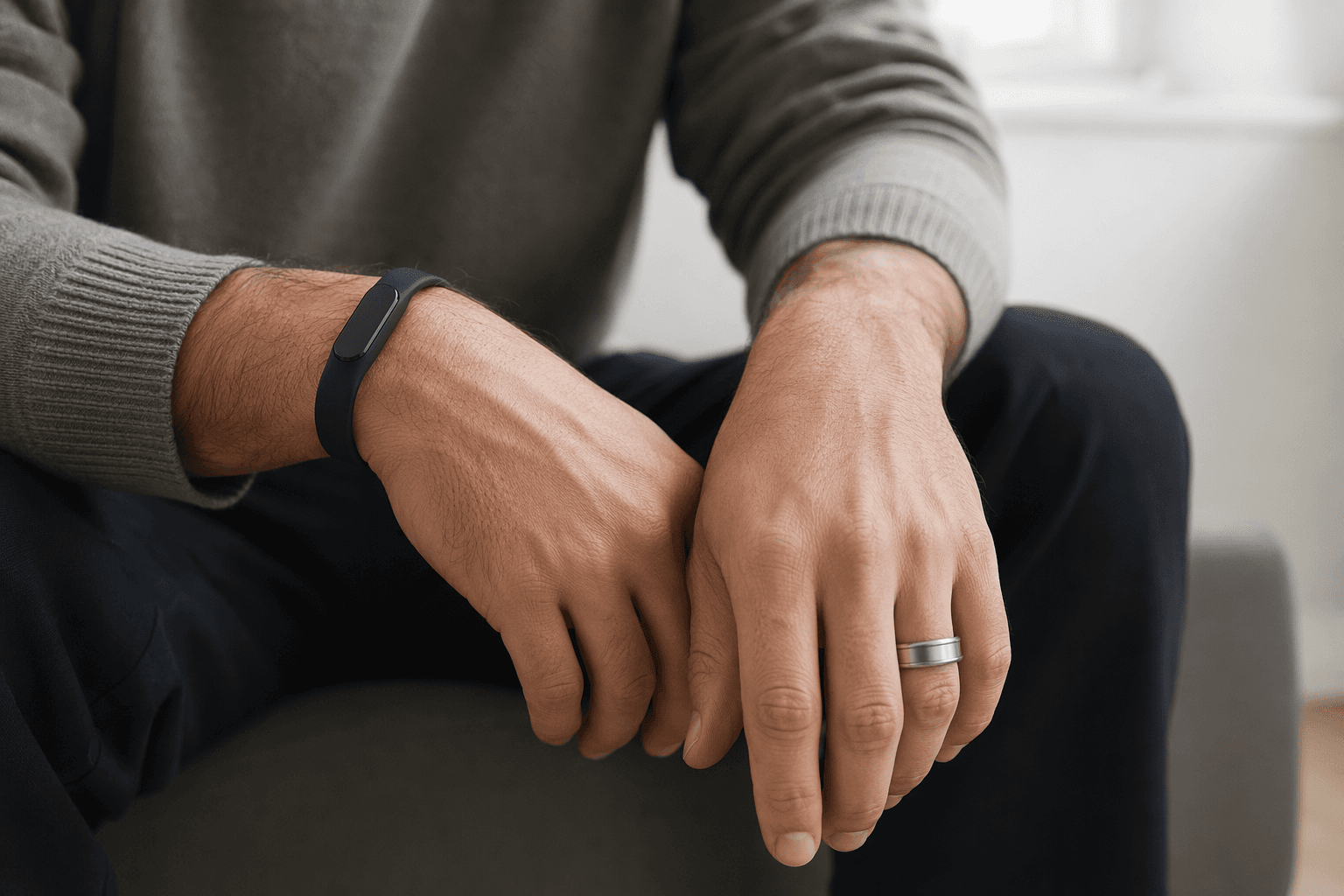
Oura’s appeal is strongest if you care about HRV, temperature trends, sleep regularity, and long-term readiness signals. That makes it a natural fit for people who want to understand how their body is trending without manually logging every set, interval, or class. For more on that angle, see our Oura recovery tracking guide.
The trade-off is workout tracking. Oura is not designed to beat a wrist-worn band for active workout heart-rate tracking, and the ring can be awkward or vulnerable to scratching during strength training. [5] If your main use case is logging hard training sessions, checking live effort, and reviewing workout-specific patterns, Oura should not be your first stop.
If your decision is really about recovery metrics rather than activity logging, our WHOOP 5.0 vs Oura Ring 4 vs Garmin recovery comparison is the more focused read.
Band or ring matters more than it sounds
A screenless tracker has to disappear into normal life. If it does not, all the recovery scores and readiness graphs become theoretical. This is where the wrist-versus-finger choice stops being cosmetic.
Choose Fitbit Air or WHOOP if you want the familiar security of a band, better fit for workouts, and fewer worries during lifting or equipment-heavy training. Choose Oura if you dislike sleeping with something on your wrist, want a less obviously sporty device, and are comfortable accepting weaker workout coverage in exchange for overnight comfort.
This is also where battery life affects behavior. WHOOP’s 14-day figure gives it the most breathing room. Fitbit Air and Oura Ring 4 both sit around a week, which is still reasonable, but you will need a charging rhythm that does not interrupt sleep tracking. [2][5]
Who should actually pay for a subscription?
A subscription makes sense when it changes behavior. That is the cleanest dividing line.
- Pay for WHOOP if you will review strain and recovery daily, adjust training based on the feedback, and value automatic detection across a broad range of workouts.
- Pay for Oura if your main interest is sleep consistency, HRV, temperature trends, and overnight wear comfort.
- Consider Fitbit Premium if you want Google’s AI Health Coach and deeper app guidance, but start with the free Fitbit Air experience if you are unsure.
The subscription trap is not that every paid feature is bad. It is that recurring costs are easy to justify during the novelty week and easy to forget six months later. Fitbit Air is forgiving if your motivation comes and goes. WHOOP is more rewarding when your consistency is already high. Oura is easiest to defend when sleep and recovery are your main reasons for buying anything at all.
The quick decision
| Choose | If this sounds like you |
|---|---|
| Fitbit Air | You want the best-value screenless fitness tracker, prefer a wrist band, and do not want a mandatory subscription. |
| WHOOP 5.0 | You train often, like being coached by data, and will act on strain and recovery feedback almost every day. |
| Oura Ring 4 | You care most about sleep, HRV, temperature trends, and wearing something comfortable overnight. |
There are other screenless and low-distraction options on the market, and Garmin’s rumored CIRQA may eventually complicate this category, but it is not a real buying alternative until it actually ships. If none of these three feels right, start with our broader screenless fitness tracker buyer’s guide before locking into a subscription.
The practical answer is simple: choose Fitbit Air unless you specifically need WHOOP’s athlete behavior loop or Oura’s ring-based sleep and recovery strengths.
References
- Engadget subscription analysis — Engadget
- Fitbit Air and WHOOP 5.0 testing coverage — DC Rainmaker
- WHOOP FDA warning letter coverage — Wirecutter, July 2025
- Oura Ring 4 sleep accuracy and overnight wear benchmarks — Wareable and Jointcorp benchmarks
- Oura Ring 4 review coverage — Wirecutter and PCMag
Comments
Join the discussion with an anonymous comment.