
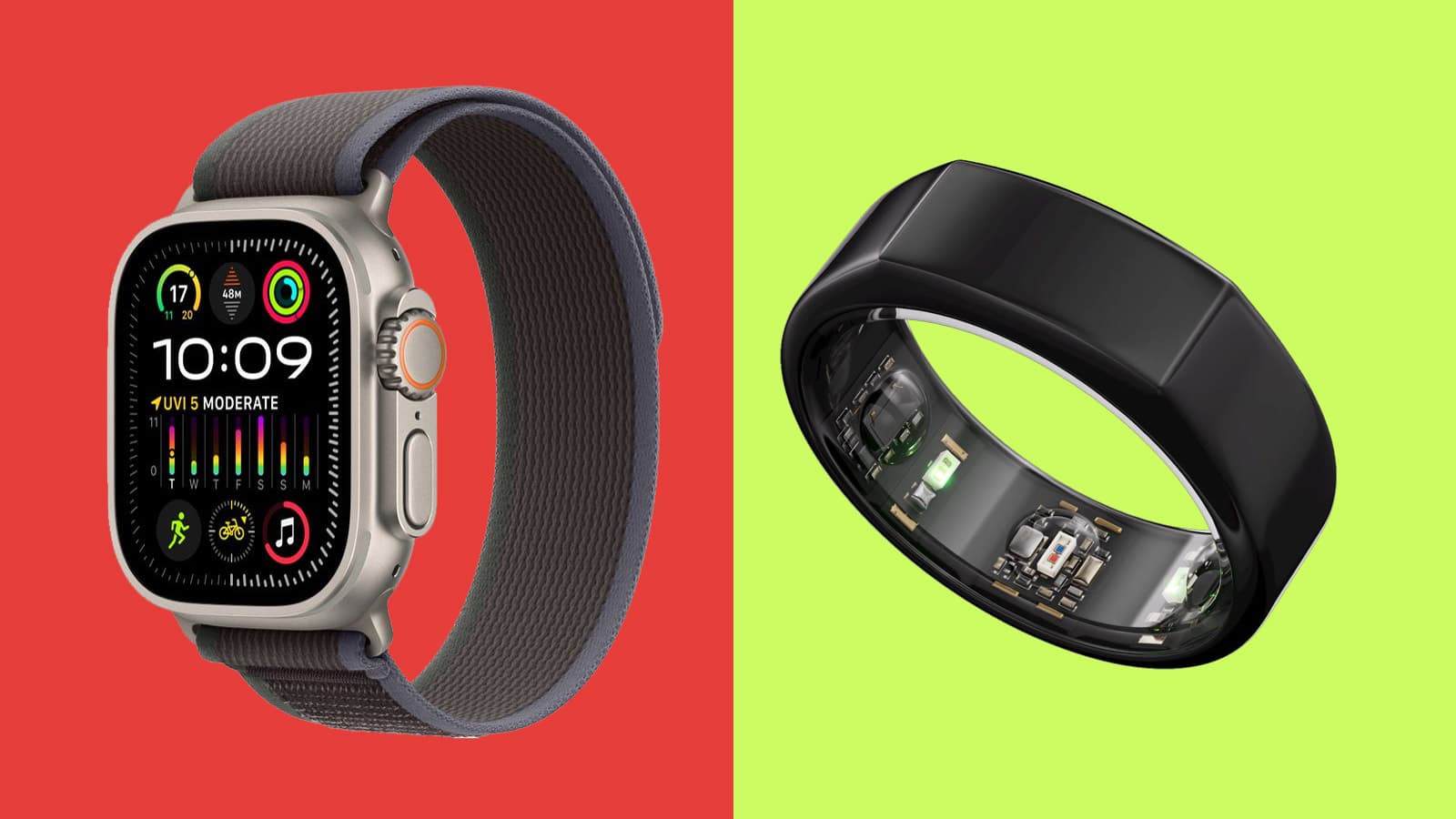
The fastest way to decide whether a fitness tracker ring can replace your watch is to look at what happens when heart rate gets messy. In Android Central’s head-to-head workout test, Derrek Lee compared smart-ring heart-rate readings against Garmin Venu 3 and Pixel Watch 3 reference watches across five workout types. The Amazfit Helio Ring stayed within 4 bpm of the watch references, while the Oura Ring 4 averaged 13 bpm low at high intensity and the RingConn Gen 2 missed by 18–63 bpm depending on the exercise [1].
That is the part buyers should see before the usual comfort pitch. A ring can feel invisible all day and still be the wrong tool for a hard interval session, heavy dumbbell rows, or a treadmill run where you actually use heart rate to pace the work. If the number is supposed to tell you whether to hold back, push harder, or compare one session to another, being pleasantly wearable is not enough.
The Android Central test is not a final verdict on every finger, ring size, skin tone, workout style, or firmware version. It was one person across five workouts. But it is a useful warning signal because the gap did not show up as a tiny rounding error. It showed up exactly where many people care most: higher-intensity exercise.
What you lose when the watch stays home
A fitness watch usually sits on a broad, relatively stable patch of wrist. It still has optical heart-rate problems, especially during fast arm movement or poor fit, but it has more surface area to work with. A smart ring is measuring from a smaller contact area on a finger that is constantly changing pressure during exercise.
That difference matters most when your hands are involved. Grip a dumbbell, squeeze treadmill handles, brace for push-ups, swing your arms during intervals, or let sweat change the ring’s contact with skin, and the optical signal can get noisy. This is why a ring can look excellent during sleep and then look much less convincing once the workout starts.
| Workout type | Can a smart ring be your main tracker? | Why it behaves that way |
|---|---|---|
| Walking | Often acceptable | Heart rate changes more slowly, hand movement is usually moderate, and the metric is less likely to decide a precise training target. |
| Low-aerobic steady-state cardio | Sometimes acceptable | If intensity stays controlled, a ring may be close enough for casual trend tracking, though a watch is still safer for zone-based training. |
| High-heart-rate running | Risky | Higher intensity and larger arm movement increase the chance that the ring reads low or lags behind the actual effort. |
| HIIT | Poor fit for most users | Rapid heart-rate changes, sweat, impact, and changing hand position are exactly the conditions that expose ring limitations. |
| Strength training | Poor fit for heart-rate accuracy | Grip pressure and finger movement can disrupt sensor contact during rows, presses, carries, and other loaded work. |
This is also where the word “tracking” gets slippery. If you only want a logged workout and a rough sense that today was harder than a normal walk, a ring may be enough. If you train by heart-rate zones, compare interval peaks, watch recovery between sets, or use heart rate to decide whether you are actually in an easy run, the gaps matter.
For a broader look at where rings, bands, watches, and apps fit, the best workout tracker guide is the better starting point. The short version here is simpler: rings are improving, but they are not automatically in the same workout-tracking category as a well-fitted sports watch.
The Amazfit Helio result is impressive, with a catch
The surprise in the Android Central test was not that Oura and RingConn had limits. It was that the $149 Amazfit Helio Ring was the one that stayed closest to the watch references, remaining within 4 bpm across the tested workouts [1]. That is good enough to take seriously, especially because the reference devices included the Garmin Venu 3 and Pixel Watch 3 [1].
Still, a good test result does not erase the buying constraints. The Helio Ring comes in only three sizes — 8, 10, and 12 — and its battery life is listed at 3–4 days [1]. With rings, sizing is not a cosmetic detail. A slightly wrong fit can affect comfort, sensor contact, and whether you tolerate wearing it through sleep and workouts.
Why rings can be better at rest than during workouts
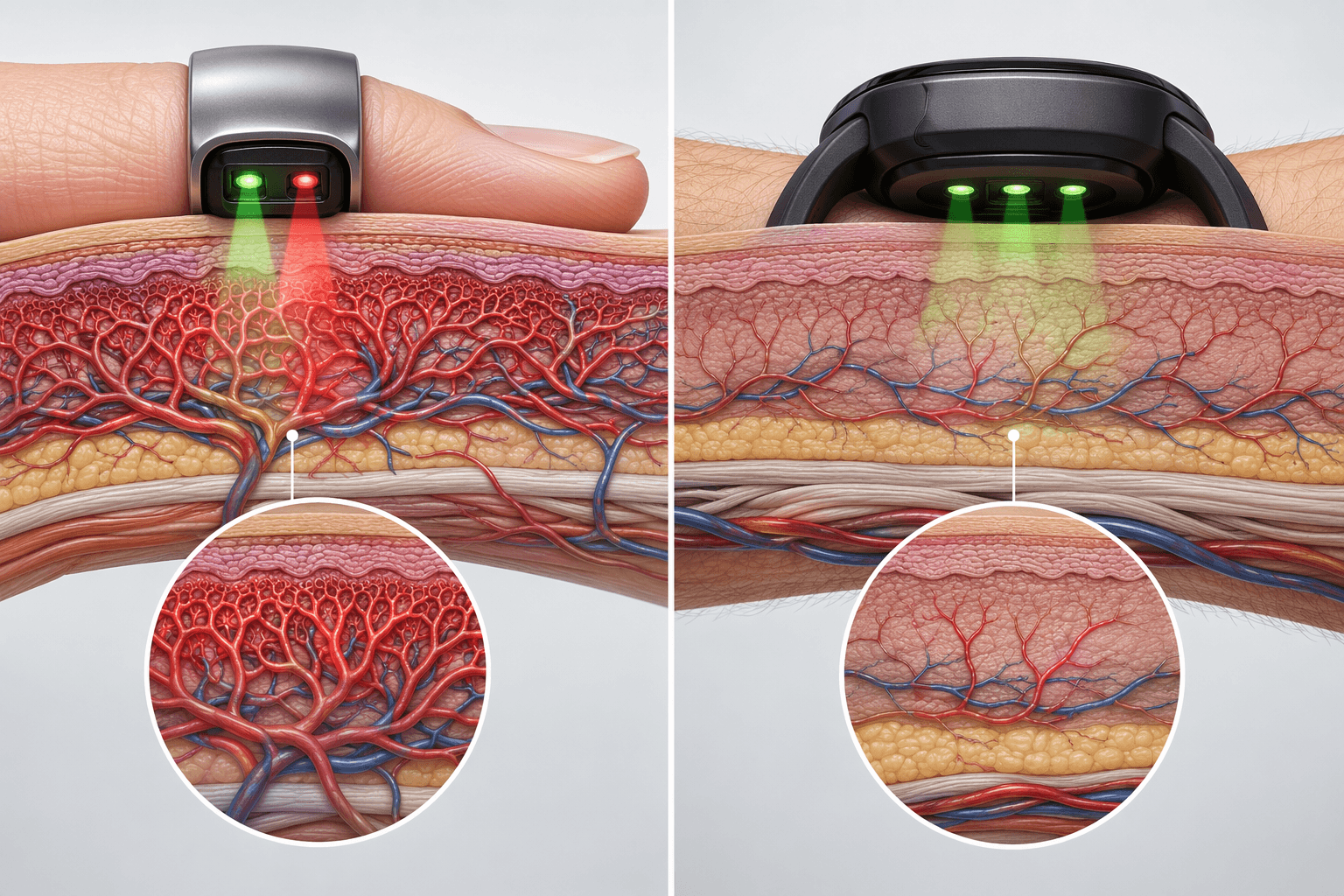
The finger is not a bad place to measure physiology. In quiet conditions, it can be a very good place. Smart rings benefit from the finger’s dense blood flow near the skin surface, and the palm-side of the finger can reduce some optical interference that affects wrist-based photoplethysmography across skin tones. That helps explain why rings often look strongest in overnight metrics rather than burpee metrics.
Sleep is the cleanest example. Live Science reported expert-reviewed ranges showing smart rings at about 92–95% sleep-stage accuracy compared with clinical polysomnography, versus about 84–91% for wrist-worn devices [2]. Those ranges come from studies with different methods, so they should not be read as a universal scorecard for every model. They do show why rings have earned their reputation as strong recovery wearables.
There is still a caveat inside that praise. The same Live Science reporting noted that a 2024 meta-analysis found rings consistently underestimated REM sleep duration [2]. So even in their best territory, rings are not miniature sleep labs. They are trend tools. The difference is that their trend tools are often useful enough for recovery decisions: resting heart rate, HRV direction, sleep timing, and whether your body looks unusually strained after a hard day.
That makes a ring much easier to recommend as a recovery tracker than as a sole workout computer. If that is the reason you are shopping, the best fitness tracker for recovery comparison is the more relevant lens than a pure exercise-watch comparison.
The workout mismatch by intensity
For walking, a fitness tracker ring can make sense. Heart rate rises gradually, hand movement is usually manageable, and most walkers are not making second-by-second training decisions from the display. If your main goals are step-like activity context, resting trends, sleep, and a general activity record, wearing only a ring is a reasonable compromise.
For low-aerobic steady-state cardio, the answer depends on how much you care about zones. A relaxed indoor bike session, incline walk, or easy elliptical session is more forgiving than intervals. If the ring is off by a little, the consequence may be small. But if you are trying to stay under a ceiling, build an aerobic base, or compare sessions week to week, a watch gives you a better chance of catching drift and spikes.
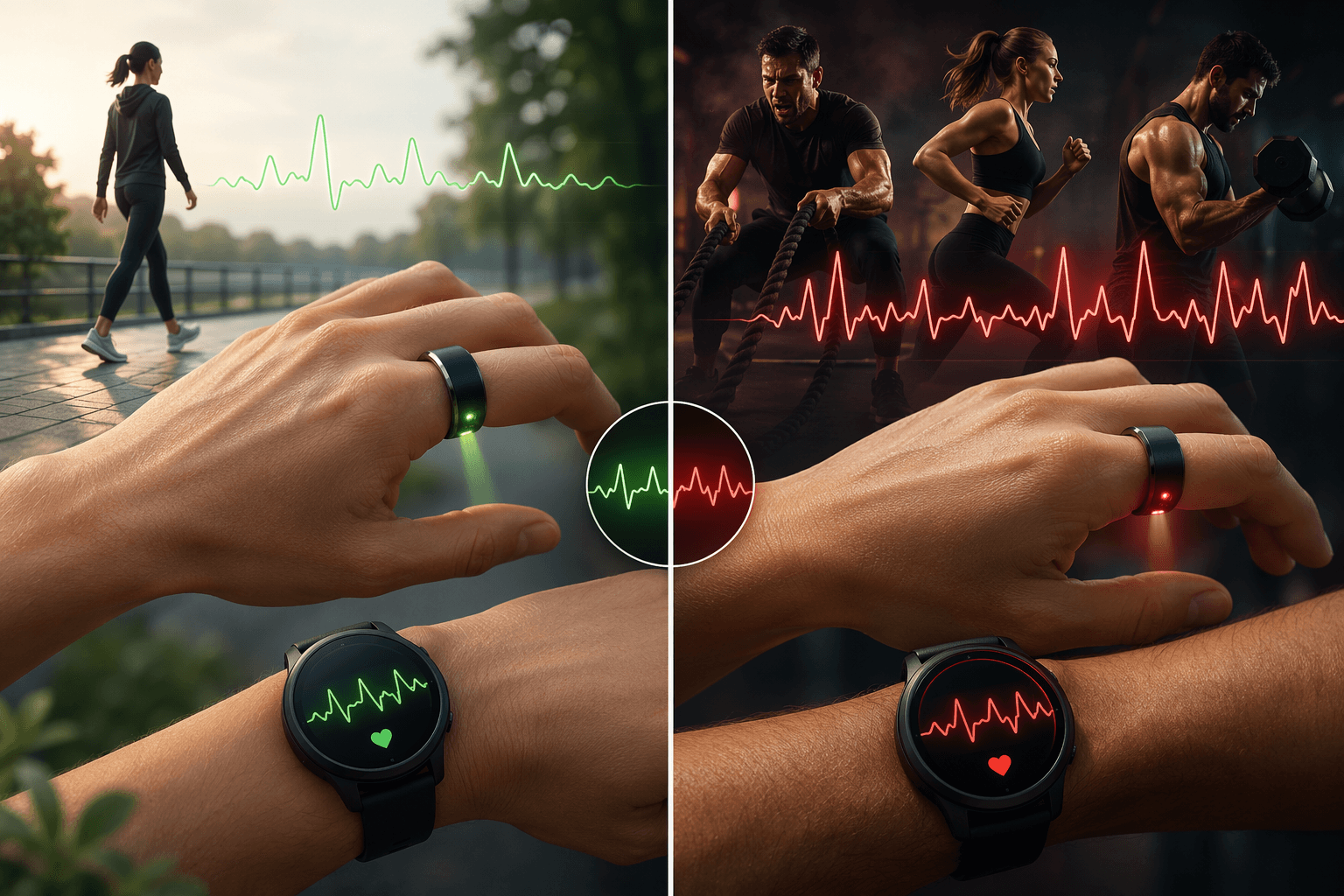
HIIT is where I would not trust a ring as the only source unless a specific device has proved itself on your body. The problem is not just that peak heart rate may be wrong. It is that the whole shape of the workout can be distorted: delayed rises, missed peaks, and recoveries that look cleaner or worse than they felt. That can make a brutal interval session look moderate in the app, or make two workouts seem comparable when they were not.
Strength training has its own problem. A ring sits exactly where lifting gets physical. Pulling a dumbbell, gripping a kettlebell, loading a bar, or doing push-ups changes pressure through the finger. Even if the ring survives the workout comfortably, the optical sensor may not get a clean enough signal during the parts you care about. For lifters, the better question is often whether you need live heart rate at all, or whether you mainly want recovery trends after the session.
Where a watch still earns the space on your wrist
A dedicated fitness watch is still the safer choice for people who use workout data while the workout is happening. The screen matters. Buttons matter. GPS and sport modes matter. So does being able to glance down during a run or treadmill interval and see whether the number matches how hard you are breathing.
Garmin’s role in the Android Central comparison is useful here because the Venu 3 was one of the reference watches [1]. That does not mean every Garmin watch is automatically perfect, but it does reflect why many exercisers still use wrist-based sports watches as the practical benchmark. If your home gym training depends on structured sessions, the Garmin fitness tracker guide is more useful than trying to force a ring into a job it may not handle.
This is especially true if your workouts are varied. A week that includes dumbbell circuits, incline treadmill walks, rowing, intervals, and outdoor runs asks a tracker to handle very different movement patterns. A ring may do fine in one session and fall apart in another. That inconsistency is harder to live with than a known limitation.
The screenless wearable tradeoff
Smart rings also overlap with another category: screenless recovery wearables. The appeal is obvious. No buzzing square on your wrist, no bedtime watch, no tiny screen begging to be checked. You wear the thing, sleep in it, and let the app interpret the background data later.
That philosophy can be excellent for people who hate traditional watches. It can also come with subscription costs, depending on the device and platform. If you are comparing rings with Whoop-style recovery tracking, the useful question is not only “which one is more accurate?” It is also whether you want live workout feedback, coaching, a display, and long-term app costs. The Whoop home workout review covers that tradeoff more directly.
So, can a fitness tracker ring replace your watch?
For most athletes, no. A fitness tracker ring should not replace a dedicated fitness watch if you use heart rate to guide hard sessions, pace runs, compare interval efforts, or judge training intensity. The exercise accuracy gap is too device-dependent and too workout-dependent to treat a ring as a clean substitute.
For walkers and low-intensity steady-state exercisers, maybe. If your workouts are mostly walks, easy cardio, and general activity, a ring can be a practical primary wearable, especially if you care more about sleep, HRV, resting heart rate, and recovery patterns than live workout control.
For many home-fitness users, the most honest setup is still two devices: a ring for quiet 24/7 recovery tracking and a watch for workouts. It is less sleek than the one-device dream, but it matches what the data is saying. Rings are often strongest when your body is still. Workouts are when the small, comfortable form factor starts asking for a little too much forgiveness.
Comments
Join the discussion with an anonymous comment.