
What's the Best Room Temperature for Sleep Recovery?
The 60–67°F sleep-temperature consensus is repeated everywhere, but the evidence behind it rarely gets examined. The largest sleep-temperature studies show heat hurts sleep more than cool air does and that age and individual variation shift the target zone — so the practical protocol is to start near 65°F and track your own sleep for about two weeks.
- Citation source
- Baniassadi et al. 2023, Science of the Total Environment
- Evidence level
- Restrained inference
- Recommended frequency
- 2 weeks
The best room temperature for sleep recovery is usually treated as a solved problem: set the bedroom near 65°F and move on. That answer is useful. It is also too tidy. The evidence behind it points to a starting zone, not a magic degree that guarantees deeper sleep, higher growth hormone, better soreness, or faster adaptation from training.
The common recommendations are close, but not identical. Cleveland Clinic gives a 60–67°F range and says temperatures above 70°F are generally too warm for sleeping well.[1] Sleep Foundation calls about 65°F ideal and notes that many doctors recommend 65–68°F.[2] Those are not strange numbers pulled from nowhere. They line up with the broader pattern in sleep-temperature research: heat tends to shorten and fragment sleep more reliably than modest coolness does.
The part that often gets lost is who the number applies to. A 30-year-old who sleeps under a heavy comforter after evening lifting, a postmenopausal sleeper with night sweats, and a 74-year-old in a drafty apartment may not land on the same setpoint. The right question is not whether 65°F is “true.” It is how much trust to put in it before checking your own sleep.
The strongest single study does not point to 65°F for everyone
The most useful temperature study for real homes is not a lab night with a handful of young volunteers. It is Baniassadi and colleagues’ 2023 study of 50 community-dwelling older adults, followed across 10,903 person-nights with sleep and indoor environmental measurements.[3] That design matters because it watches people in their own bedrooms, not in a perfectly controlled sleep lab.
For this older-adult sample, sleep was most efficient and restful when bedroom temperature was 20–25°C, or 68–77°F.[3] That is warmer than the 60–67°F consensus range repeated for the general adult population. It does not erase the consensus; it limits it. If an older adult sleeps better at 72°F than 65°F, the data gives a good reason not to treat that as failure or poor discipline.
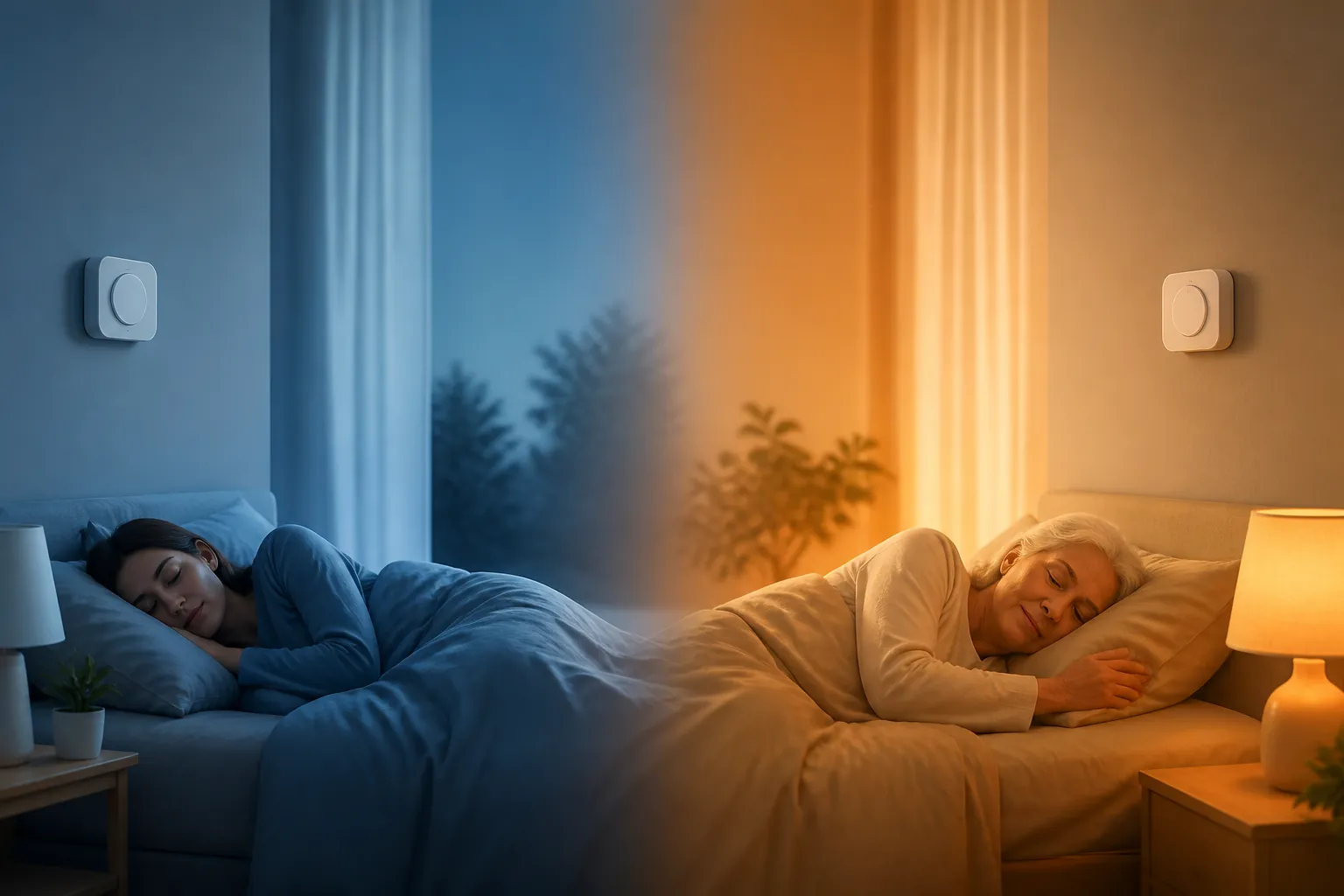
The warmer zone was not permission for an overheated room. In the same study, when temperature rose from 25°C to 30°C, sleep efficiency dropped by 5–10%, and total sleep time fell by roughly 60 minutes.[3] That is the kind of effect size worth paying attention to. Losing an hour of sleep because the room drifted from warm to hot is not a minor sleep-hygiene footnote.
For recovery, that still should be read as an indirect chain. The study measured sleep in relation to indoor temperature; it did not measure muscle protein synthesis, glycogen restoration, soreness, or training adaptation. The recovery relevance comes from sleep being a major part of the repair process, not from proof that one thermostat setting directly improves hypertrophy or endurance gains.
The uncomfortable detail: people did not all respond the same way
The same Baniassadi paper is also a useful antidote to overconfident rules. The temperature-sleep relationship was nonlinear, and some within-person effects ran in opposite directions.[3] In plain English: the average pattern matters, but it did not describe every sleeper cleanly.
That is why the older-adult result is more interesting than another generic “keep it cool” paragraph. It shows both sides of the problem. Heat above the comfortable zone can meaningfully reduce sleep. At the same time, the comfortable zone is not fixed across every age, body, bedding setup, and home.
Large datasets support the heat problem, but with smaller average effects
The large-scale evidence points in the same general direction: warmer nights are associated with shorter sleep. A 2025 USC Keck School of Medicine analysis using All of Us data included 14,232 adults and more than 12 million nights. In that dataset, each 10°C warmer night was associated with about 2.63 minutes less sleep on average.[4]
That average effect sounds small until the subgroups appear. The USC report says the association was roughly three times larger on the West Coast and stronger in females, Hispanic adults, people with chronic disease, and people with lower socioeconomic status.[4] Averages can make heat look like a minor annoyance when some groups are carrying a much larger burden.

Another large analysis published in Nature Communications in 2025 reported that about a 10°C increase was associated with about 9.7 minutes less sleep and 20% higher odds of insufficient sleep.[5] The exact design differs from the older-adult home study, and population-level findings are not the same thing as a personal thermostat prescription. Still, the direction is hard to ignore: warmer conditions keep showing up as a sleep-shortening exposure.
There is also a practical mismatch between recommendations and actual bedrooms. A SLEEP 2020 abstract reported bedroom temperature above 70°F on 69% of recorded nights, with an average range of 68.8–76.2°F.[6] That does not prove those sleepers all slept badly. It does show that many real homes run warmer than the commonly recommended zone, which makes “just set it to 65” less simple than it sounds.
Why cooler rooms usually help sleep onset
The mechanism is plausible without needing to be mystical. A 2019 review by Harding, Franks, and Wisden describes how core body temperature begins falling about two hours before sleep onset, with the steepest decline around sleep onset. Warm hands and feet reflect peripheral vasodilation, which helps the body dump heat.[7]
That is one reason a cooler room can help. The bedroom does not need to freeze you; it needs to make it easier for the body to move heat out while you stay comfortable enough not to wake up. This is also why hot, humid rooms can feel so punishing. They interfere with heat loss at exactly the time your body is trying to cool down.
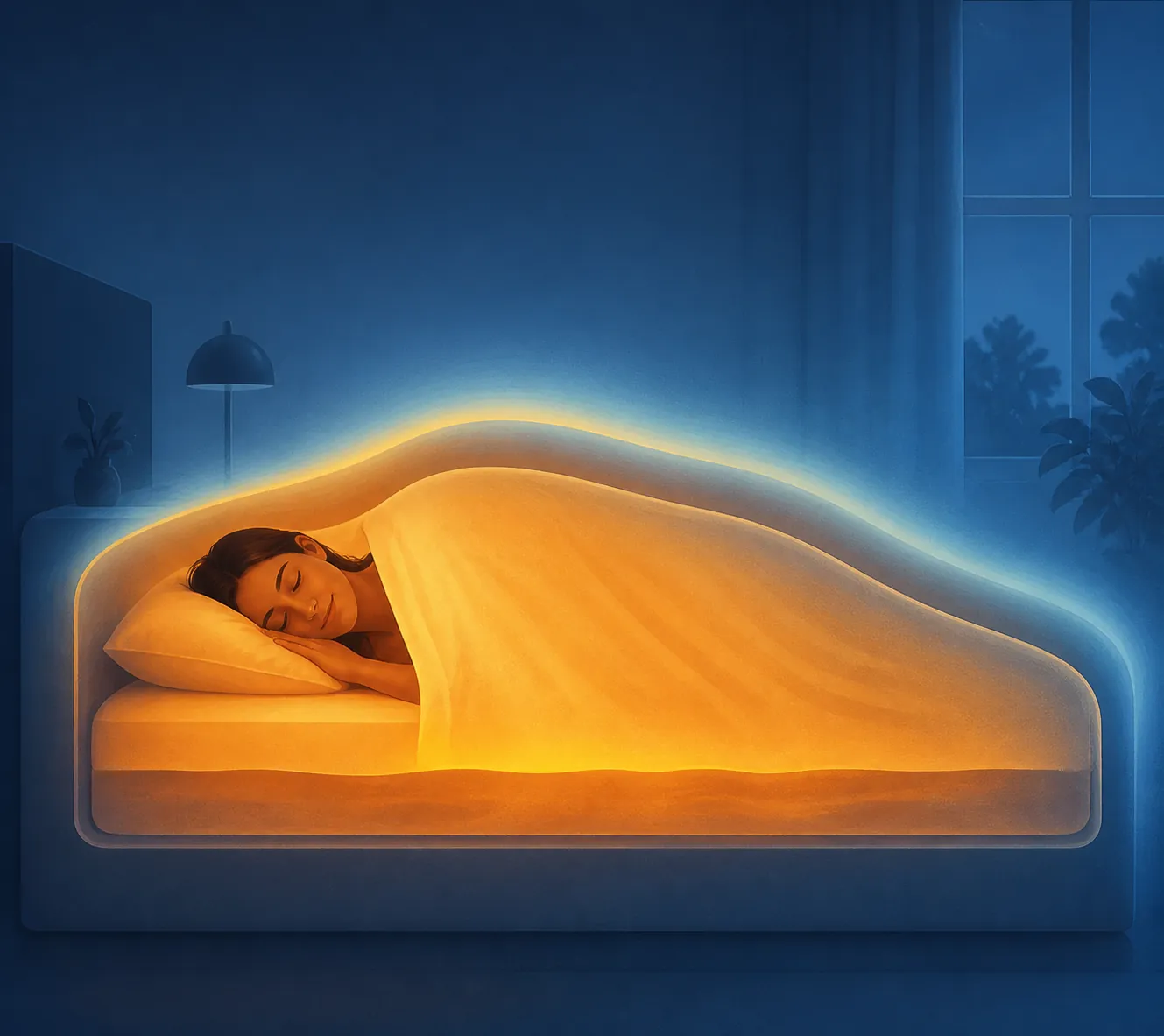
Room temperature is not the same as skin temperature under the covers. The same review notes that bedding can create a 31–35°C microclimate around the skin even when the room is around 19–21°C.[7] That detail explains why two people in the same 65°F room can have different nights: mattress heat retention, blanket weight, pajamas, body size, and whether a partner or pet is in the bed all change the actual thermal environment.
For a deeper look at the physiology, the related guide on how heat disrupts sleep and workout recovery covers the cooling process in more detail. The important point here is narrower: a cool room supports sleep biology, but the air temperature on the thermostat is only one layer of the thermal system.
So how much should you trust 65°F?
Trust it as a first setting, not as a verdict. If you are a generally healthy adult trying to improve sleep after training, starting near 65°F is sensible. It sits inside the major consensus ranges, and it protects against the more consistent problem in the data: excess warmth.
If 65°F feels too cold, the evidence does not require you to suffer through it. Try 66–68°F before deciding the whole idea is useless. If you are older, the Baniassadi data makes it especially reasonable to test a warmer band, roughly 68–77°F, while still avoiding the hot end where sleep efficiency and total sleep time declined.[3]
For the direct target range after training, see the guide to the ideal sleep temperature after a home workout. The evidence above explains why the cool zone is a good default, and why the default should bend when your sleep data and comfort consistently say it should.
A restrained two-week test
A useful protocol does not need a new gadget or a perfect HVAC system. It needs a stable starting point and enough nights to avoid judging the setting from one unusually stressful day.
- Start near 65°F if you are a typical adult and can maintain it comfortably. If you already know that is too cold, start at 66–68°F. If you are an older adult, consider beginning closer to the warmer 68–77°F range identified in the older-adult study.
- Hold the setting steady for about one week. Do not change the thermostat, bedding, pajamas, caffeine timing, and workout time all at once if you want the temperature signal to mean anything.
- Track the boring outcomes: time to fall asleep, awakenings, total sleep time, how rested you feel, and whether you wake sweaty or chilled. If you use a wearable, watch trends rather than single-night scores.
- Adjust by 1–2°F for the second week based on the clearest problem. Waking sweaty or sleeping shorter in a warm room points cooler. Waking cold, tense, or repeatedly uncovered points warmer.
- Keep the setting that improves sleep without creating discomfort. The goal is better sleep continuity, not obedience to a number.
Wearables and actigraphy-style measurements are useful for trends, but they are not laboratory polysomnography. If you are using an Oura Ring or similar device, the better move is to compare your own two-week patterns, not treat readiness or sleep-stage estimates as a medical-grade verdict. The guides on using Oura recovery data for home workouts and Oura sleep-tracking accuracy are the right companions for that part of the experiment.
If your home cannot hold the target temperature, solve the biggest heat source first: lighter bedding, airflow, pre-cooling the room, or moving heat-generating electronics away from the bed. If maintaining a steady setpoint is the hard part, start with how to sleep without AC and recover faster from workouts.
The practical answer
For most adults, the best room temperature for sleep recovery is a cool starting zone around 65°F, with 60–67°F or 65–68°F as reasonable consensus ranges depending on the source.[1][2] The evidence is strongest against letting the bedroom get hot, especially above the comfortable zone for your age and bedding setup.
For older adults, the best-supported home-data range is warmer: 68–77°F in the Baniassadi study, with clear sleep losses as temperatures rose from 77°F toward 86°F.[3] That is the complication that should survive the headline.
Start near the consensus, then test your own sleep for about two weeks. Heat appears to impair sleep more consistently and substantially than equivalent cool deviations, but the spread between people is too large for one thermostat setting to optimize everyone’s recovery.
References
- What Is the Ideal Sleeping Temperature for My Bedroom? — Cleveland Clinic.
- The Best Temperature for Sleep — Sleep Foundation.
- Nighttime ambient temperature and sleep in community-dwelling older adults — Science of the Total Environment, 2023.
- Warmer nights linked to less sleep, especially on the West Coast — USC Keck School of Medicine, 2025.
- Higher ambient nighttime temperature shortens human sleep globally — Nature Communications, 2025.
- Bedroom temperature and objectively measured sleep — SLEEP, 2020.
- The Temperature Dependence of Sleep — Frontiers in Neuroscience, 2019.
This is general fitness education, not medical advice. For diagnosis or treatment of pain or injury, consult a qualified clinician.
Pick your next session
Browse all routines to find an appropriately-spaced next session.
Spot something off?
This content sits adjacent to health guidance — tell us if a citation or figure needs a correction.