
Does exercise after a COVID vaccine boost antibodies?
A 90-minute light-to-moderate aerobic workout done within about 30 minutes of your COVID shot was linked to higher antibody levels four weeks later — without increasing side effects. Here's how to plan that session at home, and when rest is the smarter choice.
- Citation source
- Brain, Behavior, and Immunity (Hallam et al., 2022)
- Evidence level
- Restrained inference from a single small RCT
- Recommended frequency
- 90 minutes once, starting within about 30 minutes after vaccination
The best-studied version of exercise after COVID vaccine is not a hard workout, a sweat test, or a quick “get it done” circuit. In the clearest human study, adults started about 90 minutes of light-to-moderate aerobic exercise within roughly 30 minutes after receiving a Pfizer-BioNTech COVID vaccine dose. They kept heart rate around 120–140 beats per minute, and their serum antibody levels were higher four weeks later than in the no-exercise comparison group, without more reported side effects. A 45-minute session did not show the same measurable antibody boost. [1]
That 45-minute result matters. It keeps the takeaway from sliding into “any workout helps.” The finding was tied to a particular dose: a long, steady, easy-to-somewhat-hard aerobic session, done once, soon after vaccination. It was also a small study of adults who were already exercising regularly, measuring antibody levels as a correlate of immune response—not whether someone later did or did not get infected. [1]
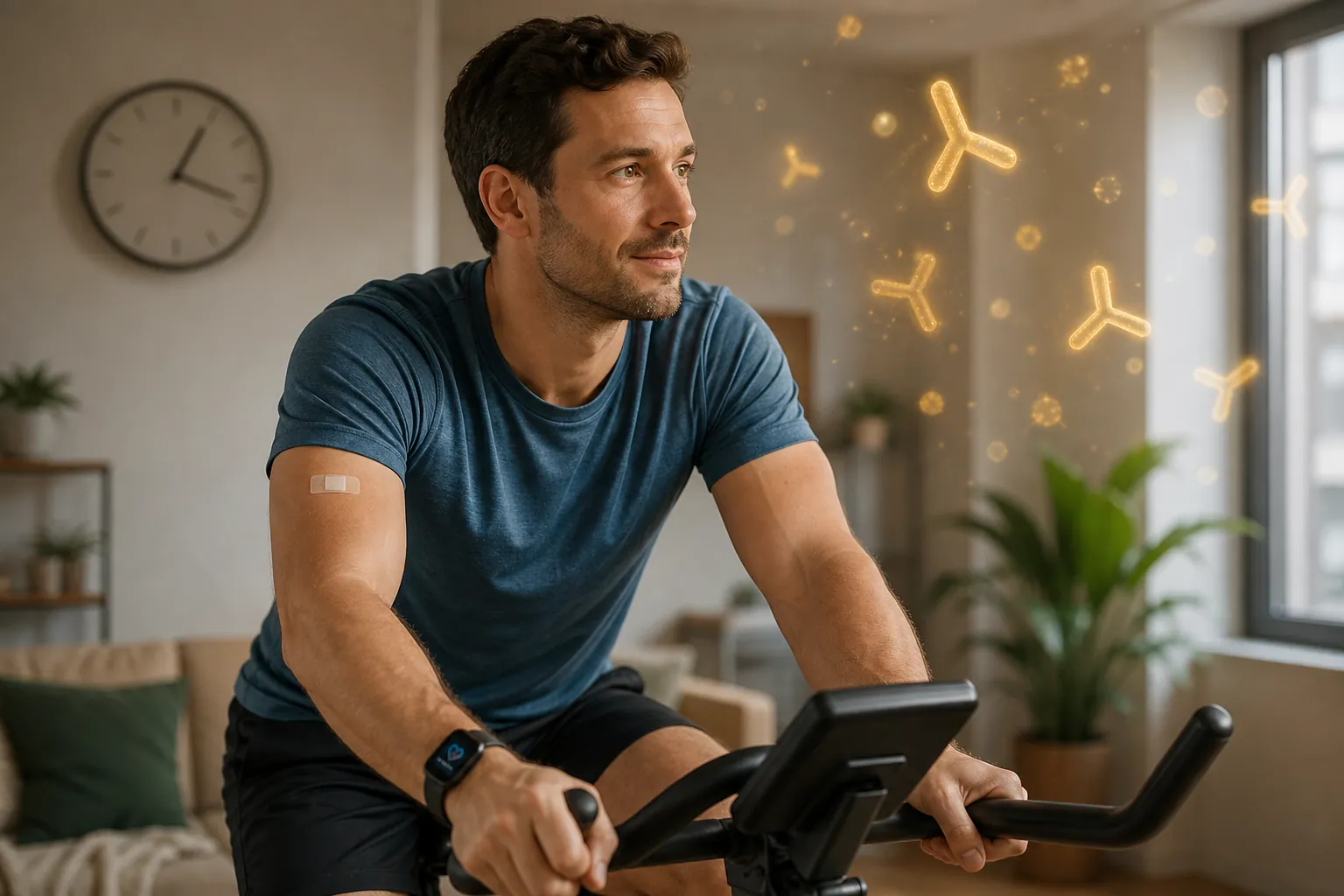
What the study actually asked people to do
The COVID-vaccine arm of the Hallam et al. trial analyzed 36 Pfizer-BioNTech vaccine participants after excluding eight people who may have had prior infection from the primary analysis. Participants were already regularly active, which is an important boundary if you are imagining this as advice for someone who has not exercised in months. [1]
After vaccination, exercisers used either a cycle ergometer or a brisk walk/jog approach. The target was practical rather than heroic: heart rate roughly 120–140 bpm, with perceived exertion described around “light” to “somewhat hard.” In the 90-minute condition, participants covered roughly 4 to more than 10 miles, which also tells you that this was not one exact speed or one exact fitness level. Nearly half of the COVID-vaccine participants had overweight or obese BMI, so the protocol was not limited to lean endurance athletes. [1]
Side effects did not increase in the exercise group compared with the no-exercise group. That is useful, because the practical question on vaccine day is often less glamorous than “immune optimization.” It is: if I ride the bike after this shot, am I making tomorrow worse? In this study, the answer was no measurable increase in side effects. [1]
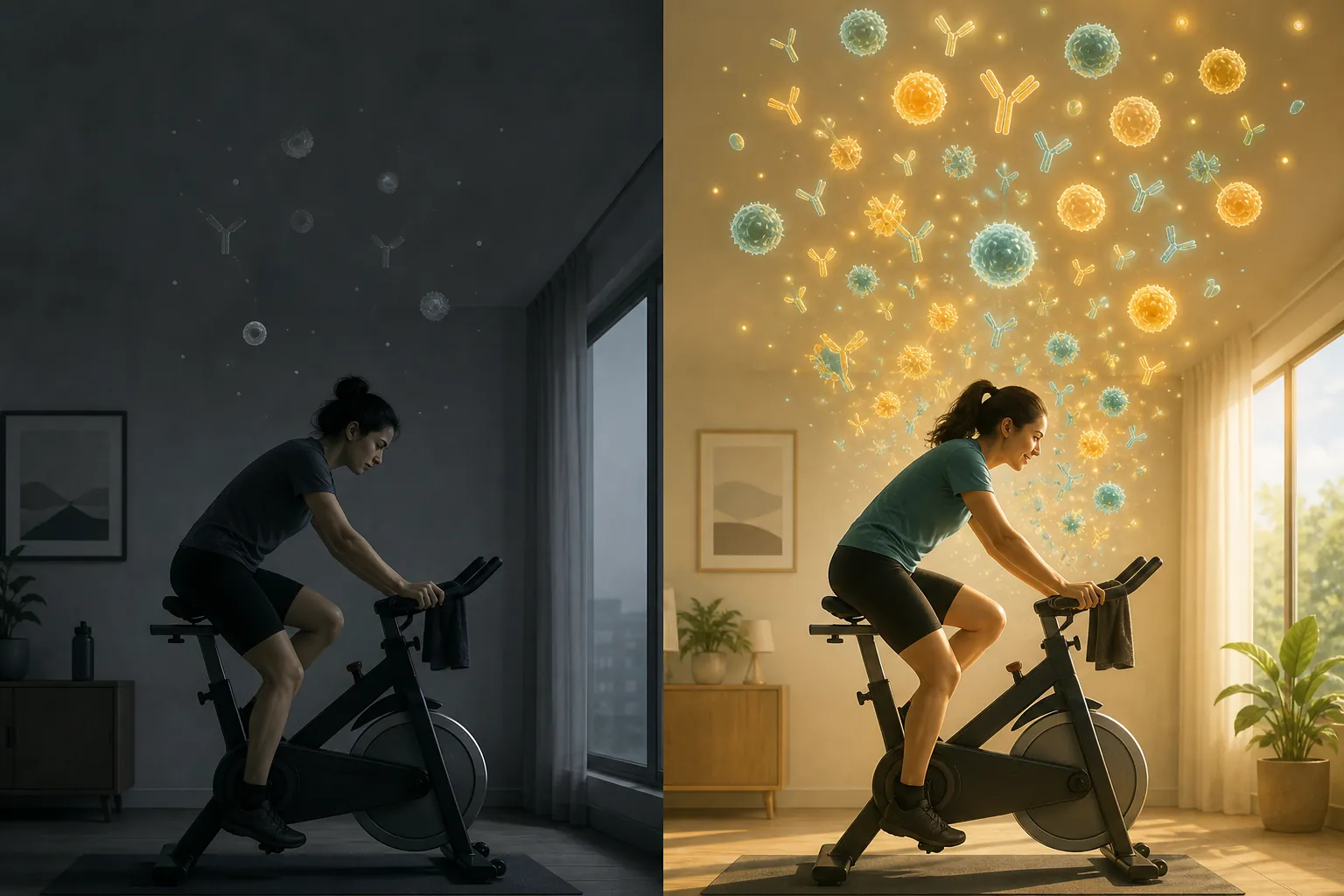
The Iowa State University release on the same research put the plain-language point this way: 90 minutes of mild-to-moderate exercise after a COVID or influenza vaccine increased antibodies several weeks later, while shorter exercise did not. The release also noted that two influenza-vaccine experiments in the project replicated the antibody effect, which makes the result more interesting than a one-off COVID-only observation, though it still does not turn the protocol into universal medical advice. [2]
Why 90 minutes might matter, without pretending the mechanism is settled
The proposed explanation is plausible and still provisional. The authors suggested that a longer bout of aerobic movement may increase blood and lymph circulation, moving immune cells through the body at a moment when the vaccine is presenting its stimulus. In the mouse model included in the paper, interferon-alpha appeared to play a role in the exercise-related antibody effect. That does not prove the exact pathway in humans after a COVID shot; it gives researchers a mechanism worth testing. [1]
This is where the result is genuinely useful for a home exerciser. The study did not ask people to crush themselves. It asked them to keep moving long enough, at a tolerable aerobic effort, soon after vaccination. If a session requires grit, nausea bargaining, or a dramatic playlist, it has already drifted away from what was studied.
A realistic home version of the 90-minute session
For a home setup, the cleanest translation is: start within about 30 minutes of the shot if you feel well, choose an aerobic mode you can sustain comfortably, keep the effort light to moderate, and stop treating this like a performance workout. The session should feel almost boring for the first half. That is a feature, not a flaw.
| Home option | How to keep it close to the studied effort | What to avoid |
|---|---|---|
| Stationary bike | Low-to-moderate resistance, steady cadence, heart rate roughly in the 120–140 bpm neighborhood if that range is appropriate for you. | Intervals, hill simulations, standing climbs, or chasing watts. |
| Walking outdoors | Brisk but conversational walking; add gentle pace before adding hills. | Turning it into a run if running pushes effort hard. |
| Walking pad | Flat or very low incline, speed that lets you breathe through full sentences. | Max incline, weighted vest, or trying to set a step-count record. |
| Rower | Low damper or easy resistance, relaxed stroke rate, smooth breathing. | Power strokes, sprint pieces, or testing a 2K pace. |
| Low-impact bodyweight circuit | Only if it behaves like steady cardio: marching, step-touches, easy shadow boxing, gentle mobility between blocks. | Burpees, jump squats, mountain-climber races, or anything that spikes effort. |
If your home cardio choice is constrained by apartment space, noise, equipment, or schedule, use a constraint-first setup rather than forcing the bike or the walk to be perfect. A cardio-at-home decision framework is more useful here than a motivational plan, because the studied session depends on sustainability. The best mode is the one that lets you stay easy for 90 minutes without turning your living room into an obstacle course.
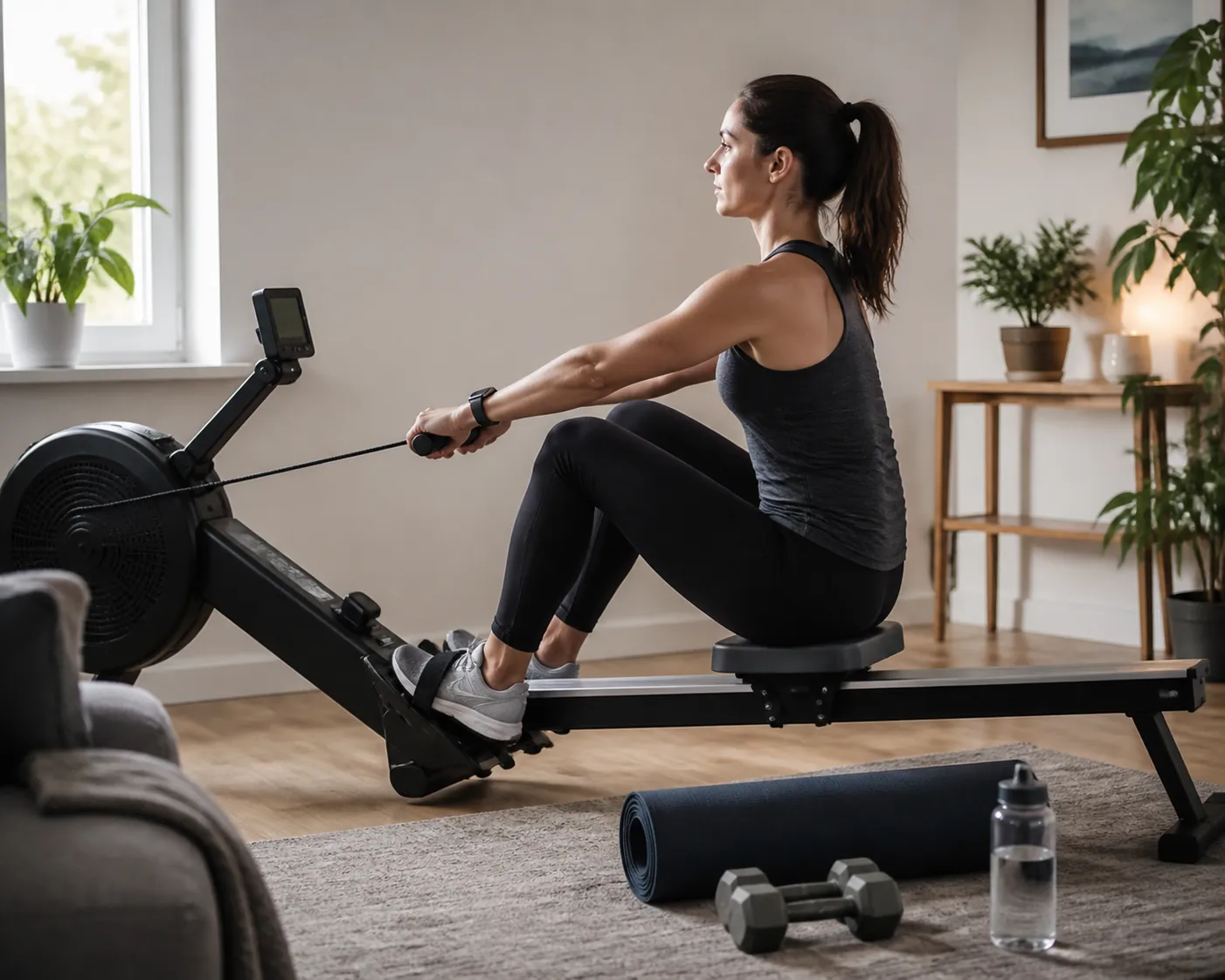
Walking deserves special treatment because it is close to one of the studied modes and it scales down well. A walking pad can make the vaccine-day version simple: set the speed low enough that you can talk, split attention with a low-stakes show or podcast, and resist the temptation to add incline just because the session feels too easy. If you already use a walking-pad plan, this is the day to borrow its easiest steady-walk setting, not its progression logic.
Use heart rate as a guardrail, not a dare
The study’s heart-rate target was about 120–140 bpm. For some people, that feels like a comfortable brisk walk or easy spin. For others, especially depending on age, medication, fitness, heat, sleep, anxiety, or dehydration, that range may be too high or not very informative. The number is a description of the studied protocol, not a universal command. [1]
A practical home check is to combine three signals: your watch, your breathing, and your ability to continue. If the watch says you are in range but you cannot speak in full sentences, back off. If the effort feels jumpy or competitive, back off. If you are bored but comfortable, you are probably much closer to the intended session than if you are proud of how hard you are pushing.
Do not swap in a high-intensity shortcut
A short hard workout is not the same intervention as a long easy one. The 45-minute condition did not show the measurable antibody increase, and the study did not test whether a harder 20-minute session would do better. [1] So this is not the moment to replace 90 minutes of easy cycling with a 7-minute high-intensity circuit and call it equivalent. That kind of workout can have its own place; right after a vaccine shot is not where this antibody finding puts it.
A simple vaccine-day decision rule
The useful question is not “Can I exercise?” in the abstract. It is “Do I feel well enough for easy movement today?” If the answer is yes, the 90-minute light-to-moderate aerobic session is a reasonable option for an already-active person. If the answer is no, rest is not a failure of discipline; it is the better plan.
- Green light: your arm is a little sore, you feel basically normal, you can hydrate, and you can keep the session genuinely easy.
- Yellow light: you are tired, under-slept, stressed, or unsure. Consider an easier and shorter walk, then stop if symptoms build. This is not the studied antibody protocol, but it may be a sensible movement choice.
- Red light: you feel feverish, genuinely sick, unusually fatigued, dizzy, lightheaded, short of breath, or otherwise unwell. Skip the workout and rest.
People with medical conditions, a history of concerning vaccine reactions, heart or blood-pressure issues, pregnancy-related concerns, or instructions from a clinician should follow their healthcare provider’s guidance rather than a general home-training article. The same applies if symptoms after vaccination feel severe, unusual, or worrying.
This is the same recovery logic that applies to home rehab decisions: the exercise only earns its place if the body is giving you usable feedback and the plan respects it. If you are sorting out a more complicated pain, injury, or return-to-training situation, an evidence-anchored home rehab framework is a better fit than trying to fold that problem into vaccine-day cardio.
How much confidence to put in this
The result is promising because the protocol is concrete and the side-effect finding is reassuring. It is limited because the COVID-vaccine sample was small, participants were already active, and the outcome was serum antibody level four weeks later rather than confirmed protection from infection. The study also used the vaccine context available at the time; applying the same expectation to later booster formulations is a reasonable question, not a directly proven result from this paper. [1]
Mainstream medical communicators have continued to discuss physical activity around vaccination as potentially useful. A UCLA Health article in January 2024 summarized the idea that physical activity can increase antibodies after vaccines, while still treating it as part of a larger health picture rather than a replacement for vaccination or routine care. [3]
The broader evidence base is still stronger for regular physical activity than for one acute post-shot session. Valenzuela and colleagues argued in 2021 that exercise may be a useful strategy around vaccination, but the acute-exercise question remained preliminary compared with the more established relationship between regular exercise and immune health. [4]
So the cleanest judgment is narrow: if you already exercise and feel well after your COVID shot, a single 90-minute easy-to-moderate aerobic session started soon afterward is an evidence-anchored option. It is a bonus layered on top of the vaccine and your normal training habits. It is not a substitute for either, and it is not a reason to push through a body that is clearly asking to lie down.
References
- The effects of exercise on vaccine-induced antibody responses: A randomized controlled trial. Brain, Behavior, and Immunity. 2022.
- Exercise post-vaccine bumps up antibodies, new study finds. Iowa State University.
- Physical activity can increase antibodies after vaccines. UCLA Health. January 2024.
- Exercise, vaccines, and COVID-19: Should we exercise before or after vaccination?. 2021.
This is general fitness education, not medical advice. For diagnosis or treatment of pain or injury, consult a qualified clinician.
Pick your next session
A 4-Week Home Workout Plan for Busy Parents (No Gym Required)
This structured four-week progressive workout plan is built for parents with limited time and no gym equipment. Each 15–25 minute full-body session fits around family life and builds consistency before intensity.
Spot something off?
This content sits adjacent to health guidance — tell us if a citation or figure needs a correction.