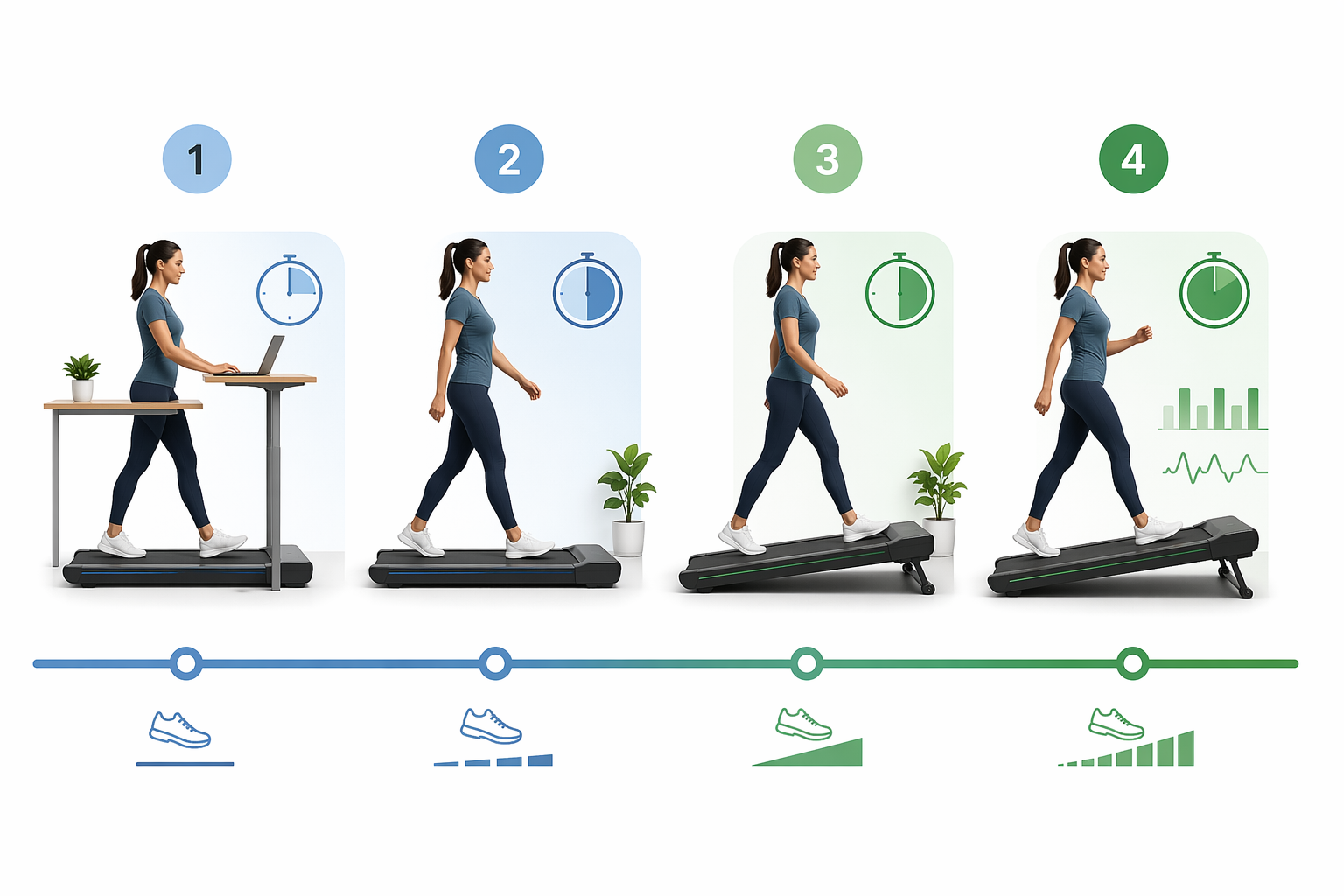
A walking pad workout plan for weight loss should not start with “walk harder.” It should start with a schedule you can repeat when you have calls, childcare, sore calves, a small apartment, and a laptop waiting for you. For most beginners, the winning progression is simple: build from 15-minute flat walks in Week 1 to 40–50-minute sessions with controlled incline intervals by Week 4.
The realistic calorie contribution is also smaller than many walking-pad ads imply. A walking-pad-specific meta-analysis of 13 studies with 351 participants found that walking pad use increased energy expenditure by 105.23 kcal per hour over sitting, with a 95% confidence interval of 90.41–120.04 kcal per hour.[1] That is useful. It is not magic. It means a 15-minute session may add roughly 26–40 kcal over sitting, while a longer Week 4 session with incline may add about 120–175 kcal over sitting, depending on body size, speed, incline, and machine quality.
That is why this plan uses duration first, incline later. The first two weeks are there to make walking feel normal enough that you keep doing it. The last two weeks raise the metabolic cost without turning the walking pad into a punishment machine.
What Weight Loss From a Walking Pad Can Realistically Look Like
The cleanest way to think about walking-pad calories is “extra burn over sitting,” not total calories on a console. If you were going to sit at a desk for 30 minutes and instead walk gently, the walking pad has added movement to a slot that was otherwise almost motionless. That is its main advantage.
This matters because some of the most repeated walking-desk claims come from modeled projections, not real-world weight-loss trials. Levine and Miller’s well-known Mayo Clinic study measured energy expenditure in 15 participants and found that sitting averaged 72 kcal per hour while walking at a workstation averaged 191 kcal per hour; the often-cited 20 kg per year weight-loss figure was a projection based on that energy gap, not an observed year-long result.[2]
The real-world check is less dramatic. In a 12-week workplace walking-pad intervention, Schuna and colleagues found changes in activity patterns but no statistically significant body-weight change.[3] That does not make walking pads useless. It means people often compensate: they snack more, move less later, reduce intensity without noticing, or stop using the pad once novelty fades.
For weight loss, the walking pad works best as one part of a boring, repeatable deficit. A reasonable target is a 300–500 kcal daily deficit from a mix of walking, food awareness, and other activity. The walking pad can contribute a measurable slice of that. It should not be expected to carry the whole job while food intake quietly rises.
The 4-Week Walking Pad Workout Plan
Use this plan five days per week. Keep two non-walking-pad days for normal steps, mobility, easy outdoor walking, or a beginner-friendly cardio option such as a no-equipment Zone 2 routine. If you are brand new to regular exercise, keep the first week almost embarrassingly easy. That is not wasted time; it is how you find the speed, shoes, desk setup, and recovery rhythm you can actually repeat.
| Week | Main Target | Sessions | Speed and Incline | Estimated Extra Calories Over Sitting |
|---|---|---|---|---|
| Week 1 | Habit foundation | 15 min/day, 5 days | 2–3 km/h, flat | ~26–40 kcal/session |
| Week 2 | Duration build | 25–30 min/day, 5 days | 3–4 km/h, mostly flat; optional 1–2% incline blocks | ~52–80 kcal/session |
| Week 3 | Incline introduction | 35–40 min/day, 5 days | 3–4.5 km/h with 3–5% incline intervals | ~90–130 kcal/session |
| Week 4 | Longer steady work plus incline intervals | 40–50 min/day, 5 days | Alternate flat steady-state days with 5–8% incline blocks | ~120–175 kcal/session |
Week 1: Habit Foundation
Walk 15 minutes per day, five days this week, at 2–3 km/h on a flat setting. If your walking pad uses mph, that is roughly a slow under-desk pace. The goal is not to sweat through a shirt. The goal is to finish each session thinking, “I can do this again tomorrow.”
- Warm-up: 3 minutes very easy, using the side rails only if needed for balance.
- Main walk: 10 minutes at a pace where you can type lightly, read, or take a low-stakes call.
- Cool-down: 2 minutes slower than your main pace, then step off before stretching.
- Expected feeling: warmer, more alert, slightly looser through the hips and calves, not drained.
- Calorie context: about 26–40 extra kcal per session over sitting, based on the walking-pad energy-expenditure baseline.[1]
If productivity drops, slow down before you shorten the session. Walking while working has a real speed ceiling. Typing accuracy tends to degrade above about 1.4–1.5 mph, so deep writing, spreadsheet work, and precise mouse use belong at the slower end of the range.[4][5] Save faster walking for a dedicated session when the laptop is closed.

Week 2: Duration Build
Walk 25–30 minutes per day, five days this week. Keep most sessions flat at 3–4 km/h. If your walking pad has incline and your knees, calves, and low back felt fine in Week 1, add one or two 5-minute blocks at 1–2% incline on two of the five days.
| Day | Session |
|---|---|
| Day 1 | 25 min flat, easy pace |
| Day 2 | 25 min flat; optional 5 min at 1–2% incline |
| Day 3 | 30 min flat, comfortable pace |
| Day 4 | 25 min flat; optional 5 min at 1–2% incline |
| Day 5 | 30 min flat, easy enough to finish fresh |
Use the same 3-minute warm-up and 2-minute cool-down structure. The middle of the walk should feel steady, not urgent. If you notice your shoulders creeping up, your typing becoming messy, or your stride getting loud and choppy, lower the speed. A walking pad session done at a repeatable pace beats a heroic session that makes tomorrow’s walk negotiable.
The calorie estimate for Week 2 is roughly 52–80 extra kcal per session over sitting. The lower end fits smaller bodies, slower speeds, and flat walking. The higher end fits longer sessions, heavier bodies, and modest incline. Treat the number as a contribution to the day, not as permission to ignore intake.
Week 3: Incline Introduction
Week 3 is where the plan starts to feel more like training. Walk 35–40 minutes per day, five days this week, at 3–4.5 km/h. On three of the five days, add incline intervals: 3 minutes at 3–5% incline, then 3 minutes flat recovery. Repeat that pattern three to five times depending on session length.
| Day | Session |
|---|---|
| Day 1 | 35 min flat, steady |
| Day 2 | 35 min with 3 min incline / 3 min flat recovery intervals |
| Day 3 | 35–40 min flat, easy-to-moderate |
| Day 4 | 35 min with 3 min incline / 3 min flat recovery intervals |
| Day 5 | 40 min with controlled incline intervals, only if joints feel good |
Incline earns its place here because it increases metabolic cost without requiring you to jog on a compact machine. General incline-walking estimates suggest each 1% incline adds about 12% more calories burned; 5% incline raises metabolic cost by about 52%, and 10% incline can roughly double calorie burn.[6][7] Those figures are not walking-pad-specific trials, so do not treat your console readout as a lab measurement. Still, the direction is useful: incline makes walking more expensive.
It also changes where you feel the work. Incline walking asks more from the glutes, hamstrings, calves, and postural muscles than flat walking while remaining a lower-impact option than running.[8] That is helpful if you introduce it gradually. It is not helpful if you jump to a steep setting on day one, grip the desk, and limp into the next morning.
Week 3 sessions add roughly 90–130 extra kcal over sitting. If your appetite noticeably increases this week, pay attention. A small extra snack can erase the walking-pad contribution quickly. You do not need aggressive dieting, but you do need enough awareness to know whether walking is creating a deficit or just making room for compensation.
Week 4: Longer Sessions With Incline Intervals
Week 4 alternates flat steady-state days with incline interval days. Walk 40–50 minutes per day, five days this week. Keep work sessions slow if you are typing. Put the harder sessions in a separate block: before work, after work, during a lunch break, or while watching something that does not require precise attention.
| Day | Session |
|---|---|
| Day 1 | 40 min flat steady-state at a comfortable pace |
| Day 2 | 45 min with 4 min at 5–8% incline / 4 min flat recovery |
| Day 3 | 40–45 min flat, easy-to-moderate |
| Day 4 | 45 min with 4 min at 5–8% incline / 4 min flat recovery |
| Day 5 | 45–50 min choice session: flat steady if tired, incline intervals if fresh |
Warm up for 5 minutes this week, especially before incline days. Start flat and slow, then bring the speed up gradually. Cool down for 3–5 minutes at the end. If your calves feel tight, your stride shortens sharply, or your knees start talking back, reduce incline before you reduce total weekly consistency. A flatter session you can repeat is more useful than a steep one that forces two days off.
The Week 4 estimate is about 120–175 extra kcal per session over sitting. Across five sessions, that is a meaningful weekly contribution. It is still not enough to guarantee scale movement if food intake rises at the same time, which is why the most honest version of this plan pairs walking with a basic intake check: protein at meals, fewer liquid calories, and enough tracking to know whether your average intake is drifting upward.
How to Adjust the Plan Without Breaking It
The plan works because the pieces are in the right order: adherence, duration, then incline. Adjust the details around your equipment and your day, but keep that order intact.
If Your Walking Pad Has No Incline
Follow Weeks 1 and 2 as written. In Weeks 3 and 4, replace incline intervals with either slightly faster flat intervals or longer steady sessions. For example, use 3 minutes brisk / 3 minutes easy instead of 3 minutes incline / 3 minutes flat. Keep the brisk pace smooth enough that you are not landing heavily on a narrow belt.
If you bought a no-incline pad for desk use, that may still be the right tool. If you now want more structured training, compare the trade-offs in walking pads versus full treadmills for home walking before assuming you need to replace anything.
If Work Quality Suffers
Split your walking into two types. Under-desk walking is for easy movement at about 1.0–2.0 mph, especially during reading, webinars, casual calls, or admin work. Workout walking is for 3–4 mph efforts, incline, and anything that makes typing clumsy. Trying to turn every work block into a workout is one of the fastest ways to stop using the pad altogether.
For people using the pad mainly to raise daily steps, a separate step-focused setup may help. The guide to reaching 7,000–10,000 steps a day with a treadmill desk is a better next step than forcing incline into the middle of focused work.
If Your Knees, Calves, or Feet Flare Up
First, remove incline. Second, shorten the session by 10–15 minutes for a few days. Third, check whether your stride is too long for the belt. Compact walking pads can encourage a stiff, cautious gait; that is fine for gentle desk walking, but it becomes a problem when you add speed and incline.
A short mobility routine can also make the plan easier to tolerate, especially for desk workers whose hips and calves are already stiff before they step onto the belt. Use a desk-worker mobility routine before longer sessions or after incline days.
If Your Machine Struggles
Not every walking pad is built for 45 minutes at higher speeds, and not every budget model holds speed smoothly as sessions get longer. If the belt hesitates, the motor smells hot, or the deck feels unstable, do not force Week 4 as written. Use shorter flat sessions, split the workout into two blocks, or keep incline work for equipment designed for it.
If you are still choosing equipment, start with the actual constraint: small-space desk walking, incline training, or a broader home-cardio setup. These comparisons can help: mini stepper versus walking pad, under-desk walking pads for small apartments, and home treadmills for walking.
Where This Plan Fits With Cardio and Strength
A walking pad is excellent at removing friction from low-level movement. It is less convincing as a complete fitness program. Walking pads often operate well under 50% of maximum heart rate, below the threshold usually needed for cardiorespiratory adaptation, so they do not fully replace structured cardio or strength training.[9]
That does not make the plan too easy. It clarifies the job. The walking pad helps you stop being sedentary for long blocks, adds a predictable calorie burn, and builds tolerance for regular movement. If you want better aerobic fitness, add dedicated Zone 2 work. If you want body composition changes beyond scale weight, add strength training. If you want weight loss, keep the food side honest enough that the walking actually creates a deficit.
After Four Weeks
After four weeks, do not judge the plan only by whether the scale made a dramatic move. A more realistic win is that you now have five repeatable weekly sessions, a better sense of which speeds work during desk time, and a weekly calorie contribution that can support a 300–500 kcal daily deficit if intake is not rising to match it.
From here, choose one next move. Repeat Week 4 if it still feels challenging. Add 5 minutes to one or two weekly sessions if recovery is good. Add structured cardio or strength if fitness is now the bigger goal. If body weight has not changed at all after several consistent weeks, reassess nutrition before blaming the walking pad.
References
- The effects of active workstation use on measures of cognition, attention and motor skill: A systematic review and meta-analysis. PMC. 2021.
- The energy expenditure of using a “walk-and-work” desk for office workers with obesity. PMC. 2007.
- Evaluation of a workplace treadmill desk intervention: a randomized controlled trial. PubMed. 2014.
- Walking on a treadmill desk affects typing performance and cognitive function. PMC. 2012.
- The effects of walking while working on productivity and cognition. SAGE Journals. 2015.
- Incline Walking: Benefits, Muscles Worked, and How to Start. Verywell Health. 2026.
- What’s a Good Incline To Walk on a Treadmill To Lose Weight?. NordicTrack.
- Are Walking Pads Good for You?. Cleveland Clinic.
- Walking Pad Research: What Science Says About Under-Desk Treadmills. FitCraft.
Comments
Join the discussion with an anonymous comment.