The mini stepper vs walking pad decision starts before you compare motors, handles, or price tags. It starts with one question: are you trying to replace a workout, or are you trying to stop sitting through the whole workday?
If you want a compact machine for a short, sweaty session between meetings, the mini stepper has the cleaner role. If you want to keep answering email, sitting in calls, and editing documents while adding low-level movement, the walking pad is the more realistic tool. The calorie numbers make that split sharper, not simpler: Merach cites Harvard Health figures showing a 155-pound person burning about 260 calories in 30 minutes on a stair stepper, compared with about 150 calories in 30 minutes walking at 3.5 mph.[1] Per minute, that gives the mini stepper roughly a 1.7-times advantage.
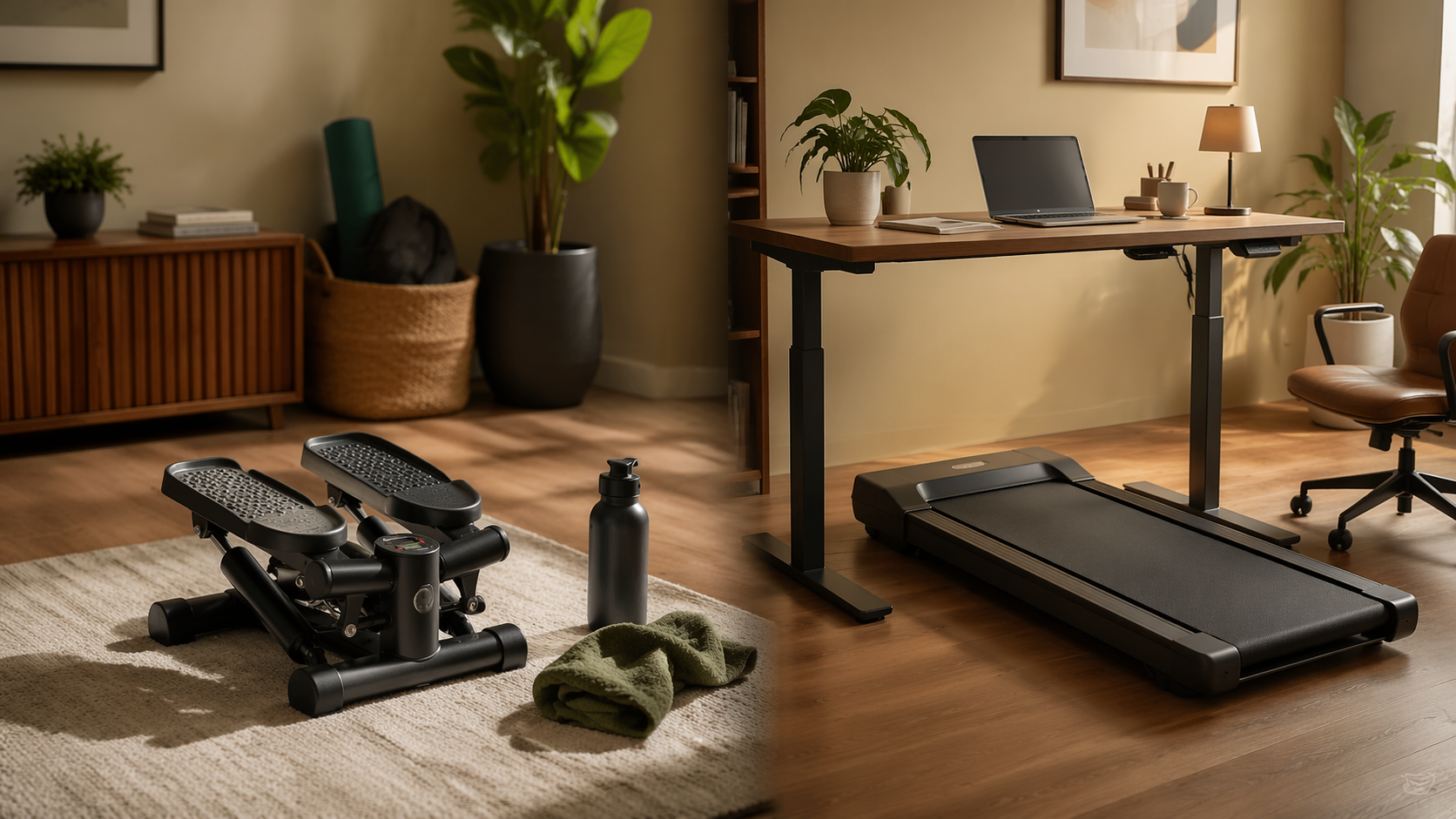
That advantage matters. It just does not answer the whole question. A walking pad may burn less per minute, but Daily Burn cites research finding that walking while working can add about 105 calories per hour over sitting; stretched across 2 to 4 hours, that becomes a meaningful daily movement change rather than a formal workout slot.[2] A mini stepper can win a 20- or 30-minute window. A walking pad can win the parts of the day that were otherwise going to be completely still.
The Quick Decision Rule
| Your real goal | Better starting choice | Why |
|---|---|---|
| Move during work | Walking pad | It supports low-intensity movement during calls, email, reading, and light typing once you adapt. |
| Replace a missed cardio session | Mini stepper | It delivers higher per-minute effort in a smaller dedicated workout window. |
| Spend as little floor space as possible | Mini stepper | It is easier to store and does not require a full walking lane behind the desk. |
| Build a whole home-office movement habit | Walking pad | It changes the sitting pattern instead of asking for another separate workout appointment. |
| Want both eventually | Walking pad first | It is more versatile for workday use; add the stepper later if you still want higher-intensity bursts. |
That is the useful split. A mini stepper is not a tiny walking pad. A walking pad is not a lazy stepper. They ask for different attention, different posture, and different kinds of time.
Calories: Intensity Versus Accumulation
The calorie comparison is tempting because it looks like a scoreboard. Stepper: higher. Walking pad: lower. But the practical question is not only how many calories the machine burns when you are on it. It is whether you will actually use it at the time of day you imagine.
A mini stepper’s advantage comes from a higher-effort movement pattern. You are repeatedly pushing down through the pedals, usually with enough resistance to raise your breathing faster than a slow under-desk walk. In a dedicated half-hour, that is exactly what many people want. The same intensity is also why it does not disappear neatly into the background of a work block.
A walking pad’s lower burn rate can still matter because it attaches to time you already spend at a desk. If walking while working adds about 105 calories per hour over sitting, a 2-hour walking block adds roughly 210 calories, and a 4-hour walking block adds roughly 420 calories.[2] Those are not lab-certified promises for every body, speed, desk setup, or workday. They are a useful way to see the trade-off: the walking pad wins only if it is actually used for longer stretches.
So the better calorie question is this: do you reliably have 30 minutes where you can stop working and exercise, or do you have several hours when your body could be doing more than sitting?
Work Compatibility Is Where the Comparison Gets Uneven
Walking pads are not effortless productivity machines on day one. Daily Burn cites research suggesting it can take 3 to 7 days for typing speed to normalize while walking at a desk.[2] That detail matters because it is more honest than the usual stock-photo fantasy: laptop open, person smiling, no missed keys, no weird shoulder tension, no meeting where the microphone picks up belt noise.
The first week is usually the sorting period. Reading, webinars, casual internal calls, inbox cleanup, and light admin work tend to fit better than dense writing, spreadsheet review, design work, or anything that requires rapid mouse control. Some people settle into a slow walking speed and keep it there. Others use the walking pad only for meetings where they are mostly listening.
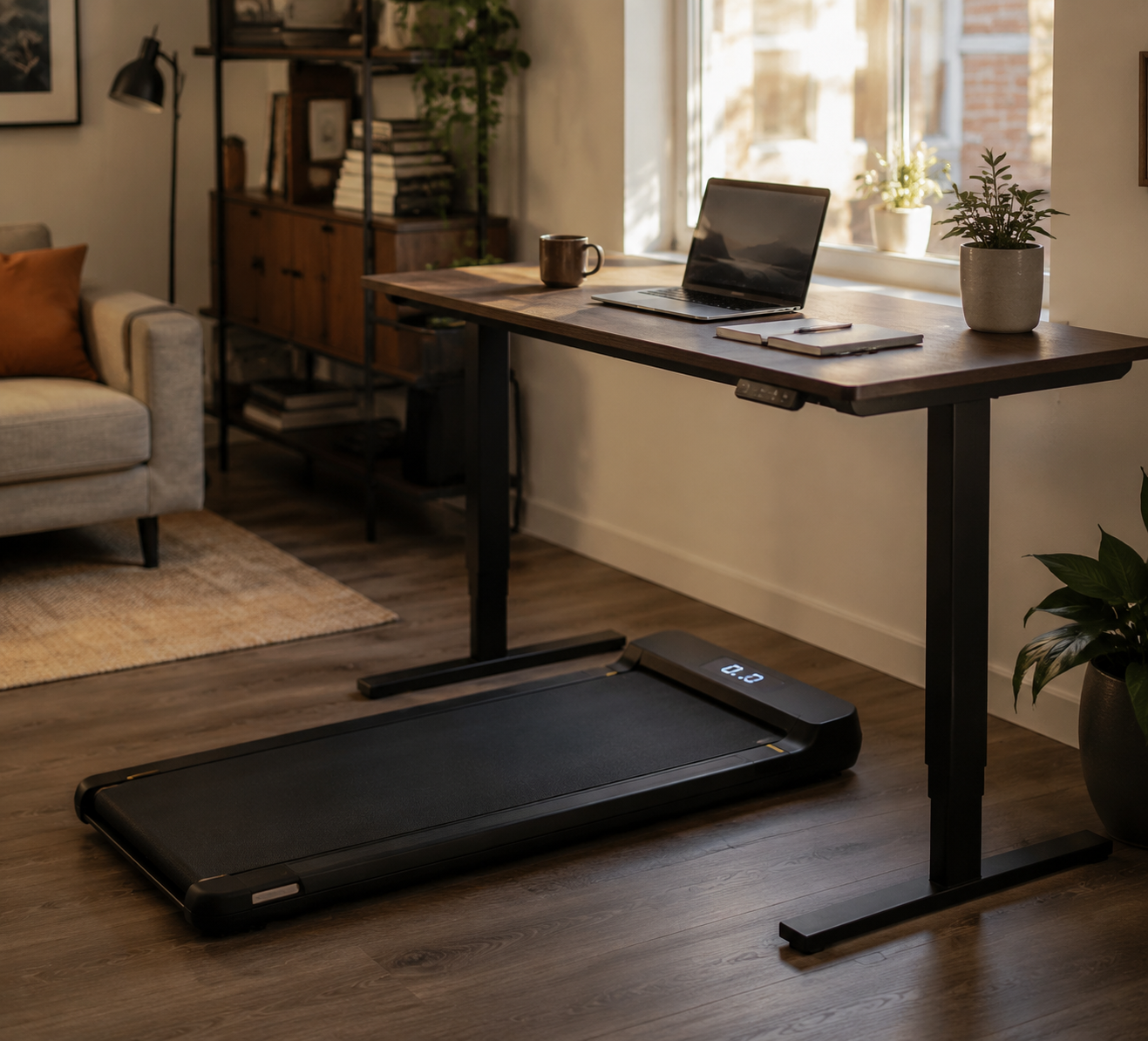
The mini stepper has a much harder time making that bargain. Even if the footprint is perfect for an apartment, the movement is too vertical and too effortful for normal desk work. Your head bobs. Your hands want balance. Your breathing changes. A short stepper session between calls can be useful; trying to write a careful client email while stepping is more stunt than system.
That does not make the walking pad automatically better. It makes it better for a specific problem: sedentary desk time. If your calendar already has clean workout breaks, or if your work requires deep concentration for most of the day, the mini stepper may fit your life with less friction.
The Mini Stepper Is a Workout Tool, Not a Secret Glute Machine
Mini steppers have become easy to oversell because they look intense in short videos. The effort is real. The glute-building claims need more restraint.
CNN reported physical therapist Tom Hendrickx’s point that mini steppers typically move the hip through only about 15 to 30 degrees of flexion, while full glute activation is closer to 90 degrees.[3] That does not mean your glutes do nothing. It means a mini stepper should not be marketed as a substitute for deeper hip-extension work, squats, lunges, step-ups, or strength training.
Where the mini stepper does make sense is as a compact cardio prompt. It is small enough to leave near the desk, easy to start without shoes-and-keys ceremony, and intense enough that 10 to 20 minutes can feel like exercise rather than fidgeting. For someone whose good intentions consistently evaporate by 6 p.m., that convenience is not trivial.
The caution is knee comfort. The stepper keeps you in repeated knee flexion, and that can be irritating if your knees already dislike stairs or deep bending. A walking pad’s cushioned belt is usually the gentler option for low-intensity movement, though neither machine should be treated as medical advice for a painful joint.
Walking Pads Are Better at Changing the Day
The walking pad’s best argument is not that it is a thrilling workout. It is that it gives idle desk hours somewhere to go. A slow walk during a status meeting will not feel like cardio training, but it changes the baseline of the day in a way a stepper usually cannot.
That is why a walking pad belongs in a different category from a mini stepper. It is closer to a workday environment change than a standalone exercise machine. If you are already deciding between compact treadmill formats, the more relevant comparison may be how walking pads compare with full treadmills for walking at home, because the trade-off shifts toward motor size, deck length, handrails, and long-session comfort.
For remote workers, the biggest walking-pad mistake is buying as if motivation alone will solve the setup. You need a desk that reaches the right height, enough floor clearance to step on and off safely, a speed slow enough for your work, and permission to be slightly worse at typing for a few days. If that sounds annoying but manageable, the walking pad has room to become part of the workday. If it sounds like a constant interruption, it may become an expensive rug.
Safety and Durability Deserve More Attention Than the Display
Compact cardio gear has a budget-friendly glow until it starts behaving badly under daily use. This is especially true for walking pads, where a cheap machine is still a motorized belt under your feet.
Consumer Reports’ 2026 under-desk treadmill testing found several safety and reliability problems in budget walking pads, including belts that slammed to a stop when the safety key was pulled, speeds that did not match their displays, and belts that tore during 12-hour robot durability testing.[4] Those are not minor feature complaints. A belt that stops harshly can throw off balance; a display that misstates speed makes it harder to choose a safe pace; a torn belt turns a bargain into waste.
Wirecutter’s under-desk treadmill testing raises the same practical concern from a different angle: its Goplus walking pad belt frayed after weeks of regular use, and belt fraying was treated as normal wear and tear rather than a covered warranty issue.[5] That is the kind of detail product pages rarely lead with, but it matters if you plan to walk for hours rather than occasionally.
Mini steppers have fewer moving-belt concerns, but they are not maintenance-free magic. Pedal feel, resistance smoothness, frame stability, and noise can all change whether you actually use the machine. Wirecutter also notes that using a stepper for 2 hours per day, in 15-minute hourly intervals, could help an otherwise sedentary person lose about 40 pounds in a year.[6] That estimate is useful only with its condition attached: it assumes a very sedentary starting point and a large, consistent change in daily movement.
For apartment buyers, noise is another practical filter. A walking pad adds motor and belt sound; a stepper can add pedal squeak, hydraulic resistance noise, or floor vibration. If quiet matters more than calorie math, start with the broader quiet cardio guide for apartment dwellers before assuming either machine will be neighbor-proof.
Space, Storage, and Price: The Fast Version
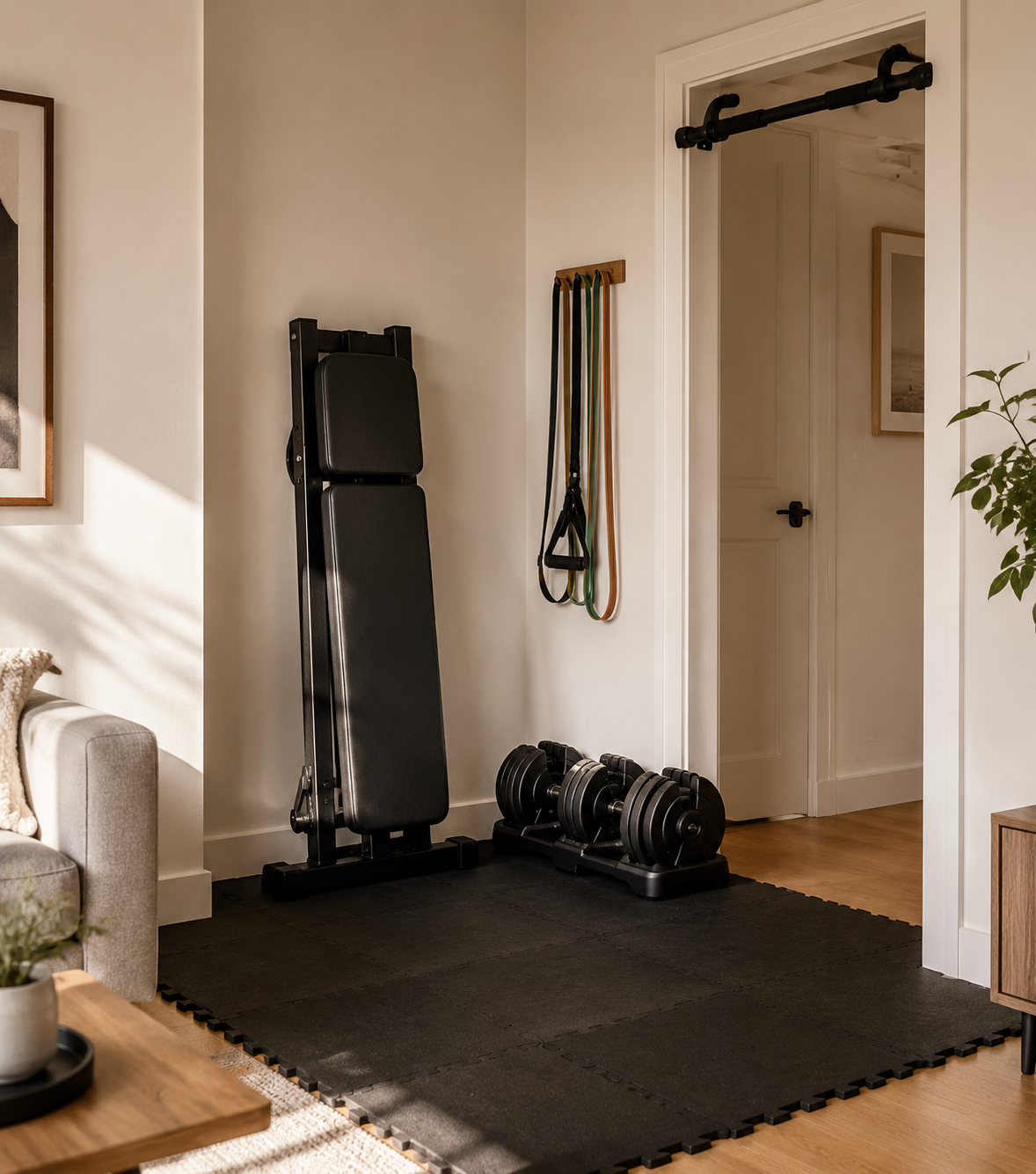
A mini stepper usually wins pure storage. It can tuck beside a bookshelf, under some desks, or into a closet without requiring a dedicated walking lane. That matters in a studio apartment or shared room where equipment must disappear after use.
A walking pad asks for more floor planning. Even slim models need enough length for your stride, clearance behind the desk, and a safe place to step off. If you are already interested in walking equipment but not sure which footprint fits, a guide to the three types of small treadmills for home is more useful than comparing dimensions in isolation.
Price can point either way depending on quality. Very cheap mini steppers are easier to find than very cheap walking pads worth trusting, but the cheapest version of either machine is not automatically the best budget decision. If the machine is loud, awkward, unstable, or fragile, the money saved at checkout gets paid back in nonuse.
Choose Based on the Part of Your Day You Actually Control
Choose the walking pad if the main problem is sitting through work. It is the better first purchase for remote workers who can walk during meetings, email, light admin, or reading blocks, and who are willing to give themselves a few days to adapt. After you have decided on the category, specific model testing matters; a curated list of the best home treadmills for walking can help narrow the field.
Choose the mini stepper if the main problem is missing a workout. It is smaller, simpler, and better suited to short dedicated cardio bursts. It is also the cleaner choice if your work cannot tolerate walking, your desk does not adjust well, or you know you prefer separating exercise from work.
If both sound appealing, buy the walking pad first for versatility. It can turn sitting time into movement time, and that is the harder pattern to recreate with other gear. Add the mini stepper later if you still want a compact higher-intensity option for short sessions, or if you are building out a broader budget home gym starter kit around limited space.
References
- Stepper vs Walking Pad: Complete Comparison — MERACH
- Walking Pads: Are Under-Desk Treadmills Worth It? — Daily Burn
- Can the viral mini steppers help you reach your cardio goals? What experts say — CNN, Jan 2025
- 5 Best Under-Desk Treadmills of 2026, Expert-Tested — Consumer Reports
- The 2 Best Under-Desk Treadmills of 2026 — Wirecutter
- The 2 Best Mini Stair Steppers of 2026 — Wirecutter

Comments
Join the discussion with an anonymous comment.