
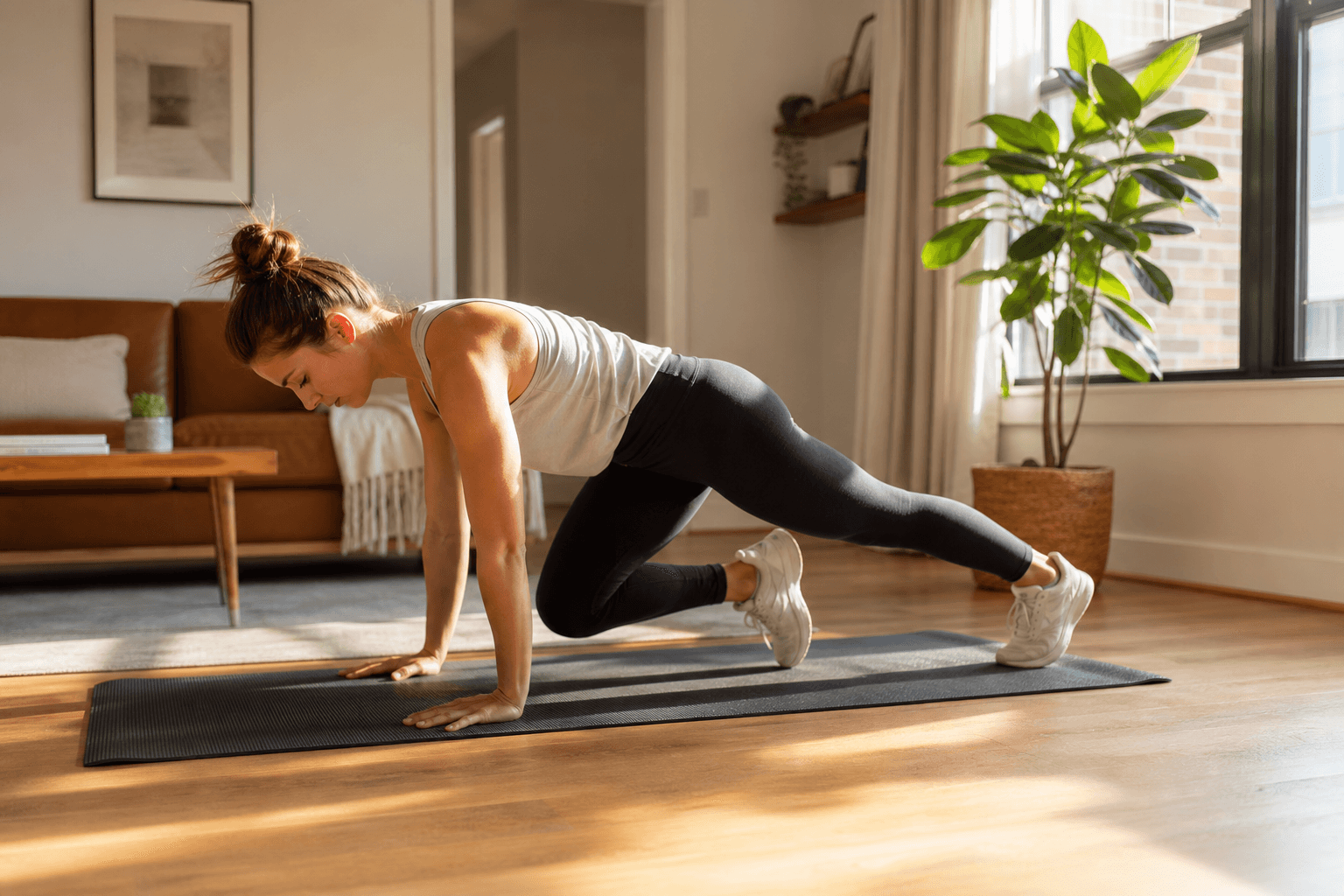
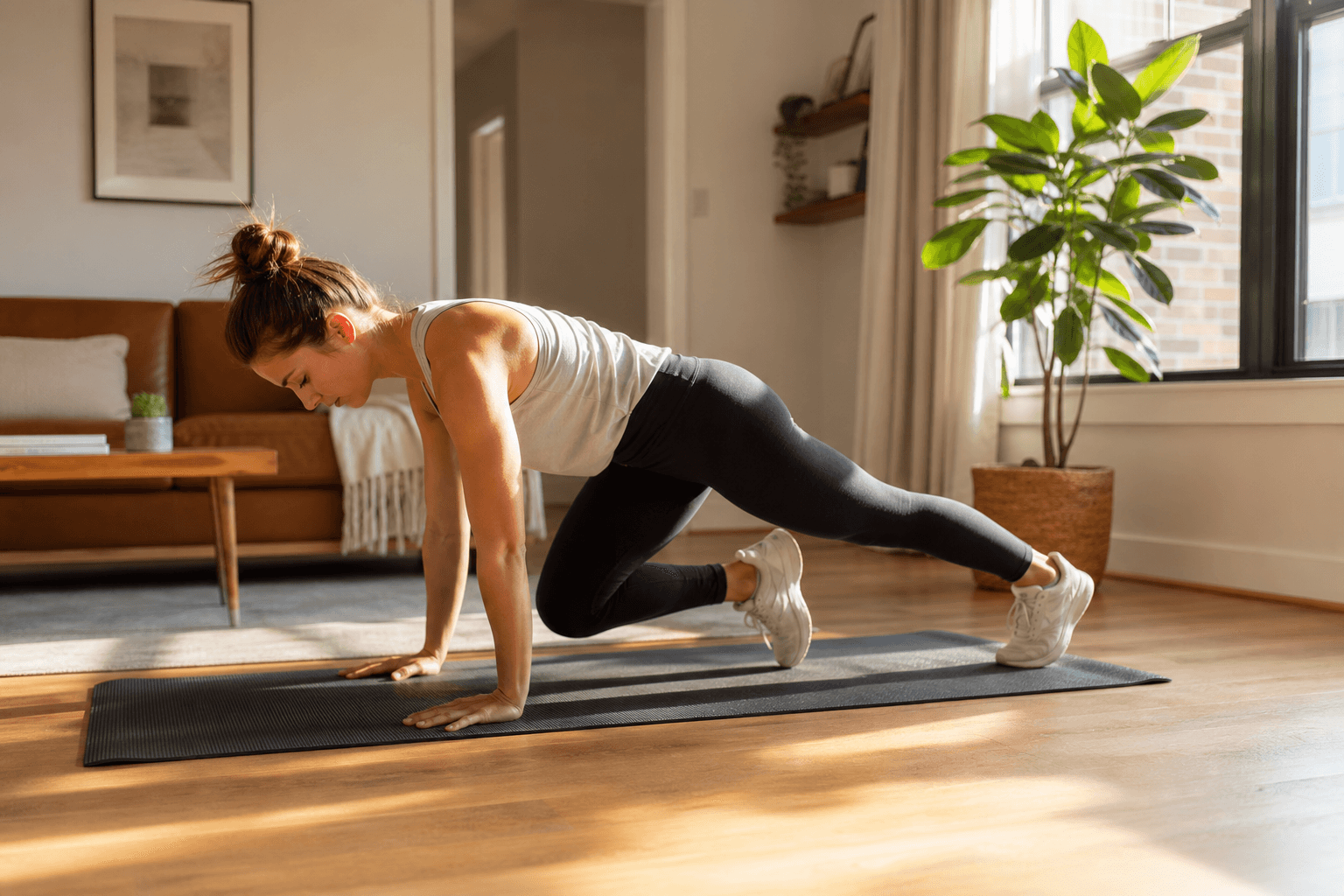
I’ve failed at home cardio twice. Not from lack of willpower — from noise. First time a downstairs neighbor tapped the ceiling with a broom handle during my second burpee. Second time I gave up before starting because I could already hear the thud of my own feet. The real barrier to doing cardio in an apartment isn’t motivation or equipment. It’s the fear of being heard.
Most home cardio advice ignores this. Generic lists of “low-impact exercises” assume swapping a jump for a step is enough. It’s not. The intensity drops, you feel like you’re wasting time, and you quit. I know because I fell for it twice. What actually works is a system that replaces impact with deliberate intensity control — tempo manipulation, precise work-to-rest ratios, and a library of moves that genuinely spike heart rate while staying silent.
What Generic Lists Get Wrong
Take the POPSUGAR collection of 17 quiet moves. It lists mountain climbers as “elevating heart rate,” but a casual pace barely hits zone 2. The real work happens when you push tempo — exactly what most articles skip. Without RPE targets, work-to-rest ratios, or how fast to go, the instruction is useless.
Jumping delivers a heart rate spike because it demands rapid, forceful contraction from large muscle groups. The same effect can be achieved without leaving the ground by manipulating speed and tension. Instead of using impact to force your heart to work, you use acceleration and holding positions. The Harvard HIIT meta-analysis found bodyweight HIIT programs produce similar body composition improvements as moderate-intensity continuous training in 40% less time — but only if you actually hit high intensity. You can do that with tempo alone.
Here’s what that looks like. Instead of a jump squat, do a speed squat: drop into a full squat as fast as you can control, then explode up onto your toes (without jumping). The rapid acceleration recruits fast-twitch fibers and spikes heart rate. Mountain climbers at a sprint pace — driving knees toward chest with max speed — become a full HIIT stimulus. That’s tempo replacing impact.
Six Moves That Deliver, With the Tempo Instructions
I use these six in my own apartment workouts. Each one can be cranked to RPE 7–8 with deliberate pacing.
- Mountain climbers (RPE 7–8): Sprint pace for 30 seconds. Core tight, shoulders stable.
- Speed squats (RPE 7): Explosive up, controlled down. Keep heels flat.
- Sliding mountain climbers (RPE 7–8): Use paper plates or sliders. Silent, increases core demand. Test on your floor first — carpet vs. hardwood changes the slide.
- Lunge kicks (RPE 7): Kick leg out, step back into reverse lunge. Fast tempo turns this into a heart-rate raiser.
- Speed skaters (low-impact, RPE 7–8): Step into deep lateral lunge instead of jumping. Fluid motion, no bounce.
- Marching in place (high knees, RPE 6–7): Raise knees to waist height, pump arms. Speed is everything.
Three Workouts That Prove the System
These use the same moves with specific work-to-rest ratios. No jumping, no thumping.
- 10-minute HIIT (quick morning session): Warm-up 1 min marching. Circuit — 30 sec work, 30 sec rest for 3 rounds: mountain climbers (sprint), speed squats, marching high knees. Cool-down 1 min slow march. RPE 8 work, 3 rest.
- 20-minute moderate steady state: 5 min warm-up (marching + toe taps). 10 min continuous: 2 min each of speed squats, lunge kicks, sliding mountain climbers, lateral shuffles, marching high knees — maintain RPE 6–7. 5 min cool-down.
- 30-minute full body HIIT: Warm-up 3 min (marching + arm circles). Circuit — 40 sec work, 20 sec rest for 4 rounds: mountain climbers (sprint), speed squats, low-impact speed skaters, lunge kicks. After circuit, 2 min rest. Repeat circuit once. Cool-down 5 min. RPE 8–9 work, 2–3 rest.
These follow the Nike HIIT structure of 5–8 movements, 30–60 sec work, 30–60 sec rest, 3 rounds. The difference: every movement is quiet, and intensity comes from how fast you do them, not from leaving the ground.
Equipment That Stays Quiet (and What to Skip)
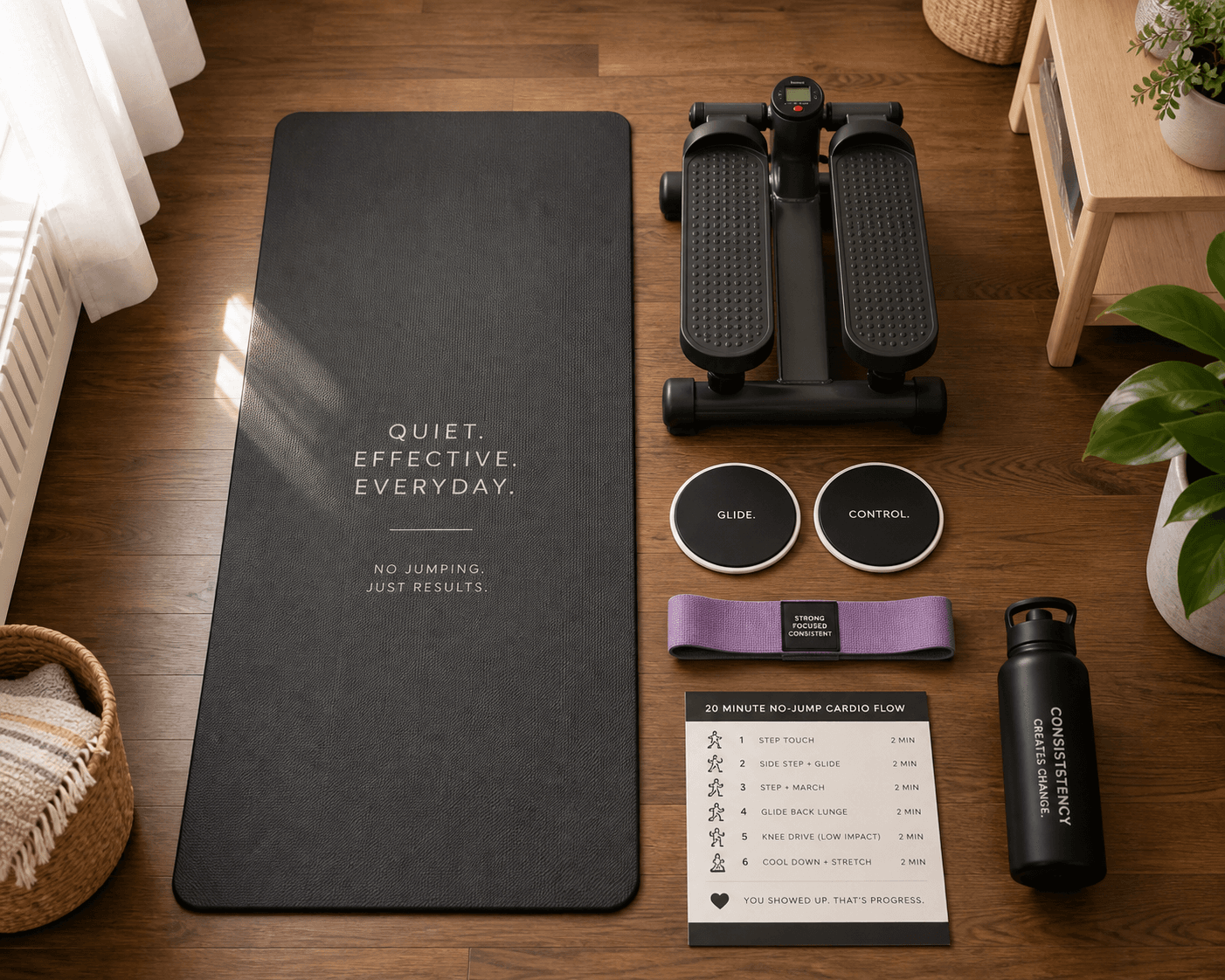
You don’t need much. What you need is silent.
- Sliders, paper plates, or towels: Turn bodyweight moves into gliding exercises that are silent and increase core demand. Test one rep first: on carpet they slide smoothly; on hardwood they can slip too much or leave scuff marks. A cheap foam mat underneath solves both.
- Yoga mat: Essential for floor moves. Dampens sound and protects knees. Thicker mats (6mm+) are better for quiet workouts.
- Resistance band loop: Adds resistance to squats and lateral walks without noise. Perfect for active recovery.
- Compact stepper (optional): A small aerobic step or sturdy low stool allows step-ups, toe taps, incline jacks. Silent if placed on a mat.
Skip jump ropes (even “silent” ones create floor impact), heavy dumbbells you drop, and any exercise that requires a slam or hard-bottom push-up. If you can hear it, your neighbor can hear it.
How to Not Annoy Your Neighbors
Even with quiet moves, thumps happen. A misstep during a lateral shuffle, a dropped foot during mountain climbers. The key is to minimize frequency — and have a plan for the inevitable.
- Timing windows: In older buildings (pre-1940s wood joists), avoid before 9 AM and after 8 PM. Sunday mornings are especially sensitive. Aim for 10 AM–12 PM or 4–6 PM. If unsure, ask your neighbor what time works.
- Floor protection: A cheap interlocking foam mat (24 sq ft is enough) absorbs impact and muffles sound. Place it under your yoga mat. Also protects floors from sweat.
- Apology script: If your neighbor complains, say: “I’m really sorry about the noise. I’m doing a quiet workout — no jumping — but I’ll put a mat down and be more careful. Does a particular time of day work better for you?” Shows empathy, not defensiveness.
A Weekly Schedule That Builds Consistency, Not Burnout
The Physical Activity Guidelines recommend 150–300 minutes of moderate activity per week — about 30 minutes, five days a week. That’s achievable with quiet cardio. The challenge is sustaining motivation, especially on low-energy days.
This schedule follows the Verywell Fit model of mixing intensity zones. I’ve added a fail-safe day: a 10-minute session you can fall back on when motivation is low. Consistency lives or dies on that fail-safe.
| Day | Workout | Intensity | Duration |
|---|---|---|---|
| Monday | High intensity HIIT (30:30) | RPE 8–9 | 20 min |
| Tuesday | Moderate steady state (continuous moves) | RPE 6–7 | 30 min |
| Wednesday | Active recovery (resistance band circuit, walking) | RPE 3–4 | 30 min |
| Thursday | Moderate-high HIIT (40:20) | RPE 7–8 | 25 min |
| Friday | Moderate steady state (favorite moves) | RPE 6–7 | 30 min |
| Saturday | Low-moderate (long march, light mobility) | RPE 4–5 | 30 min |
| Sunday | Rest or fail-safe: 10 min easy HIIT (light circuit) | RPE 5–6 | 10 min |
The fail-safe day is crucial. I keep it in my own calendar — a 10-minute circuit of four moves, no timer, just go easy. On days I want to skip, I tell myself I’ll only do 10 minutes. Nine times out of ten I end up doing more. But even if I stop at 10, I still showed up.
Quiet Cardio Isn’t a Compromise
I believed for years that home cardio had to be loud to be effective. Jump rope, burpees, box jumps — that was the real stuff. Everything else was a weak substitute. That belief cost me consistency. The workouts that stuck were the ones that didn’t make me nervous about the ceiling thud.
Quiet cardio works. It works because tempo and structure replace impact as the intensity driver. It works because you can actually do it every day without guilt or neighbor friction. And it works because the system — exercises, equipment, etiquette, schedule — is designed for your actual life, not for a gym floor.
Start with the 10-minute workout this week. Then build up. Your neighbors won’t notice, but your heart rate will.
Comments
Join the discussion with an anonymous comment.