If you have a hard ceiling of $100, $300, or $500, the best budget home gym equipment is not the single nicest item you can afford. It is the smallest complete kit that lets you train the major patterns often enough to keep going: push, pull, squat or lunge, hinge, core, and conditioning. The useful question is not “What is cheap?” It is “What combination will still make sense after the first two weeks?”
| Budget | Buy first | What it trains well | Main trade-off | Best for |
|---|---|---|---|---|
| About $100 | Resistance bands, exercise mat, jump rope | Conditioning, mobility, light full-body resistance, core | Limited progressive overload for strength | Absolute beginners, habit-building, very small spaces |
| $100–$300 | Adjustable dumbbells, resistance bands, doorway pull-up bar | Full-body strength, assisted pulling, basic conditioning | Bench work is limited unless you add a bench later | Most beginners who want strength progress |
| $300–$500 | Adjustable dumbbells, adjustable bench, bands, kettlebell or suspension trainer | Full-body strength with more angles, unilateral work, conditioning, longer progression | Still not a rack-and-barbell gym for heavy compound lifting | Beginners who want one setup to grow into |
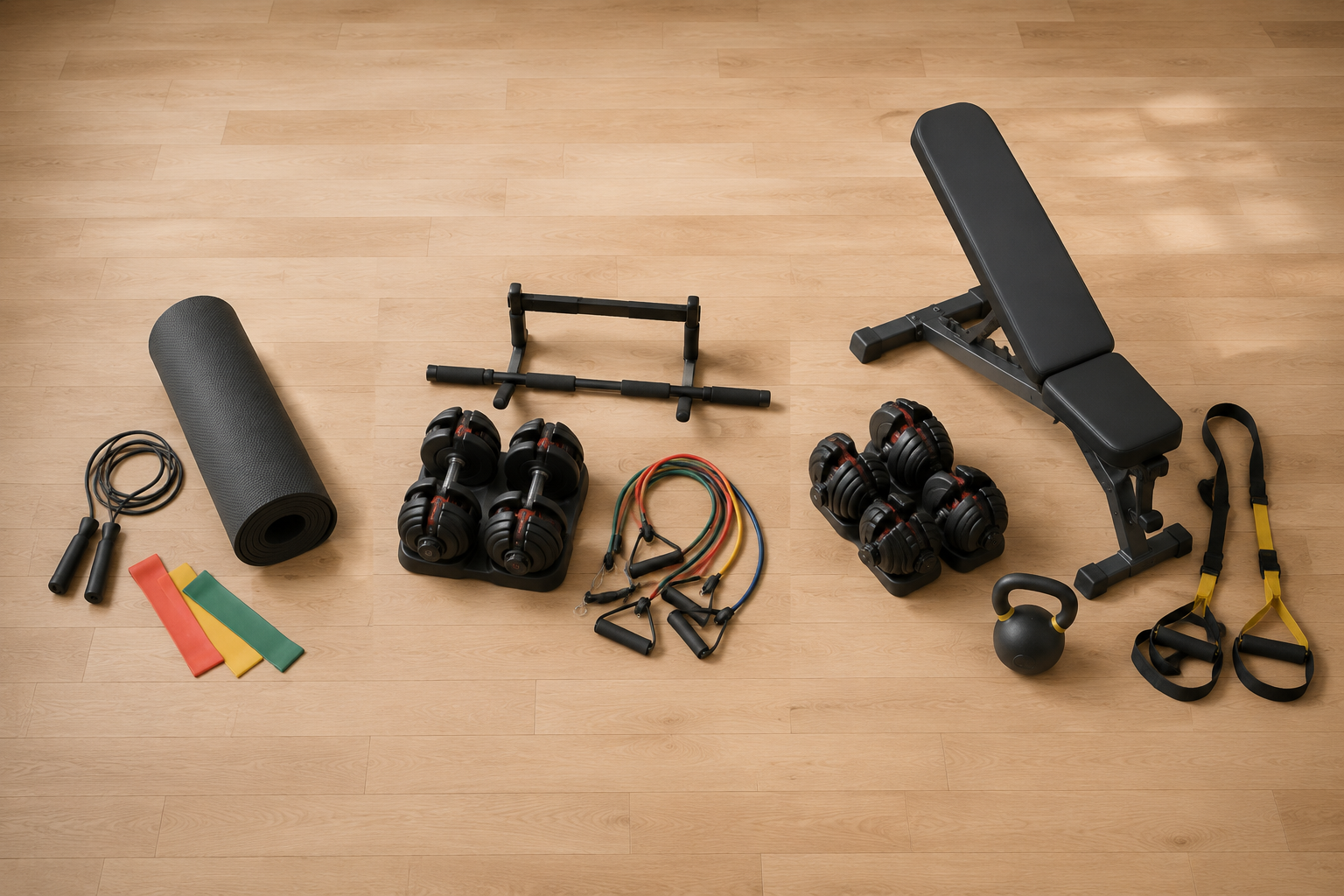
Garage Gym Reviews’ 2026 budget equipment testing puts resistance bands, adjustable dumbbells, benches, and related compact tools near the center of the value conversation, while Verywell Fit’s tested budget roundup also points beginners toward portable, multi-use pieces rather than bulky single-purpose machines.[1][2] That matches what tends to survive in real homes: equipment that can be used on a rushed weekday, stored without a fight, and progressed without replacing the whole setup.
The broader market makes this decision feel more crowded than it needs to be. A Health & Fitness Association survey published in December 2025 reported that Americans planned to spend $60 billion on health and fitness in 2026, with an average planned spend of $733 per spending household.[3] Fortune Business Insights also reports continued growth in the home fitness equipment market.[4] Those numbers explain why there are so many products in front of you; they do not tell you which cart to check out with.
The $100 Kit: Bands, Mat, Jump Rope
At about $100, buy a set of resistance bands, a basic exercise mat, and a jump rope. RitFit’s budget-tier guidance treats this combination as a workable entry point for conditioning and light resistance, and Verywell Fit’s testing identifies bands as one of the highest-return budget tools, with examples in the $15–$20 range.[2][5] Garage Gym Reviews and REP Fitness also include inexpensive accessories and bands among the low-cost items that can actually earn their storage space.[1][6]
- Resistance bands: rows, presses, curls, triceps work, lateral walks, assisted mobility, warmups
- Exercise mat: floor core work, push-ups, stretching, mobility, recovery sessions
- Jump rope: simple conditioning, footwork, warmups, short intervals
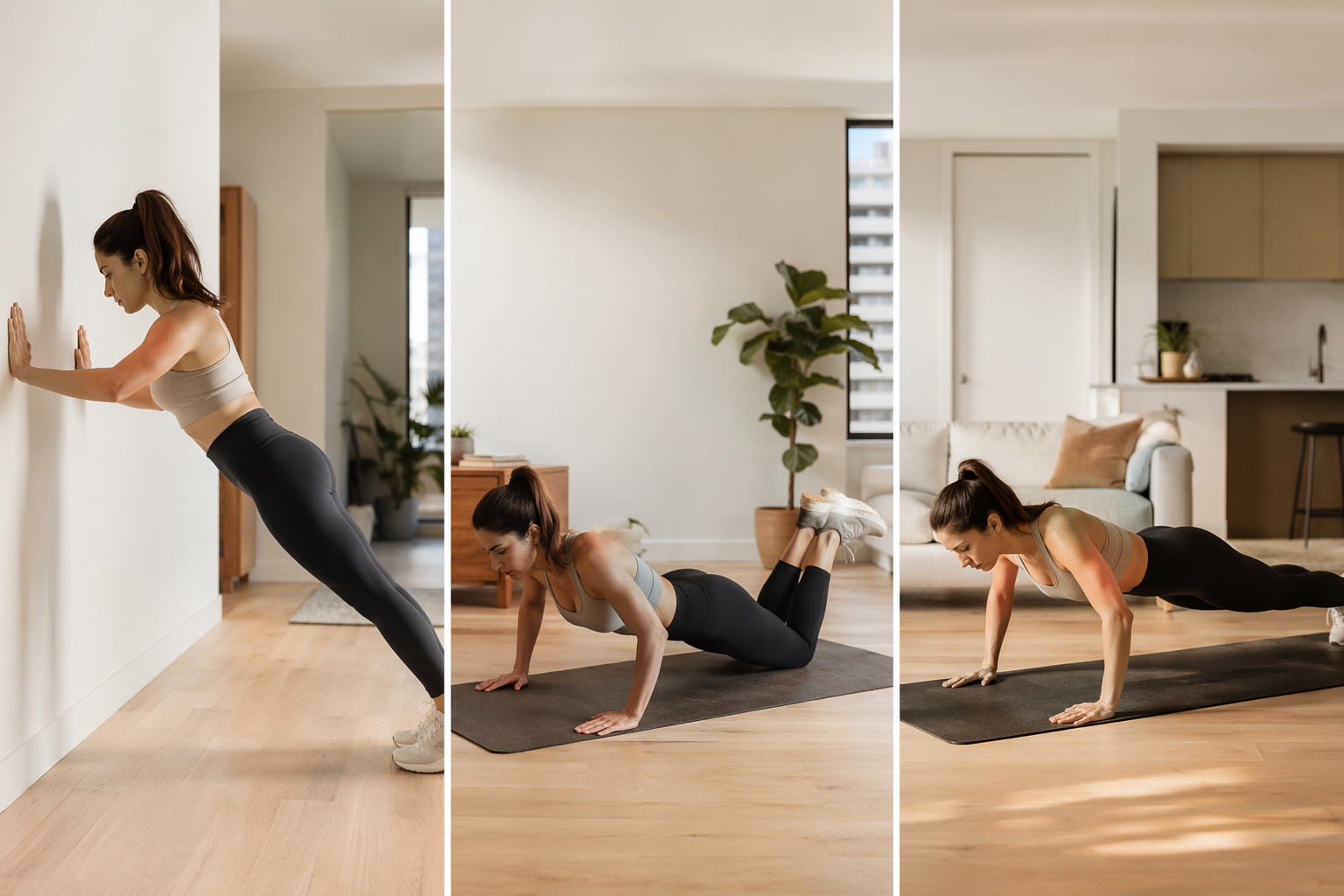
This kit is not fake training. A beginner can squat to a box or chair, do band rows, band presses, glute bridges, dead bugs, planks, push-ups from an incline, and short jump-rope intervals. It is enough to build a routine, learn how movements feel, and find out whether home training fits your week.
The ceiling shows up quickly. Bands can be made harder by changing stance, shortening the band, slowing the tempo, or choosing a heavier band, but they do not give the same clean loading path as dumbbells. If your main goal is muscle gain or measurable strength progress, the $100 kit is a start, not the destination.
Choose this tier if the honest priority is getting moving without overcommitting. It is also the right choice if you are still sorting out space, schedule, or motivation. If the budget is flexible and strength is already the goal, skip the temptation to add five more small accessories and move toward adjustable dumbbells instead.
The $300 Kit Is the Sweet Spot for Most Beginners
The $100–$300 range is where the kit becomes a strength setup rather than a general fitness bundle. The purchase order is simple: adjustable dumbbells first, resistance bands second, doorway pull-up bar third. If the dumbbells take most of the budget, that is usually fine. They are the item that changes the training path.
Garage Gym Reviews notes that adjustable dumbbells can replace 12 or more pairs of fixed dumbbells, with an industry-wide average price of $625 and the REP QuickDraw starting at $336 in its testing context.[1] That $336 example sits just above a strict $300 ceiling, which is why budget shoppers often look at lower-cost adjustable dumbbells such as BCBIG models around $100 as the entry point for progressive overload.[1] The trade-off is usually feel, speed of adjustment, weight range, or long-term durability—not the basic logic of the tool.
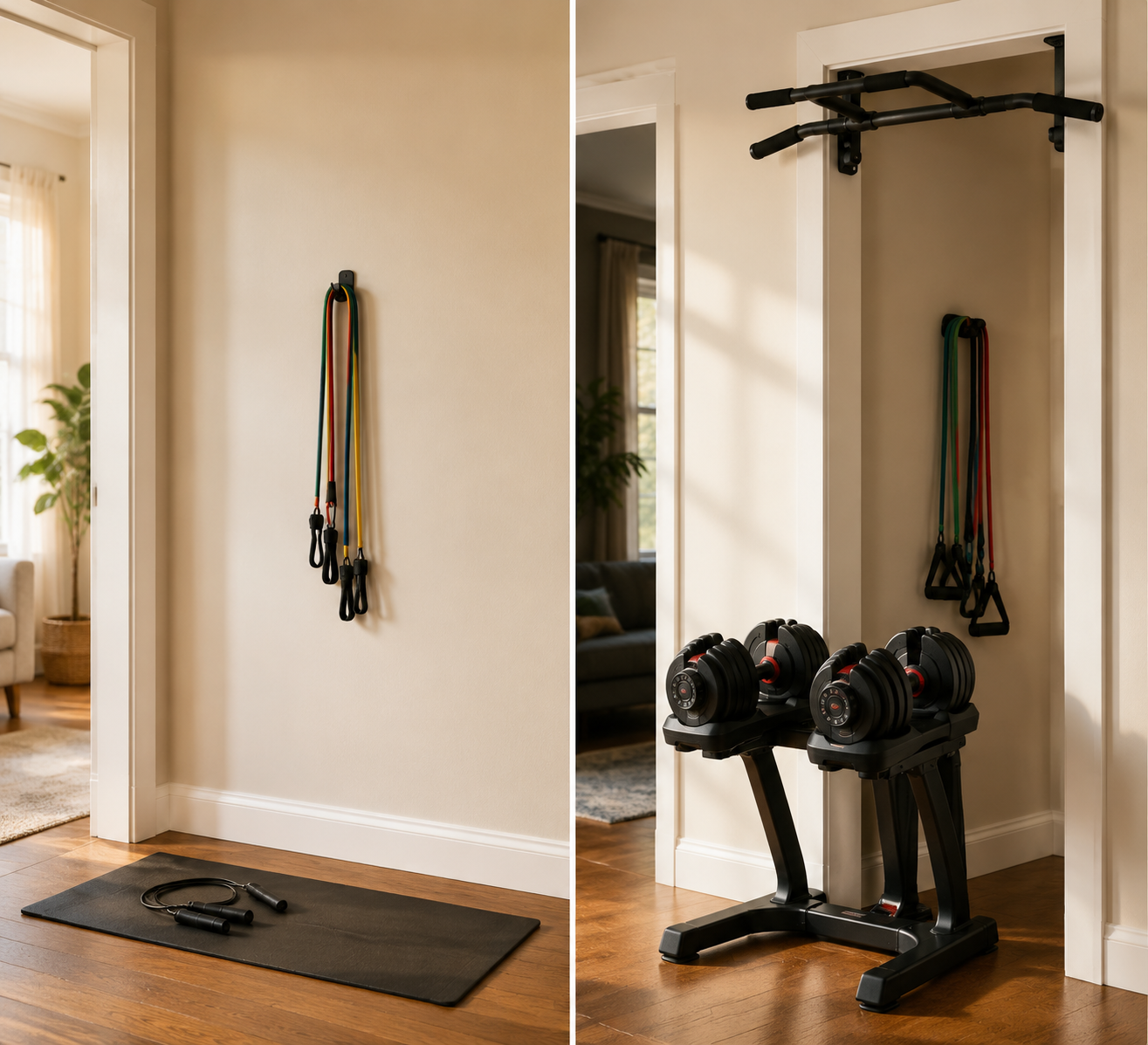
With adjustable dumbbells, a beginner can train goblet squats, Romanian deadlifts, split squats, floor presses, one-arm rows, overhead presses, curls, triceps extensions, loaded carries, and weighted core work. Bands fill in warmups, assisted movements, face pulls, pull-aparts, and higher-rep work. The doorway pull-up bar gives you a real vertical-pull target, even if the first stage is hanging, negatives, or band-assisted reps.
| Movement pattern | $300 kit examples | What progresses |
|---|---|---|
| Squat/lunge | Goblet squat, reverse lunge, split squat | Dumbbell load, reps, range of motion |
| Hinge | Dumbbell Romanian deadlift, single-leg RDL | Dumbbell load, tempo, unilateral control |
| Push | Floor press, push-up, overhead press | Dumbbell load, reps, push-up angle |
| Pull | One-arm row, band row, hang or assisted pull-up | Dumbbell load, band tension, time under tension |
| Core | Dead bug, plank, suitcase carry | Load, hold time, anti-rotation control |
| Conditioning | Dumbbell complexes, band circuits, jump rope if retained | Intervals, density, total work |
This is why the $300 kit usually beats a cheap cardio machine, a budget all-in-one station, or a collection of random accessories. One adjustable dumbbell pair can serve legs, back, chest, shoulders, arms, and carries. A single-purpose machine may feel more like a “real” home gym on delivery day, but it often covers fewer useful decisions once the novelty wears off.
There are still limits. Floor presses shorten the range of motion compared with bench presses. Heavy lower-body training eventually outgrows light dumbbells. Doorway pull-up bars depend on the doorway and user setup, so they are not universal. If you are still unsure whether dumbbells, bands, or a pull-up bar should come first, the more basic buying-order logic in Home Gym Equipment for Beginners: What to Buy First (And What to Skip) is a better starting point than comparing another dozen products.
What $500 Adds: A Bench, More Angles, and a Longer Runway
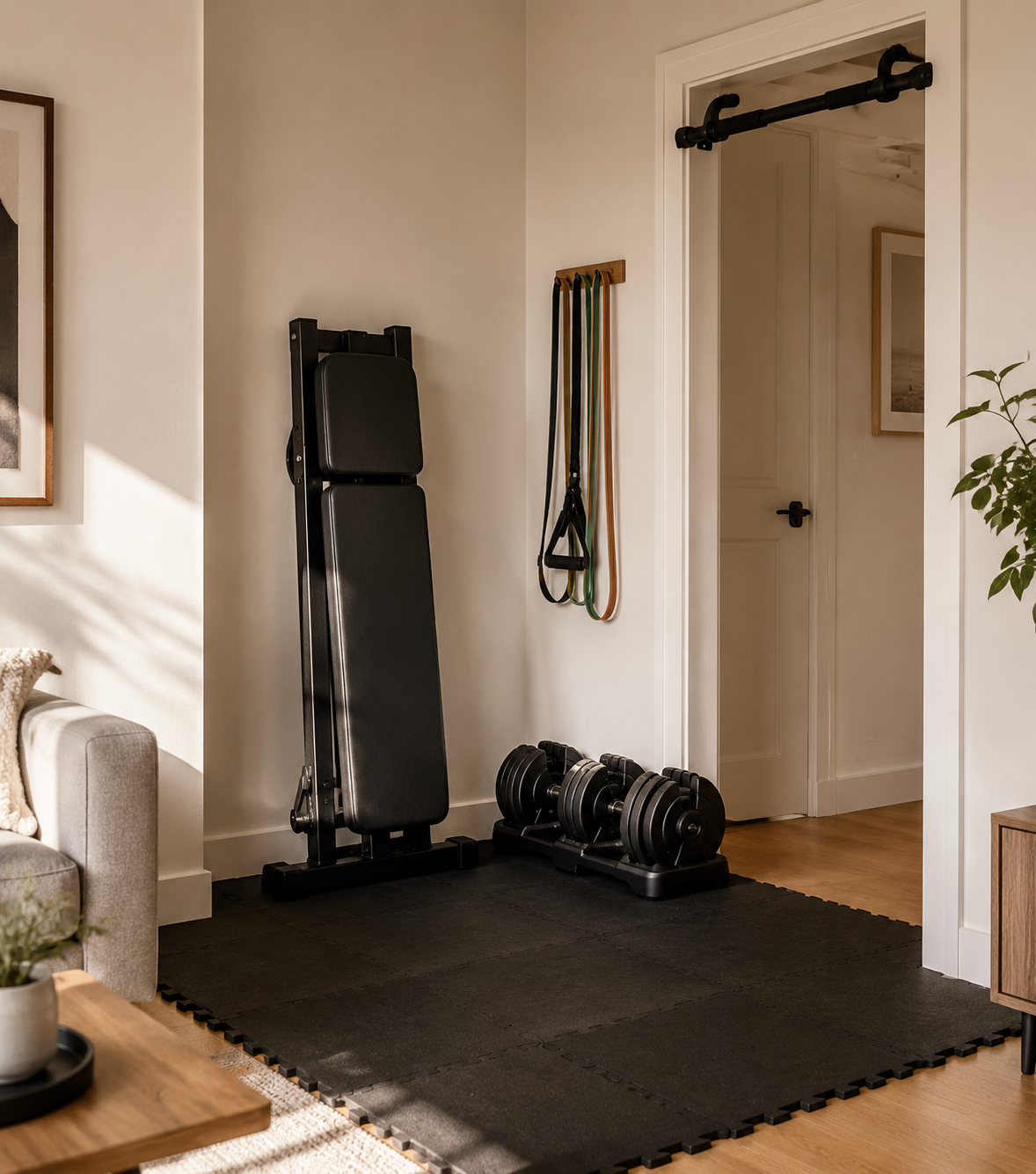
At $300–$500, do not replace the $300 idea. Build on it. The usual winning kit is adjustable dumbbells, an adjustable bench, bands, and either a kettlebell or a suspension trainer. The bench is the piece that makes the dumbbells feel less like a compromise.
Garage Gym Reviews’ under-$500 home gym guide lists 12 tested product picks and includes adjustable-bench options such as the Major Fitness adjustable bench at $220 and the Pasyou folding bench at around $150 with a listed 500-pound capacity.[7] In this budget range, the bench is not just furniture. It opens incline presses, chest-supported rows, seated shoulder presses, step-ups, Bulgarian split squats, hip thrusts, and more stable dumbbell work.
The fourth slot depends on how you like to train. A kettlebell adds swings, goblet squats, carries, cleans, and simple conditioning circuits. A suspension trainer, with TRX examples around $230 in the research brief, adds bodyweight rows, assisted single-leg work, push-up variations, fallouts, and scalable core work. Neither is mandatory on day one if the dumbbells and bench already use the full budget.
- Pick a kettlebell if you want simple conditioning, carries, hinges, and compact power work.
- Pick a suspension trainer if you want more pulling options and scalable bodyweight training.
- Pick heavier or better adjustable dumbbells instead if strength progression matters more than variety.
This is a genuinely versatile starter gym. It can support muscle gain, fat-loss training, general strength, and conditioning for a long time if the loads are appropriate. It is still not a rack-and-barbell setup. Heavy squats, heavy deadlifts, and barbell bench work require different equipment, more space, and a different budget. If that is the direction you already know you want, the $500 kit can be a bridge, not the final room.
How to Choose the Right Tier Without Overbuying
Start with the consequence you are willing to accept. The $100 kit accepts limited strength progression in exchange for low cost, easy storage, and almost no setup friction. The $300 kit accepts fewer exercise angles in exchange for the first serious loading path. The $500 kit accepts that it is still below rack-and-barbell territory in exchange for a home setup that feels complete for general strength training.
| If this sounds like you | Choose | Do not spend the leftover money on |
|---|---|---|
| You have not trained consistently before and mainly need a routine | $100 kit | Novelty accessories that do not change your workouts |
| You want to get stronger and can spend more than the bare minimum | $300 kit | A cheap machine that trains one pattern |
| You want one compact setup you can grow into for years | $500 kit | A bench so poor that it makes dumbbell work feel unstable |
| You have severe space limits | The highest tier you can store comfortably | Equipment you will have to move every session |
Space can override the budget. A $500 setup that blocks a shared room may get used less than a $300 setup that lives cleanly in a closet. If storage is the real constraint, use How to Build a Budget Home Gym That Actually Fits Your Space before adding a bench or stand.
The cleanest upgrade path is also the least dramatic: bands, then adjustable dumbbells, then a bench, then one specialty tool that solves a real gap. For a fuller buying sequence after the starter kit, follow Best Home Exercise Equipment: A Phased Purchase-Sequence Guide. If you are already thinking beyond the $500 ceiling, The $1,000 Compact Home Gym System is the more honest next comparison than trying to squeeze barbell expectations into a starter budget.
What to Skip at These Budgets
The easiest way to waste a starter budget is to buy equipment that looks complete but does not train many patterns. Cheap cardio machines, bargain cable towers, ab-only devices, and oversized benches with questionable stability can consume the money that should have gone toward load, movement variety, or consistency.
That does not mean fun equipment is automatically wrong. If a jump rope, mini stepper, or familiar cardio tool is the thing you will actually use, that matters. Just be clear about what it is doing. Conditioning equipment is not a substitute for progressive resistance. A bench without dumbbells is not a strength system. Bands plus a mat are useful, but they do not become a complete long-term lifting setup because the cart also includes sliders, a massage ball, and a deck of exercise cards.
When two products compete for the same dollars, favor the one that opens more exercises and a clearer progression path. That is the practical reason adjustable dumbbells keep showing up in tested budget guides, and it is why the bench becomes valuable only after there is something worth pressing, rowing, and loading on it. For a deeper split between smart savings and false economy, use Where to Spend vs. Save on Affordable Home Gym Equipment.
The Simple Decision
Spend about $100 if you need a low-risk way to start moving: bands, mat, jump rope. Spend $100–$300 if you want the best value starter gym for strength: adjustable dumbbells, bands, pull-up bar. Spend $300–$500 if you want the same strength base with enough variety to last longer: adjustable dumbbells, adjustable bench, bands, and a kettlebell or suspension trainer.
The mistake is not choosing the cheaper tier. The mistake is buying disconnected cheap items and hoping they become a training plan.
References
- GGR "Best Budget Home Gym Equipment 2026", Garage Gym Reviews
- Verywell Fit "17 Best Budget Home Gym Equipment, Tested", Verywell Fit
- Americans Plan to Invest $60 Billion in Health and Fitness in 2026, Health & Fitness Association, Dec 2025
- Home Fitness Equipment Market, Fortune Business Insights
- Best Affordable Home Gym Equipment, RitFit
- Budget Home Gym Products Under $50, REP Fitness
- GGR "Best Home Gyms Under $500", Garage Gym Reviews
Comments
Join the discussion with an anonymous comment.