
Will it actually fit?
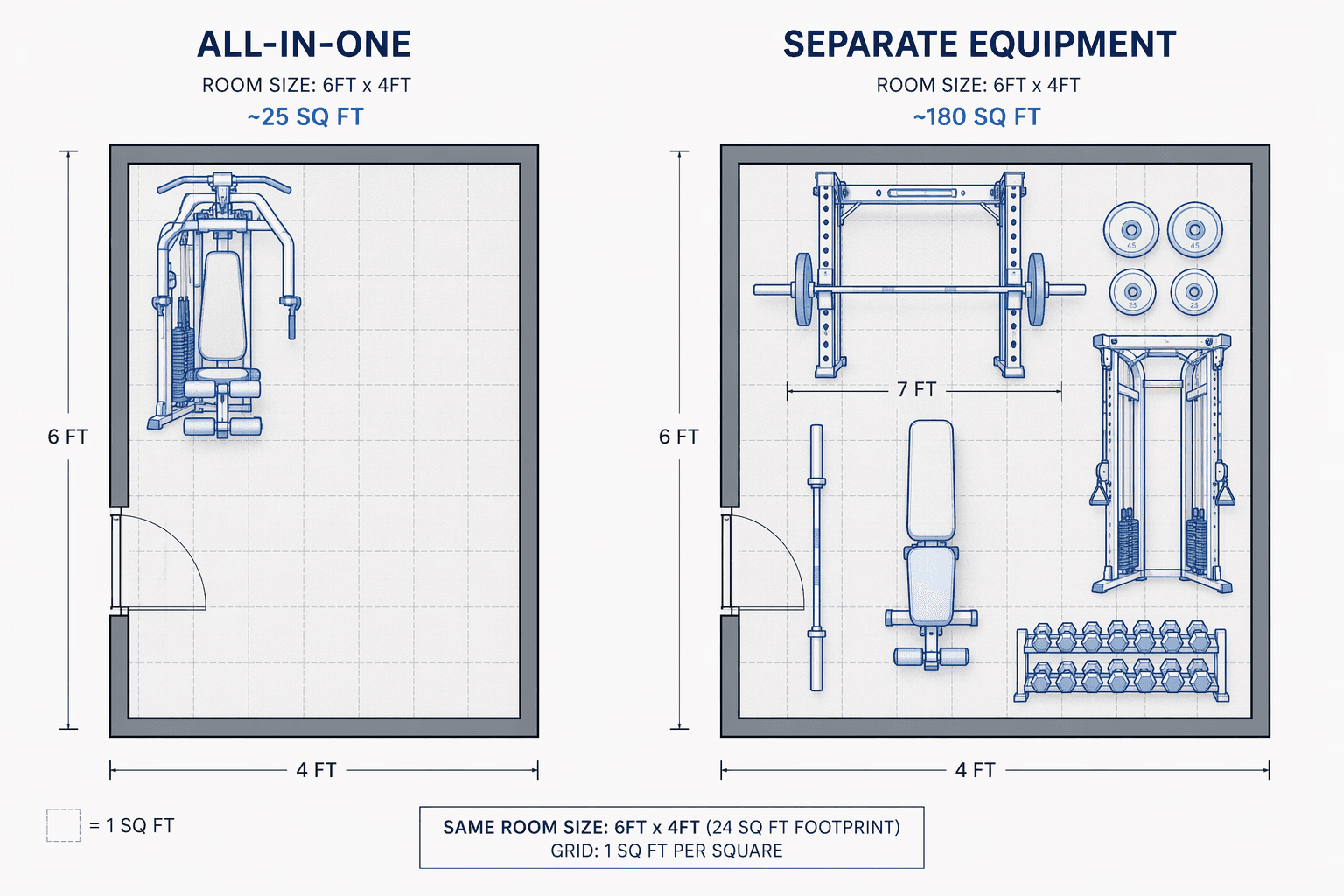
I have seen people buy a power rack and discover the ceiling is too low, or order a functional trainer and realize they have to rearrange the whole bedroom. The all-in-one machines sidestep that by packing everything into a footprint that actually fits in a spare room or apartment corner. Here are the numbers from Garage Gym Reviews (an affiliate site, so take the “best overall” language with a grain of salt): the Bells of Steel All-in-One takes about 22.3 square feet, the Speediance Gym Monster compresses to 9.7 square feet, and the largest model, the Major Fitness B17, sits at roughly 37 square feet. Compare that with a separate setup: a power rack alone needs about 4×6 feet, and once you add a bench, barbell, plates, a functional trainer, and a dumbbell rack, you are easily looking at 100 to 250 square feet. That is an estimate, not a sourced number, but it illustrates the gap.
For anyone with less than 120 square feet of dedicated gym space, the all-in-one wins on feasibility alone. You can still squat and bench, but you give up the ability to spread out and the open floor area.
Price: $1,300–$4,200 vs. a separate build
If space is not the constraint, cost often is. All-in-one prices span a wide range. The Bells of Steel starts at $1,300. The Bowflex Xtreme 2 SE runs $1,499. The Major Fitness B17 goes up to $4,200. On the premium smart side, the Tonal 2 costs $4,295 and adds a $50 monthly subscription—a hidden recurring cost that most roundups gloss over. Over three years, that subscription adds $1,800 to the total.
| Setup | Estimated Total |
|---|---|
| All-in-one (budget) | $1,300 (Bells of Steel) |
| All-in-one (mid-range) | $1,499 (Bowflex Xtreme 2 SE) |
| All-in-one (premium) | $4,200 (Major Fitness B17) |
| Smart gym (Tonal 2) | $4,295 + $50/mo subscription |
| Separate equipment (mid-range) | ~$5,385 (see breakdown below) |
The separate-equipment figure comes from mid-range gear. A REP PR-4000 power rack costs about $950. A REP Colorado Bar is $300. Fringe Sport bumper plates run about $1.79 per pound—for 300 pounds that is $537. A Titan Fitness functional trainer with dual 200-lb stacks is $2,999. An IPF-standard adjustable bench (Titan) costs $635. That totals roughly $5,385. If you go premium with Rogue or Eleiko, the number climbs well above $7,000. If you go budget, you can shave it to around $3,500, but then you are buying gear that may not last or perform the same.
For a buyer with a hard ceiling of $3,000, the all-in-one offers more exercises out of the box. The separate-equipment approach at that budget means a bare-bones rack, a cheap barbell, used plates, and no dedicated cable station—which is a real loss for lat pulldowns, triceps pushdowns, and face pulls.
Does the machine actually limit your gains?
A common refrain in gym forums is that all-in-one machines “miss stabilizer muscles” and are inferior for functional strength. I have read this claim in dozens of articles, but few of them cite actual evidence. The PMC meta-analysis comparing elastic resistance training to conventional weight training found no significant difference in upper limb strength gains (SMD −0.11, 95% CI −0.40 to 0.19, p=0.48) nor in lower limb gains (SMD 0.09, 95% CI −0.18 to 0.35, p=0.52). Another review of 16 studies concluded that weight-stack training and free weights produce comparable maximal strength outcomes.
To be fair, these studies compare elastic resistance and weight stacks to free weights in general, not specifically all-in-one machines. And they do not directly measure stabilizer recruitment. But the evidence we have says that for most lifters, the resistance modality matters less than consistency, effort, and progressive overload. The all-in-one will get you stronger. The stabilizer argument is not backed by the research we have in hand; it is a popular belief that may be true for very specific movements but is overstated in general advice.
The upgrade trap: weight stack ceiling
This is where the all-in-one story starts to crack. Most machines cap their weight stacks at 210 to 260 pounds per side. The Bowflex Xtreme 2 SE starts at 210 but can be upgraded to 410. The REP Ares 2.0 slides in at 260 per side, upgradable to 310. But even 260 pounds feels lighter because of the 2:1 pulley ratio—the weight you feel is half of the stack. So a 260-pound stack delivers about 130 pounds of resistance on many exercises. That is fine for a beginner, but an intermediate lifter squatting or rowing 250 pounds will hit the ceiling in a year or two.
With separate equipment, you just add more plates. The same power rack that costs $950 can handle 1,000 pounds plus. You can swap the barbell, upgrade the bench, add a lat pulldown attachment. The upgrade path is open-ended. The all-in-one is a closed system. You cannot put heavier weight stacks in most models, and even if you can upgrade (like Bowflex), the cost and complexity are higher than buying a pair of 45s.
I have also heard that separate equipment retains 60–80% of its value on the used market, while all-in-ones are harder to sell and transport. I would love to cite a source for that, but none of the pre-crawled research provides it. It may be true; it may be anecdotal. If you are the kind of person who resells gear every few years, treat that claim as unverified and check your local market.
So who should buy what?
After weighing space, cost, exercise quality, and upgrade path, the decision comes down to your realistic trajectory.
- You have under 120 square feet of dedicated space. The all-in-one fits; separate gear probably does not.
- Your budget is under $3,000 and you want a full body workout out of the box. The all-in-one gives you cables, chest press, leg extension, lat pulldown, and core work without buying piece by piece.
- You are a seasoned lifter who expects to exceed 250 pounds on deadlifts, squats, or rows within two years. The all-in-one will cap you. Buy a power rack, barbell, plates, and a separate adjustable bench and plan to add a cable attachment later.
- You want the option to upgrade gradually over time. Separate equipment lets you start with a rack and bar, then add plates, then a bench, then a cable station. The all-in-one locks you into its ecosystem from day one.
- You are in an apartment or rental with noise concerns. All-in-one machines with weight stacks are generally quieter than dropping barbells, even with bumper plates. Check the compact home gym space tiers guide for more on acoustic and floor protection.
- If you plan to build your gym in phases, see the phased build guide for single-car garages. That strategy works much better with separate gear.
Verdict
For the majority of home gym builders who are starting out, short on floor space, and operating under $3,000, an all-in-one machine is the rational choice. It delivers a wider variety of exercises per dollar and per square foot than any equivalent collection of separate equipment. The evidence does not support the claim that it will hold back your strength gains at the beginner to early-intermediate level.
But the ceiling is real. Once your working weight on major lifts passes 250 pounds, or once you want to specialize in Olympic lifts or powerlifting-style training, the all-in-one becomes a limitation rather than a solution. The upgrade path is closed, the resale market is uncertain, and the machine's weight stack cannot grow with you the way a rack and plates can.
The smartest thing you can do is to be honest about where you will be in two years. If you plan to get serious and stay consistent, separate equipment is the better long-term investment. If you just want a practical, all-in-one solution that fits in the corner of your bedroom and gets the job done today, the all-in-one is a solid bet.
Either way, double-check current prices. The mid-2026 data here is a snapshot, not a guarantee. And take the resale value claim with a heavy dose of salt—I could not find reliable support for it in the research I worked with.
Comments
Join the discussion with an anonymous comment.