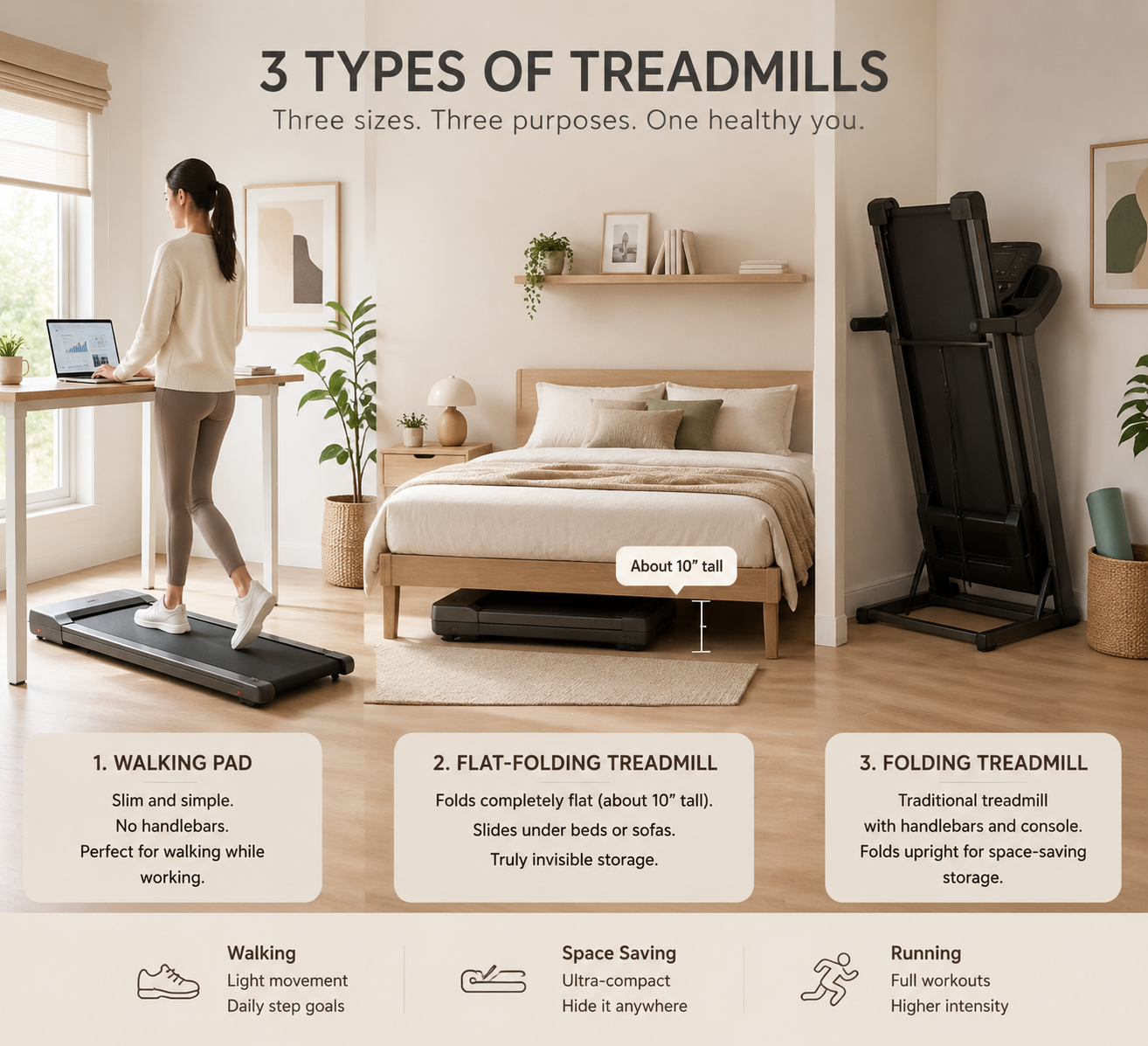
Search for a small treadmill for home and you will see three very different machines treated as if they belong in one neat ranking: a handlebar-free walking pad for slow workday steps, a flat-folding treadmill that can slide under a bed, and a heavier upright-folding treadmill meant for regular running. That mix is where many bad purchases start. The question is not just “Will it fit?” It is “Will it still be safe and useful for the way I plan to move?”
A quick first pass helps: choose a walking pad if your main goal is walking while working; choose an ultra-compact flat-folding treadmill if you want jogging or modest running and need under-bed storage; choose a traditional folding treadmill if you want regular running and can give up a permanent corner. Those are not three price tiers. They are three different compromises.
| If this is your real use | Start with this type | What you are accepting |
|---|---|---|
| Walking during calls, email, or TV | Under-desk walking pad | Low speed, short deck, little or no incline, often no handlebar |
| Jogging or modest running, then storing under a bed | Ultra-compact flat-folding treadmill | More speed than a walking pad, but tighter deck, cushioning, and incline trade-offs |
| Regular running or structured workouts | Traditional folding treadmill | A dedicated footprint, more weight, and upright storage rather than invisibility |
Walking pads are for walking, and that is fine
The walking pad is the easiest category to love for the wrong reason. It looks harmless. It can be light enough to roll away, cheap enough to buy on impulse, and low enough to disappear under furniture. Some models in this group sit around 59 pounds, with typical retail pricing roughly in the $180 to $500 range and capacities around 220 to 265 pounds in the examples commonly cited by review sites.[1]
The limit is also clear: most under-desk walking pads top out around 3 to 4 mph, and short decks around 40 to 47 inches are built for walking strides, not running strides.[1] That is not a defect if the buyer wants 45 minutes of easy movement during a work block. It is a problem if the buyer imagines the same machine becoming a beginner running treadmill after a motivated first week.
Models such as the WalkingPad C2 and UREVO Strol 2E belong in this conversation because they show the walking-pad promise: low profile, apartment-friendly storage, and an under-desk form that does not require a dedicated gym corner.[1] Many walking pads also have no handlebar, or use a design where the handrail is not the main point. That is exactly what makes them work under a desk, and exactly why they should not be treated like miniature running treadmills.
The safety details matter more here than an app badge. Consumer Reports’ 2025–2026 testing of specific under-desk treadmills found belt durability failures during 12-hour durability tests, inaccurate speed displays, and safety-key designs that stopped the belt instantly rather than easing it down.[2] Those findings do not prove every walking pad is unsafe, but they are enough reason to read owner reports and warranty terms with more care than the product photos invite.
In a tight apartment, a sudden stop is not an abstract engineering issue. The user may be between a desk, a chair, a wall, and a power strip. A belt that tears early or a speed display that runs optimistic changes the risk calculation, especially for someone buying their first treadmill and assuming “low speed” automatically means “low consequence.”
When a walking pad is the right buy
- Your main activity is walking, not jogging.
- You need it under a desk, sofa, or bed more often than you need speed.
- You are comfortable with little or no incline.
- You can check the return policy, warranty length, and user reports for belt and controller problems before buying.
For a remote worker trying to make sedentary days less stagnant, this category can be the cleanest answer. For a beginner runner, it is usually the wrong starting point, even if the listing says “compact treadmill” in large type.
Flat-folding treadmills are the tempting middle
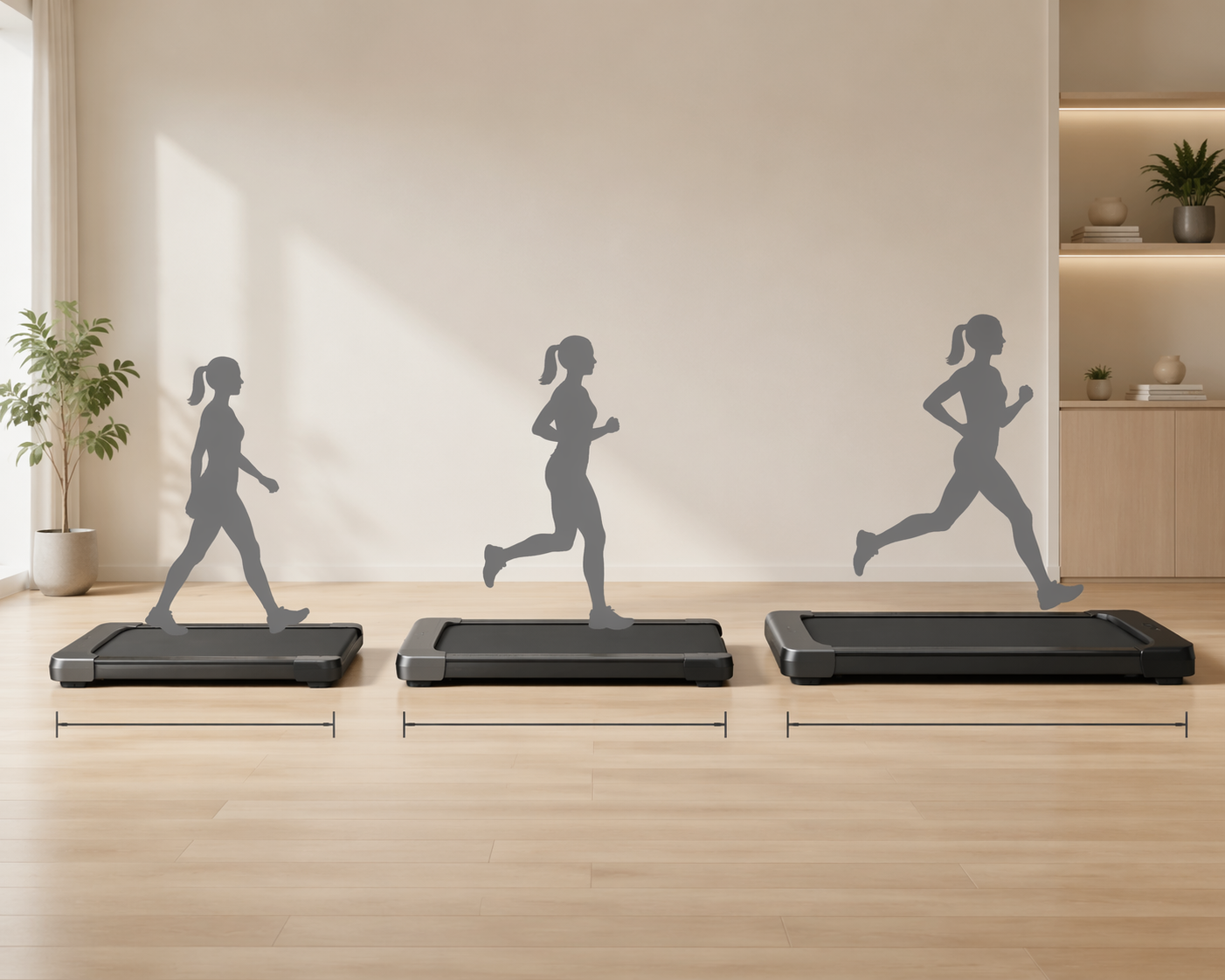
The ultra-compact flat-folding treadmill is the category many shoppers did not know they were looking for. It promises something a walking pad cannot honestly offer: jogging and modest running speeds, often around 7 to 10 mph, while still folding low enough for under-bed or low-furniture storage. In mid-2026 retail terms, this group commonly sits in a wider range, roughly $400 to $1,700 depending on motor, deck, folding system, and screen features.[3][4]
The appeal is obvious in the specs. The DeerRun A1 Pro is described with an 8-inch folded height, 86-pound machine weight, 3 HP motor, 350-pound capacity, and 54.1-inch deck.[3] The WalkingPad X25 folds in half twice, weighs 104 pounds, and uses a 47.24-inch deck.[4] The Echelon Stride-6S pushes closer to full treadmill territory with an approximately 10-inch auto-fold profile, 156-pound weight, and 60-inch deck.[3]
Those examples should not be read as a ranked list. They show how wide the bridge category has become. One model is light enough that a renter may actually move it. Another has a deck short enough that taller runners should pause. Another gives a longer deck but weighs enough that “slides under the bed” becomes a question about flooring, bed clearance, and whether anyone wants to wrestle 156 pounds after a workout.
This is also where the word “compact” can hide the most compromise. Compared with full-size folding treadmills, flat-folding models often give up cushioning depth, incline range, or the stable feel that matters once the belt is moving faster.[3][4] A 7 or 10 mph top speed does not automatically mean a machine feels good at that speed for your stride, your weight, or your floor.
Check the folded height after you check the deck
Under-bed storage sounds simple until the machine arrives. A folded height of 8 to 10 inches only helps if the bed frame, rug, casters, and nearby clearance cooperate. A deck length in the high 40s may fit the room and still feel cramped under a jogging stride. A 54-inch deck may be workable for some joggers, while a 60-inch deck gives more room for running but usually brings more weight and bulk.
If this is the category you are considering, measure in this order: your usable deck need, the unfolded footprint, the folded height, the machine weight, and the path from workout spot to storage spot. Door swings, bed legs, closet lips, and radiator pipes are not details. They decide whether the treadmill gets used or becomes a large object you resent.
Who should look here first
Flat-folding treadmills make the most sense for the buyer who genuinely has no permanent corner but wants more than walking. That usually means jogging, short interval work, or modest running rather than heavy daily training. If your intended use is mostly under-desk walking, this category may be more machine than you need. If your intended use is regular running, it may still be less machine than you will want.
Traditional folding treadmills are compact only in a different sense
A traditional folding treadmill does not disappear. It folds upright, and that is useful, but it still announces itself in the room. This category is the answer for people who can dedicate real floor space and want a treadmill that behaves more like gym equipment than furniture that happens to move.
The typical running-oriented benchmarks are different: 10 to 12 mph top speeds, 55- to 60-inch decks, 300- to 400-pound capacities, and incline up to about 12% in the traditional folding class described by major treadmill reviewers.[3][5][6] When unfolded, these machines often need around 16 to 18 square feet of permanent floor space; folded upright, they may shrink to roughly 6 to 8 square feet, but they still need vertical clearance and room around the base.[3][5]
The Horizon T101 shows the lower-cost end of this serious folding category: about 46 by 34 by 61 inches folded, 180 pounds, a 55-inch deck, and mid-2026 retail pricing often around $650 to $800.[3] The Sole F63 moves heavier and larger, with a folded size around 50 by 35 by 72 inches, a machine weight over 250 pounds, a 60-inch deck, and retail pricing roughly around $1,000 to $1,300.[3][5] NordicTrack’s EXP 7i also belongs in this traditional folding conversation, especially for buyers comparing guided workout ecosystems and subscription requirements.[5]
This is where warranties start to separate the categories in a practical way. Horizon’s T101 is cited with a lifetime frame and motor warranty, while many walking pads offer only around 12 months of total coverage.[3] Warranty length does not make a treadmill fit your apartment, but it does say something about what kind of use the maker expects the machine to survive.
Subscription lock-in also belongs in the buying decision, not as an afterthought. Wirecutter notes that some NordicTrack and iFit-connected treadmills are closely tied to ongoing guided-workout subscriptions.[5] That may be valuable if you want coached classes. It is much less attractive if you mainly need manual speed, incline, and a belt long enough for your stride.
For runners, deck fit is not decorative. A taller runner with a long stride can outgrow a short deck quickly, even at beginner speeds. If you are deciding between a 55-inch and 60-inch deck, use a body-and-stride check rather than guessing from product photos; our compact treadmill deck size guide goes deeper on that fit question.
The comparison that matters is within the category
A walking pad and a traditional folding treadmill should not be compared as if one simply has fewer features. They answer different constraints. A walking pad protects your floor plan and your workday routine. A traditional folding treadmill protects running mechanics, incline training, and long-term durability. The flat-folding treadmill sits between them and asks you to inspect every promise carefully.
| Spec to compare | Walking pad | Flat-folding treadmill | Traditional folding treadmill |
|---|---|---|---|
| Primary use | Under-desk walking | Jogging or modest running with hidden storage | Regular running and structured workouts |
| Typical speed range | About 3–4 mph top speed | About 7–10 mph top speed | About 10–12 mph top speed |
| Deck pattern | Shorter walking decks, often around 40–47 inches | Varies widely, from short compact decks to 60-inch examples | Commonly 55–60 inches |
| Storage reality | Slides away most easily | May fit under a bed if height and weight work | Folds upright but keeps a visible footprint |
| Main caution | Do not treat it as a running treadmill | Do not assume flat-fold means full-size feel | Do not assume upright folding makes it disappear |
Noise deserves the same practical treatment. Reviewers sometimes report walking pads as quieter than full-size treadmills, and full-size models are often discussed in rough ranges such as 55 to 70 dB, but those figures are usually measured under different home or review conditions rather than one standardized lab setup.[4][5] Treat them as directional, not as a promise to your downstairs neighbor.
Price ranges need the same restraint. The numbers in this article reflect U.S. retail ranges around mid-2026, and treadmill pricing shifts with seasonal sales, retailer bundles, and membership offers. A discounted traditional folding treadmill may overlap with a premium flat-folding model. That does not make them the same kind of purchase.
A practical way to choose
Start with the activity you will actually repeat. If that activity is walking during work, choose from walking pads and spend your comparison time on belt quality, speed accuracy, warranty, return policy, and whether you want a handrail. Do not pay for running claims you should not use.
For jogging or light running with under-bed storage, compare flat-folding models only against other flat-folding models. Check folded height against your furniture, then check deck length and machine weight before you get distracted by screens. This is the compromise zone, and the compromises are not always obvious from a product title.
For regular running, accept the dedicated corner early. Then compare traditional folding treadmills for deck size, motor and frame warranty, incline, capacity, stability, and whether any connected features require a subscription you actually want. A small treadmill for home can still be a real running treadmill, but not if the room plan depends on it vanishing after every workout.
Once you have chosen the type by use case, the storage question becomes much easier. For the mechanics of flat-fold, upright-fold, and other storage styles, use our small treadmill storage-type guide. Compare models only after the category is settled; otherwise you are measuring the wrong machines against each other.
References
- Best Compact Treadmills 2025, TreadmillReviews.com
- Best Under-Desk Treadmills 2026, Consumer Reports
- Best Folding Treadmills 2026, Garage Gym Reviews
- Best Treadmills for Apartments 2026, BarBend
- Best Treadmills 2026, Wirecutter
- Best Folding Treadmills 2026, Runner's World
Comments
Join the discussion with an anonymous comment.