
Before you shop for a pull-up bar for your home, rule out the types that cannot safely live in your home. Start with four questions: Can you drill into studs or joists? Does your doorway have compatible width and trim? Do you have floor space for a freestanding station? And are you training strict pull-ups, or do you want kipping, muscle-ups, rings, or suspension work?
That order matters. A doorway bar may look like the easy default until the molding is too wide, the frame is delicate, or the bar has nowhere convenient to be stored. A wall-mounted bar may be the most stable choice until the lease says no drilling. A power tower solves the mounting problem, then asks for a permanent chunk of floor. The “best” type is usually the one that survives those boring checks.
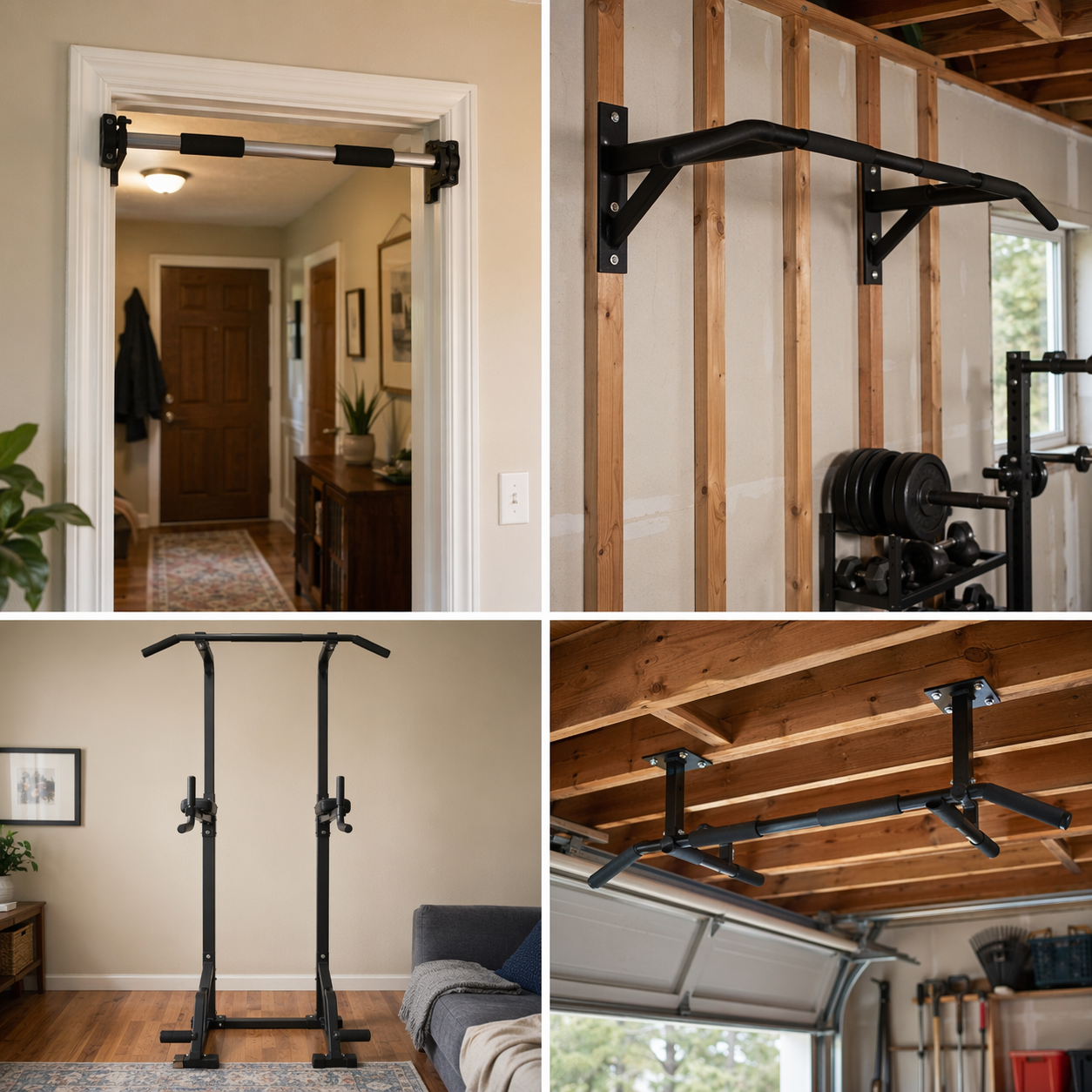
Choose by eliminating the bad fit first
Use this as the first pass, before brand names or grip angles enter the conversation.
| Your constraint | Usually rule out | Usually consider |
|---|---|---|
| You cannot drill and cannot risk trim damage | Wall-mounted and ceiling-mounted bars; many leverage-style doorway bars | Freestanding bar or power tower |
| You can drill into wall studs | Loose doorway setups for serious training | Wall-mounted bar or above-door stud-mounted bar |
| You have a compatible doorway but little floor space | Power towers and wide freestanding stations | Doorway bar, if trim and width check out |
| You want kipping, dynamic reps, or attachments | Most doorway bars; some freestanding foldable bars with explicit restrictions | Stud-mounted wall bar, properly installed; sometimes ceiling-mounted |
| You have garage or basement joist access | Doorway-only thinking | Ceiling-mounted or wall-mounted bar |
| You are unsure you will train consistently | Expensive permanent setups as a first move | Doorway bar if compatible, or a used/foldable freestanding option if drilling is off-limits |
The biggest mistake is treating listed weight capacity as the whole safety answer. Capacity matters, but it does not tell you whether your door casing is shaped correctly, whether the screws are in studs, whether the tower rocks on your floor, or whether the bar feels steady when you lower slowly instead of dropping off at the top.
Doorway bars: convenient only when the doorway cooperates
Doorway bars earn their popularity honestly: they are inexpensive, removable, and realistic for strict pull-ups in a small apartment. Category comparisons commonly place door pull-up bars around a practical maximum load of about 265 pounds, or 120 kilograms, while wall-mounted bars sit higher as a category.[1] That does not mean every doorway bar is unsafe. It means this is not the category to stretch into aggressive movement or sloppy installation.
The catch is the doorway itself. There is no single “standard” trim profile that every leverage bar fits. Wide trim, crown molding, unusually shallow frames, or fragile casing can prevent a secure mount or leave marks over time. Reviews by Wirecutter and Men’s Journal both flag doorway and trim compatibility as a real buyer concern rather than a cosmetic footnote.[2][3]
Wirecutter’s tested top pick, the Ultimate Body Press Elevated XL, is a useful example of the category’s tradeoff rather than a universal answer. It adjusts for doorways 24 to 36 inches wide and lists a 300-pound capacity, but Wirecutter also notes that it takes roughly 30 minutes longer to assemble than simpler options and needs substantial storage space when not in use.[2] Check the current listing before relying on those details. That is the doorway-bar bargain in miniature: less permanent than drilling, but not automatically tiny, invisible, or compatible.
Choose a doorway bar if you are doing strict pull-ups or hangs, your doorway width and trim match the product’s requirements, and you can tolerate either leaving the bar up or storing an awkward object between sessions. Skip it if your lease deposit depends on pristine trim, your doorway has unusual molding, or your training plan includes kipping, swinging, muscle-ups, or loaded pull-ups.
Wall-mounted bars: the regular-training choice, if the studs are yours to use
If you can drill into studs and you expect to train regularly, a wall-mounted bar is usually the cleaner long-term answer. Brand-owned category guidance commonly puts wall-mounted bars around 550 pounds, or 250 kilograms, as a typical upper range and describes them as more suitable for dynamic movement than doorway bars.[1] Garage Gym Reviews’ 2026 pull-up bar testing includes wall-mounted examples such as Titan’s model with a listed 500-pound capacity, which fits that broader pattern.[4]
The stability comes from the same thing that makes the choice serious: the bar is attached to the building. Screws must hit studs, not just drywall. The mounting height has to leave room for your head above the bar and your legs below it. If you rent, you need permission or a realistic plan for patching holes when you move.
Above-door stud-mounted bars sit between a removable doorway bar and a full wall station. The Rogue Jammer, for example, is discussed by Garage Gym Reviews as an above-door option that still requires mounting into studs.[4] That can work for some renters because the holes may be patchable, but it is not magically lease-proof. It is a drilling choice, just a more compact one.
Choose wall-mounted if pull-ups are a real part of your routine, you have a suitable wall, and you want fewer questions about wobble. It is also the first category to consider if you care about controlled negatives, weighted pull-ups, kipping, or attaching other gear. If you cannot verify studs or cannot make holes, do not talk yourself into “probably fine.” That is how a cheap bar becomes a drywall repair.
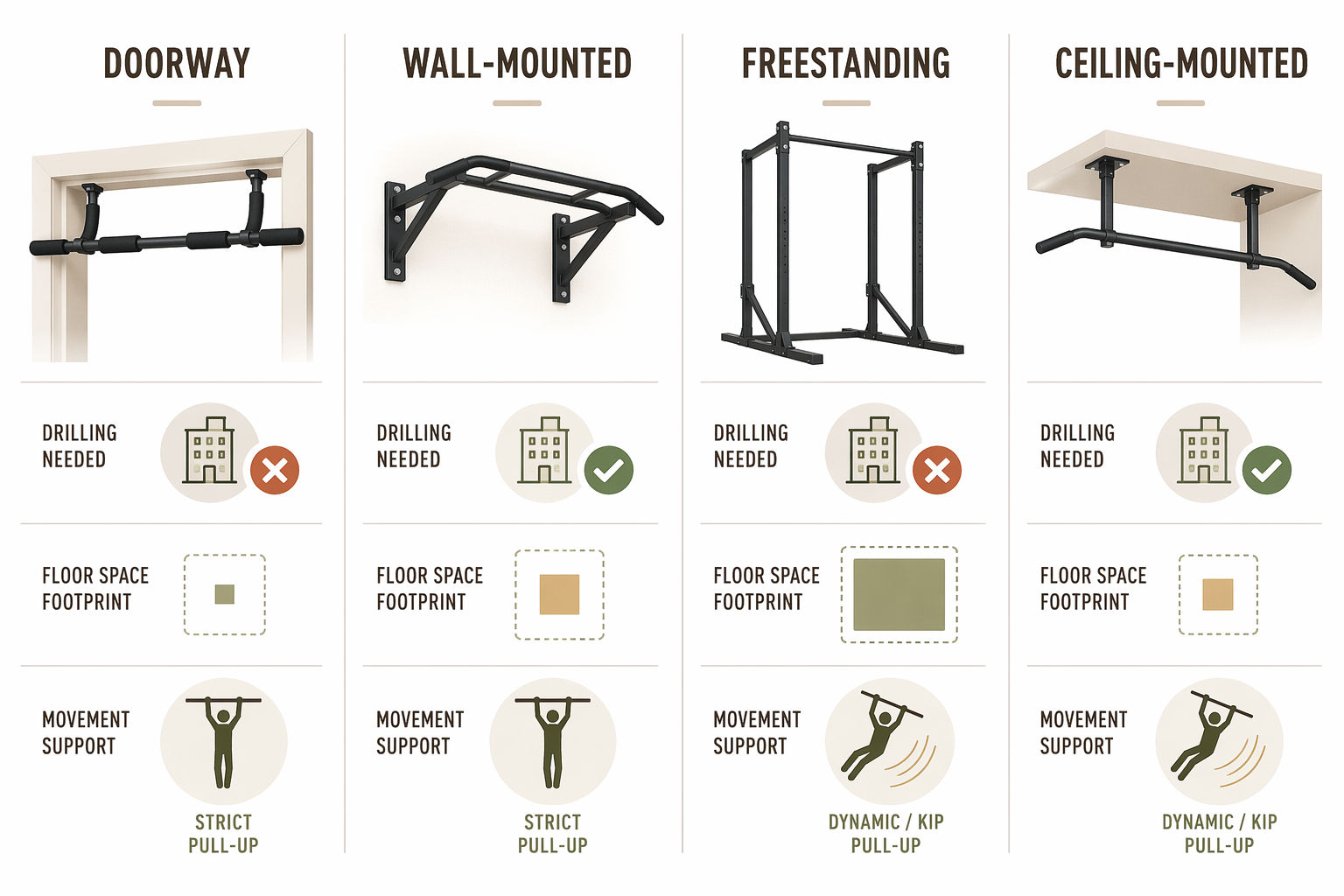
Freestanding bars: no drilling, not no compromise
A freestanding pull-up bar or power tower is the obvious escape route when you cannot drill and do not trust the doorway. It can also give you dip handles, push-up grips, or more exercise options. The tradeoff is physical: it needs floor space while you train, and often while you store it. In a small room, that footprint matters more than the product photo suggests.
The category has a wide spread. Garage Gym Reviews lists BaseBlocks The Big Bar at a 660-pound capacity, $249 price, about 15 minutes of assembly, and a folding design that reduces its stored footprint by about 30 inches.[4] BULLBAR lists its own freestanding unit at 400 pounds, $499, no assembly required, a folded size of 45 by 13 by 11 inches, and a slip-resistant base.[5] Those are both “freestanding,” but they solve storage, price, and setup in different ways.
Movement restrictions deserve close reading here. BULLBAR’s own product page explicitly prohibits muscle-ups, kipping pull-ups, and TRX attachment.[5] That does not condemn the category; it is exactly the sort of warning buyers should look for. A no-drill bar can be strong enough for strict reps and still be the wrong tool for swinging or hanging accessories from one side.
Choose freestanding if drilling is off the table, your doorway is not trustworthy, and you have a place where the unit can live without becoming furniture you resent. If you are comparing several types of compact equipment at once, it may help to step back to a broader compact home gym decision guide before spending half the budget and half the room on one station.
Ceiling-mounted bars: useful when the overhead structure is obvious
Ceiling-mounted bars are not the default first pull-up bar for most bedrooms or apartments. They make more sense in garages, basements, and utility spaces where joists are accessible and the ceiling height leaves room to hang without bending your knees into a wall or door.
Treat this as a structural choice, not a decorating choice. You need joist access, correct fasteners, enough clearance around the bar, and a location that will not put your head into a garage-door track or low beam. If those conditions are easy to verify, ceiling-mounted can be excellent. If they require guesswork, wall-mounted or freestanding is usually the less annoying route.
What the price usually tells you
Price is a useful filter, but it should not outrank fit. BarBend and Garage Gym Reviews pricing data put average pull-up bar costs roughly around $155 to $197 across tested or reviewed options, while doorway bars often sit around $30 to $60, wall-mounted bars around $70 to $150, and specialty or freestanding options commonly exceed $150.[6][4]
That range explains why doorway bars attract beginners: the entry price is low. But the cheapest bar is not cheap if it damages trim, cannot fit your doorway, or gets abandoned because you hate taking it down. A $150 wall bar can be a bargain for an owner who trains four days a week. A $300 freestanding setup can be wasteful in a room where it blocks the closet.
If the pull-up bar is one piece of a larger setup, compare it against your full equipment budget rather than treating it as an isolated purchase. A broader home fitness budget breakdown can help you decide whether the bar should be the main investment or just the first inexpensive layer.
Quick matches for common homes
- Renter with no drilling permission: Start with freestanding. Consider doorway only if the trim, width, and damage risk are clearly acceptable.
- Owner training regularly: Wall-mounted is usually the first serious option, assuming studs and clearance are easy to verify.
- Small apartment with storage pressure: Doorway may work for strict training, but measure storage too. Foldable freestanding bars can help, though they still need a training footprint.
- Garage user with exposed studs or joists: Wall-mounted or ceiling-mounted both make sense; choose based on clearance and where the bar will not interfere with storage or doors.
- Beginner unsure about consistency: Avoid the most permanent or expensive answer until you know you will use it. Compatibility still comes before price.
- Dynamic-movement goal: Skip most doorway bars and read freestanding restrictions carefully. A properly installed stud-mounted bar is the safer starting category.
Test stability before you trust the number on the box
After installation, do not jump straight into hard reps because the listing shows a large capacity. A practical stability screen is simple: dead hang for 20 to 30 seconds, perform a 3- to 5-second eccentric, and pause at the top and bottom of a rep while watching for shifting, creaking, slipping, or rocking. BULLBAR’s small-space stability checklist uses this kind of dead-hang and slow-lowering approach as a way to expose bars that feel fine only during quick reps.[7]
Use that test with the source in mind: BULLBAR is a brand, not an independent lab. The method is still sensible because it checks the thing you actually need to know at home: whether this bar, in this location, under your body, stays put when the movement slows down.
Go/no-go checklist before comparing models
- Confirm permission: drilling into studs or joists, if required, is allowed or realistically patchable.
- Measure the actual space: doorway width, trim shape, ceiling height, wall clearance, or freestanding footprint.
- Match the movement: strict pull-ups and hangs need less stability than kipping, weighted work, muscle-ups, or attachments.
- Read product restrictions: especially for foldable and freestanding bars that may prohibit swinging or accessory use.
- Plan storage: removable does not always mean small, and freestanding does not always mean easy to live with.
- Run the stability test: dead hang, slow eccentric, and pauses before regular training.
Once those checks pass, then compare specific models. And once the bar is installed, use a plan that matches the equipment you actually bought, not the equipment in a product photo. A progressive home gym workout plan is a better next step than adding a second bar because the first one did not fit the way you train.
References
- Door Pull-up Bars vs. Wall Pull-up Bars – The Differences, Pullup & Dip
- The 3 Best Pull-Up Bars of 2025, Reviews by Wirecutter
- Best Pull-Up Bars, Men's Journal
- Expert-Tested: Best Pull-Up Bars (2026), Garage Gym Reviews
- BULLBAR product page, BULLBAR
- Best Pull-Up Bars, BarBend
- In a Small Space, the Best Pull-Up Bar…, BULLBAR
Comments
Join the discussion with an anonymous comment.