
Why Most Home Cardio Advice Is Useless to You
You live on the third floor. No elevator. The second “best cardio exercise” on a popular list is jumping jacks. The floor shakes. The neighbor below bangs on the ceiling. You stop after two reps—not because you are tired, but because you literally cannot do this here.
That is not a failure of motivation. It is a failure of matching. The listicle assumed a house with a basement or a ground-floor apartment with concrete floors. It did not ask about your space, your noise tolerance, or your equipment. I have seen this exact scenario dozens of times. People blame themselves, but the advice should be blamed.
The American Heart Association reports that only about one in five adults gets enough exercise to maintain good health. That statistic is usually framed as a problem of willpower or convenience. I think it is also a problem of advice. When every roundup ignores the constraints that actually determine whether a workout can happen, people stop trying. And honestly, I don't blame them.
Four Questions You Need to Answer Honestly
Before you pick a single exercise, answer four questions. Each one will narrow your options sharply. Do not lie to yourself. No one is watching.
| Constraint | What to ask yourself | Your score (1–5) |
|---|---|---|
| Space | How much clear floor area do you have? Can you fully extend your arms and legs in every direction? Is your ceiling height normal or low? (1 = cramped corner, 5 = spare room or garage) | |
| Noise tolerance | Do you share walls, floors, or ceilings with neighbors? Is your building old with thin construction? Can you make thumping sounds without disturbing anyone? (1 = upstairs apartment with thin floors, 5 = ground floor house with no one below) | |
| Equipment | What do you own? Nothing? A yoga mat? Resistance bands? Dumbbells? A walking pad? (1 = no equipment, 5 = several pieces including a cardio machine) | |
| Experience | Have you done structured cardio before? Can you pace yourself or do you need guided intervals? (1 = new to exercise, 5 = comfortable with intervals and intensity changes) |
If your scores cluster low on space and noise (say, 1–2 on both), you belong in the quiet, small-space archetype. If you have space and tolerance but little experience, a steady-state approach fits. The grid does the matching so you do not have to guess. But be honest: if you score a 3 on noise but you know your neighbor is sensitive, treat it as a 2. The framework only works if you are honest.
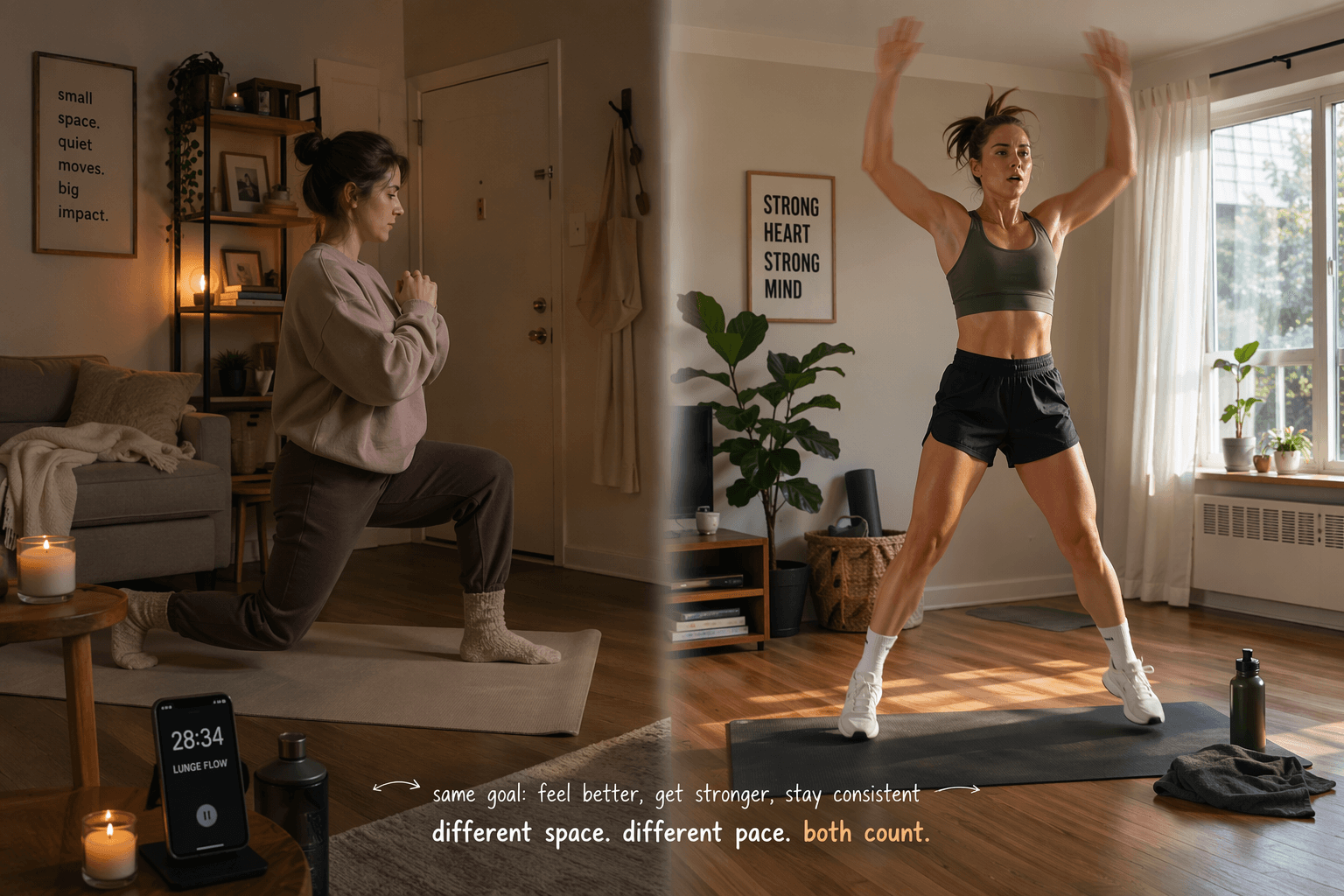
Five Archetypes – Pick One and Start
Each archetype below is defined by its constraint signature. The sample sessions and 4-week plans are designed to feel native to that profile—no repackaged jumping jacks for quiet spaces, no long holds for beginners with low endurance. I checked each one against the constraint profile. They fit.
1. Cozy Starter — Low space, low noise tolerance, beginner, no equipment
This is the entry point for people who have tried nothing because every suggestion felt too hard or too loud. Cozy cardio—walking in place, gentle marching, step-touch, low squats—lowers the psychological barrier. The Cleveland Clinic notes it can serve as an entry point. But here is the catch: there is a real risk of staying too cozy and never reaching moderate intensity. I have seen people do gentle steps for weeks and wonder why they are not getting fitter. You must push.
Your 15-minute sample session:
- 3 min warm-up: Walk in place at a comfortable pace, swing arms naturally (RPE 2–3)
- 4 min: March with knees lifting to hip height, arms pumping (RPE 4)
- 2 min: Step-touch side to side with controlled arm reach overhead (RPE 4)
- 3 min: Walking in place with a slight heel raise on each step (RPE 5)
- 3 min cool-down: Slow walk, shake out arms and legs (RPE 2)
Your 4-week plan: Add two minutes each week by extending the moderate segments. Week 2: 3 min warm-up, 5 min moderate, 2 min step-touch, 3 min heel raises, 2 min cool-down. Week 3: 5 min moderate, 3 min step-touch, 4 min heel raises, 3 min cool-down. Week 4: aim for a continuous 20-minute session at RPE 4–5. If you cannot sustain the talk test (able to speak in short sentences without gasping), scale back. Do not stay at week 1 forever.
2. Quiet Apartment — Low noise ceiling, limited space, intermediate, minimal equipment
You have enough space for a yoga mat lengthwise, but jumping is out of the question. No burpees, no tuck jumps. The solution is low-impact, circuit-style work that raises your heart rate without leaving the ground—like bodyweight squats, lunges, push-ups, controlled mountain climbers, and inchworms. SELF’s quiet workout ideas show how Tabata (20 s work / 10 s rest), EMOM, and AMRAP can work without noise. I will not reprint their lists here. If you need more detail on this profile, see our quiet cardio guide.
A quick 15-minute EMOM sample:
- Minute 1: Bodyweight squats (15 reps)
- Minute 2: Push-ups (10 reps) or knee push-ups
- Minute 3: Reverse lunges (10 each leg)
- Minute 4: Plank hold (20 sec)
- Minute 5: Mountain climbers (20 reps, controlled pace)
- Repeat circuit three times, resting 1 minute between rounds.
Progression: Over four weeks, increase the number of reps or reduce rest. Week 1: 3 rounds with 60 s rest. Week 2: 4 rounds with 45 s rest. Week 3: 5 rounds with 30 s rest. Week 4: attempt 6 rounds with 20 s rest.
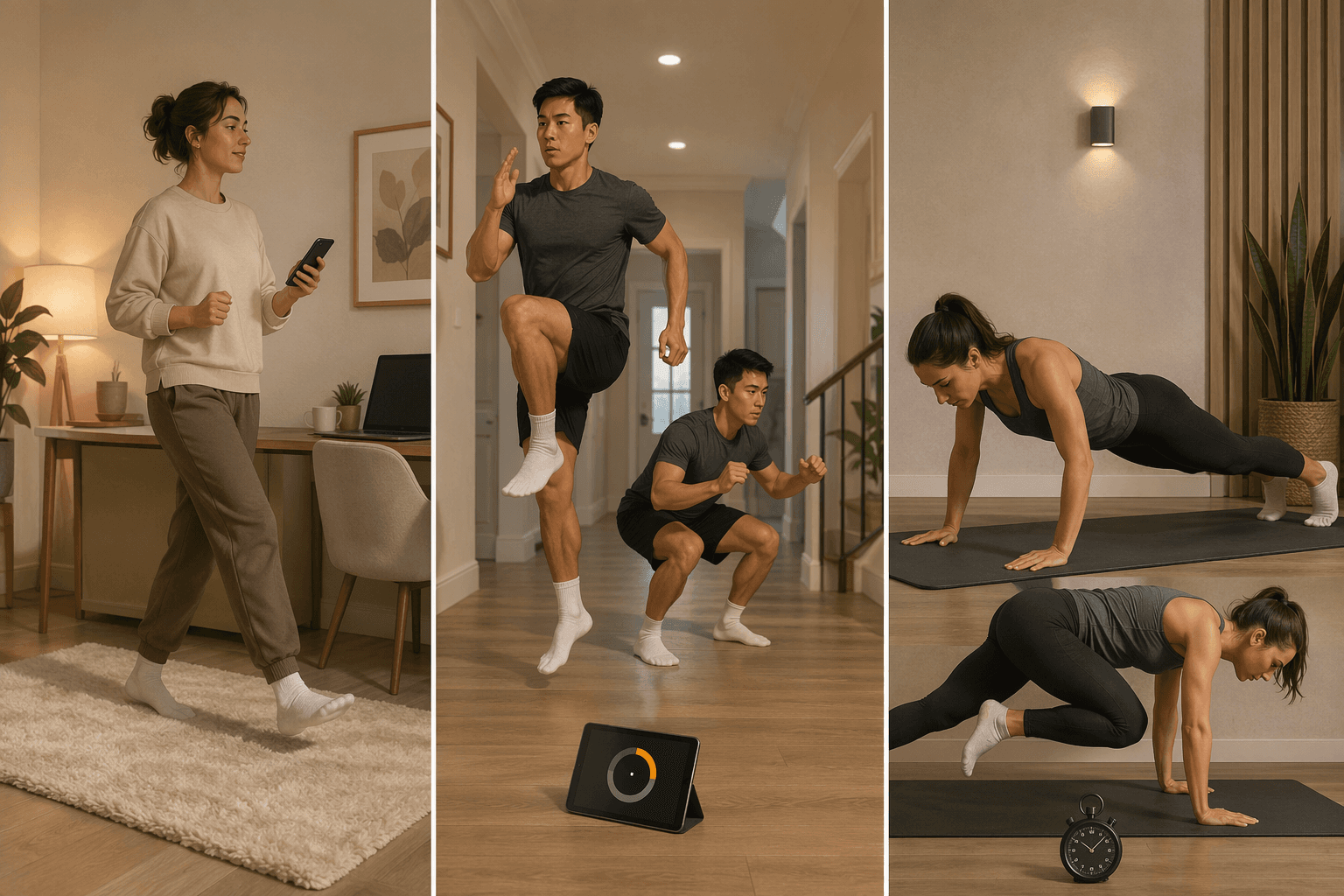
3. Limited Space, High Energy — Small area, no noise worries, intermediate
You have a tight footprint—maybe a 5x5 foot cleared spot—but the floor is ground-level or well-insulated, so you can jump. HIIT circuits are your friend. High knees, burpees (without the push-up if needed), squat jumps, and plyo lunges fit in a small area. A simple 15-minute Tabata: 20 seconds of work (burpees), 10 seconds rest, repeat 8 times. Warm up for 3 minutes with light jogs in place, then go. Progressive overload: increase the work interval to 25 seconds in week 3, and add a second Tabata set (with a different exercise like high knees) in week 4.
4. Open Space, Steady State — Moderate space, good noise tolerance, all levels
If you have room to take several steps in one direction and noise is not a concern, steady-state cardio becomes practical. Walk back and forth, jog in place, or use a machine (walking pad, exercise bike). A 20-minute session: 5 min warm-up at RPE 3, 10 min at RPE 5 (brisk walk or light jog), 5 min cool-down. Each week add 2 minutes to the middle segment until you reach 30 minutes. This is the simplest archetype and the easiest to sustain long-term.
5. Home Athlete — Adequate space, experienced, possibly with gear
You have a dedicated workout area, a few pieces of equipment (dumbbells, resistance bands, maybe a jump rope), and comfort with intervals. Progressive Tabata or EMOM with added complexity—like weighted squat jumps or banded sprints. Sample 15-minute EMOM: minute 1 – dumbbell thrusters (8 reps), minute 2 – jump rope (30 seconds), minute 3 – burpees (10 reps), minute 4 – plank to toe taps (10 each side), repeat 3 rounds. Increase intensity by adding weight or reducing rest.
Are You Working Hard Enough? The Talk Test
Once you start a plan, you need a way to check intensity without a heart rate monitor. The talk test works: at moderate intensity you can speak in short sentences; at vigorous you can only say a few words. The Rate of Perceived Exertion (RPE) scale uses 1–10: 3–4 is moderate, 5–7 is vigorous.
A large study in Circulation tracked 116,221 adults over 30 years and found that those who did 300–599 minutes of moderate activity per week had 26–31% lower all-cause mortality. The jump from inactive to even modest levels (75–150 min vigorous or 150–300 min moderate) reduced cardiovascular disease mortality by 22–31%.
Those numbers are impressive, but they come from people who likely had parks, gyms, and quiet spaces. If you are doing bodyweight squats in a 5x5 corner, 300 minutes per week may be unrealistic. That is fine. The goal is to move from where you are to a level that is maintainable. The American Heart Association’s baseline of 150 minutes of moderate activity per week is a solid north star. Start there and let the talk test confirm you are working hard enough.
When You Plateau, Here's What to Do
After four to six weeks, you may hit a plateau. Two paths forward: add equipment or manipulate intensity.
If your space and budget allow, a walking pad is the quietest, most space-efficient upgrade. It turns a 20-minute walk-in-place routine into a measurable, progressive activity—you can increase speed and incline. Read our comparison of walking pads vs. treadmills to see which fits your constraint profile.
If you cannot or do not want to buy gear, push harder within your existing setup:
- Slow down the eccentric (lowering) phase of bodyweight squats or lunges.
- Reduce rest periods between circuits by 10–15 seconds.
- Add a pulse at the bottom of a squat or a hop at the top (if noise allows).
- Switch from Tabata (20/10) to shorter rest (15/5) for a tougher dose.
A study in Health.com found that home workouts are equally effective as gym workouts when consistency is present. But consistency itself is harder without the gym’s structure. That is exactly what the constraint-matched plans aim to fix. Once you have a routine that actually fits your life, the ceiling is much higher than you might think.
Your Constraints Are Parameters, Not Excuses
The core idea is simple: matching your routine structure to your real constraints matters more than the exact exercises you pick. That 15-minute session will work—if you actually do it three times a week, and if it pushes you appropriately for your space and noise level.
Pick your archetype, start the 4-week plan, and measure your progress with the talk test. That is the system. Not a list of 20 random moves. Not a guilt trip about not going to a gym. A framework that starts with where you live.
Comments
Join the discussion with an anonymous comment.