
Before comparing a Tonal, a rack, a cable machine, or a dumbbell setup, measure the part of the room you can actually lose. Not the empty-looking corner in a listing photo, and not the floor area before the bench is pulled out. A compact home gym has to survive the door swing, the closet path, the person walking past it, and the day you are tired enough to skip any setup that feels annoying.
The cleanest first filter is four-part: usable square footage, budget ceiling, subscription tolerance, and training style. If one of those is wrong, the spec sheet stops mattering.
- Usable square footage: the space after doors, furniture, walking paths, bench clearance, and exercise movement are accounted for.
- Budget ceiling: the amount you can spend without depending on future enthusiasm to justify the purchase.
- Subscription tolerance: whether a monthly fee will still feel acceptable in year three, not just during the first guided workout.
- Training style: strength, general fitness, guided cardio-hybrid training, or a mix that changes what kind of resistance and stability you need.

Start With the Approach, Not the Product
Most compact home gym mistakes happen because people shop across categories as if they are interchangeable. They are not. A wall-mounted smart gym, a folding rack, an all-in-one cable station, and a modular dumbbell setup all solve different space problems and create different long-term obligations.
| Approach | What it solves best | Space reality | Cost reality | Best fit |
|---|---|---|---|---|
| Smart wall-mounted gym | Guided strength and fitness programming in a very shallow wall profile | Tonal 2 mounts at 5.25 inches deep, but requires wall studs and a 7'10" ceiling; Speediance Gym Monster folds to about 15 inches deep | Tonal 2 is listed at $4,295 plus $60/month; Speediance Gym Monster is listed at $3,199 | Users who value coaching, compact visual footprint, and digital resistance |
| Foldable strength rack | Barbell training without giving the room away full-time | PRx Profile PRO folds to 12 inches deep between workouts and supports 1,000 pounds | PRx Profile PRO is listed at $1,099 with no subscription | Strength-focused lifters who have wall structure and setup clearance |
| All-in-one cable machine | Cable exercises and guided movement variety without a subscription | Bells of Steel All-in-One uses a 54.6-inch by 59-inch footprint with a 210-pound weight stack | Bells of Steel All-in-One is listed around $1,300 with no subscription | Users with a dedicated corner who want cable training more than floor flexibility |
| Modular adjustable-dumbbell setup | Flexible training with equipment that can be stored or moved | REP Quickdraw dumbbells, a bench, and bands can be split around the room instead of occupying one permanent machine footprint | REP Quickdraw dumbbells start at $336; Ironmaster Super Bench Pro V2 is $499; Living.Fit bands are $129 | Renters, beginners, couples sharing space, and general fitness users |
That table is not a ranking. It is a sorting tool. The wall-mounted smart gym looks almost magical when it belongs in the room. The folding rack is the more honest choice when load and stability matter. The cable machine is only compact if you really have the footprint. The modular setup looks less dramatic, but it is the easiest to move, downgrade, expand, and live around.

A Practical Decision Tree
Use the questions in order. The early ones are deliberately boring because they prevent the expensive errors.
- Do you have a structurally suitable wall, studs, enough ceiling height, and permission to mount? If yes, a smart wall gym or foldable rack can stay in the conversation. If no, move toward modular equipment or a freestanding cable machine.
- Can the room give up a machine footprint while you train? If not, avoid floor-dominant cable machines and prioritize wall-mounted, foldable, or modular gear.
- Will $40–$60 per month still feel fair after the novelty wears off? If yes, smart gyms may earn their place through programming. If no, do not pretend the monthly cost is incidental.
- Do you mainly want progressive strength training? If yes, favor a rack, cable machine, or heavy-enough modular setup over a system chosen mostly for its screen.
- Do you need something a renter can relocate without drama? If yes, modular equipment is the safest default.
For a deeper category-by-category comparison after this first sort, the compact home gym equipment types guide is the better next stop. This article stays at the decision level: which lane deserves your attention before you start comparing models.
Space Brackets Rule Out More Than They Recommend
A compact product can still be wrong for a small room. Mounted depth, folded depth, and machine footprint are only the stored dimensions. Training depth is what happens when a bench comes out, arms swing, cables travel, or a barbell needs clearance.

Under 10 Square Feet
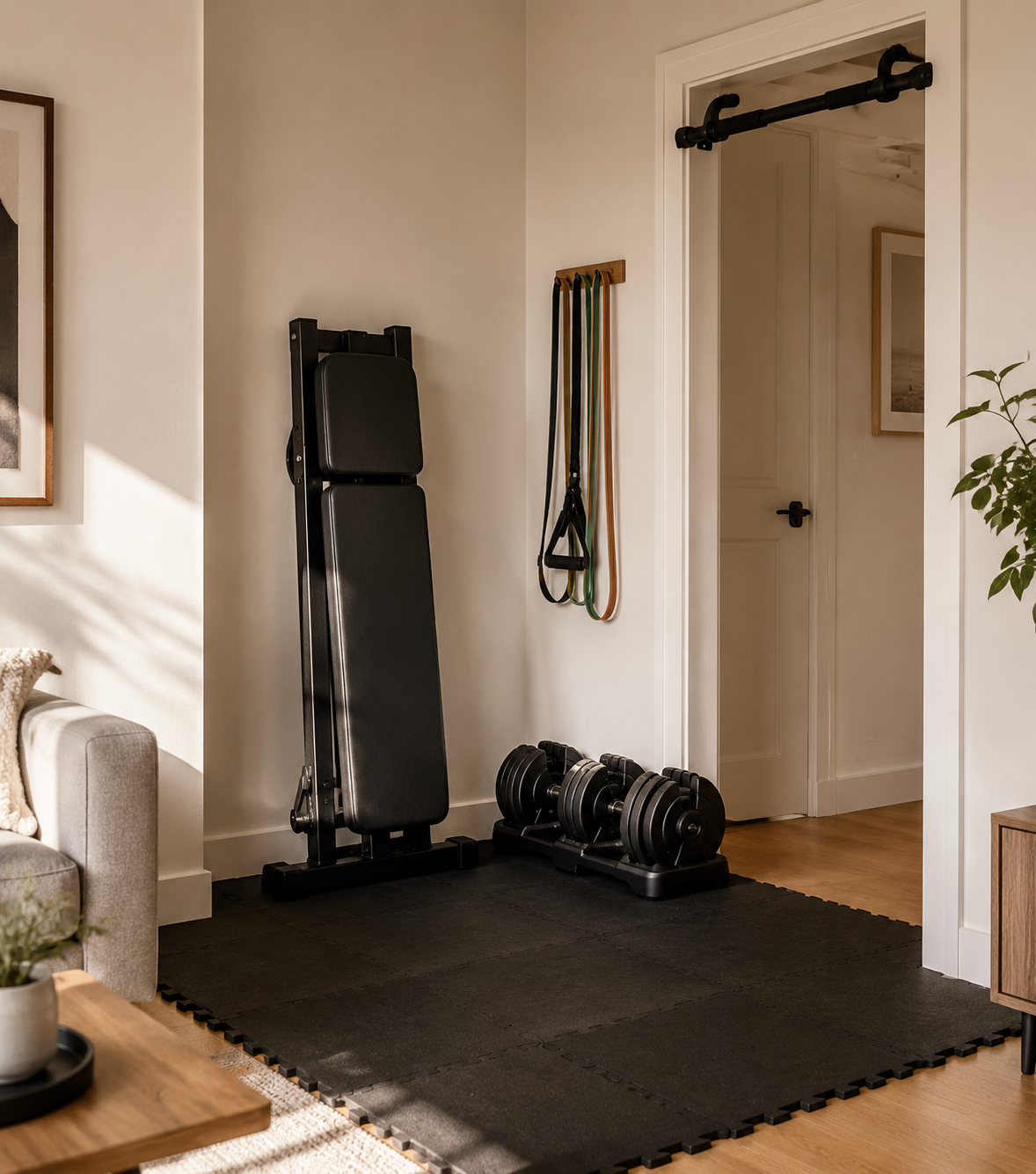
Under 10 square feet is not a tiny gym room. It is a storage-and-setup zone. In this bracket, modular equipment usually wins because it can live in pieces: dumbbells under a console table, bands in a drawer, a bench folded or moved against a wall. REP Quickdraw adjustable dumbbells cover 5–60 pounds, Living.Fit bands are rated up to 250 pounds, and the Ironmaster bench gives the setup a real training surface without asking for a permanent machine footprint.[1]
A wall-mounted smart gym can physically look compatible here because Tonal 2 sits only 5.25 inches off the wall when mounted. That does not mean every under-10-square-foot area works. You still need the right wall, studs, ceiling, arm clearance, and a place for the body to move in front of it. Tonal’s 7'10" ceiling requirement is the kind of constraint that should be checked before price, color, or class library.[1]
Foldable racks and cable machines usually do not belong in this bracket unless the room has unusual geometry. A PRx rack may fold to 12 inches deep, but barbell training needs open space during the workout. A Bells of Steel All-in-One footprint of 54.6 inches by 59 inches effectively consumes the bracket by itself before the user stands in it.[1]
10–25 Square Feet
This is the bracket where choices become tempting and mistakes become more expensive. A renter with a 4-by-5-foot corner may feel close to a real gym, but the correct question is still what happens during a set. Can a bench slide out? Can cables move without clipping furniture? Can another person cross the room while equipment is open?
Smart wall-mounted systems make the most sense here when the wall is eligible and guided programming is part of the value. CNET’s 2026 smart home gym coverage treats smart gyms as a distinct category built around connected coaching, resistance systems, and guided training rather than simply small equipment.[2] That distinction matters because the screen and software are not decoration; they are part of what the buyer is paying for.
A foldable rack can also work in this bracket if the wall mounting is allowed and the lifter accepts setup rituals: folding down, moving the bench, loading plates, clearing the area, and folding back. The reward is real load capacity. The PRx Profile PRO is listed with 1,000-pound support and no subscription, which makes it a different kind of commitment from a smart gym.[1]
All-in-one cable machines are borderline in 10–25 square feet. They can fit on paper and still make the rest of the room worse. If a 54.6-by-59-inch machine turns a shared room into a permanent equipment zone, it is not compact in the way an apartment dweller usually means compact.[1]
25–50 Square Feet
At 25–50 square feet, the room can start supporting a dedicated training identity. This is where an all-in-one cable machine becomes reasonable, a foldable rack becomes easier to use, and a modular setup can expand without feeling like scattered clutter.
Garage Gym Reviews notes a 7-by-7-foot, or 49-square-foot, general minimum for floor-based workouts plus one equipment piece, while also noting that actual needs vary by user height and equipment type.[3] That is useful as a planning reference, not a universal rule. A tall lifter pressing overhead, a couple sharing the room, and a beginner doing bands and dumbbells do not need the same clearance.
If you are choosing within this bracket, the more detailed compact home gym space tiers guide can help refine the layout after the approach is clear.
The Five-Year Cost Changes the Comparison
Upfront price is the number people notice. Five-year cost is the number they live with. Smart gyms are the obvious place to check this because the subscription is not a side note; it is part of the product experience.
| Setup | Example first cost | Monthly cost | Five-year total before accessories, taxes, installation, or price changes |
|---|---|---|---|
| Tonal 2 | $4,295 | $60/month | $7,895 |
| Tonal 2 with the five-year total cited in the brief | $4,295 | $60/month | About $8,390 |
| Modular example: REP Quickdraw dumbbells, Ironmaster bench, Living.Fit bands | $964 | $0/month | $964 |
| Modular example rounded with small accessories allowance | About $1,014 | $0/month | About $1,014 |
The table is not saying the cheaper setup is automatically better. It is saying the smart-gym buyer should be buying the coaching, interface, tracking, and guided structure on purpose. If those features keep training consistent, they may be worth paying for. If they are mainly impressive during the first demo, the long-term cost gets harder to defend.
Garage Gym Reviews lists the average home gym machine cost at $1,855 and notes resale value observations around 40–60%.[3] That resale range is a reminder to be cautious with large purchases, not a promise that a specific machine will hold value. A heavy or wall-mounted product can be harder to sell, move, or reinstall than a pair of adjustable dumbbells.
FitnessFactory.com’s 2026 all-in-one home gym coverage is useful here because it shows that cable and multi-station systems occupy a middle zone: often less expensive than premium smart gyms, more equipment-like than modular free weights, and still large enough to demand a real footprint.[4] They can be excellent when the room is ready for them. They are poor compromises when chosen just to avoid a subscription.
Readers who want a fuller cost ladder can use the home gym cost breakdown from $500 to $5,000. If your practical ceiling is closer to $1,000, the $1,000 compact home gym system gives the modular route a concrete shape.
Match the Setup to the Training You Will Actually Do
Training style is secondary to space and budget only because a setup that does not fit the room will not last long enough to serve any goal. Once the physical and financial constraints are real, the training match matters a lot.
Strength-Focused Lifters
If your training revolves around progressive loading, stability, and familiar barbell or cable patterns, start with a foldable rack or an all-in-one cable machine. Digital resistance can be useful, but the headline number needs context. Tonal 2 lists 250 pounds of digital resistance, while Speediance Gym Monster lists 220 pounds; those numbers are not the same experience as a loaded barbell and do not make the systems interchangeable with a rack.[1]
A PRx-style wall rack asks more from the wall and the user, but it gives strength training room to grow. A cable machine gives variety and smoother accessory work, but it asks for a fixed footprint. The better choice depends on whether your main lifts need a rack or your routine is built around pulleys, rows, presses, and accessory patterns.
Cardio-Hybrid and Guided-Workout Users
Some people do train more consistently when the workout is chosen, displayed, timed, and coached. That is a real value, especially for beginners or anyone who dislikes building programs from scratch. Smart gyms belong in the conversation for those users, provided the wall, ceiling, and subscription still make sense.
Cardio equipment can also be part of a compact setup, but it should be judged by storage and use patterns. The Echelon Stride 6s-10 folding treadmill is listed at $1,999 and folds flat under a bed, which makes it different from equipment that simply claims to be space-saving while staying in the way all day.[1]
General Fitness and Shared Apartments
For general fitness, a modular setup is often the least glamorous and most durable answer. Adjustable dumbbells, bands, and a bench can support strength circuits, mobility work, conditioning, and beginner progression without permanently claiming the room. They also make fewer assumptions about future housing.
That matters in shared apartments. The best setup is not just the one you like during training; it is the one your partner, roommate, or future self does not resent between workouts.
When Each Approach Makes Sense
| Choose this approach | When these conditions are true | Be careful if |
|---|---|---|
| Smart wall-mounted gym | You have an eligible wall, enough ceiling height, a higher budget, and you value coaching enough to pay monthly | You are mainly drawn to the clean look but have not checked mounting, clearance, or five-year cost |
| Foldable strength rack | You want real strength training, have wall-mount permission, and can clear space during workouts | Your room cannot handle barbell movement even though the rack folds shallow |
| All-in-one cable machine | You have a dedicated 25–50 square foot zone and want cable variety without a subscription | The machine footprint would turn a shared room into a permanent gym |
| Modular adjustable-dumbbell setup | You rent, share space, have a tighter budget, or want the safest first compact home gym | You need very heavy barbell work or hate setting up equipment piece by piece |
NordicTrack’s compact gym guide is useful for the reminder that small-space planning has to account for dimensions, storage, and how equipment moves through a room, though it is brand-produced and should not be treated as a neutral product ranking.[5] That distinction is important across this whole category: manufacturer dimensions are useful; manufacturer enthusiasm is not the same as a fit assessment.
If you land on the smart-gym path, check the Tonal installation requirements before you compare accessories. If you land on the all-in-one path, the all-in-one home gym decision framework is the more useful next filter. If you are still between categories, the constraint-based equipment guide can help pressure-test the choice.
The right compact home gym is the one that fits the room, the budget, the ongoing cost tolerance, and the way you actually want to train. Once the approach is clear, product comparison becomes much easier—and much less likely to leave you with an impressive machine in the wrong apartment.
References
- Expert-Tested: The Best Compact Exercise Equipment (2026), Garage Gym Reviews
- Best Smart Home Gyms for 2026, CNET
- Best Home Gyms (2026) Personally Tested, Garage Gym Reviews
- Best All-In-One Home Gym Systems for 2026, FitnessFactory.com
- Compact Home Gym Setup: Smart Gear for Small Spaces, NordicTrack
Comments
Join the discussion with an anonymous comment.