
Compact home gym equipment sounds like one shopping category until you put it in an actual room. Then the differences get loud. Adjustable dumbbells can live beside a sofa but stop being enough if your legs outgrow them. Resistance bands disappear into a drawer but do not load like iron. A folding rack gives you real barbell training, provided your wall, ceiling, budget, and patience are all on board.
Before comparing individual products, it helps to eliminate whole categories. The question is not which compact gym is most impressive on paper. It is which type can stay set up, stay usable, and not make the room worse six months from now.
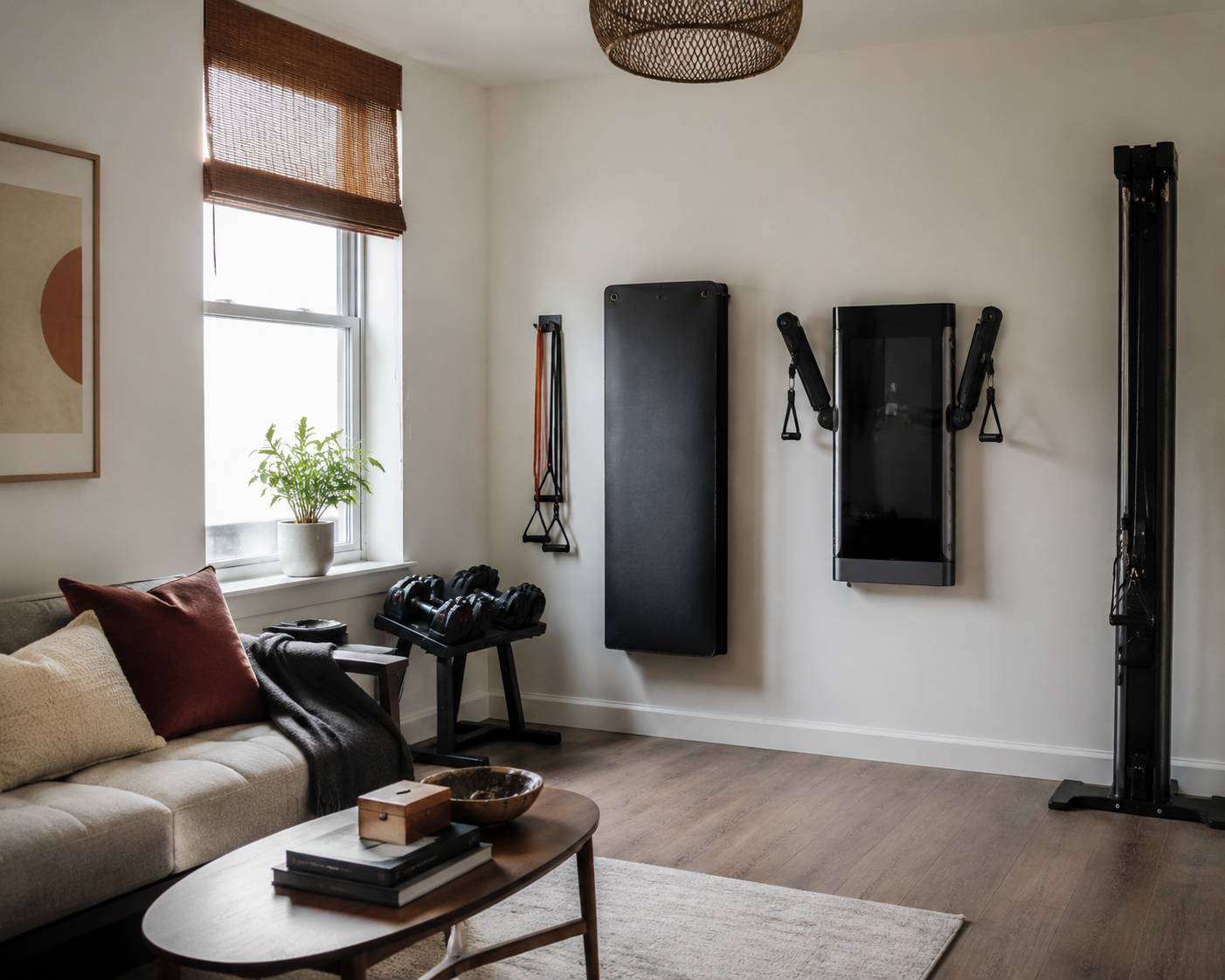
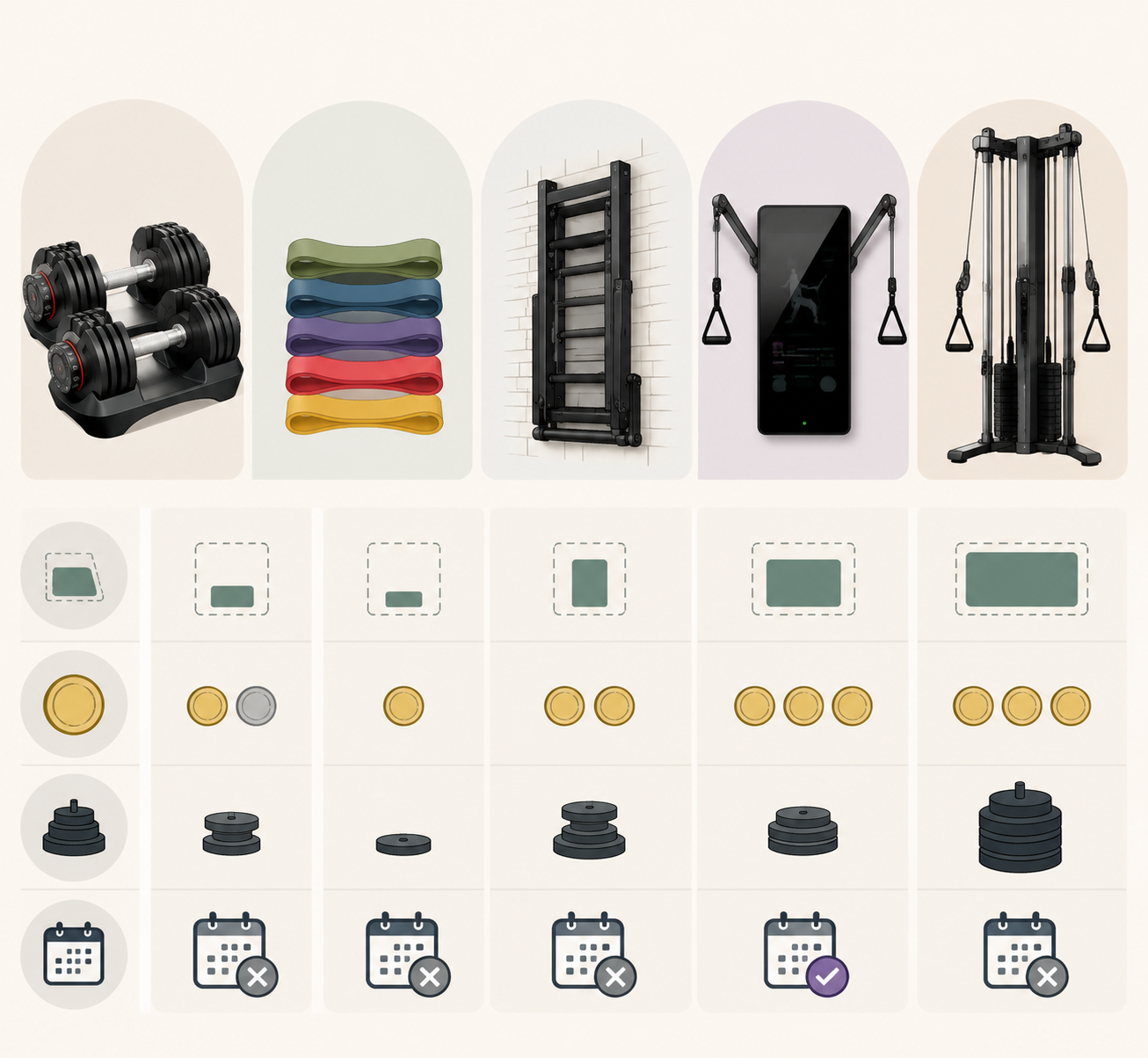
The category comparison that should happen before product shopping
| Category | Typical compact-space fit | Current example price | Resistance ceiling | Subscription | Best use | Eliminate it if |
|---|---|---|---|---|---|---|
| Adjustable dumbbells | Very small; REP QuickDraw is described as fitting in a shoebox-sized footprint | $335–$530 for REP QuickDraw | Up to 60 lb per hand | No | Progressive free-weight training in apartments, bedrooms, and shared rooms | You need heavy barbell-style lower-body loading or hate changing handles between exercises |
| Resistance bands | Smallest; Living.Fit bands fit in a drawer | $128 for Living.Fit | Manufacturer-rated up to 250 lb at full stretch | No | Travel, rehab-style work, accessory training, and very low-footprint strength work | You want free-weight feel, precise loading, or consistent resistance through the whole rep |
| Folding squat rack | Wall-based; PRx Profile PRO folds to 12 inches of depth | $1,099 for PRx Profile PRO before barbell and plates | Rack rated to support 1,000 lb | No | Barbell lifters who can install into a suitable wall and leave a lifting zone clear | You rent, cannot mount into studs, lack ceiling clearance, or do not want to buy plates |
| Smart wall-mounted gym | Tiny wall footprint; replaces many free-weight and cable movements | $4,295 for Tonal 2; $3,199 for Speediance Gym Monster | Digital resistance varies by system and is not the same category as plate-loaded free weights | Tonal: $60/month; Speediance: no subscription noted | Guided training, cable-style variety, and people who value coaching more than modular ownership | You dislike subscriptions, want open-ended upgrades, or need the lowest long-term cost |
| Compact cable machine | Corner or wall-adjacent footprint; larger than bands or dumbbells | $435+ for Bells of Steel Cable Tower; $1,299 for Bells of Steel All-in-One | Depends on stack, plate loading, or configuration | No | High exercise variety per square foot, especially pulls, rows, arms, and single-leg work | You do not have a permanent corner or want equipment that fully disappears after use |
That table is the useful part of the decision. If a category fails on installation, footprint, or total cost, it does not matter how good the best model is. A renter who cannot drill into studs can stop reading folding-rack reviews. Someone who wants guided sessions and hates programming may fairly keep Tonal or Speediance on the list even if a modular setup looks better on a spreadsheet.
Adjustable dumbbells: the cleanest first cut for most small rooms
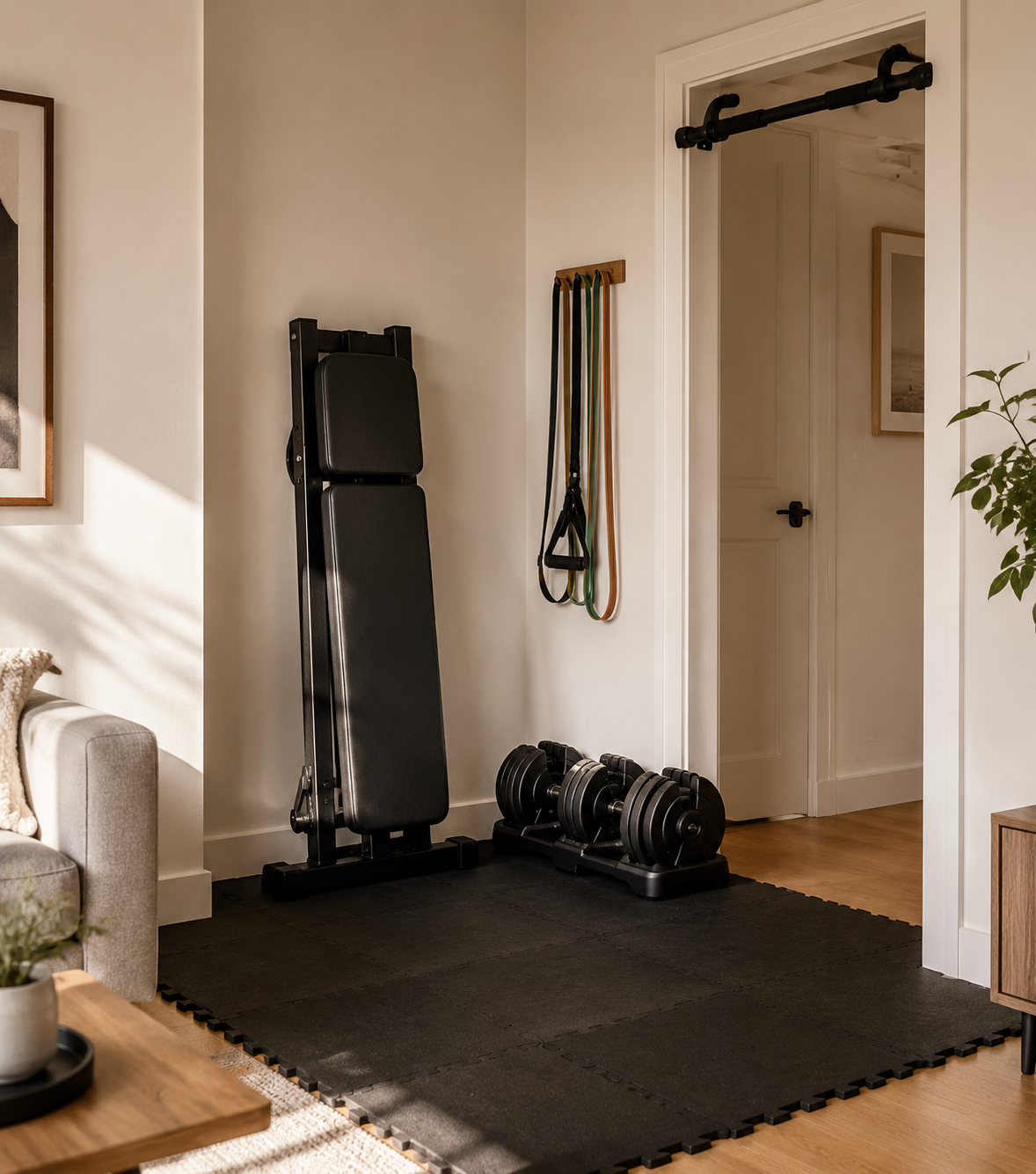
Adjustable dumbbells are usually the first category I would try to make work because they solve the most common small-space problem without asking the room to become a gym. The REP QuickDraw example makes the argument neatly: $335–$530, up to 12 dumbbell pairs replaced, a shoebox-sized footprint, and a top weight of 60 pounds per hand.[1]
That 60-pound ceiling is both generous and limiting. For presses, rows, curls, lateral raises, split squats, Romanian deadlifts, and many beginner-to-intermediate movements, it covers a lot. For stronger lifters, especially anyone trying to load squats and hinges heavily, it becomes the point where compactness starts collecting interest.
The other quiet advantage is friction. Dumbbells do not need Wi-Fi, wall brackets, a membership, or a cleared walking path beyond the space you need to lift safely. If they are stored on a small stand or in a corner, they are ready. That matters more than it sounds, because compact equipment that must be assembled every session eventually becomes decorative.
Eliminate adjustable dumbbells if your main goal is heavy barbell strength, if you need a machine-guided experience, or if grip and setup changes annoy you enough to skip workouts. Keep them on the list if you want the most flexible low-tech base for a bedroom, apartment, or shared living room.
Resistance bands are real training tools, not magic 250-pound barbells
Resistance bands deserve better than the usual two-line treatment. They are not just “better than nothing,” and they are also not a drawer-sized replacement for every loaded movement. The Living.Fit set cited in Garage Gym Reviews testing costs $128, fits in a drawer, and is rated up to 250 pounds of resistance.[2]
The important phrase is rated up to. Band resistance increases as the band stretches, so the hardest part of a movement is often the position where the band is most elongated. That is useful for some exercises and awkward for others. A 250-pound manufacturer rating at full stretch should not be read as equivalent to putting 250 pounds on a barbell, where the load remains the same through the rep.
The evidence is still meaningful. A 2019 meta-analysis by Lopes et al. in SAGE Open Medicine found that elastic band training can produce strength gains similar to conventional resistance training across multiple populations.[7] That supports bands as a serious option, especially when the alternative is no consistent resistance training at all. It does not mean bands feel like dumbbells, measure progression as cleanly, or solve heavy lower-body loading for everyone.
Bands are strongest as the smallest, cheapest, most portable category. They are also excellent as a second layer: assisted pull-ups on a rack, face pulls, pulldowns from an anchor, warmups, travel workouts, and higher-rep accessory work. Eliminate bands as your only system if you need exact load tracking, dislike anchoring equipment, or know that elastic resistance will make you feel undertrained even when the work is effective.
A folding rack is compact only after you solve the room
Folding racks are the category most likely to be called compact and still require a real conversation with your walls. The PRx Profile PRO is listed at $1,099, folds to 12 inches of depth, and is rated to support 1,000 pounds.[3] Folded up, that is elegant. In use, it is still a rack.
The rack itself is only the start. You need proper wall mounting, a barbell, plates, collars, enough floor space to lift, and enough clearance around the bar. Plate storage also has to go somewhere. In a garage or dedicated spare room, that trade can be excellent. In a living room with a couch that has to move every session, it may become a weekly negotiation.
This category is for people who already know they want barbell training and are willing to build the room around it. It is not the natural next step after “I want compact home gym equipment” unless heavy compound lifting is the point. Eliminate it if installation is uncertain, if your lease is unfriendly, or if buying plates would break the budget you thought belonged only to the rack.
Smart wall-mounted gyms compress the workout, not always the cost
Smart wall-mounted gyms are the most polished answer to the small-space problem. They can turn one wall into guided strength training, cable-style movement, tracking, classes, and programming. For the right person, that convenience is not fluff; it is the thing that makes training happen.
The ownership math needs to be visible before anyone falls in love with the screen. CNET lists Tonal 2 at $4,295, and Garage Gym Reviews notes a $60 monthly membership for Tonal 2.[4][5] Over five years, that membership adds $3,600 before considering taxes, accessories, installation, or price changes. Speediance Gym Monster is listed at $3,199 with no subscription requirement in the cited CNET comparison, which makes it a very different long-term purchase even though both sit in the smart-gym category.[4]
This is why smart gyms should not be compared to dumbbells as if they are just expensive weights. They are partly equipment, partly coaching interface, partly software ecosystem. If you will use the guided programming, the premium may be rational. If you already know how to train and only want resistance in a small footprint, the same money can buy a lot of modular equipment.
Eliminate smart wall-mounted gyms if you want the lowest five-year cost, dislike closed ecosystems, or do not want a screen and membership shaping your workouts. Keep them on the list if coaching, automatic progression, and a tidy wall-based setup are worth paying for.
Compact cable machines are the quiet alternative to smart gyms
Cable machines do not disappear the way bands do, and they are not as visually sleek as smart wall units. But for exercise variety per square foot, they are hard to ignore. Garage Gym Reviews cites the Bells of Steel Cable Tower at $435+ and the Bells of Steel All-in-One at $1,299.[6]
The appeal is the movement menu: rows, pulldowns, curls, triceps work, lateral raises, face pulls, cable presses, wood chops, pull-throughs, and single-leg work. A cable tower can make one corner unusually productive without asking you to enter a full smart-gym ecosystem.
The cost is floor commitment. Even a compact tower wants a stable position, access around the pulley path, and storage for handles or plates if the model is plate-loaded. This is not usually the right first purchase for someone who needs equipment to vanish after every session. It is more appealing once a room has a permanent training corner.
Eliminate compact cable machines if your only available space is temporary floor space beside a bed or sofa. Keep them on the list if you want cable variety without a subscription and can give up a corner permanently.
Where the categories start to blur
Most good small-space gyms are not pure categories. They are compromises that borrow from two or three categories without buying the most expensive version of any one idea.
- Adjustable dumbbells plus a bench: the simplest modular base for pressing, rowing, split squats, hinges, and accessory work.
- Dumbbells plus bands: a strong apartment setup when bands handle pulldown patterns, warmups, assisted work, and higher-rep accessories.
- Folding rack plus bands: useful for barbell lifters who want cable-like accessory options without adding a cable tower.
- Cable tower plus adjustable dumbbells: a subscription-free alternative to many smart-gym movement patterns, provided the room can spare a corner.
- Smart gym plus minimal free weights: a convenience-first setup for people who want guided sessions but still like a few traditional lifts.
This is also where budget decisions get more honest. A $1,000 modular system built from adjustable weights, bands, a bench, and storage can be more adaptable than a sealed all-in-one machine for some users. The article “The $1,000 Compact Home Gym System That Beats All-in-One Machines” is the natural next stop if that combination sounds closer to your room than a single premium unit.
How to narrow the category without pretending there is one best answer
Start with the constraint that cannot move. For renters, that may be wall mounting. For shared rooms, it may be whether equipment can look acceptable between workouts. For stronger lifters, it may be load ceiling. For beginners, it may be whether the setup removes enough decision-making to make training regular.
| If this is your real constraint | Start with this category | Be cautious with |
|---|---|---|
| Smallest possible storage | Resistance bands | Folding racks, cable towers, most smart gyms |
| Best low-tech strength base | Adjustable dumbbells | Smart gyms if you do not need coaching |
| Heavy barbell training | Folding rack | Bands or smart gyms as complete replacements |
| Guided workouts and minimal programming | Smart wall-mounted gym | DIY modular setups that require self-direction |
| Most cable-style exercise variety without subscription | Compact cable machine | Bands if you want smoother, more consistent pulley resistance |
| Uncertain goals and limited budget | Adjustable dumbbells plus bands | Closed ecosystems and installation-heavy racks |
The categories also age differently. Adjustable dumbbells and bands can move apartments, expand with a bench, or coexist with a later rack. A folding rack can become the center of a serious strength setup, but only if the room supports it. A smart gym may be the cleanest daily experience, but the subscription-dependent models change the long-term cost calculation. A cable tower can feel like a luxury at first and then become the most-used piece once the corner is claimed.
If you have narrowed the field to smart machines, free weights, and cable systems, the next comparison is “Compact Home Gym Decision Guide: Smart Machine, Free Weights, or Cable System?” If you already know the category and need a complete build, use “Compact Home Gym Systems for Small Spaces: Complete Setups at Every Budget.” If you are buying in phases, “Best Home Exercise Equipment: A Phased Purchase-Sequence Guide” is the safer path than trying to finish the room in one order.
The category I would investigate first
For most small-space buyers with uncertain goals, I would start with adjustable dumbbells and bands, then decide whether the missing piece is a bench, a rack, a cable tower, or coaching. That path keeps the room flexible and avoids locking the budget into a system before your training habits are clear.
Choose the folding rack first only if barbell training is non-negotiable. Choose the smart gym first if guided convenience is the reason you will actually train. Choose the cable machine first if you can spare a permanent corner and want cable variety without a membership. Choose bands alone if the equipment truly has to fit in a drawer, and be honest that the feel will not be the same as free weights.
References
- Expert-Tested: The Best Compact Exercise Equipment (2026), Garage Gym Reviews
- Garage Gym Reviews bands testing, Garage Gym Reviews
- Garage Gym Reviews rack testing, Garage Gym Reviews
- Best Smart Home Gyms for 2026, CNET
- Tonal 2 Review, Garage Gym Reviews
- Garage Gym Reviews Bells of Steel testing, Garage Gym Reviews
- Effects of training with elastic resistance versus conventional resistance on muscular strength: A systematic review and meta-analysis, SAGE Open Medicine, 2019
Comments
Join the discussion with an anonymous comment.