
The awkward part of buying at home Pilates equipment for a small apartment is not the workout. It is the five minutes before and after: moving the coffee table, checking whether the mat blocks a doorway, trying not to scrape chair legs across the floor, then deciding whether the gear is going back where it belongs or becoming one more pile beside the sofa.
A small room can absolutely support a complete Pilates practice. The catch is that “compact” has to mean more than “arrives in a small box.” For apartment use, equipment has to pass three tests: it must fit while you move, stay quiet enough for shared walls and floors, and disappear cleanly when dinner, work, or guests need the room back.
First, measure the space you actually clear
For mat Pilates, the useful minimum is roughly 2m by 1.5m, which converts to about 6.5ft by 5ft of clear floor space for a US reader.[1] That is the measurement that matters more than the size of the mat itself. Your arms may reach wider than the mat. Your legs may sweep to the side. You need enough room to move without clipping the sofa, radiator, desk chair, or TV stand.
Reformer-style work is a different room problem. Polse’s small-apartment guide gives a reformer in-use zone of about 2.5m by 1m, or roughly 8.2ft by 3.3ft, plus a suggested 0.5m of clearance on each side.[1] That side clearance is best understood as a safety and comfort recommendation, not a promise that every apartment user will have the ideal setup. But it does show why a reformer that folds neatly can still be difficult to use if the only available long wall is already doing three other jobs.
| Setup type | Clear floor space to plan for | What usually gets in the way |
|---|---|---|
| Mat-based Pilates | About 6.5ft x 5ft | Coffee table, desk chair, rug edges, doorway swing |
| Foldable reformer | About 8.2ft x 3.3ft in use, plus side clearance where possible | Bed placement, sofa depth, dresser drawers, walking paths |
If you are working with under 50 sq ft of workout space, this is the decision point. Start with the room in its normal state, not its fantasy state. If clearing the mat zone takes one move and thirty seconds, mat equipment will probably get used. If using a reformer requires shifting furniture into a hallway, dragging the machine across a rug, and reversing the whole process after class, the folded footprint is only half the story.
The small-apartment kit that does not take over the room
The most reliable small-space Pilates setup is not a sad substitute for studio equipment. It is a compact practice built around a mat, grip socks, resistance bands, a Pilates ring, and sliders. Polse estimates that this kind of starter kit can come in under $100, while Peak Primal Wellness places basic Pilates equipment setups in a broader $50–$150 range depending on quality and retailer.[1][2] Prices move with sales cycles and region, so the better point is not that the kit is cheap. It is that the whole thing can have one home.
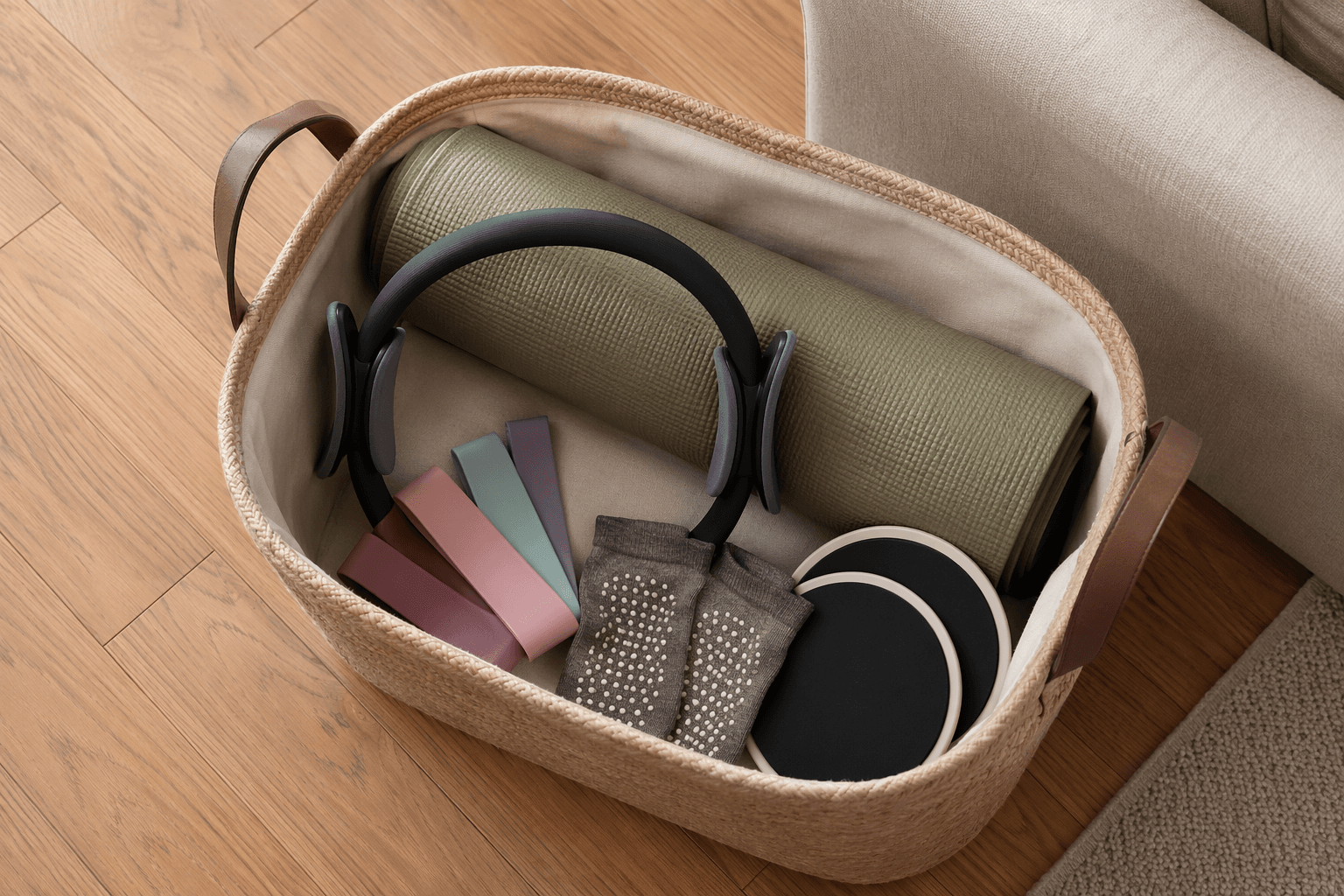
One basket, one tote, one under-sofa bin, or one set of wall hooks changes the daily friction. The mat rolls up. The ring stands vertically against the basket wall. Bands and sliders can go into a pouch so they do not migrate into desk drawers. Grip socks belong with the kit, not in the laundry pile across the room, because hunting for them is exactly the kind of tiny inconvenience that cancels a short workout.
A good small-apartment Pilates kit can look this simple:
- A mat thick enough to make hard flooring tolerable, but not so bulky that it refuses to roll tightly.
- Grip socks for traction on smooth floors and for days when rolling out an extra rug would be one step too many.
- A small set of resistance bands for arm work, glute work, and controlled progression without adding a large machine.
- A Pilates ring for inner-thigh, arm, and core engagement that stores flat against a wall or inside a tall basket.
- Two sliders for low-profile leg and core work on suitable flooring, or with a smooth mat-compatible surface.
That kit is enough to support beginner and intermediate mat work without turning the living room into a storage unit. Shape’s overview of mat versus reformer Pilates notes the basic distinction clearly: mat Pilates uses body weight and small props, while reformer Pilates adds spring-based resistance and a moving carriage.[3] That difference matters for progression, but it does not make mat work incomplete. For a small apartment, the ability to repeat a practice without rearranging your life is part of the equipment’s value.
Where the kit should live
The storage location should be close to the workout zone. Across the room is fine. In a closet behind winter coats is usually not. If you need a step stool, a sliding closet door, and a small negotiation with a vacuum cleaner before you can reach the mat, the setup has already become too expensive in time.
Peak Primal Wellness discusses wall-mounted and over-door storage as a way to reduce floor clutter and create visual cues that can support consistency.[2] That is a useful design idea, not a guarantee that hooks will make anyone work out. The practical version is modest: visible, orderly storage reminds you that the session is easy to start, while closed, awkward storage asks you to make a decision every time.
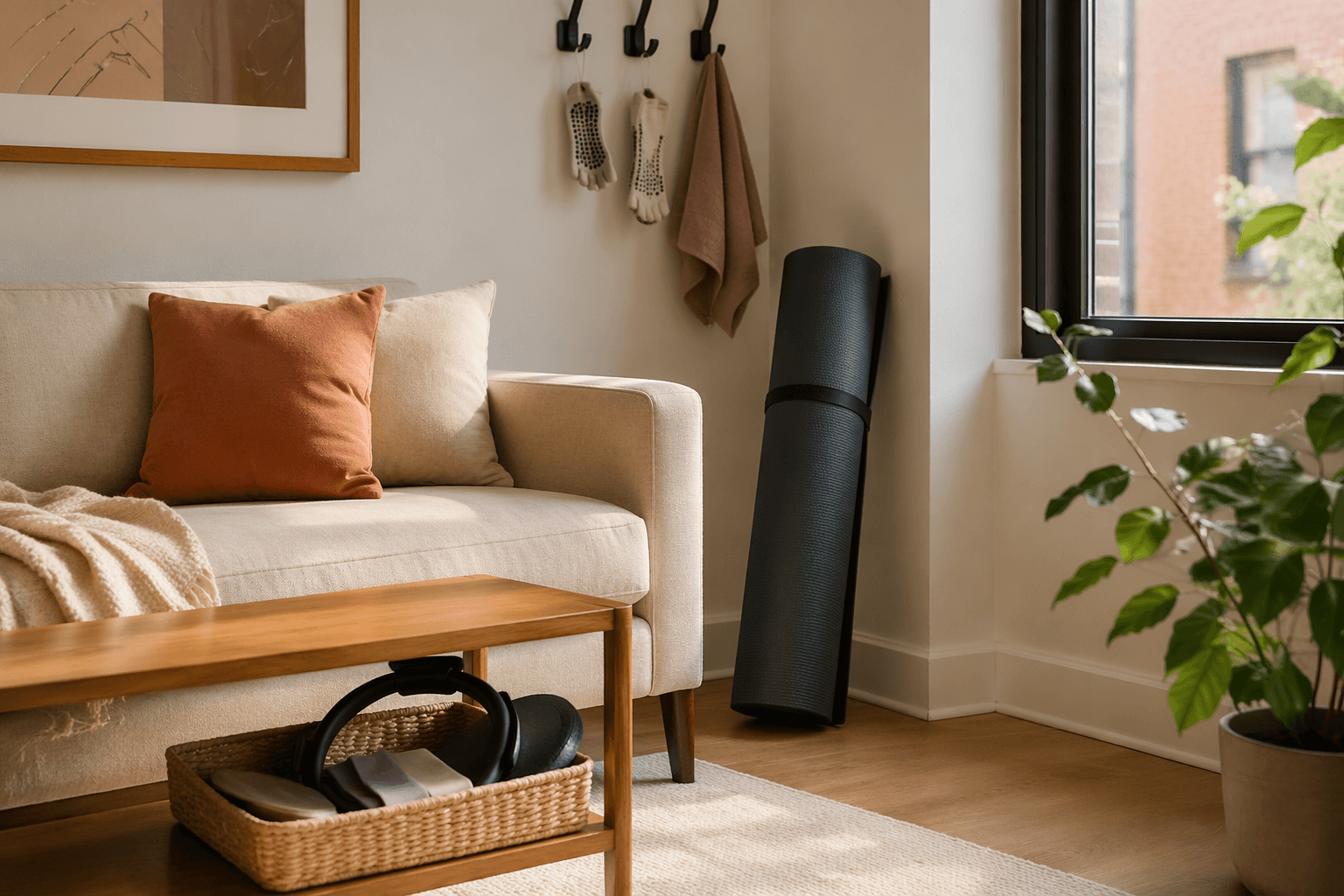
For renters, the least annoying solutions are usually freestanding or damage-light: a woven basket under a coffee table, a fabric bin under the sofa, an over-door organizer, removable hooks rated for the actual weight, or a narrow rolling cart that can park beside a desk. The goal is not to display discipline. It is to prevent a Pilates ring from living permanently on an accent chair.
Noise and flooring: keep this part boring on purpose
Pilates is already one of the easier apartment workouts to keep quiet, but equipment choices still matter. A mat should dampen pressure changes during rolling work and protect the floor from sliders, rings, and the occasional dropped band handle. On hardwood or laminate, test sliders carefully before committing to them; some glide beautifully, and some sound like a small animal scratching under the floorboards.
If downstairs noise, floor protection, or rug layering is a real concern, use a dedicated renter-focused flooring guide before buying thicker mats or foam tiles. The decision is less about making the room look like a gym and more about choosing a surface that stays flat, does not become a trip edge, and can be put away if the room still needs to be a living room. See the home gym flooring guide for small spaces and apartments for a fuller flooring decision.
When a foldable reformer actually makes sense
A reformer is the point where small-apartment advice often gets too cheerful. A machine can fold and still be wrong for your apartment. It can store vertically and still be too irritating to set up on a weeknight. It can be a good piece of equipment and still be a bad roommate.
Before looking at brand, upholstery, or resistance options, separate four measurements:
- The folded size: where the machine lives when it is not being used.
- The in-use footprint: the full working length and width once opened.
- The side clearance: the room needed to mount, move, adjust springs, and avoid hitting furniture.
- The teardown effort: how many steps, how much lifting, and how awkward the storage path is.
Verywell Fit’s tested reformer roundup highlights a few foldable models that are relevant to apartment shoppers, though the listed dimensions and storage details should be read as tested and manufacturer-derived product information rather than firsthand measurements from this article. The Align Pilates F3 is described as folding to a 9-inch profile with a one-handed folding operation, while the Pilates Power Gym Plus is listed at 53 inches long and able to store under a standard bed.[4]
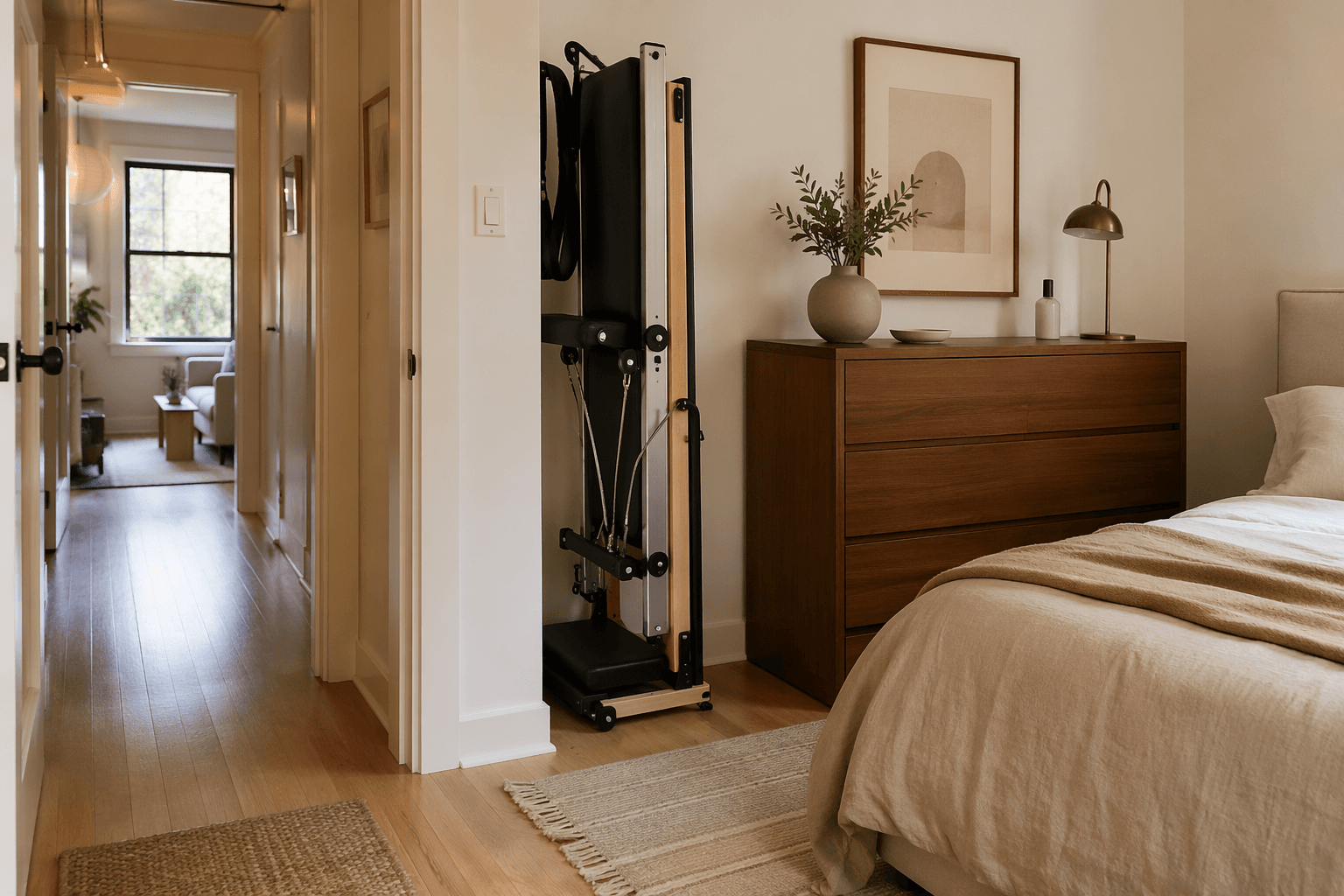
Those are promising storage profiles. They still do not answer the apartment question by themselves. A 9-inch folded machine needs a wall, closet side, or under-bed path where it will not block drawers. An under-bed reformer has to clear the bed frame, rug, storage bins, and whatever else already lives there. A machine stored vertically has to be stable enough for the household it is in, especially if pets, children, or narrow walkways are part of the room.
Then comes the in-use test. Tape out roughly 8.2ft by 3.3ft on the floor before buying, and add side clearance where you realistically can.[1] Open dresser drawers. Pull out the sofa bed if guests use it. Sit at the desk. Walk the path from the kitchen to the bathroom. A reformer that only fits when the apartment is frozen in workout mode will feel larger than its spec sheet.
The reformer pass-fail test
A foldable reformer belongs in a small apartment only if you can answer yes to most of these without bargaining with yourself:
- Can I open it in the same room where I store it?
- Can I set it up without moving more than one major piece of furniture?
- Can I walk around it safely once it is open?
- Can I fold and store it when tired, not just when excited on delivery day?
- Does its storage spot remain available year-round, including when guests visit or seasonal items come out?
Price should come after those answers. Peak Primal Wellness’ Pilates cost guide places reformers in a much higher tier than basic small-equipment setups, with pricing varying substantially by model and feature set.[5] That matters, but a bargain reformer that is too annoying to unfold is not cheaper in any meaningful small-apartment sense. The cost you feel every week is the setup cost.
What to skip in a very small space
Most apartment Pilates setups do not need a long equipment list. They need fewer objects that work harder. Large barrels, oversized chairs, bulky storage racks, and decorative studio-style pieces can be beautiful, but they ask for dedicated square footage. If the room is also an office and guest space, dedicated square footage is usually the thing you do not have.
Duplicated props are another quiet clutter source. Three band sets, two mats, multiple rings, and a few “maybe I’ll use this” accessories can make a compact practice feel messy without adding much capability. Start with one complete kit. Replace items when they wear out. Add only when a specific exercise or limitation has made the need obvious.
A practical buying order
For most small apartments, the buying order should follow storage friction, not aspiration.
- Clear and measure the mat zone. If you can reliably create about 6.5ft by 5ft, you have enough room to begin.[1]
- Buy the mat and the storage container together. The storage home is part of the setup, not an afterthought.
- Add grip socks, bands, a ring, and sliders only if they can live with the mat in the same basket, tote, or hook system.
- Use the kit for long enough to learn what kind of resistance or support you actually miss.
- Consider a foldable reformer only after taping out both the in-use footprint and the storage position.
The room gets the final vote. If you can clear a mat-sized zone and give the gear one reliable home, you already have enough for at-home Pilates. If you want a reformer, make it prove that it can appear for the workout and disappear afterward without making the apartment feel borrowed from the machine.
References
- Best Pilates Equipment for Small Apartments (2026 Guide) — Polse
- Getting Started with Pilates Equipment — Peak Primal Wellness
- Mat Pilates vs. Reformer Pilates — Shape
- The 10 Best Pilates Reformers, Tested — Verywell Fit
- How Much Does Pilates Equipment Cost? — Peak Primal Wellness
Comments
Join the discussion with an anonymous comment.